Category Archives: church

Beautiful Artos

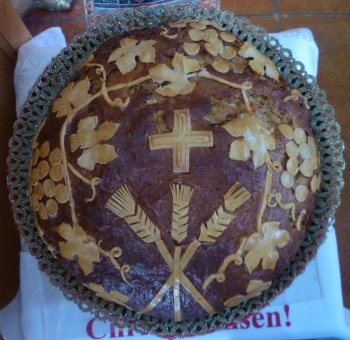
artos 15 crpHere is this year’s Artos, the blessed bread that remains in the church all during Bright Week, one more reminder of the Resurrection and of how our Lord is The Bread of Life.

I’ve been looking at other photos of loaves of Artos and truly I think our parish has the most gorgeous! In a few days we will all get a piece to eat. I happened to go into the church kitchen last week while the dough was being kneaded, so I know it has olive oil and orange zest in it, but other than the wheat itself I don’t know what other flavors it holds.

The Gospel reading at the Bright Tuesday Liturgy told the story of the disciples meeting the risen Christ on the Road to Emmaus, and I was very moved by it. I seemed to feel as never before how their world had collapsed when Jesus was crucified and dead. How heartbroken they must have been, to be suddenly without the One who meant everything to them, who was their very life. And then to hear how He, not recognized, spoke to them, and “beginning at Moses and all the Prophets, He expounded to them in all the Scriptures the things concerning Himself.” (Luke 24) The drama of this well-loved story grew in my heart as our priest read the passage.

When they convinced Him to stay with them that evening, their eyes were opened as they broke bread and ate together, and they knew Him. Then He vanished from their sight, and they realized that even though they hadn’t at the time realized why, their hearts had “burned within them” as they had listened to Him on the road.

My heart was joyful, and I got chills thinking about the unspeakable gift of breaking bread with God, partaking of the Holy Mysteries and by that sacrament receiving a kind of knowledge that can only come by His grace.

And we are only halfway through Bright Week! Christ is risen! He is risen indeed!

artos 15

(This is my 900th blog post!!)

The Church’s Wedding Night

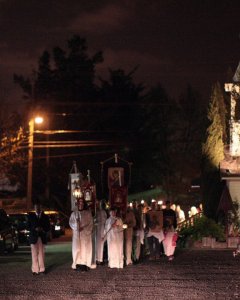
Pascha night chandelier 2012Pascha procession 2 2010 PW
O night clearer than the day!
O night more luminous than the sun!
O night whiter than the snow!
giving more light than our torches,
sweeter than Paradise!
O night that knows no darkness;
driving away our sleep,
you make us keep watch with the angels.
O night, the terror of demons,
Paschal night, awaited for a year!
The Church’s wedding night
which gives life to the newly baptized
and renders harmless the torpidity of the demon.
Night in which the Heir
brings the heirs into eternity.

–Asterius of Amasea,
Homily 19 on Psalm 5, early 5th century

Pascha night TR 2012


(From Christ is in our Midst.)

To be without God and to die of it.

I find myself in a phase of grief where from time to time during the day I feel acutely lost without my husband, the absence of him like a soreness in my spirit, an ache in the middle of my chest telling me that something is very wrong with me. Yes, something is wrong!! It’s death that is wrong – it’s wrong for us to be separated, for me to lose the heart of my heart. I have known this truth in my mind and for the world generally – now I understand it in my bones.

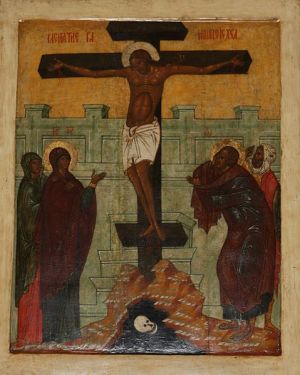
Crucifixion wikimediaBut as I’ve said here more than once already, I have the peaceful assurance that we are not absolutely separated, and a huge thankfulness as well that neither of us has been cut off from the Source of our life and existence. Sometimes we humans use the figure of speech that we will “die of grief,” because it feels that wrenching. But I know even as I am feeling it and railing against it, that I will live through it. This is all because Christ suffered for us, and he overcame death. My pain is like a pinprick compared to what Christ endured on our behalf. As  for my husband, “Blessed are the dead who die in the Lord.”

These words from Metropolitan Anthony Bloom that I first read in God and Man two years ago are even more meaningful to me on this Holy Saturday:

When in the Apostles’ Creed we repeat “And he descended into Hell,” we very often think “That’s one of those expressions,” and we think of Dante and of the place where all those poor people are being tortured with such inventiveness by God.

But the Hell of the Old Testament has nothing to do with the spectacular hell of Christian literature. The Hell of the Old Testament is something infinitely more horrid; it is the place where God is not. It is the place of final dereliction; it’s the place where you continue to exist and there is no life left.

Harrowing-Dionisius

And when we say that he descended into Hell, we mean that having accepted the loss of God, to be one of us in the only major tragedy of that kind, he accepted also the consequences and goes to the place where God is not, to the place of final dereliction; and there, as ancient hymns put it, the Gates of Hell open to receive Him who was unconquered on earth and who now is conquered, a prisoner, and they receive this man who has accepted death in an immortal humanity, and Godlessness without sin, and they are confronted with the divine presence because he is both man and God, and Hell is destroyed — there is no place left where God is not.

The old prophetic song is fulfilled, “Where shall I flee from thy face — in Heaven is thy throne, in Hell (understand in Hebrew — the place where you are not), you are also.” This is the measure of Christ’s solidarity with us, of his readiness to identify himself, not only with our misery but with our godlessness. If you think of that, you will realise that there is not one atheist on earth who has ever plunged into the depths of godlessness that the Son of God, become the Son of Man, has done. He is the only one who knows what it means to be without God and to die of it.

— Metropolitan Anthony Bloom

Mystical Supper

mysticalsupper02

On Thursday of Holy Week (today) we commemorate the first eucharist as the Lord Jesus instituted it, what we Orthodox call The Mystical Supper. On the Orthodox Wiki discussion page I found that someone had asked for clarification of what the Real Presence is, according to Orthodoxy; it seemed confusing to them. Then various people gave input. One said that it may be confusing because it is a Mystery. [Think smiley face] It is a common joke in or on the Church that this is a facile answer.

But it points to the true nature of the faith, that our relationship with God is not purely intellectual. We do not know Him by putting together all the facts we’ve learned; He doesn’t reveal Himself through our intellects alone, or even primarily.

Fr. Thomas Hopko says, “The mystery of the holy eucharist defies analysis and explanation in purely rational and logical terms. For the eucharist — and Christ himself — is indeed a mystery of the Kingdom of Heaven which, as Jesus has told us, is ‘not of this world.’ The eucharist — because it belongs to God’s Kingdom — is truly free from the earth-born ‘logic’ of fallen humanity.”

The page on The Holy Mysteries, what we call the sacraments, is very good! It starts right out with this perspective and reality about the Church that I love:  “…the Orthodox Church considers everything which is in and of the Church as sacramental or mystical.” I suppose this is why “There has never been a universal declaration within the Orthodox Church that there are only seven sacraments.”

I knew that, but I learned some other things, more historical and not so mystical, reading these pages today: “While the Synoptics do give the Last Supper as a Passover seder, John’s Gospel (which the Church privileges over the others) has it happen before the Passover.” The contributors all seemed to agree on these points though they differed on their theological significance.

On a more personal note, while I am grieving the death of my husband, I’ve been so grateful that we are in Holy Week, with its numerous opportunities to participate in this sacrament, this mystery of the Kingdom of Heaven — and truly, in all the abundant graces of the Church. It’s not facts that have been sustaining me, but His Real Presence.