Category Archives: church

The wounds are consecrated.

P1120829 holy unctionI attended a Holy Unction service with my goddaughter last night. Before the service proper our priest read an article on The Grace of Suffering. An excerpt:

Weakness and sickness wipe away everything superficial in us. We are inwardly purified when we are baptized with tears of suffering. The Lord always visits us there, while we are dry  on the inside, truly thirsting for living water and reaching out for Him in what we know, deeply and seriously.

He also told us about various responses he has seen in people who were healed from their sicknesses, and said that usually if we are relieved of one form of suffering, it is for further suffering.

It was a long service, including psalms, hymns, prayers, and seven anointings with oil, each preceded by an epistle reading and a Gospel reading. Before each Gospel reading a candle was lit, which helped us keep track of where we were in the service. Seven times the ill and afflicted lined up to be anointed on their forehead, cheeks, lips, chest, and hands.

I was a bit scattered in mind and heart and didn’t feel able to participate with as much attention as I’d have liked, but it was a great blessing nonetheless to help in little practical ways and by praying along. Having my mind washed by the Word, and being in the church with so many repentant hearts singing, “Hearken unto me, O Master, Hearken unto me, O Holy One….” was soothing to my own soul.

Here is an excerpt from another article about this sacrament:

The express purpose of the sacrament of holy unction is healing and forgiveness. Since it is not always the will of God that there should be physical healing, the prayer of Christ that God’s will be done always remains as the proper context of the sacrament. In addition, it is the clear intention of the sacrament that through the anointing of the sick body the sufferings of the person should be sanctified and united to the sufferings of Christ. In this way, the wounds of the flesh are consecrated, and strength is given that the suffering of the diseased person may not be unto the death of his soul, but for eternal salvation in the resurrection and life of the Kingdom of God.

It is indeed the case that death inevitably comes to man. All must die, even those who in this life are given a reprieve through healing in order to have more time on the earth. Thus, the healing of the sick is not itself a final goal, but is merely “instrumental” in that it is given by God as a sign of his mercy and as a grace for the further opportunity of man to live for him and for others in the life of this world.
Anything less is a bondage.

Fr. Stephen asks rhetorically, “Can You Forgive Someone Else’s Enemies?” with a look at the words and actions of Jesus in the Gospels, and reflecting on the story of The Brothers Karamazov. He writes:

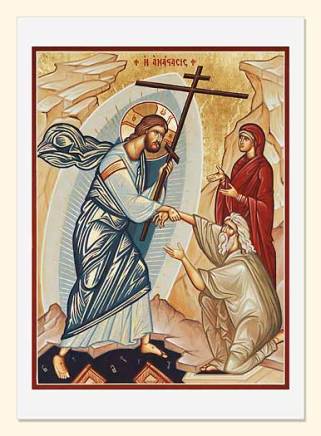
Forgiving is “loosing.” Refusing to forgive is “binding.” The imagery of loosing and binding helps move the imagination away from a legal construction. When we sin, or even when we are involved in sin, we become bound. There is a binding that occurs because we ourselves were the cause of the sin. There is a binding that occurs because we ourselves were the victim of a sin. Thchrist forgiving resurrection 2ere is a binding that occurs because we simply witness the sin. There is even a form of binding that occurs to the whole of humanity because of the diminishment of even one of its members. If everyone were somehow only responsible for their own actions the world would be quite different. As it is, the action of one involves the binding of all. Adam’s sin has left us bound ever since. We are not being held legally responsible for Adam’s action. We are existentially and ontologically bound by Adam’s sin.

These truths are hard to grasp, even for the intellect, and Fr. Stephen helps me quite a bit at that level. But to live in the reality of our freedom, to acquire and absorb and give this kind of liberating love — it’s something impossible, were it not for the fact and the power of the Resurrection. Lent is a good time to pray about this, yes?

I’m looking forward to seeing all of my children at once this weekend, and the thought of them and their tender, breakable and forgiving hearts gives me great comfort; they are a testimony to the kindness of God. And His kindness certainly pertains to the article I was referencing, the whole of which you can read here.

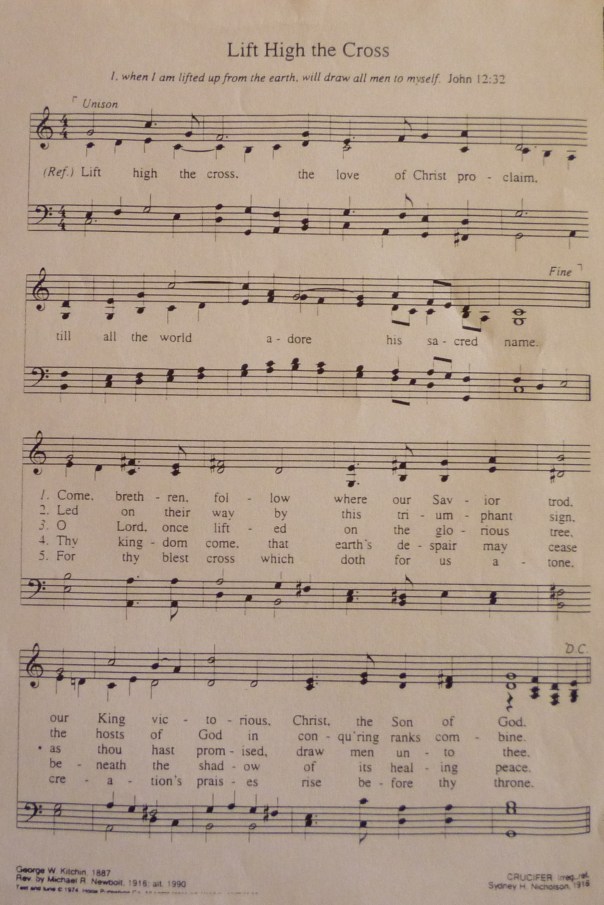
Lift High the Cross

This morning I wasn’t able to attend Liturgy, but as it was the Sunday of the Veneration of the Holy Cross, I was singing the Troparion hymn of the feast to myself as I went about opening the blinds and other movements of greeting the day. (“Oh, God, save Thy people, and bless thine inheritance….”) Gradually, without my fully noticing for a while, the melody of my humming changed to this hymn, which our family learned relatively recently and which has become a favorite of mine. I suppose it’s slightly more appropriate for another Sunday focusing on the Cross, that one in September when we consider The Elevation of the Life-Giving Cross. But it came to me today, so here it is, for your uplifting, too.

Lift High the Cross

Why do we eat?

SOME REMARKS ON FASTING by Fr. Stephen Freeman:

…. I have seen greater good accomplished in souls through their failure in the fasting season than in the souls of those who “fasted well.” Publicans enter the kingdom of God before Pharisees pretty much every time.

Why do we fast? Perhaps the more germane question is “why do we eat?” Christ quoted Scripture to the evil one and said, “Man does not live by bread alone but by every word that proceeds from the mouth of God.” We eat as though our life depended on it and it does not. We fast because our life depends on the word of God.

I worked for a couple of years as a hospice chaplain. During that time, daily sitting at the side of the beds of dying patients—I learned a little about how we die. It is a medical fact that many people become “anorexic” before death—that is —they cease to want food. Many times family and even doctors become concerned and force food on a patient who will not survive. Interestingly, it was found that patients who became anorexic had less pain than those who having become anorexic were forced to take food. (None of this is about the psychological anorexia that afflicts many of our youth. That is a tragedy)

It is as though at death our bodies have a wisdom we have lacked for most of our lives. It knows that what it needs is not food—but something deeper. The soul seeks and hungers for the living God. The body and its pain become a distraction. And thus in God’s mercy the distraction is reduced…Why do we fast? We fast so that we may live like a dying man, and in dying we can be born to eternal life.

Read the whole article here.