Category Archives: church

Sunday of the Last Judgment

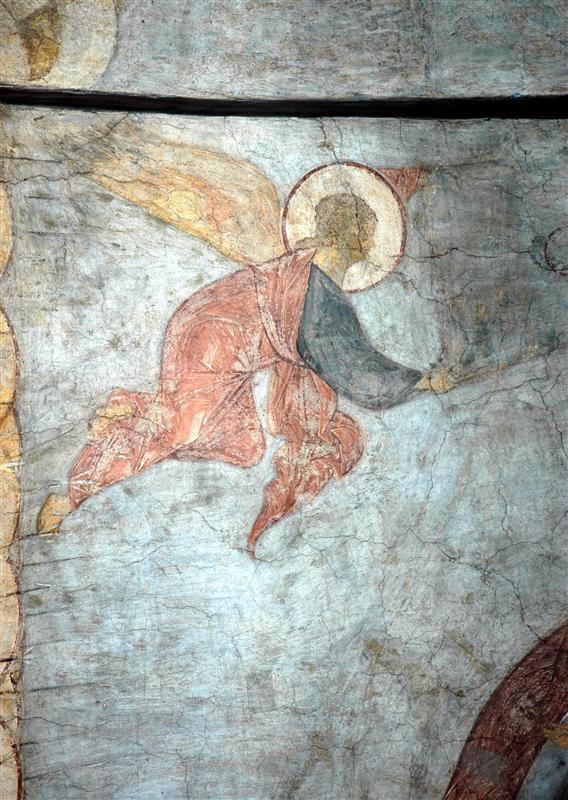
Andrei Rublev – The Last Judgment (detail), Assumption Cathedral, Vladimir, Russia, 1408

The Gospel for today: Matthew 25:31-46 

When the Son of Man comes in His glory, and all the holy angels with Him, then He will sit on the throne of His glory.

All the nations will be gathered before Him, and He will separate them one from another, as a shepherd divides his sheep from the goats.

And He will set the sheep on His right hand, but the goats on the left.

Then the King will say to those on His right hand, ‘Come, you blessed of My Father, inherit the kingdom prepared for you from the foundation of the world:

for I was hungry and you gave Me food; I was thirsty and you gave Me drink; I was a stranger and you took Me in;

I was naked and you clothed Me; I was sick and you visited Me; I was in prison and you came to Me.’

Then the righteous will answer Him, saying, ‘Lord, when did we see You hungry and feed You, or thirsty and give You drink?

When did we see You a stranger and take You in, or naked and clothe You?

Or when did we see You sick, or in prison, and come to You?’

And the King will answer and say to them, ‘Assuredly, I say to you, inasmuch as you did it to one of the least of these My brethren, you did it to Me.’

Then He will also say to those on the left hand, ‘Depart from Me, you cursed, into the everlasting fire prepared for the devil and his angels:

for I was hungry and you gave Me no food; I was thirsty and you gave Me no drink;

I was a stranger and you did not take Me in, naked and you did not clothe Me, sick and in prison and you did not visit Me.’

Then they also will answer Him, saying, ‘Lord, when did we see You hungry or thirsty or a stranger or naked or sick or in prison, and did not minister to You?’

Then He will answer them, saying, ‘Assuredly, I say to you, inasmuch as you did not do it to one of the least of these, you did not do it to Me.’

And these will go away into everlasting punishment, but the righteous into eternal life.”

Let us be candles pure and sweet.

As part of our celebration of the Feast of the Presentation of Christ in the Temple, in the Orthodox Church we bless candles. Maybe some other Christian traditions still do this, as it is the ancient feast of Candlemas, and many cultures and nations have their many practices around it. I’d be interested to hear of any that linger among my readers’ communities.

As to candles, I found this helpful article from St. Gabriel Orthodox Church in Ashland, Oregon, about some of the symbolism in our use of of them, “handed down to us from St. Symeon of Thessaloniki (c. 1381–1429).”

1 – As the candle is pure (pure beeswax), so also should our hearts be pure.

2 – As the pure candle is supple (as opposed to the paraffin), so also should our souls be supple until we make it straight and firm in the Gospel.

3 – As the pure candle is derived from the pollen of a flower and has a sweet scent, so also should our souls have the sweet aroma of Divine Grace.

4 – As the candle, when it burns, mixes with and feeds the flame, so also we must struggle to achieve theosis.

5 – As the burning candle illuminates the darkness, so must the light of Christ within us shine before men that God’s name be glorified.

6 – As the candle gives its own light to illuminate a man in the darkness, so also must the light of the virtues, the light of love and peace, characterize a Christian. The wax that melts symbolizes the flame of our love for our fellow men.

So let us pray that the Light of Christ may illumine us as well!

In a monastery.

Illuminations on this January weekend.

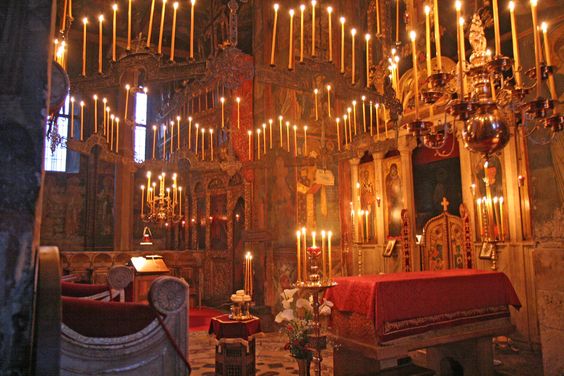
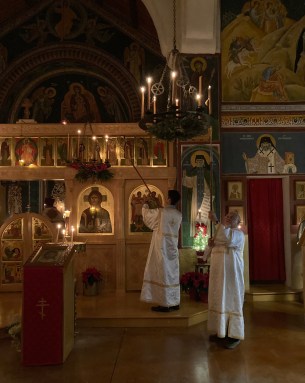
At Vespers last night, the lighting was unusual, in that electric lights had been turned on in the dome; typically we do without those, and in the winter it means that we see the icon of the Pantocrator only dimly. Because the amount of light, and the angle at which it enters through the cathedral windows, is always in flux, every service at every time of day is differently illumined — but the effect is always sublime.

Over the last two days, at church and on my neighborhood path, I was warmed by the beauty of physical lights, not separate from their symbolic role: They represent and mysteriously convey the presence of Christ Who is, as the Evangelist said, “The true Light, which lighteth every man that cometh into the world.”

Today was the Leavetaking of Theophany, and I was the chanter of the Third and Sixth Hour prayers before the service. On Sundays we always have hymns of the Resurrection, and usually hymns of that Sunday’s feast or saints as well. It was the Kontakion of Theophany that got my attention this morning:

On this day Thou hast appeared unto the whole world,
And Thy light, O Sovereign Lord,
is signed on us who sing Thy praise,
and chant with knowledge:
Thou hast now come, Thou hast appeared,
O Light Unapproachable.

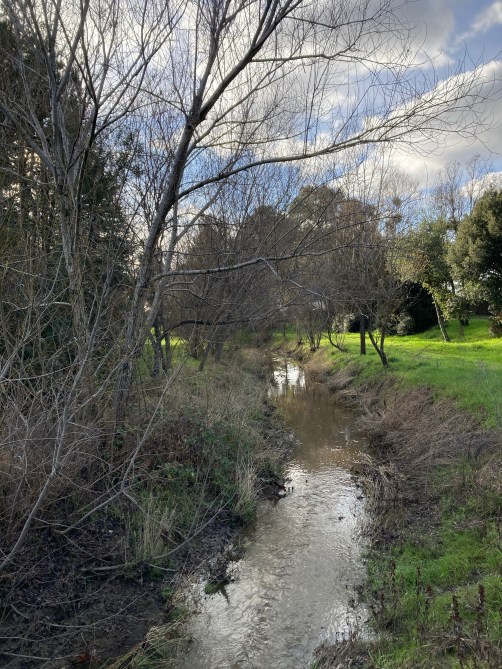
As soon as I returned after church, I (shock!!!) changed my clothes and went for a walk. We had been surprised by the sun coming out in the afternoon, so it was delightful out there. Even though the creek was muddy from rain, the light shining on it made it lovely.

And I practiced Psalm 89 some more. Reading the same lines and stanzas over and over, thinking of links to help me transition from one thought to another, has been the most rewarding kind of meditation; the theology and the poetry fill my heart, certainly in much  the same way as one line states:

We were filled in the morning with Thy mercy, O Lord,
And we rejoiced and were glad.

But this line is in the latter half of the psalm, when the mood has turned upward. A few stanzas before, the psalmist is considering how in the evening man “shall fall and grow withered and dry.” “We have fainted away,” “our days are faded away… our years like a spider have spun out their tale,” and “Return, O Lord, how long?”

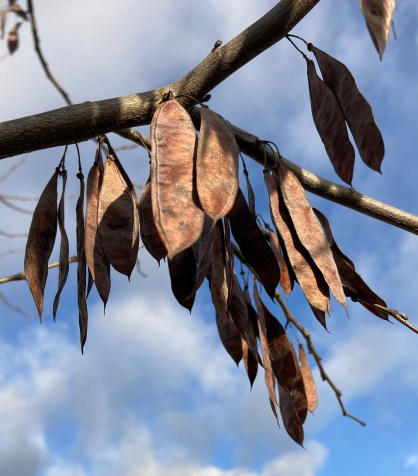
Withered and dry, but still handsome.

I have looked at two other translations of the Psalm, one of them a different version of the Septuagint, and compared with the one I am using (see sidebar note), to me they both are clunky and harder to read, though they do have many of the same vivid images that help me to learn this poem.

I stopped a couple of times on my walk to sit on a bench and think about these things. And when I got home again I looked at the notes in the Orthodox Study Bible, which points out that this is “a morning prayer designed to keep one focused on the Lord rather than on this temporal life and its hopelessness. For He exists outside time, and is therefore our only refuge…. It is read daily at the First Hour.” 

There are many references to morning and evening, days and years, and our lifespan being “in the light of Thy countenance.” But one reason I have wanted to learn the whole prayer poem is the last verse, whose first line brings me back to “Thy light is signed on us” in the hymn we read and sang this morning:

And let the brightness of the Lord our God be upon us,
and the works of our hands do Thou guide aright upon us,
Yea, the work of our hands do Thou guide aright.

Between the temple and the kitchen.

For the last week or so, I’ve been spending a lot of time in the kitchen, and an equal amount in church. It was quite the experience to attend Divine Liturgy three days in a row: First for Sunday, the usual Resurrectional Liturgy — though the cathedral had been so brightly decorated on Saturday, it was far from the usual visually. Plus, at the end of the service the choir sang several carols with great zest. We returned for a short Festal Matins in the evening, and sang the glorious “God is With Us!”


Then Monday, which was Christmas, the Nativity of Christ, and the church was full again, with lots of families with babies. My baby goddaughter has had stranger anxiety for several months but that morning she was okay with me carrying her up for Communion, after which I toted her around for a while and showed her off to everyone.

Today is the Synaxarion of the Mother of God, she who was so essential to the event we celebrated yesterday. Of course, the church was not as full of people as on Christmas Eve and Day, but it was surprising how many of us came back for more of the rich spiritual feast — and there was certainly more than we could take in, more than enough to fill our cups to the brim, with a holy elixir.

Cranberry Jellies

My cookie tins have been filled to their brims, too, with more worldly contents, and then partially emptied as I give them for gifts, and then filled again. I made several kinds of cookies before the First Day of Christmas, and I am continuing now on the Second Day, and have plans for a few more, days and flavors.

Salty Licorice Brownie Cookies

I have friends who will be celebrating according to the old calendar, which means they won’t have Christmas until January 7th, which means more opportunities for gifting cookies that I bake “late.”

So far I have made:

Cranberry Jellies
Apricot Macaroons
Ginger Spice Cookies
Salty Licorice Brownie Cookies
Chocolate Almond Macaroons
Fruity Meltaways
Rolled Gingerbread Cookies
Lemon Poppyseed Sandwich Cookies


The end of Christmas Dinner

And I’ve started on:

Flourless Mandarin Almond Cookie (my invention)

…and still plan to make:

Salted Anise Butter Cookies and
Mexican Hot Chocolate Cookies

I’d like to replenish the supply of Ginger Spice Cookies, because the first batch I made with einkorn flour, and I didn’t know one needs to use more of that type than of regular wheat flour; the cookies came out flat flat flat. Still yummy, but they don’t present so nicely…

None of my own family were able to come spend Christmas with me this year, except for my grandson Pat and his wife who spent Saturday with me. But I have other guests for a month, a family with three children, and the children do not speak more than a few words of English. It’s surprising how little one needs to talk, to bake cookies together. I added the rolled gingerbread cut-out cookies to my list for their sake, and well, for my sake, too, because it’s a lot of fun to help them have fun.

Fruity Meltaways

So… today I boxed up some more cookies on Boxing Day, and put them out in the garage to stay cool. Tomorrow is St. Stephen’s Day, and if I weren’t ironing altar cloths (we are going back to gold now, after the Christmas red) I would consider driving to our sister parish where they will commemorate the first Christian martyr with another Divine Liturgy.

But, I will stick closer to home, and hopefully bake a few more cookies, and/or help the children to decorate the gingerbread with Royal Icing. And I will visit some dear church friends to share some Christmas cheer, which may or may not include — cookies!

Happy St. Stephen’s Day!