Category Archives: church
The truth of honey and grapes.
It’s eleven years !! since I wrote this post at the Feast of Transfiguration, and focused on honey and bees. Since then I’ve posted several times about various aspects of the feast, and now I’m going to return to this one focusing on honey, that marvelous substance in great abundance all over the earth. Who can believe it? Only God could have thought of such a food. I’ve updated the following with some bee photos of my own, and kept my favorite honey pictures:
My parish is lucky enough to have our own vineyard right behind the church. This is very handy on the Feast of Transfiguration; at the end of the liturgy we can process out the doors and around the vineyard, to bless the grapes. It’s traditional to bless grapes or apples or any fruit, really, on this day.
Earlier on the feast day morning people brought into the church baskets of fruit and herbs and flowers. I carried a wooden bowl of blueberries and peaches. While we sang and communed and focused on the main event being commemorated, the fruit waited. The incense was particularly sweet that day, and I didn’t notice the smell of the beeswax candles as much as I usually do. Though I could see basil in a couple of the baskets, I didn’t catch its aroma either.
At the end of the service, with the prescribed prayers for the event, our priest (and all of us) thanked God for all His bounty, and then he sprinkled holy water over the representative sampling.


He explained to us that this is not a superstitious rite we perform, using holy water to do magic on the fruit. When we bless anything in this way we do not make it into something other than what it is, but ask God to reveal it to be what it has always been.
Whatever created things we are talking about, they have always been meant by God to bring us into communion with Him. The service of blessing of fruit brings our thoughts back to Paradise, and the right and good use of the fruits of the earth that God has given us. We are reminded of how in the beginning God made Adam and Eve to be stewards over the Garden of Eden; human beings were called to exercise a loving and thankful dominion over the earth.

But we by our sin have instead caused destruction on the earth. Mankind more often than not has overused, abused and consumed in perverse ways the gifts of the Creator. Personally, I often gobble my food and eat without attentiveness to Him.

We have prayers for the blessing of bees and beehives and honey, too, usually in a separate service. Around here it’s August 1st, but I found pictures of honey blessings in Bulgaria where they do it dramatically on February 10 (see the bright cross picture down the page).
People like to take pictures of little girls and honey, I was happy to discover, and I am posting some of them here. The Russian ones are from Optina Monastery, and the Oregon photos from the Facebook page of New Martyrs of Russia Orthodox Church.
Father Ted Bobosh has posted a large photo collection of bees and other pollinators, along with quotes about bees and Orthodox prayers for them. Just looking at the pictures will likely make you burst into prayer, too. Here is one of the prayers he posted:
O God, who knows how to work benefits through human labor and irrational living things, You instructed us in your loving-kindness to employ the fruits and works of the bees for our needs. Now humbly we beseech Your majesty: Be pleased to bless the bees and increase them for the profit of the human race, preserving them and making them abundant. Let everyone hoping in Your majesty and Your boundless compassions, and laboring in the care of these living things, be counted worthy to receive abundant fruits of their labors and to be filled with heavenly blessings in Christ Jesus our Lord, to whom is due glory, honor and worship unto ages of ages. Amen.

The photo above is from my church on Transfiguration, baskets of all kinds of fruits of the earth waiting for the prayers of blessing. Some of them were inspiring in the variety and arrangement of items, but one of my favorite baskets is the big one in front, full of apples picked just that morning.I don’t eat much honey these days, but I get a whiff of it in the candles every Sunday in church, and I can imagine the heady scent emanating from these tables laden with jars and bowls and plates of honey.
Doesn’t it just tell you something about our God, how sweet He is, and how extravagantly generous, that He would give us something as intense and rich as honey? The bees, of course, are also in the business of pollinating the fruit. The whole Creation and its interconnectedness is reflected in the Church and in our salvation history, all of a piece and orchestrated in love by our dear Father God.


Ascension, looking toward Pentecost….

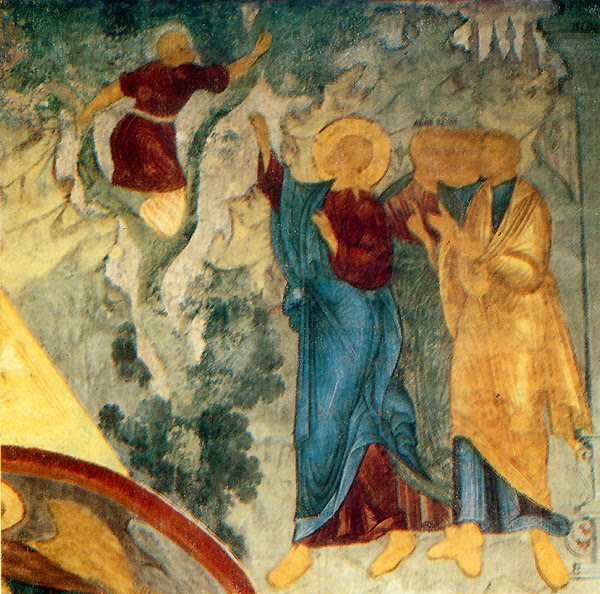
Today was Ascension Day for the Eastern Orthodox. During his homily our pastor drew our attention to the fresco we could see behind him, of Christ ascending, with the disciples looking up at him, 40 days after his resurrection. He said that in our temple that event is depicted above the altar as a reminder that in the Divine Liturgy we also ascend to Heaven. The icon shows what St. Luke tells in the first chapter of the Book of Acts:
“The first account I composed, Theophilus, about all that Jesus began to do and teach, until the day when He was taken up, after He had by the Holy Spirit given orders to the apostles whom He had chosen. To these He also presented Himself alive, after His suffering, by many convincing proofs, appearing to them over a period of forty days, and speaking of the things concerning the kingdom of God.
“And gathering them together, He commanded them not to leave Jerusalem, but to wait for what the Father had promised, “Which,” He said, “you heard of from Me; for John baptized with water, but you shall be baptized with the Holy Spirit not many days from now.”
“And so when they had come together, they were asking Him, saying, ‘Lord, is it at this time You are restoring the kingdom to Israel?’ He said to them, ‘It is not for you to know times or epochs which the Father has fixed by His own authority; but you shall receive power when the Holy Spirit has come upon you; and you shall be My witnesses both in Jerusalem, and in all Judea and Samaria, and even to the remotest part of the earth.’
“And after He had said these things, He was lifted up while they were looking on, and a cloud received Him out of their sight. And as they were gazing intently into the sky while He was departing, behold, two men in white clothing stood beside them; and they also said, ‘Men of Galilee, why do you stand looking into the sky? This Jesus, who has been taken up from you into heaven, will come in just the same way as you have watched Him go into heaven.'”
St. Paul mentions our own situation when he writes to the Ephesians :
“God raised us up with Christ and seated us with him
in the heavenly realms in Christ Jesus.”
In our daily prayers, we no longer start with the Paschal Troparion, “Christ is risen from the dead, trampling down death by death, and upon those in the tombs bestowing life,” but replace that line with the Troparion of Ascension:
Thou hast ascended in glory, O Christ our God,
and gladdened Thy disciples with the promise of the Holy Spirit.
And they were assured by the blessing
that Thou art the Son of God, and Redeemer of the World.

In only ten days we will come to Pentecost, and return to the usual beginning, “O Heavenly King, the Comforter, the Spirit of Truth….” But for now, we are with the disciples, waiting for the Spirit, Whom Christ said would “come upon” them.
“They were looking intently up into the sky as he was going, when suddenly two men dressed in white stood beside them. ‘Men of Galilee,’ they said, ‘why do you stand here looking into the sky? This same Jesus, who has been taken from you into heaven, will come back in the same way you have seen him go into heaven.’

“Then the apostles returned to Jerusalem from the hill called the Mount of Olives, a Sabbath day’s walk from the city. When they arrived, they went upstairs to the room where they were staying. Those present were Peter, John, James and Andrew; Philip and Thomas, Bartholomew and Matthew; James son of Alphaeus and Simon the Zealot, and Judas son of James. They all joined together constantly in prayer, along with the women and Mary the mother of Jesus, and with his brothers.”
In anticipation of Pentecost, I might revisit the history of that feast in the Old Testament, and in the Book of Jubilees, which Richard Rohlin and Jonathan Pageau discuss in two podcasts, which are also about the giving of the Law on Mount Sinai, and about the Tower of Babel. What — are all these connected? Yes.
Pentecost is traditionally considered an inversion of the curse of Babel. I heard some of these thoughts at the Symbolic World Summit I attended earlier this year, but it is a lot to stretch my mind toward. To consider how “the confusion of tongues is resolved,” explained by a philologist like Rohlin — I have to say, it reveals God’s glory, and His wonderful plan through the ages.
Here are the two podcasts, if you want to check them out:
The Tower of Babel with Richard Rohlin
and
The Tower of Babel Part 2 with Richard Rohlin

To the edge at last, in Donegal.
Yesterday we commemorated St. Columba. It was the Sunday of the Blind Man in the Orthodox Church, and I was getting ready to chant-read the prayers of the 3rd and 6th Hours before
Liturgy. Usually on Sundays there are two changeable parts of those readings called troparia, always one for the Resurrection, and often another for the feast or saint of the day. There was another sort of hymn, a kontakion, for the Blind Man, but there was not a troparian hymn in the lectionary for that event.
So our rector said I might read the troparion to St. Columba, which I did. I can’t find the text of it anywhere online now; I read it in the Horologion, or Book of the Hours, which is a big book of texts used, mostly by the reader or cantor, in liturgical services of the Orthodox Church, both the fixed and movable parts.
He also suggested that I take home a copy of that tome, to spend a while familiarizing myself with it. Occasionally over the years someone instructs me, in a very hit-and-miss fashion, on how to find what I need in the Horologion, but I seem to be dense when it comes to learning anything that I have to read standing, at a lectern, for example. So I’ll be glad to bring the book home and read at my leisure through the church calendar, with its treasures of saints and feasts.
Fr. Malcolm Guite was remembering St. Columba yesterday, too, and tells the story of how his mystical connection to the saint was renewed in his youth, “Columba and My Calling,” on his blog. An excerpt:
“One evening, St. John’s Eve it was, right at the end of my journey, I came round a headland at sunset into a beautiful little bay and inlet on the west coast in Donegal, just as the fires were being lit around the headlands for St. John’s Eve, and there was drinking and fiddle playing and dancing round the fires that evening. And I asked where I was, and they said Glencolmcille, and I felt a sudden quickening and sense of connection, as though a memory stirred. And they asked me my name and I said ‘Malcolm’, and they said, ‘Ah that is why you have come, because he has called you’, and I said ‘who?’ and they said ‘Colm has called you, Malcolm, for this is the place he fought his battle and gathered his disciples and from here he left for the white martyrdom and Scotland.”

He has written a touching sonnet in honor of his saint and that “small epiphany,” from which I took the title of this blog post. You can read “Columba,” and/or listen to him read it: here. It’s one of the poems in his book, The Singing Bowl.