Category Archives: culture

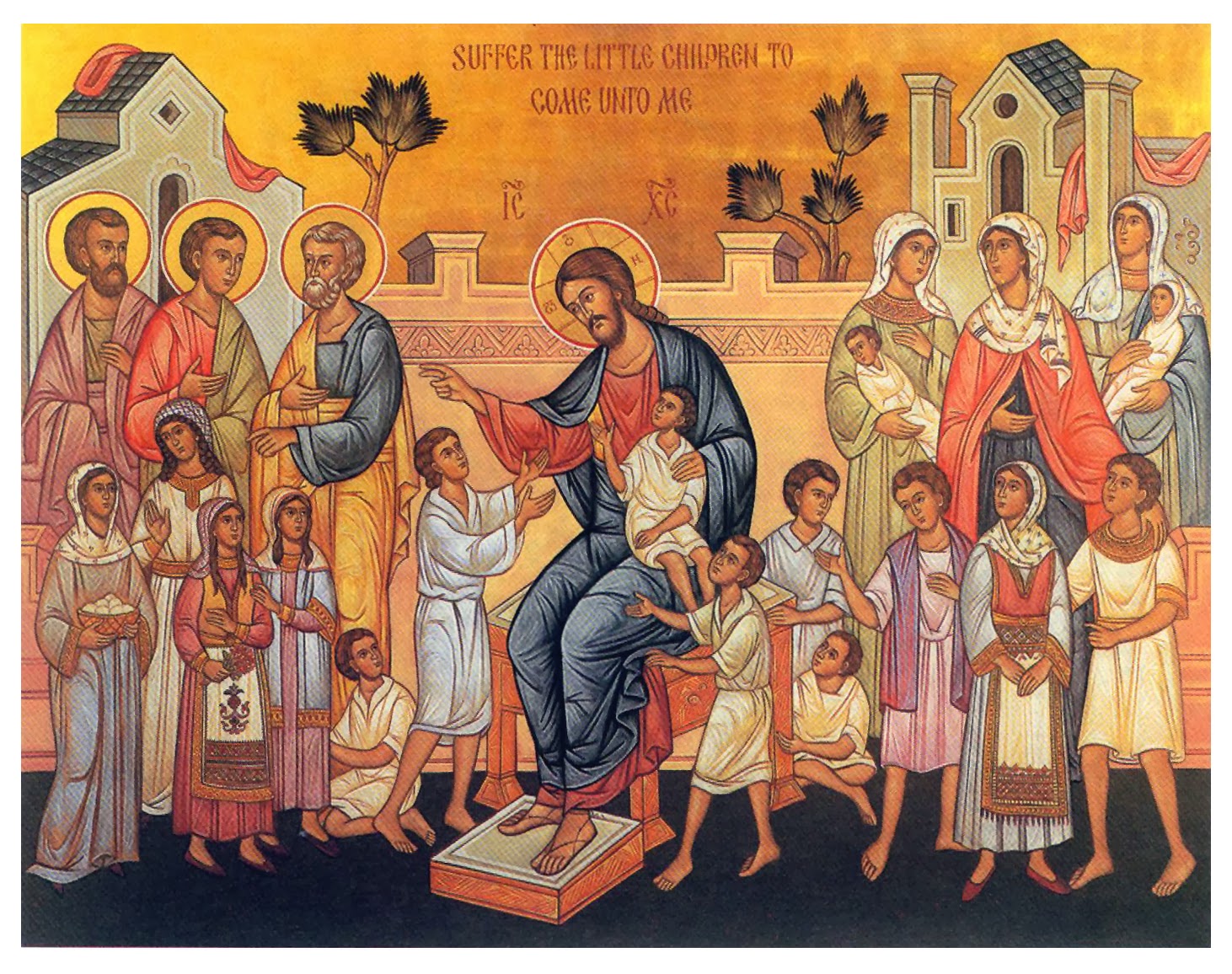
Let them believe.

It is assumed that the skeptic has no bias; whereas he has an obvious bias in favor of skepticism.

That is the one eternal education:
to be sure enough that something is true
that you dare to tell it to a child.

— G.K. Chesterton

These quotes having to do with teaching and learning remind me of something I read years ago when we were in the middle of our 25 years of homeschooling. It was in John Senior’s book The Restoration of Christian Culture, which I had borrowed and still don’t own, so it may be that I am not remembering it exactly right. I’d love it if any of you know enough to correct me or just articulate more clearly what I am trying to get at.

Dr. Senior warned parents against teaching children what modern educators call “critical thinking,” because it would turn them into skeptics and take away the simplicity of their childhood. They need to be taught to believe, rather than to doubt, and to have their joy and love for the world nurtured. If we teach them to be skeptics we are guilty of stunting their souls.

I thought about these things when I read an article by Ken Myers that was published last summer in Touchstone, titled “Trinity & Modernity” (unfortunately not available online). In it he introduces us to the book The One, the Three and the Many: God, Creation and the Culture of Modernity by Colin Gunton, and Myers discusses the fragmentation of current culture and thought, and the necessity of Trinitarian faith and the Body of Christ if we are to be saved from “modernity’s fatal confusion.”

His introductory paragraphs are what I want to share here, about our universal Christian story:

“We have been told that to be postmodern is to approach metanarratives — the Big Stories that explain Life, the Universe, and Everything — with incredulity. Of course, this raises the question of whether or not this definition of the postmodern temperament is itself a metanarrative…”

“…I do detect among most younger people a yawning indifference to efforts to explain history or theology or ethics or art in terms of grand and arching chronologies or chronicles. I suspect their minds and hearts have been colonized by thousands of what [Jean-François] Lyotard called petit récits, small amounts of highly particular and often idiosyncratic episodes, all blithely disconnected from any framework, all resistant to organization in any structure of meaning. Perpetual exposure to a numbing torrent of bewildering bursts of narrativish fragments — increasingly in fewer than 140 characters — leaves little time or mental space for attending to connections and causality.

“I remain unrepentantly pre-modern in my love of metanarratives. If the gospel has any power, it is only because it tells a great story that explains all things. It is a very particular story and it makes universal claims, which make both card-carrying moderns and postmoderns nervous. It was foolishness to the Greeks as well.

“This fragmentation and lack of understanding was a problem even in Chesterton’s day, but certainly it’s worse in more recent decades, with the giving over of education to a woefully pragmatic vision (Perhaps we do have a metanarrative: Do Whatever You Have To, To Get a Good Job.) and the gazillion bits of information and “communication” of the computer age.”

In my case, I always had Truth to tell to my children, because I knew at heart that Christ was the “yea and amen to all the promises of God,” and God was the Creator and upholder of everything. But in my experience the Protestant Evangelical world lacked cohesion, and certainly the continuity with the historic faith that would make it a true metanarrative.

It was incomplete, fragments that could not explain Everything, and I am sorry that I couldn’t tell my young children the Big Story that I am learning now, now that I am coming to know Christ and His Church. In The Church we have Christ the Head of the body. They go together, and can’t really convey the faith any other way. Christ comes to us in His Church, “the fullness of Him that filleth all in all.”

The intellectual focus of the West — which even we in the Eastern Orthodox Church breathe in the air of the modern world — seems to make it hard for me to avoid skepticism in myself. I can’t see that anything but prayer and sacrament can keep my heart tender and trusting. Let’s pray for the children, too, that they might be saved from the spirit of the age.

Linking up to Weekends with Chesterton

It takes wisdom to be content – or discontent.

Comforts that were rare among our forefathers are now multiplied in factories and handed out wholesale; and indeed, nobody nowadays, so long as he is content to go without air, space, quiet, decency and good manners, need be without anything whatever he wants; or at least a reasonably cheap imitation of it.

–G.K. Chesterton in Commonwealth, 1933

I don’t know that my comments on this ironic statement can add much, but for my own sake I will think while I type, and ramble as I think. GKC’s words startle me out of feeling guilty for complaining about modern life — after all, “We are so well off!” We have (noisy) leaf blowers so we don’t have to spend so much time raking. We can stop for fast food on our mad trips up the interstate, and while we eat off paper plates at dirty tables and lick our fingers we can be thankful we didn’t have to go to the trouble of finding a picnic spot by the river.

My first encouragement to question the amassing of things we don’t really want was 40 years ago, in the La Leche League’s Womanly Art of Breastfeeding. The motive was to help women cultivate a peaceful home in which they would have the time to leisurely nurse their babies; that goal would require sorting out one’s priorities concerning what we now call lifestyle choices. Do you really want your tabletop cluttered with knick-knacks, the author wrote, or might you enjoy having clear surfaces that are easier to keep clean and will ultimately be, in their simplicity, more pleasing to the soul?

The whole concept of More With Less has gained ground in the last decades, but Chesterton’s words reveal how easy it is to lose, bit by bit, the most valuable and wholesome “comforts” that our poorer forebears had in abundance, and not even notice what we have given in trade. Note that intangibles such as decency and good manners are on the list, to remind us that civilization is more than physical comforts.

The book Margin by Richard Swenson comes to mind here. He writes (first in 1995) about how the  people he doctored in third-world countries were by-and-large happier than the Americans back home, and he analyzes the reasons why. Even without health care and modern technology, they enjoyed several of the things mentioned in the quote, in good measure.

My own life provides the leisure that Josef Pieper calls the Basis of Culture, enough of it that I can take the time to ruminate on several facets of Chesterton’s clever jibe. At this stage, for myself, I can’t complain. But I pray that I’ll always have the wisdom to know what I want and need to go without, for the sake of being content.


 Linking up to Weekends with Chesterton.

What you put in the dough you’ll find in the cake.

So much talk about education…It’s a theme of many Internet articles that have come my way in the last couple of weeks, and I’m trying to pull them together here. If education is about the forming of a person, about what children learn and about how they are prepared for whatever we consider to be a successful life, then it’s not surprising that I see nearly every little thing in the world as related.

“What you put in the dough you’ll find in the cake,” is a proverb that speaks to me metaphorically of the growth of a person. A real cake is also affected by things you don’t consciously add to the mix, such as the temperature at which it’s baked, and the moisture of the air, and whether you can prevent someone from opening the oven door at the wrong moment. Human beings are much more complicated than cakes, and only God knows everything about us and what influences and ingredients through the years are making us who we are. Even so, He has given us a lot of wisdom and common sense about how to nurture our young and facilitate healthy growth.

One part of our education is what we learn in school. Though only a smaller fraction of that part is formed by the curriculum and the teachers’ efforts, it’s usually what people mean when they talk about the subject. Lately it’s the Common Core goals of our nation’s Department of Education that are in the news. Janet wrote on the subject and how the goals might be contrasted with some words from Wendell Berry on what education is.

One of her concerns stems from the fact that private businessmen are supplying a lot of funding and ideas to the program. She writes, “The fact that millionaires, rather than respected educators, are developing the educational plan for the next generation feeds my cynical belief that it’s all about creating good consumers, dependent on a host of intermediaries between themselves and everything they want.”

(That cake-baking metaphor could apply to a blog post, and in case you haven’t noticed, this one is turning into a sort of lumpy Dump Cake, and you’re not halfway through. If you’ve already had enough of my unique concoction, I invite you to eat the rest later, or skip it entirely. I don’t want you to get sick.)
Another article I ran across treats the Orwellian tendencies of the Dept. of Education, which wants to create a huge database using statistics about our children and their test scores and jobs from birth on into the future. This discussion may seem tangential — but don’t you think that children learn something a bit skewed about what it means to be a person, when their privacy is diminished and their labors and accomplishments are reduced to measurable facts that will fit on charts and graphs in the service of The State?

And that’s just one questionable ingredient in the cake I am envisioning. So many things our children learn may as well be molecules in the air they breathe, they are so unconsciously incorporated into their philosophical selves. Since most children spend much of their time at school, many of these unhealthy ingredients first enter the dough during those hours, as ideas, assumptions, or practices. Everything that goes in contributes to what they come to think of — or to live — as normal.

The perspective of this man (who has very good sense considering his youth) on relationships, specifically how “the fullness of another person’s identity is a secret between them and God,” fits in here. That’s a truth that The State does not take into consideration or encourage anyone to explore personally. But what sort of education would leave out God? It’s from Him we get wisdom and understanding.
If your children must go to a public school, and you believe that God is real, then you better explain to them that every school day they are going into enemy territory; isn’t it the work of our enemy the devil to make us think that we can leave God out of everything for several hours of the day and call it “neutral”? Warn them that much of the “food” that will be offered them during the school day is poison. Or if at all possible, follow the example of the writer of my next linked article.

Amanda writes at A Chime of Hearts about education, but she doesn’t use the word much. In this particular post she tells about the learning she and her brother did in their loving home, learning which to some people might sound a bit haphazard or incomplete, but which consisted of a spiritually and academically rich lifestyle. This education formed an understanding of the world that Amanda now passes on to her own family and even to the blogging world. She has a wisdom beyond her years and I’m personally thankful to her parents for providing the atmosphere and nurturing that contributed to it.

What got me started on this whole topic was Anna (also a former homeschooler and an excellent example of what can happen when God gives a child to a pair of loving and thinking parents), who recommended this article by Meghan Cox Gurdon in Hillsdale College’s Imprimus. It is a revisiting of the topic over which Gurdon drew sharp criticism and Twitter-flooding in 2011, with her article “Darkness Too Visible.”

Gurdon introduces this recent piece: “…my article discussed the increasingly dark current that runs through books classified as YA, for Young Adult — books aimed at readers between 12 and 18 years of age — a subset that has, in the four decades since Young Adult became a distinct category in fiction, become increasingly lurid, grotesque, profane, sexual, and ugly.”

For specifics, and for the many specific reasons this kind of reading material is hurting our children, please read the article. The sort of books she writes about I’d like to gather by the dozens off the library shelves and throw into a big bonfire! They seem always to be paperbacks, and would make a good hot blaze.

May the Lord have mercy on our young people — they are under attack by forces that would like to cripple their souls, turning what might be sweet cakes into bitter. I have to keep reminding myself (mixing metaphors) that God can restore what locusts eat (Joel Ch. 2), but it’s painful to watch the destruction.

Children learn other untruths about the world in many of the movies made just for them, as another of Anna’s links points out, this one to an article in The Atlantic. Such as: 1) Just believe in yourself and you can accomplish anything — no limits.  2) Your parents are too old and dull to realize this so it’s o.k. to defy their authority, and 3) You have a right to skip over the lower rungs of the ladder of success (and the people who are toiling there) and go quickly to the top, because you were made for greatness.

I’m not disappointed that I’ve missed all of the film examples of what is called the “magic-feather” syndrome: “Examples from the past decade abound: a fat panda hopes to become a Kung Fu master (Kung Fu Panda); a sewer-dwelling rat dreams of becoming a French chef (Ratatouille); an 8-bit villain yearns to be a video-game hero (Wreck-It Ralph); an unscary monster pursues a career as a top-notch scarer (Monsters University). In the past month alone, two films with identical, paint-by-numbers plots–Turbo and Planes–have been released by separate studios, underlining the extent to which the magic-feather syndrome has infiltrated children’s entertainment.”

I’m more familiar with Charlie Brown, whom the same Atlantic writer Luke Epplin points out is a fictional character more likely to keep us in touch with the real world. I’ve so often heard, “It’s only a story!” or “It’s just a movie, for heaven’s sake.” Yes, for Heaven’s sake, realize that the vicarious experience we get from books and movies is a very potent type of experience.

In just the last month I’ve heard many stories from teachers and administrators around the nation, of the mixed-up lessons being taught to students by the school policies that stem from something other than a good educational philosophy. I’m not smart enough to articulate all the lessons that I intuit are being learned. They are not always acknowledged as part of the curriculum to be taught, and sometimes the “lesson plans” can only be extrapolated from a kind of Doublespeak. Certain behaviors and attitudes may be subtly or clearly encouraged or discouraged, and too often the treatment of the student is insulting or disrespectful of him as a person made in the image of God.

For example, today I heard from the administrator of a nearby high school that the school is legally responsible for any criminal behavior of the student not only while the student is on campus, but also after school until he arrives home. Theoretically, because “it’s all about liability,” if at a non-school dance on Saturday night a student gets in a fight, and the altercation can be construed to have begun at school the day before, the school can be held responsible for any damages. A truth that is fundamental to any education, that each person is responsible for his own behavior, is being turned on its head.

I have more than one blogger to thank for a link to this article pointing out that in schools even reading is actually discouraged, no matter what the posters and slogans might lead you to believe. Why should that surprise me? Reading is a wonderfully private encounter with whole worlds that you can explore — and yes, where you can have life-changing experiences.

The word privacy comes up as part of the debate about what our children experience in the restrooms at school, and we have a new law in California about that. The bigger question I ask is, what are they learning about life and God in this strange world where it is widely believed that your sex is only a matter of your feelings about yourself at a given moment in time, a kind of consumer’s choice that each of us autonomously determines? In the past everyone knew who was a boy and who was a girl, and that there was a restroom designated for each group. If you asked a child of my era, “Why are you a girl?” (or “Are you a girl?”) she would find it nonsensical, but she might say, “I just am!” or if pressed, perhaps, “God made me a girl.”

Now, in California, a boy student need only say that he feels rather more like a girl, or a girl might express that she really, deep down, is a boy, and he/she can use whichever restroom she/he wants. That’s what they are teaching them here. (Many people don’t like it and are working on a fix.)

My last link should not be heavy or discouraging, because it’s about play. Unfortunately it’s about the deficit of play in the lives of many 21st-century children. Their hours and days are overly managed to the point where even activities that used to be play have become work. When some of us were discussing this problem I found out that at the school that one of my grandsons attends, there is a rule against running on the playground. Every day at recess the children are lined up so that this rule can be explained to them once more.

Having raised a couple of boys myself, and having eight grandsons — and being married to a boy! — I didn’t know whether to laugh or cry at this idiocy. It’s insane, and yet, it’s an inhumanity of sorts that these children have had to receive in a daily lecture and get used to, to learn and accept as normal.

Again, it must be all about liability. And they may run on the soccer field, so perhaps it isn’t as bad as it sounds? Except that it is! It’s hard enough that little boys should have to sit at desks for an hour or two at a time, but then, when they go out for recess, what do they get? It sounds like the prison yard. I’m sorry, but this last story has put me over the edge and is the cause of my cake (blog) also overrunning the pan very messily.

At least I do know that all my grandchildren have excellent parents who have always provided for plenty of play time, so in their case I don’t worry. I just fume, and grieve for the children of our society who have so much to put up with. I pasted in pictures of my children and grandchildren playing, to cheer us all up.

The Music of My Life

The third chapter of The Hidden Art of Homemaking is the impetus for this post. It is titled simply “Music,” and continues the theme of how Christians might express their creativity in their varied and unique circumstances. I am participating in the discussion of the book on Cindy’s blog, Ordo Amoris. This is a long post and I apologize — you would be smart to skip it and go do something creative!

It might have been 30 years ago that I first read Hidden Art, and I wrote on the day of the author’s death how important it was in developing a vision for my life. At the time of its publication in 1971 I don’t think there was anything else like it, but feminists were writing plenty about the stifling life of the typical housewife. It was lovely to have laid out before me many concrete examples of interesting people and their home-enriching activities.

Just a couple of years later, Karen Mains wrote Open Heart, Open Home, which also contributed to my Christian vision, on the theme of hospitality. And I was married in the early 70’s, and enjoying keeping house and garden even before the children started arriving. When the house began to fill with kids, I never lacked for creative projects and plans.

But I hadn’t even read Schaeffer’s book yet. My young-married-childbearing years were overflowing with culture and creativity, and I could not relate to the reader Edith seemed to be writing for, someone who is frustrated, locked up, or unfulfilled (her words).

Only recently have I been able to look back over my life and see with more understanding (I hope) why the story reads the way it does. I needed time to think, and I needed to see more of the plot toward the end, before I could notice how the first chapters fit with middle parts of my saga.

Part I contained an excess of family drama, as we call it these days, emotional and psychological stress that I didn’t get any help dealing with. If you have a splitting headache it is hard to tap into your creativity. It’s the same with emotional pain, maybe more so when it isn’t diagnosed or even acknowledged, but stays like an always-freshening wound that makes you want to move as little as possible.

Me in Part II

What brought me into Part II was getting married to a good man and empowered to create my own story, free of distracting pain. The setting was calm and clear and full of the hope of the gospel. It was somewhat the opposite of what Schaeffer talks about, because being home was my obvious opportunity to do just about anything. I had had no lack of examples and ideas; actually, the hippie era for me segued into a homesteading spirit a la The Mother Earth News. And there were all the creative people I’d known growing up (just about everyone), while I was storing up tinder for my creative fires.

I see that I have mixed a few metaphors here trying to tell my story — or am I writing the score for the symphony that has been playing out? Though this chapter is about music, it seems as good a place as any to bring up what seem to me to be realities on which our artistic life is built. They apply to music, too.

I received little musical training as a child, and I had no career that I had to put on the back burner. But growing up in church was good ear-training, and even in the Girl Scouts and in public school we sang a lot. I was lucky to marry a musician, and by means of his guitar and my singing we filled the house and our children’s ears with music.

We sang in the car, using songbooks I wrote out by hand. We sang around the campfire. We parents sat on the bedroom floor and crooned lullabies to our children every night. And in church I helped the young readers to develop fluency while hymn-singing, running my finger along the page under the words while they looked on. But I don’t know how to read music.

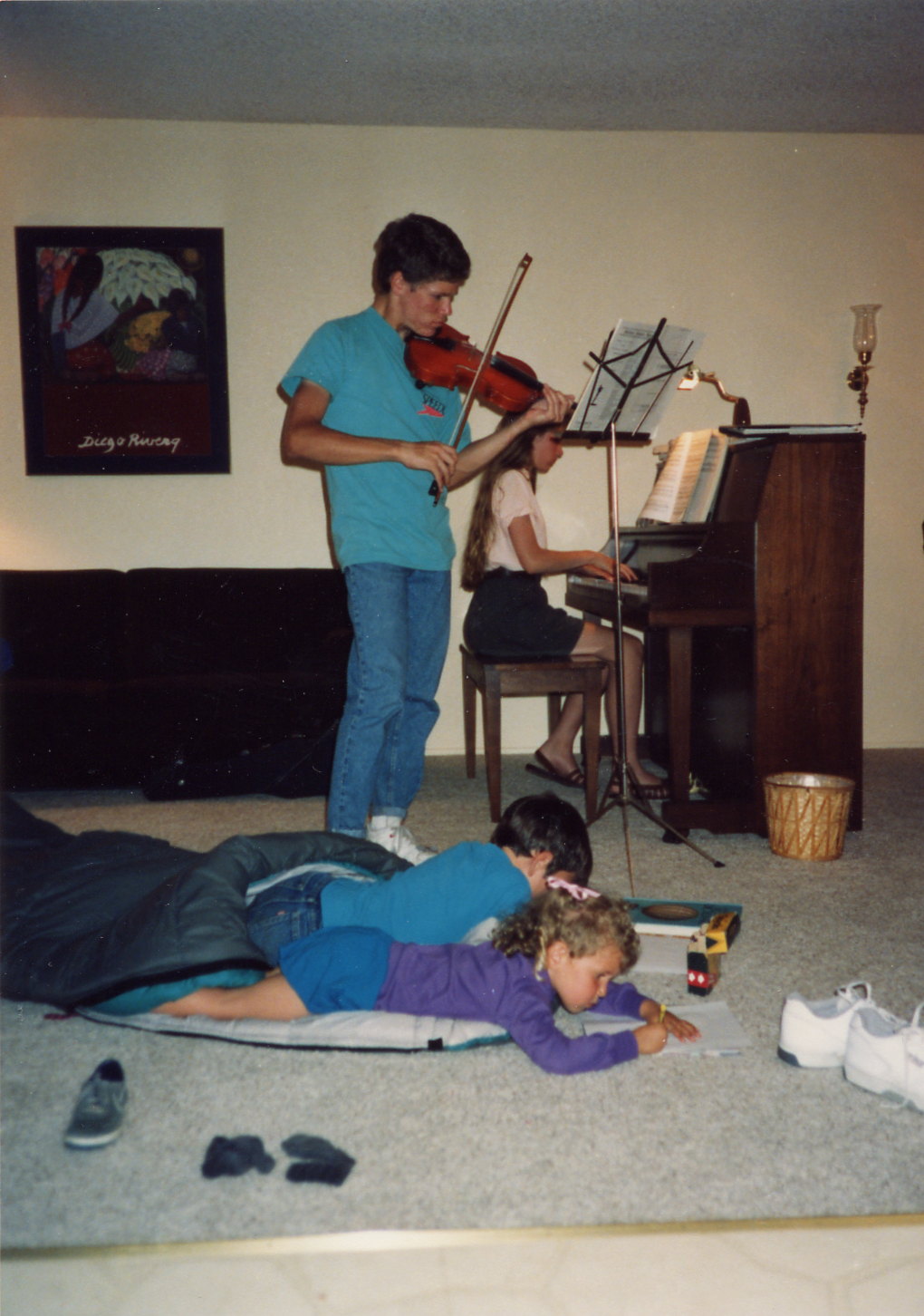
At first there wasn’t money for music lessons, and I wept over the injustice of a world in which my firstborn had no opportunity for a more structured musical education. Then grandparents and great-grandparents stepped in and God provided a generous piano teacher two blocks from our house. From that time forth the provisions continued in various ways, so that eventually all of our five children learned to play at least one instrument. The photos are of them and a grandson enjoying their music. Two of our daughters became piano teachers in their teens.

But for many families, music is not something they can really accomplish. My parents could not provide it for me, but it all worked out o.k. Some women find that their distracting drama only starts when they marry, or when a child falls ill. There are women for whom getting through the day is like climbing a steep mountain, and while they might be relieved to stop and smell the flowers, it’s asking a lot to tell them they ought to get out the seed catalog and develop a plan for further landscaping. But I suppose they aren’t the ones reading Hidden Art.

When Schaeffer says things like, “Christian homes should…be places where there is the greatest variety of good music,” I balk at the word should. I don’t know how she might otherwise have presented a picture of what she considers the ideal home, but every time she says we should do this or that to develop our creative side — and in the short Chapter 2 she used the word nine times — I get annoyed that she is telling me what my Christian duty is.

To me that’s backwards, because I can’t recall ever doing one creative homemaking thing out of a sense of duty, though I firmly believe we are all obligated to do our duty. To fear God and keep His commandments is the whole duty of man, according to Ecclesiastes (Not that we can even accomplish those basics on our own). It seems to me that the rest, the art and music and beauty, flow naturally from a human soul that is nurtured by God’s love — just as sap running up a tree trunk results in bright leaves and colorful fruit. The main thing is not to tell the tree to make fruit, but to keep the connection to the life-giving Fountain — Who is also the One who heals all those diseases of the heart that might hinder us.

What do you know — beauty in our life is one of the healing potions God provides. So if we start with small things that brighten our homes, say, singing a few lines from a hymn over the kitchen sink, or teaching a nursery rhyme to a toddler, just in response to the impulse, we are creating culture and feeding our own souls. It keeps the sap running, and the more the tree grows, the more sap and delicious fruit there will be.

Since Edith Schaeffer wrote this book and What is a Family, the only two of hers that I have read, thousands of families have discovered that homeschooling provides the opportunities to build the kind of family life and culture that the author presents a vision for. Just give us enough time with our children and all these good things are more likely to happen. The vision she sets forth was an ingredient in the soil that nourished my own heart and gave me the courage I needed. All the rest is in Part II, Part III, and still writing… Oh, and still singing new songs!