Below are encouraging words from Metropolitan Anthony Bloom, prefaced by a few of my own Holy Saturday thoughts from six years ago, when I was freshly bereaved of my husband. I will leave that mercifully dated personal context as is, though it is for the more enduring words of Metropolitan Anthony that I am re-posting:
– – – – – – – – – – – – – – – – – – – – – – – – – – – – –
I find myself in a phase of grief where from time to time during the day I feel acutely lost without my husband, the absence of him like a soreness in my spirit, an ache in the middle of my chest telling me that something is very wrong with me. Yes, something is wrong!! It’s death that is wrong – it’s wrong for us to be separated, for me to lose the heart of my heart. I have known this truth in my mind and for the world generally – now I understand it in my bones.
 But as I’ve said here more than once already, I have the peaceful assurance that we are not absolutely separated, and a huge thankfulness as well that neither of us has been cut off from the Source of our life and existence. Sometimes we humans use the figure of speech that we will “die of grief,” because it feels that wrenching. But I know even as I am feeling it and railing against it, that I will live through it. This is all because Christ suffered for us, and he overcame death. My pain is like a pinprick compared to what Christ endured on our behalf. As for my husband, “Blessed are the dead who die in the Lord.”
These words from Metropolitan Anthony Bloom that I first read in God and Man two years ago are even more meaningful to me on this Holy Saturday:
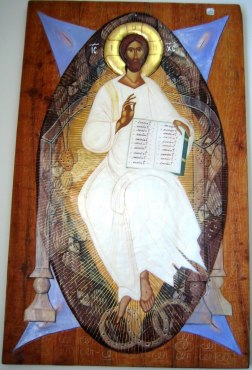
When in the Apostles’ Creed we repeat “And he descended into Hell,” we very often think “That’s one of those expressions,” and we think of Dante and of the place where all those poor people are being tortured with such inventiveness by God.
But the Hell of the Old Testament has nothing to do with the spectacular hell of Christian literature. The Hell of the Old Testament is something infinitely more horrid; it is the place where God is not. It is the place of final dereliction; it’s the place where you continue to exist and there is no life left.

And when we say that he descended into Hell, we mean that having accepted the loss of God, to be one of us in the only major tragedy of that kind, he accepted also the consequences and goes to the place where God is not, to the place of final dereliction; and there, as ancient hymns put it, the Gates of Hell open to receive Him who was unconquered on earth and who now is conquered, a prisoner, and they receive this man who has accepted death in an immortal humanity, and Godlessness without sin, and they are confronted with the divine presence because he is both man and God, and Hell is destroyed — there is no place left where God is not.
The old prophetic song is fulfilled, “Where shall I flee from thy face — in Heaven is thy throne, in Hell (understand in Hebrew — the place where you are not), you are also.” This is the measure of Christ’s solidarity with us, of his readiness to identify himself, not only with our misery but with our godlessness. If you think of that, you will realise that there is not one atheist on earth who has ever plunged into the depths of godlessness that the Son of God, become the Son of Man, has done. He is the only one who knows what it means to be without God and to die of it.
— Metropolitan Anthony Bloom
 Some time before he died in 2019, I became slightly acquainted with the work of
 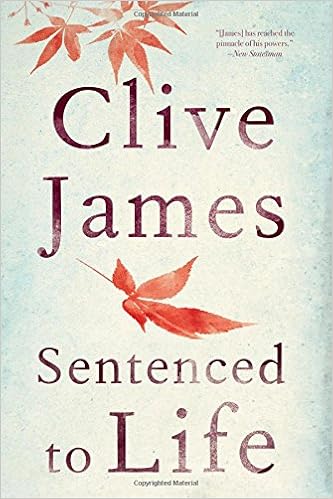 Now as I revisit James’s work, I am very interested to read about this: “Clive James spent the spring and summer of 2019 writing and editing an autobiographical anthology called The Fire Of Joy, a raid on ‘the treasure-house of his mind’: a collection of the poems that first awoke in him his love of poetry and that were lodged forever in his memory.” I was disappointed to find that the book is not in any library I can access, and it’s expensive to buy, for someone like me whose appreciation of poetry is not at a level that would justify the expense.
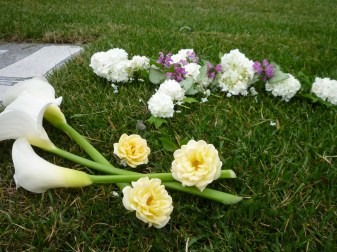
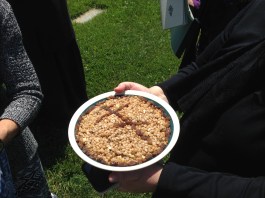
 I almost broke out of my “cage” last week to visit my husband’s grave. My priest would meet me there, and we would pray on the memorial of my beloved’s repose, five years ago. But we changed our plan and had a virtual gathering with him praying in the church and more of us praying along via Zoom than would ever have been able to come to the cemetery. Before we had conceived the graveside plan and given it up, we had planned for me to bring a

 “It is the disruption of Ivan Ilyich’s pleasant life, the pain of his illness, and the growing realization that he is dying, that make him pay attention, and even pray. His prayer is along the lines of, ‘What did I do to deserve this?’ but nevertheless: ‘Then he was still, ceased weeping, held his breath, and was all attention; he listened, as it were, not to a voice uttering sounds, but to the voice of his soul, to the current of thoughts that rose up within him.'”
 “O
“O
 Gladsome Lights