Category Archives: family

Bicycling ages considered.

I didn’t know C.S. Lewis had written about bicycles until I read The Inklings blogAntique-Bicycle-Girl-Image-GraphicsFairy-1024x984, but I was considering my own history of bicycling when, while on vacation and staying in a house whose amenities included eight bicycles in the garage, I went for a spin with my granddaughter.

It was the first time I’d been on a bike in about 20 years, as lower back problems had made perching on a bike seat uncomfortable during my last pregnancy and beyond. I wasn’t motivated to try very hard, because by the time my back was healthier, we had moved to the suburbs,  and riding where there are a lot of cars and stop signs to look out for and accommodate is at worst harrowing, and at best a chore.  So we gave away my bicycle.

The bike I rode for just a few minutes in Oregon was a bit large for me, but that didn’t prevent me from enjoying the sensation of rolling along with the wind in my hair, smelling the pines and listening to the chatter of my little companion.

It all took me back to the freedom and happiness of my youth, when for a few years in adolescence two or three friends and I would tool around the back roads of our Central Valley villages, spanning the miles that separated our houses hidden in orange groves.

From Lewis: “‘Talking about bicycles,’ said my friend, “I have been through the four ages. I can remember a time in early childhood when a bicycle meant nothing to me: it was just part of the huge meaningless background of grown-up gadgets against which life went on. Then came a time when to have a bicycle, and to have learned to ride it, and to be at last spinning along on one’s own, early in the morning, under trees, in and out of the shadows, was like entering Paradise. That apparently effortless and frictionless gliding — more like swimming than any other motion, but really most like the discovery of a fifth element — that seemed to have solved the secret of life. Now one would begin to be happy. But, of course, I soon reached the third period. Pedalling to and fro from school (it was one of those journeys that feel up-hill both ways) in all weathers, soon revealed the prose of cycling. The bicycle, itself, became to me what his oar is to a galley slave.’

“‘But what was the fourth age?’ I asked.

“‘I am in it now, or rather I am frequently in it. I have had to go back to cycling lately now that there’s no car. And the jobs I use it for are often dull enough. But again and again the mere fact of riding brings back a delicious whiff of memory. I recover the feelings of the second age. What’s more, I see how true they were — how philosophical, even. For it really is a remarkably pleasant motion. To be sure, it is not a recipe for happiness as I then thought. In that sense the second age was a mirage. But a mirage of something.’

“‘How do you mean?’, said I.

“‘I mean this. Whether there is, or whether there is not, in this world or in any other, the kind of happiness which one’s first experiences of cycling seemed to promise, still, on any view, it is something to have had the idea of it. The value of the thing promised remains even if that particular promise was false — even if all possible promises of it are false.'”

— C.S. Lewis, Present Concerns, “Talking About Bicycles”

For myself, my memories also include unpleasant experiences on bicycles in my youth, both involving moments of panic at the realization of my helplessness. Once I was borrowing the bike of my grandmother’s friend, in a strange neighborhood. The bike had been offered to keep me entertained while the ladies had tea indoors. I blithely pedaled around the residential streets for a very few minutes and suddenly knew that I had no idea where Grandma’s friend lived, or how to get back there. I didn’t know her name; I hadn’t noted what street she lived on.

The feeling of being lost was so sharp and guilty — it was my own stupid fault, of course. With my heart beating madly I rolled along vaguely back the way I had come, and eventually saw my grandmother’s car. I went back in the house with the awareness that no one there knew how close I’d come to disaster; and I never told my secret, about how the lighthearted floating through space took away my common sense.
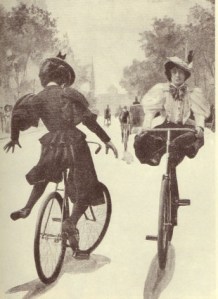
bicycle bloomersAnother time, with my cousins in their city, we walked our bikes up a hill so that we could ride down fast. I was wearing my cousin’s child’s cowboy hat, and as we picked up speed on the descent I felt the hat fly off at the same moment I saw that the traffic light at the bottom of the hill was turning red. My instincts told me not to slam on the brakes, for fear of losing control even more, so I ran a red light, and I think I might have screamed at least a little. Drivers of cars waited for us to go through, and as we slowed to a saner speed I noticed that the cowboy hat had a neck cord that had kept it on my head after all.

No, I didn’t get off to a good start with city riding. My favorite rides of all time are the country ones I took with Pippin riding on a small plaid child’s seat behind me, when she was a toddler. We would take a half-hour ride in the mornings sometimes, when her father worked swing shift and could watch the older children. There was a narrow road I liked to take, with oaks arching over, and in springtime the banks along the way were covered with sweet-smelling broom.

Even then, the pleasure of bicycling was for me as much in the surrounding sights and smells as in the mode of travel — which means a preference for meandering rural rides. Mr. Glad has teased me for decades about getting a tandem machine for us to pedal together, but that has never sounded relaxing in the least.

I wonder if there could be some more appealing variation of my earlier experience still ahead for me, maybe a “third age,” as above, followed by a richer “fourth age”? The gentle prodding I received to revisit the topic has made me more open to the possibility of a bicycle (or a tricycle??) in my future.
Trying to remember, hold, and pray.

Three years ago I posted this piece as “Ways to Remember the Dead.” It’s time for me to revisit it and and remember once more.

* * * *

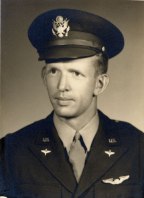
My mother’s brother Bill died before she was married, so I didn’t know him. He was a pilot who died in a plane crash during wartime, after having flown many successful bombing missions over Europe.

All my life I’ve never known more than that, and I never thought to ask my mother more. Or my grandmother, who lost her only son and half of her children when she lost him. No one in my family was very talkative generally, or the sort to tell family stories to children — especially stories of pain and loss.

I wonder what was wrong with me, that I never asked about him? I have recently inherited a beautiful framed portrait of my uncle in uniform, which I hope to put on the wall somewhere. If this portrait had been on the wall of our house when I was young, maybe it would have prompted my mother to talk about him, or me to inquire. Now that I am older, and want to know more about many of my ancestors and relations, there’s no one to ask!

I guess I shouldn’t blame myself for not being more inquisitive when I was younger; probably it isn’t in the nature of children, or even of young adults getting set up in the world, to think about their parents’ and grandparents’ past and about people who aren’t present in the here and now.

And if that is the case, knowing how I feel at this stage, when it’s too late to do anything about my own ignorance of my family history, I think about how to make it better for my own children when I’m gone and they are having similar regrets. All I know to do is to write down what I do know. Then it’s there for anyone to access at whatever time they do come to that place in life where they are more hungry for connection to deeper family roots.

What might it take to feel this connection? Your feelings remembering a grandparent you spent a lot of time with would differ, certainly, from those toward a family member you never met, even if the latter were famous and had a long entry on Wikipedia. There are different kinds of knowing — and loving.

Once my priest talked to me about how to keep from getting offended by other people and to avoid sinning against them. If we hold them in our minds, there are mostly facts there: this person does this, is that, said this, thinks that. We are set up for judging the facts and the person as to whether she is good or bad or whether she likes us or not, if he is trustworthy or not, and so forth.

But if we can hold the person in our hearts, he continued, where the Kingdom of God is, we are holding him in Love. God is there, and God is Love, and the warmth and peace of the Holy Spirit control our responses to the one we are called to love.

Perhaps this is what II Cor 5:16 refers to when it says, “…from now on, we regard no one according to the flesh.” If we strive to know another person according to Christ, in our hearts, there must be an element of prayer involved, as we carry them with us into God’s presence.

We Orthodox pray for the dead not because we have a doctrine of Purgatory (we don’t) but only out of love, a practice I considered at length two years ago in a blog post when my father died. Isn’t this a way to hold the departed, also, in our hearts, and not in our intellect, where for some of them we only have biographical sketches?

Memorial Day is a good day to express my love for my uncle, who died before I was born, and my longing to know him, in prayer. I never sat on his lap or flew a kite with him; I don’t know if he had a sweetheart or what he planned to do after the war. But God made him and knows him, and when He sees Uncle Bill and me, it is in the Now, because our Father sees everything at once.

I can remember my uncle in the Reality of the presence of God, and perhaps I’ll meet up with him later in the coming Kingdom, where it will be obvious that we didn’t miss much by not meeting here on earth, and where we’ll know each other in the best way.

Tales from Flowery Town

FT azaleasFor a few days I helped out the family of Soldier and Joy, as grandmas like to do when new babies are around. I mostly played with little Liam. (Scroll down fast if you can’t wait for the Liam-related pics.) We took walks around their neighborhood, in the Sacramento area where the hot summers make for some lush landscapes. In their very own back yard live two or three real orange trees, and guess what? It’s orange blossom time right now.
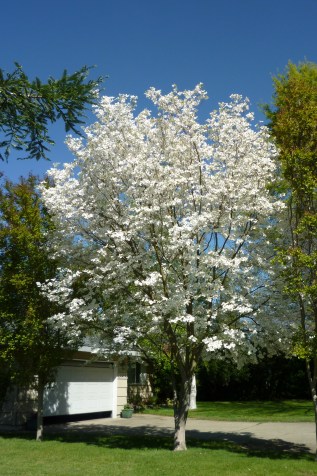
If you’ve never smelled orange blossoms, I hope you get the chance before you die. The scent they exude must be what Adam and Eve smelled in Eden before death came into the world. Which makes me realize, on second thought, that you won’t have missed anything if you get to heaven without experiencing orange blossoms, because the Reality of the the One who made them in order to give us something of Himself will be there to delight you so much more.

It’s a quiet and peaceful neighborhood I was pushing the stroller through. I met up with two ladies older than I who were right away taken with Liam. I asked them, “What is that scent in the air that is so sweet?” We knew it wasn’t orange blossoms, though mention was made of them.

“The photinias are all blooming now,” said one woman, and that rang a bell with me, though farther down the street I came upon one of the photinias that grow as big as trees here, and a whiff of the flowers made me know that their scent wasn’t the only ingredient in the spring mix. Many, many big trees of all sorts are blooming in this town, and it’s like strolling through a bouquet.

The Raphiolepis is no doubt in the mix of scents. I’ve never seen such giant specimens before.

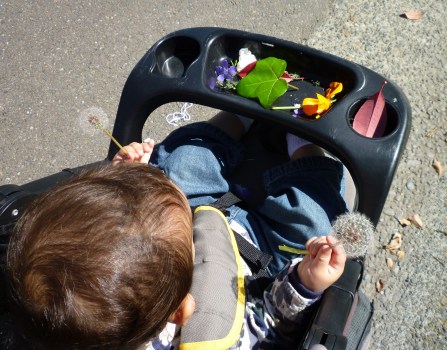
Liam seems amazingly studious of natural artifacts for a child of 21 months. As we walked past the landscaped yards or the occasional weedy strip, I plucked a dandelion more than once, and a red leaf, juniper needles and cones, and a poppy flower to hand to him. We smelled roses.

FT P1090307

He examined each thing as he rode, and then stashed it in the tray of his stroller. When we arrived home his mother put all of the items on a plate, and that was not the end of it. He kept looking at his treasures and carrying the plate back and forth. We did the same thing the next day, and then my back was hurting.

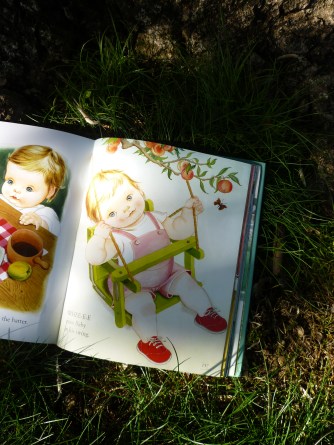
I had ordered a compilation of Eloise Wilkin stories sight-unseen, and brought it along for Liam. He now doesn’t want to read any other book, I think partly because this one is well-suited for practicing the thumbing of the pages along their edges that children enjoy learning to do, as in a flip book — is there a word for that? It doesn’t work if the pages are too few or too thin, and certainly not with most books aimed at toddlers.FT white tree

After sitting on my lap and getting acquainted with the book in this cursory way, we found pictures that bore resemblance to things in his world. Of course that is common in books for small children, but I suppose I started a new way of making connections for Liam when, as we were looking at a picture of a bumblebee and I was making the “buzz” sound, I said, “There must be bees around your orange trees right now — let’s go find out,” and we dropped the book right there to go see the real thing.

There were bees, but almost too high to see, and they were at the height of their midday frenzy right then, but L. paid close attention. That afternoon when we were playing with sidewalk chalk and water out on the patio that they shade, he suddenly looked up in the trees as though listening for the bees, and then he ran into the house to fetch the book and came out to stand underneath holding it with both hands very solemnly as he gazed up for a minute.FT P1090413

This sort of thing happened with several more connections, such as his riding toy, a bright plastic contraption with lights flashing that didn’t much resemble the humble wooden kiddie car of yesteryear featured in the book. But he saw enough likeness to believe us, and began to want to bring his toy from across the room to sit next to the couch where we were reading.


P1090409


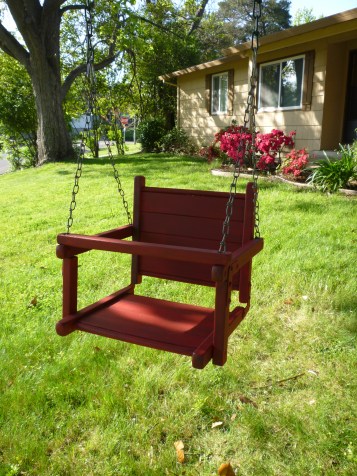
The most fun link was with the tree swing. Wilkin’s illustration in one story shows a swing that is nearly identical to the one in Liam’s magnolia tree, and he must have the book out there on the grass when I pushed him in it. I opened it to the page with the picture he wanted, and set it against the trunk where he could see it while he swung up and back and I recited “How Do You Like to Go Up in a Swing?” which poem, by the way, is also in that book. He laughed and pointed to the picture and I hoped I wouldn’t have to swing him as long as that child was swinging.


FT peas

FT orange tree

Lying in bed my last morning there, I was blessed by the songs of scores of enthusiastic birds, and the smell of orange tree flowers coming through the screen. I had been able to leave it open all night as the season is now so warm and mild. Through the glass door I could watch those orange trees take shape in the dawn.

Now I am home, where it’s mild, but not warm. I wouldn’t mind going back to Flowery Town soon. Next time I do, sometime after Pascha, I’ll give you a little report on Liam’s baby brother, or at least a nickname for the little guy. He’s very dear!

defeat of the bogey

Fairy tales do not give the child his first idea of bogey. What fairy tales give the child is his first clear idea of the possible defeat of bogey. The baby has known the dragon intimately ever since he had an imagination. What the fairy tale provides for him is a St. George to kill the dragon.

― G.K. Chesterton, Tremendous Trifles

 Linking up to Weekends With Chesterton