Category Archives: family

Blogs and Babies

Before I was married I didn’t keep a journal, at least not after the 5-year diary attempt in adolescence. And newly married, before children, I limited my writing to letters and sermon notes. It was only after having a child or two that I wanted to write at all, and I don’t understand all the reasons for the delay, but I used to think it had something to do with types of mental or creative energy.

I noticed after two or three pregnancies that I had no urge to write while I was pregnant. There are five long blank periods in the recorded history of my thoughts, scrawled in a mishmash of notebooks and stored in a box on a shelf. Much of my journaling over the years was filled with angst over church tensions or worries about whether I was being lazy about finding a “ministry” other than my family. I wrote long lists of what I had accomplished in a typical day followed by the lament, “And it wasn’t enough!”

What was it about carrying a child in my womb that eliminated the need for hashing everything out with pen and ink? Perhaps it wasn’t anything to do with the creative aspect of my participation in a magnificent process of nurturing a new and unique person–though my writing had been potentially creative in helping me to make sense of my world.

I started to write this blog about the similarities with my current life, where I am participating in a months-long creative work–thank God it isn’t nine months–and don’t have the thinking power to devote to any questions other than towel racks and paint colors. It’s only with great faith that I can imagine having anything significant to say ever again.

The idea I started with when I sat down just now doesn’t stand up to more scrutiny. Maybe my intellectual life 30 years down the road is entirely different. In the former time it was in a somewhat dormant stage, really, as I reminded myself in a recent post. The simple reality is that being with child made me happy and content. Maybe it was hormones. In any case, I didn’t need to write.

Now it’s that I can’t think well, that prevents me writing as I’ve become accustomed to. I hope it’s just a matter of distraction and overload, and that I will return to a version of my old self within another month or two. Already I have started sleeping better; it happened when I got the appliances into the kitchen. Family get-togethers and summer vacations will delay putting everything else back in place, but when the day comes that I don’t have to be ready at 8:00 in the morning for invading construction workers, it will be the beginning of my full return.

No, no, I mean the beginning of the next phase of my life. I know I can’t even return to last week, much less last year, intellectually or creatively or any other way. There’s always something new replacing something old, some loss and some gain. Today we moved the old furniture on to the new wood floors, and it all looks pretty, but we have lost some quietness from having (dirty) carpeted stairs.

The disruption has forced me to thin out my belongings, and take stock of how I actually use my kitchen. Having canisters of flour and sugar on the counter doesn’t make sense for someone who rarely bakes anymore. Maybe stress and insomnia and change will blow some cobwebs out of my mind as well, to make room for fresher and clearer thoughts that I can type into blogs on my computer when it is re-installed in the room with the pretty new floor.

A Lullaby Sound

My definition of lullaby presupposes a woman’s voice, though I will allow for poetic license in lines such as “The rain made a lullaby sound on the roof,” which phrase I’m pretty sure stuck in my mind from reading The Maggie B. a hundred times. But some people must think a lullaby is anything boring enough to make a child flee in desperation to the Land of Nod. That is my conclusion after listening to a recording titled “Lullabies” in the car today.

Before I set off this morning for a long drive, I rummaged through the box of CD’s temporarily in storage during the remodel, and spied two collections of such songs, which made me think, “Why not brush up on your lullaby repertoire?” So I brought them along, and as I was listening to the Lifescapes CD I realized that it was for the first time.

When I had babies in the house, I never thought of playing a recording for them at bedtime. When I borrowed LP’s from the library or bought lullaby songbooks it was so that I might discover a new soothing melody to croon myself. For years Mr. Glad and I would sit on the children’s beds or on the floor at night and sing to them for a long time as they drifted off.

I did know a grandma, long before I was a grandma myself, who played recorded music for her grandchildren in their beds when they came to visit, but at least it was of a woman singing sweetly — though it was admittedly too sweet for my taste. One young mother filled me with dismay, and pity for her children’s impressionable souls, when she complained that she couldn’t get her kids to settle down unless she played the “Christian rock” radio station at nap time.

My own children had their father and me to sing to them, or they had silence, or in the case of one baby, she got to the point where she groused at me when I stood by her crib singing, and when I gave up and left the room, she contentedly babbled herself to sleep.

Some favorite bedtime songs that come to mind, of the family collection, were: the Italian “Nina, Nana, Cocolo Della Mama,” “Swing Low, Sweet Chariot,” “All the Pretty Little Horses,” “Summertime,” “Hush, Little Baby, Don’t Say a Word,” and many Psalms that had been put to folksy tunes by Jesus People. “Trot Along, My Little Pony” was a huge favorite. My most recent acquisition is “A La Na Nita Nana,” which may actually be a Christmas song, but I think babies don’t mind.

I didn’t pick up any new ideas from the Lifescapes anthology. There were many traditional lullabies that I already knew, but bereft of any lyrics, and with minimalist and s-l-o-w string renditions even on “Dance to Your Daddy.” I hit the skip button many times because I couldn’t stand the dragging sensation, kind of like being tranquilized by annoyingly tasteless sweets.

The last fifteen minutes of the CD is pretty much equally divided among non-tunes. Not rain-on-the-roof, but “Running Water,” “Womb,” and “Heartbeat.” Running water I didn’t think was a good idea. It immediately made me think of the bathtub overflowing, and I wondered how was a child eventually to learn to be alarmed at the sound of water trickling in a house? Womb sounds were not so boring, but reminded me of a recording of humpback whales we once had, and whose songs I found more lovely. “Heartbeat” was, of course, tedious to an old woman, whereas it might be comforting to an infant. Perhaps the producers put five minutes of an adult-speed beating heart at the very end, thinking that if nothing else had lulled the baby to sleep after the first tiresome hour, that fundamental lub-dub might do the trick.

It’s likely that these sounds would calm a child, especially if the same recording were played every night. That could be true, though, of many sounds coming from a machine. It seems right to give my children what I myself like and what seems most wholesome. In a real live human voice you can be embraced and loved even after you are in your cradle. If the babies could tell us, I think that is what they would say.

My Famous Pipe-Smoker

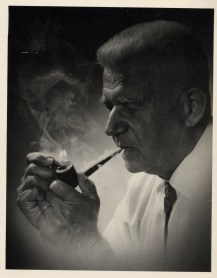
Pipe tobacco was what my siblings and I gave our father for Christmas year by year. He smoked his pipe every evening while reading after dinner, and when my grandfather was visiting, they would settle down in armchairs side-by-side and smoke together.

My understanding of the health risk is that it is significantly less than cigarette-smoking, because one doesn’t inhale very much. Those who smoke a pipe testify that it is incredibly relaxing, and the practice has even been prescribed as a treatment for anxiety disorder.

I can see how the habit might preclude other worse habits from developing, such as overeating, hurrying and worrying. My father lived to the age of 90, but to make a full disclosure, I must say that he stopped smoking a pipe when he was in his 50’s. Grandfather (his is the arty pic below) also lived past 90; he stopped when my father stopped, as he no longer had a smoking companion.

That pipe-smoke smell is one of my favorites from long ago, but one that I haven’t encountered for many years. Let it here be noted that if any of my sons or grandsons take up the custom, I will start making gifts of tobacco again. This offer doesn’t apply to the girls.

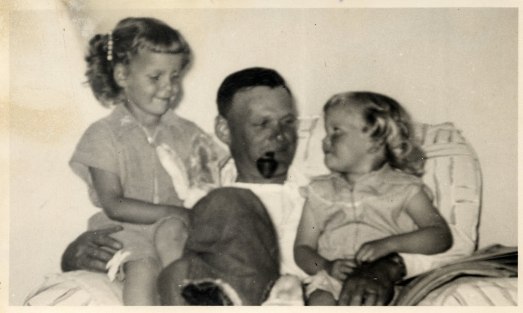
I recently discovered a blog honoring  Famous Pipe Smokers , hundreds of them, from Clark Gable to Winston Churchill and Oscar Peterson. None of the fascinating photographs of these people pipes-in-mouth is as charming to me as the one of my sister and me on the lap of our dear pipe-smoker. He is not likely to be noted with the celebrities, but he is the most famous to me.

Memory and Memory Eternal

My father-in-law has been forgetting things. In fact, in the last many months he can’t remember most events longer than a couple of minutes after they take place. If they happened 60 or 80 years ago there is a good chance that he will remember them, but what one would call his short-term memory, that which he is losing, is broadening in scope. Ten years ago he often told us stories about things that happened 10, 20, 30 years previous, and I heard some of those stories enough times to remember them myself.

One had to do with his old leather jacket. We were at the assisted-living place where he lives, about to go out to dinner, and I wanted to take his recent favorite jacket home to launder, so I handed him another old favorite to put on. As we took the elevator down and signed out at the front desk, he got several compliments on his appearance. I told the concierge, “He and his cousin both bought leather jackets in Spain when they were on a trip there together more than 30 years ago.”

“I did?” he chuckled. “I’m glad you remember these things.” I remember some other stories he used to tell, but lately I hear new stories, from further back. Even his daughter was surprised to hear, when the conversation at a Christmas gathering turned to pets, “We always had fox terriers.” She didn’t know anything about a fox terrier tradition, because the dogs of her childhood were dachshunds and schnauzers. But W. was referring to the first dog he remembered, when he was a boy, named “Spot.” And he’s told us a few times since about Spot.

When we passed a purple house on the way back from a doctor’s appointment one afternoon, he said, “That reminds me of a woman in our church who we always called ‘The Purple Lady.’ Everything she had was purple. I haven’t thought of Mrs. Finnegan for a long time.” That was a church of his childhood, 75 yeas ago. It’s as though the loss of one data set has forced his mind to resort to a long-neglected mine of memory if it wants to keep busy.

One tale that is like the overarching First Story of his life, sweetly involves his wife, my late mother-in-law. And it happened when he was only about five years old, so I hope it will be the last one to be forgotten. Their families were friends–an aunt and uncle had even married–and they lived only a couple of blocks from each other. W. came by and walked F.K. to school on the first day of Kindergarten. They were always companions, never dated anyone else, and married when they were 21. The picture was taken in 2nd grade, cropped from the class photo where they were sitting next to each other.

W. has some good habits, which trump the rational; that is, he doesn’t have to remember to do these tasks. On another laundry-gathering visit, I asked him to take off his clothes and put on clean ones right then, so I could take the dirty ones home. When I came back into the bedroom, he had neatly folded the pants and hung them back on their hanger on the doorknob, and hung up the shirt likewise. Because he always does. And he had already forgotten why he was changing his clothes in the middle of the day.

He has a habit of being friendly and gentlemanly, so that he kept trying to help ladies scoot their chairs up to the table even when he was becoming unsteady on his feet. And he cracks really funny jokes–new ones–in the emergency room or anywhere there are people, strangers or friends.

God only knows if I have any good habits that will remain when I lose my mind’s faculties. How many pair of pants needed folding before it made a habit that endured? If I start now, building the habits I think might serve me, or God, is it too late?

I once heard Wynton Marsalis exhorting young people about the power of the daily habit of practicing their musical instruments: “Every day you go around making yourself into you.” We are not what we dream of being, we are not our vision of ourselves, or God’s plan for us, but a collection of usually little, seemingly insignificant acts that add up to a unique person.

I see people I love weaken and become confused by the afflictions of age and the loss of memory, like Vivian, who asked her daughter, “Am I myself?”

“Yes, Mom, you are.”

But there are people who don’t seem to know themselves, and certainly multitudes who have forgotten their own important stories. One aunt of ours thought she was in her right mind, but did not recognize her own daughter, and told her she was an impostor.

The possibility that I might forget important people, forget who I am, is certainly disturbing. It happens to a lot of people, being another way we are not in control, even of our own memories.

The scariest thing imaginable is to forget God. When Christ said to “take no thought for the morrow,” surely this thought was included! I have to quickly move on, and rest in the belief that it’s more important for God to remember me, than for me to remember Him. And I pray He will not soon forget someone who has tried to “stick to Christ like a burr to a coat,” as Martin Luther’s wife Katharina is said to have resolved.

Recently I read Tolkien’s “Leaf by Niggle,” which added a new dimension to my musings on this mysterious unknown toward which we are all headed. Niggle and his art are eventually forgotten by everyone on earth, and what he accomplished in his life “down here,” which was always less than he should have done, and always incomplete, has faded somewhat from his own memory. God remembers him, though, and makes use of Niggle in surprising and grand ways. What Niggle learns of Love becomes a story, a work of art and even a spiritual retreat, called by his own name, that continues to benefit souls out of time.

In the Orthodox Church we sing a simple hymn, “Memory Eternal,” at the end of memorial services, and in me it is a prayer for just this wondrous kind of thing God can do, to wrap us up in Himself and carry us through whatever shadowy places we encounter, whether in our minds or along our pathways, until our minds and hearts, and all things, are made new in that heavenly and everlasting Kingdom.