Category Archives: food and cooking

Trying to Focus, on a Wintry Day

Into the blowing and pouring rain I forced myself this morning, so that I could use the machines at the gym. While walking on the treadmill for an hour, I read The New Yorker Food Issue from last November. I pick these magazines up at the library for 25 cents each, and usually find at least one article, though not usually in the Food Issue, to keep my attention while I work out. (I have tried many other reading materials, and everything else is either too heady and distracting, or too boring to keep my mind off the discomfort.)

Today I learned about a cake that is baked on a spit for several hours and is called Baumkuchen, which means Tree Cake in German, because some of them are cone-shaped like a tree. These cakes date back to the Middle Ages, and currently are pretty popular in Japan.

I read about poutine, beloved especially of youth in Canada, where I think I could get into eating it, at least in winter, when one might be able to burn enough calories shoveling snow and keeping warm so as not to put on the pounds from enjoying a dish that consists of French fries, cheese curds, and gravy.

The Michelin Guide to restaurants took several pages to explain, after the author hung out with one of the inspectors for the company during a meal at a three-star restaurant. These inspectors and their identities are top-secret and incognito, so that they can remain objective and also get the same food and treatment as any old customer who is willing to pay dearly for their daily bread.

Later in the morning I read a blog about how good homeschooling can be if the family actually stays home a lot, so that the children can concentrate on whatever it is they are doing and not be constantly interrupted by having to run hither and thither to group classes and such. That got me thinking about how it is better for me, too, still a self-homeschooler, an autodidact, who always gets confused and scattered when I have to come and go.

I read another blog that linked to an interview with Makoto Fujimura, a Christian Japanese-American artist who has a lot to say about God and creativity. I remembered that I’d heard a different interview with him not long ago on the Mars Hill Audio Journal, and I was able to locate the tape and listen to him. I was not able to multi-task, though; I found that if I tried to find his website at the same time, I stopped listening.

I started to take notes on the audio interview. He was talking about how the habit of reading is even more important to cultivate now that our society is so image-oriented. Also about how all the fast-action images that people are feeding on teach their minds to avoid real concentration. They scan, instead of engaging with visual information in a more focused manner. I was still feeling distracted myself and wondering why I was picking this one topic and writer to think about. Was I randomly and shallowly scanning?

No, I had wanted to listen to him again and think more about these things. But if I hadn’t gone to the gym and taken hours to collect myself afterward, I’m not sure I’d have had so much trouble being calmly thoughtful. In the early afternoon I had to go out again and run errands–more dissipation of mental energies!

I was saved by duty–my husband’s needs were what helped me to pull myself together. We were nearly out of granola, his staff of life. And he would need a real dinner. (Without him, I’d eat eggs and toast and tea forever.) He would like to feel the warmth of a fire as he came in the door from work. When I got a fire kindled and started assembling the granola I was happy to give my attention to concrete and practical tasks.

This granola has fed the family for more than 35 years. I make a huge batch still, so that I don’t have to do it very often, even though B. often eats Power Pancakes for breakfast nowadays. The basic proportions of oats, honey and oil have remained the same, while the extras of nuts, seeds and other grains are infinitely flexible. It doesn’t make a very sweet cold cereal, as you might guess if you compare with other recipes.

GretchenJoanna’s Granola
30-32 cups of regular rolled oats, divided
3-5 cups unsweetened shredded coconut
2-5 cups chopped almonds and/or other nuts
0-2 cups each of wheat germ, sesame seeds, buckwheat groats, rice or oat bran
0-1 teaspoon salt
2 1/2 cups oil
2 cups honey (or substitute part sugar syrup, made with 1 cup sugar and 1 cup water)
3 tablespoons vanilla, or substitute part almond extract
Put 20 cups of the oats in a giant bowl. Add whatever other dry ingredients appeal. In a pot, heat and stir the wet ingredients gently and slowly together until the honey is liquid. Pour onto the dry ingredients and stir to moisten them thoroughly. Then add the other 10-12 cups of oats and mix in evenly.
Spread up to an inch deep in pans and bake in batches at 300° until as toasty brown as you like it, stirring every ten minutes. Lately I’ve been using big roasting pans that happen to have 2″ sides, but the toasting may happen faster using pans with less lip. I use the biggest pans I have, and both oven racks, so that it doesn’t take all day. 🙂
I store a gallon jar of this on the kitchen counter, and the remainder in the freezer.

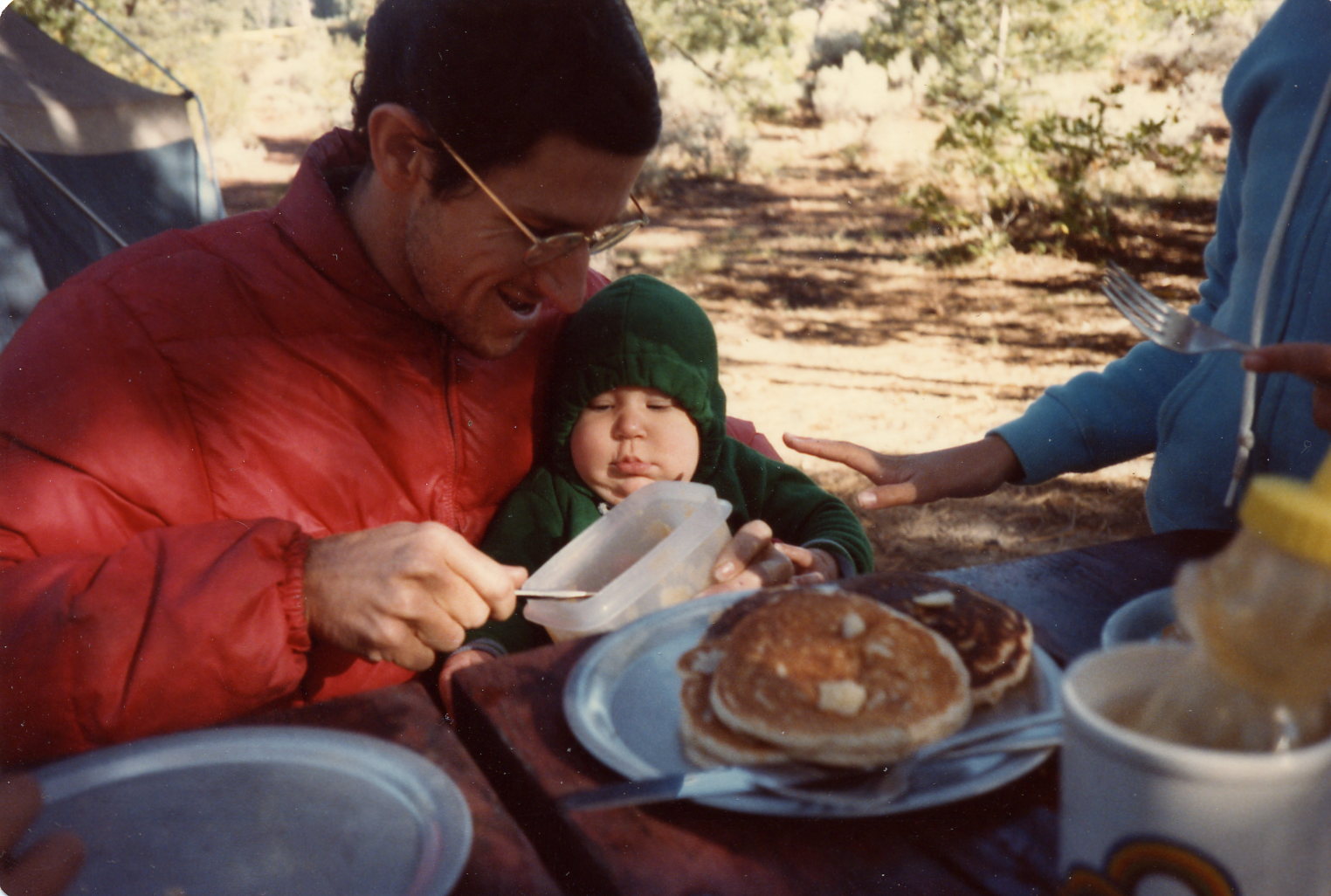
I was going to show a photo of the big bowl of finished granola, but my camera battery is spent. So here is a picture of someone enjoying an early version of GJ’s Granola, circa 1977 (notice the gold draperies and tablecloth).

Time for bed now, and thank God, I can end the day having accomplished reading, writing, and homemaking, even if I wasn’t very organized in my concentrating. I want to do better tomorrow.

Neapolitans–the cookie

I’ve made these exotic Italian cookies the last two Christmases before this one. Not this year. But they are so pretty, I’m going to post the photos for your enjoyment–and the recipe, too. I got the recipe from a library book ages ago and don’t know where to give credit.

I looked at scads of other Neapolitan recipes on the Internet–I forget why–and they were all dreadfully inferior. This one uses two different doughs, each with many tasty ingredients, whereas the others I saw used just one fairly simple dough that just had different food colorings added. This one also has no food coloring other than what is in the candied fruits.

Neapolitans

These Italian cookies present an interesting way of making icebox cookies. They are dramatic and unusual. You will make two entirely separate recipes for the dough—and it must chill overnight.

DARK DOUGH

3 cups sifted all-purpose flour
¼ tsp. salt
1 tsp. baking soda
½ tsp. powdered cloves
½ tsp. cinnamon
6 oz. (1 cup) semisweet chocolate morsels
½ pound (2 sticks) butter
2 tsp. finely-ground coffee beans
1 cup dark brown sugar, firmly packed
2 eggs
5 oz. (1 cup) green pistachio nuts

You will need an 11x5x3” loaf pan, or any other loaf pan with 8-9 cups capacity (or use two smaller pans of equal capacity—two medium loaf pans worked for me). To prepare the pan: Cut two strips of aluminum foil or two strips of wax paper (see Notes), one for the length and one for the width; they should be long enough so that they can be folded over the top of the pan when it is filled and should cover the whole surface. Place them in the pan and set aside.

Sift together the flour, salt, baking soda, cloves, and cinnamon and set aside. Grind the chocolate morsels in an electric blender (or they may be finely chopped, but they must be fine or it will be difficult to slice the cookies), and set aside. In the large bowl of an electric mixer cream the butter. Add the coffee and brown sugar and beat well. Add the eggs and beat to mix. Beat in the ground chocolate. On low speed gradually add the sifted dry ingredients, scraping the bowl with a rubber spatula and beating only until blended. Beat in the nuts.

Transfer the dough to another bowl, unless you have another large bowl for the electric mixer. Set the dough aside at room temperature and prepare the following light dough.

LIGHT DOUGH

2 cups sifted all-purpose flour
¼ tsp. salt
¼ tsp. baking soda
¼ pound (1 stick) butter
1 tsp. vanilla extract
½ tsp. almond extract
½ cup granulated sugar
2 tablespoons water
1 egg
3 ½ oz. (3/4 cup) currants, unchopped, or raisins, coarsely chopped
Finely grated rind of 1 large lemon
6 candied red cherries or maraschino cherries, cut into quarters
6 candied green cherries, cut into quarters

Sift together the flour, salt, and baking soda and set aside. In a clean large bowl of the electric mixer, with clean beaters, cream the butter. Add the vanilla and almond extracts, the sugar and water, and beat well. Add the egg and beat to mix. On low speed gradually add the sifted dry ingredients, scraping the bowl with a rubber spatula and beating only until blended. Mix in the currants, lemon rind, and both kinds of cherries.

To layer the doughs in the prepared pan: Use half (about 2 ¾ cups) of the dark dough and place it by spoonfuls over the bottom of the pan. Pack the dough firmly into the corners of the pan and spread it as level as possible. With another spoon spread all of the light dough in a layer over the dark dough—again, as level as possible. Form an even top layer with the remaining dark dough. Cover the top with the foil or wax paper and with your fingers press down firmly to make a smooth, compact loaf.

Chill the dough overnight in its pan(s) in the freezer or refrigerator.

To bake the cookies: Adjust two racks to divide the oven into thirds and preheat to 400°. The cookies may be baked on unbuttered cookie sheets or on sheets lined with foil–or parchment paper, as I used. Have the sheets ready.

To remove the dough from the pan: Use a small, narrow metal spatula or table knife to release the dough from the corners of the pan. Fold back the foil or wax paper from the top of the loaf of dough, invert the pan onto a cutting board, and remove the pan and the foil or paper.

With a long, heavy sharp knife cut the dough in half the long way. Wrap one half and return it to the freezer or refrigerator while working with the other half.

With a very sharp knife cut the dough into slices about ¼” thick. Place the slices 1 to 1 ½ inches apart on the cookie sheets. (It’s best to use insulated sheets to prevent burning.) The second half of the dough may be sliced and baked now or it may be frozen for future use.

Bake for about 10 minutes, reversing the cookie sheets top to bottom and front to back as necessary during baking to insure even browning. Bake until the light dough is lightly colored, but watch them carefully—the dark dough has a tendency to burn.

With a wide metal spatula transfer the cookies to racks to cool.

NOTES: The original recipe said that if the dough crumbles when you slice it, it hasn’t chilled enough. But as mine had been in the freezer overnight, I didn’t have this problem.

If you use wax paper instead of foil, each piece should be folded so that it is two or three thicknesses. Wax paper is weaker than foil and a single layer would tear.

I loved these cookies, but both times I made them the house was full of about ten other kinds of cookies with more gooey and rich ingredients, so these didn’t get the appreciation they deserve–that is, until I gave some to the choir director at church, who has Italian heritage, but no source for such cookies. He was so thrilled, I ended up giving him a few dozen.


Bird Food Improved Upon

I am inspired by a blog on Brussels sprouts and peanuts here to prepare the recipe posted. Also to tell you my own story of birds and sprouts. Missing from my story are the peanuts.

This is what the vegetable should look like before it is harvested, but my own try at growing these impressive stalks didn’t work out as planned. At the time when little buds should be growing into big sprouts, there was nothing but  big, bare stems. Could the flocks of quail who frequented our back yard have anything to do with this? I knew they ate the leaves on top….

Eventually I took the time to examine those stems up close, and there were indeed little sprouts on them, the size of pinheads, and never able to grow larger. My plants had been so starved by the constant bird pruning that they had nothing to put toward production of fruit.

I love to cook Brussels sprouts, and even B. has overcome his off-putting childhood initiation so that now he happily eats them. Cooked, mind you. Once as a little boy he was accompanying a farmer friend of the family on a walk through the vegetable garden when the man plucked a sprout off the stalk and handed it to young B. saying, “Here, try it, it’s a Brussels sprout.” B. obediently chewed the raw sprout and found it the most horrible thing he’d eaten in his short life.

It took many years for him to get over that first taste. Sprouts are so darling and yummy, though, that simple steaming has been enough preparation to suit us most of the time. After I got married I learned to cut a deep X into the base of each sprout before dropping it into the steamer basket. That lets the inside leaves cook along with the outside, so you aren’t left with a choice between mushy outsides or crunchy centers.

Now I’m off to the market and will certainly bring home some Brussels sprouts. I’ll let the birds eat the raw, and will serve mine cooked.

Psalter and Soup

This Advent season I’m participating with other women, organized by Sylvia, in reading the Psalter every day for the 40 days. Our Psalter is divided into 20 groupings each of which is called a kathisma, and every woman will read one per day.

There are more than 40 of us participating so that the whole book of Psalms will be read twice a day. Everyone who perseveres will end up having read the Psalter through twice before Christmas, as well! What a joy it has already been.

I’m also trying to read The Winter Pascha by Fr Thomas Hopko, which has 40 readings about this period in the church year that has similarities to Lent and Pascha. I read two days’ entries and now can’t find the book, so we’ll see how that goes….

We just got a good rain and everything is washed clean, the sky is blue, and the snowball bush is showing its glory.

It’s the season for soup! It’s easy to make a lenten meal in the soup kettle, and today I am putting in three kinds of beans and some winter vegetables.

I don’t often buy parsnips or turnips. When I used to read Down, Down the Mountain by Ellis Credle to my children, the vegetables the characters are so fond of must have seemed as exotic as boys and girls riding barefoot for lack of shoes to wear.

In the story, the mountain children carry a bagful of turnips down to the town, turnips they themselves planted and tended lovingly, in hopes of selling them for enough money to buy shoes. But everyone they meet along the way is hungering and thirsting for just such a delicacy, and when they arrive in town they discover that only one turnip is left in the bag.
 I’m afraid that after my first 15 years of family cooking, with its centerpieces of lentil soup and bread, I might have inadvertently started cultivating a taste in my family for fancier food. Fast periods are a good opportunity to repent and reform.
 But this plain food tastes pretty fancy after all.