Only a couple of days ago I was in love with the season and my new plants and all. Then last night, as I was airily driving to Vespers, suddenly it descended like a solid black cloud, the realization that I would not have my beloved companion with me this year. The days are cooler and damper and one can take a walk at any time of day and it will be pleasant, but he will not be here to share the delights of the season with.
Today I took a walk alone, as I will have to do more often now, trying to hold on to what is left of me. I hoped the exercise would improve my weepy mood, and I thought I might take some pictures with my phone, because that urge is something of me that remains, and it’s not overly challenging work.
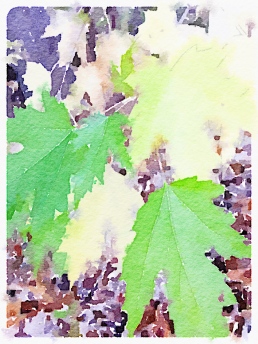
turning leaves
The change in me is one of the griefs that is so disturbing. I don’t only miss my husband, my companion of 45 years, but I miss my very life, because it is changed at several levels. I know in faith, and even by the evidence of the recent months, that God’s plans for me are good, but now I feel the down side of the season’s changes in the way they mark the progress through the cycles of the years and seasons of life, and make me feel the sting of change and decay.
Last night I saw a photo slide past on my screen saver, set to shuffle family pictures, a snapshot taken of my husband when he was just a little boy on the beach, looking serene and calm. He didn’t know then that his life would speed up year by year, that he was racing toward the grave. I was stunned and angry. He comes forth like a flower, and is cut down: he flees also as a shadow, and continues not. (Job 14:2)
The memorial service for which I made the koliva was also last night, just before Vespers, right after I was hit by the black cloud. As I served up little cups of the boiled wheat dish in the narthex several of us were remarking on how we can’t keep track of the passage of time; what year was it that Sarah reposed? We need help to remember, and to remember the things that we ought. It’s good for us to have these services and to pray for the dead partly because it reminds us that our own death is coming, and we should live in light of that.
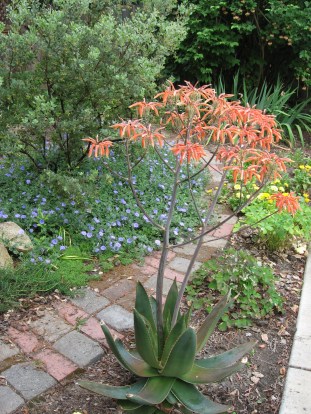
Neighbor Elizabeth’s front yard
To remind myself of the realities that have sustained me through the last months, I spent some time this morning looking through the blog posts I have written since my husband’s death. I was surprised to find that the comments from you readers were the most comforting words to read, because you have suffered with me via my blog and have prayed for and affirmed me through everything. I wanted to write a private e-mail to so many of you, but I decided to write this post instead. Writing is a way for me to tame my wild thoughts and feelings as I organize them and put them into a perspective that is in tune with Truth, and the love of The Holy Trinity.
Several “real life” friends learned of my extra sorrow today. I received hugs and phone calls and e-mails, and prayers. I know that many of you pray for me often, and that is heartening. I ask my husband to pray for me too, as I know that in reality he is not far away, no matter how I may feel in the moment. Thank you all, for reading my blog, for praying. Thank you, God, for everything.
For God has not given us the spirit of fear; but of power, and of love, and of a sound mind. (II Timothy 1:7)
Yesterday when I wrote about my grief, I had started out to write a critique of the book I quoted from. Being my sweet self I had begun my essay not with what I didn’t like, but with something I appreciated about this grief counselor’s message. Immediately I realized that I wasn’t competent at that time to do anything requiring intellectual focus, because the quote helped me to see that I was scrambling to find my bearings without my “landmarks,” and that can consume all of one’s inner resources. So I wrote about that.
The fact is, I recommend the book with great reservations. It is Grieving Mindfully:A Compassionate and Spiritual Guide to Coping With Loss, by Sameet M. Kumar. The author presents several helpful metaphors like Landmarks and (traveling up) a Spiral Staircase, and important warnings about not trying to relieve the pain and depression with drugs, because that prevents you from doing the work of grieving.
All of those good things, and even the advice I didn’t find useful, could have been presented in a book half the length. The author is very repetitive, as though you are consulting him in his office for a year during which he has to reiterate the prescription every week.
Kumar is a clinical psychotherapist and grief counselor, and a Buddhist who credits the Dalai Lama with giving him the tools to find his career path and change his own life for the better. I mentioned some major concerns I had about his philosophy in my post on Changing Views, so if you like you can read them there; today I have thoughts on other aspects, though I haven’t the time, and maybe not the ability, to treat all of the problems I find.
I just read over that article and find that back then I unknowingly used a phrase that I hadn’t yet encountered in Kumar’s book: emotional energy. On the day I was writing about in August, I was surprised to find that I lacked emotional energy to do simple everyday tasks that should have been easy and even fun. But Kumar says that we should “use the tremendous influx of emotional energy that comes from experiencing loss to nurture life.” This labeling of the debilitating pain of grief as just another kind of power we can use to drive whatever activity we want is very odd, if not ludicrous.
Kumar writes a lot about compassion, and how we can turn the energy of our grief to compassion for others, but the book is short on concrete examples of what this looks like. From what I can tell, it means telling people, “Everyone suffers. Get used to it.” Can compassion be cold? Buddhists say yes.
Recently I read a brief account of a Buddhist who converted to Orthodox Christianity and became a monk on Mount Athos. He was questioned by a visiting priest about his reasons for leaving “such a great cultural tradition,” and he answered,
“Divine companionship!…In Buddhism, my Father, you are very very much alone. There is no God. Your entire struggle is with yourself. You are alone with yourself, with your ego. You are totally alone in this path. Great loneliness, Father. But here you have an assistant, a companion and a fellow-traveler in God. You are not alone. You have someone who loves you, who cares about you. He cares even if you don’t understand Him. You speak with Him. You tell Him how you feel, what you would have hoped for – there is a relationship. You are not alone in the difficult struggles of life and spiritual perfection.”
I can well understand this man’s natural desire to be with God, a Trinity of three persons in love and community, because it is a desire instilled in us by that God, who made us in such a way that we can’t be fully ourselves until we are pulled into that love relationship.
But Kumar says, “The acceptance of emotional hardship is the core of radical acceptance—simply being present with your feelings in the here and now, rather than longing for something different.“ [emphasis mine] Acceptance, I realize, is the path I am also on, but I think of it as being something like full contentment. My favorite word on contentment is in the book of Hebrews,
“Let your conversation be without covetousness; and be content with such things as ye have: for he hath said, I will never leave thee, nor forsake thee. So that we may boldly say, The Lord is my helper, and I will not fear what man shall do unto me.”
For many of us, being with God is something different and well worth longing for. To accept and be content with our lot is only proper and possible if we have found the One who will never leave us or forsake us. Divine Companionship is the very Presence of the Almighty God who has many names, each one speaking to one aspect of our heart’s longing.
This brings me to the last point of disagreement I will address, which is the form of mindfulness and meditation that is taught in this book. I don’t think it hurts to “simply be present with your feelings,” or to “come in full contact with yourself,” at least as a starting place. But I don’t believe that those encounters are likely in themselves to reveal “how capable we are of containing and healing the grief we carry.”
Jeffrey Brantley tells us in the Foreword that “…the benefits depend not upon trying to change anything, but instead mainly upon one’s willingness and commitment to reside in the present moment, while making room and becoming intimate with the texture of unfolding experience – whatever that is.”
And Kumar goes further in describing the intended results of this activity: “Mindful attention does not try to change what is happening. Instead, it reflects— accurately and precisely.” This idea of the accuracyand precision of our thoughts that float by also seems to me lofty and unrealistic.
What we need is PRAYER, People! I am no expert on it, except to know assuredly that I need to do it, and that it is work. It doesn’t spontaneously generate from my random thoughts, but it comes from finding God in the present moment, in spite of our thoughts. Just google Orthodox and Prayer and you can find all the resources you need for getting started. My spiritual father told me early on to read anything that Anthony Bloom writes on the subject. It is in real prayer, in Divine Companionship, that we will find healing and contentment and a truly spiritual kind of energy, the Energies of God.
“One of the reasons that loss can feel so overwhelming is that it disrupts many components of your identity all at once. The loss of a loved one hurts because a relationship that formed a cornerstone of your experience of the world is no longer there. It’s as if someone removed all of the familiar landmarks in your neighborhood.”
It is in sections like this, when he is describing the experience of grief, that Sameet M. Kumar is most helpful to me, in his book Grieving Mindfully: A Compassionate and Spiritual Guide to Coping With Loss.
My current sense of this disorienting loss of familiar landmarks has to do with the Christmas season. From my widow’s perspective, Christmas is frightening. I don’t consciously think that in my mind, but I gather it from my sudden reactions to the displays of decorations in stores, and the way I start to choke up at the thought of buying a tree and taking the ornaments out of their boxes.
The tree was always my husband’s project; had the decision been left to me, our family might never have had a Christmas tree, if my feelings at the beginning of our marriage were any indication. I always felt that his family, because of their Christian focus, knew better how to “do Christmas” than I did. I learned a lot from them over the years, and my husband and I passed on traditions to our children.
In the last fifteen years I’ve also come to know that the heart of Christmas, my own Christmas-heart, is in the Church, and for that many years I have attended Liturgy on Christmas morning, and I keep the Nativity Fast; those practices will be unchanged. I would suppose that after all these years Christmas would have its own richness and momentum supported by the Church and by all the Glad people loving each other, and that I would be carried gently along in the flow.
It’s not like that. In our family’s culture and history, Christmas is mostly about Family. For me, the heart of my family was my husband, and he’s a pretty big landmark to go missing.
From where I sit at my computer I can’t see the vast expanse of naked hard dirt that makes up most of my back yard now. All I can see is an unchanged view which includes the manzanita, and the conifer branches hanging above the fence.
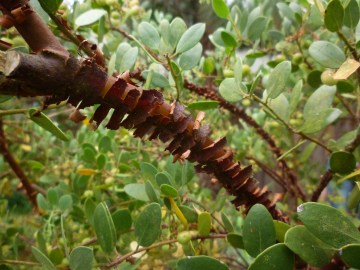
Manzanita in the peeling stage.Manzanita blooming in February.
The Landscape Ladies said that my manzanita is a nice shrub and worth keeping. That has been a very comforting word for me to play over in my mind, as I wait for something material (I wrote “concrete” first, but I have had quite enough of concrete for a while.) to be created in the yard. It means that I succeeded in pruning it in such a way that it kept its natural twisty shape.
The last few days I have been feeling unsettled more than my usual, excepting the splendid day when Soldier and Joy and the little boys came over and my capable and willing son did so many handyman things. He helped me prune the strawberry bush into a tree shape.
I read stories to Liam, and a visit to the world of Benjamin Bunny with him snuggled against my chest was the most nurturing activity – for the grandma! I actually cooked that day, too; I baked a frittata. Joy brought a peach pie, and I am heating the last slice in the oven as I type, for my dinner. Having friends J&C around for a couple of weeks has been good; C. is a professional nutritionist — how convenient, eh? — who cooks healthy things, and they have been modeling for me the kind of cooking-and-eating behavior I hope to learn again.
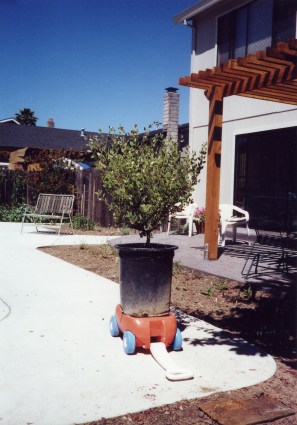
Manzanita before planting 2002
For several nights I haven’t been sleeping soundly. Today marks five months of widowhood, and I attended the funeral of a man in my parish, and felt that I was keeping a memorial to my husband at the same time, so that was good, but heavy.
I drove the grandfather of little Mary my god-daughter home after the reception, and that put me in the neighborhood of my favorite thrift store. I went in and tried on a few things, but it was too stressful somehow. I didn’t have the emotional energy. Trader Joe’s is also in that neighborhood so I stopped by there…buying food is more soothing, right? After loading my groceries into the car I sat in it and phoned some friends who want me to come for lunch soon, and I told them I can’t do it this week, because I am “in a slump.” They are people who want to love me, but they are too needy themselves and don’t know how they drain me instead.
On the recommendation of a blogging friend, I am reading Grieving Mindfully: A Compassionate and Spiritual Guide to Coping with Loss by Sameet M. Kumar, a book that tells me to pay attention to what is going on and not to try to escape it.
A quote: “Like suffering and grief, resilience — which means having the elasticity and buoyancy to recover from the experience of enduring suffering and pain — may also be a part of the natural order.”
As long as the speed of resilience we are talking about is along the lines of a memory foam pillow, and not a foursquare ball, I think I can believe in it. And I trust it is a natural thing, or at least a supernatural thing….in any case, I can’t make myself “bounce back,” if I even wanted to, which I don’t. There is no getting back to Before, anyway.
Kumar writes, “Mindfulness can help you get reacquainted with the vast potential of each moment of your life — it is the antidote to the endless waiting for tomorrow.” This attitude is what I learn from Orthodoxy, to be present with God all the time, everywhere. Now that is potential! But for now, being present in the moment means accepting my grief, and accepting that my emotional resources are fairly used up by this kind of activity. As the author says, “…come in full contact with yourself and learn to ride the waves of grief.”
Working in my garden never drains me, even if it makes me physically tired. Last night I sawed and lopped the dead parts of the osmanthus, and trimmed back the Raphiolepis next to it. I’m running a soaker hose on the osmanthus (Sweet Olive) to encourage its recovery from drought, and the faucet is whining from the backed-up pressure. It’s not a nice noise, but most of the time, now that the yappers are gone, I live in a very quiet neighborhood. As I think back over the 25 years I’ve lived here, so many things have evolved and developed on and around the property.
Glad workers take on a project.
Thirteen years ago we had to replace all the pool decking, and we took out the diving board to give us more room in our patch of ground at the end of the pool. We leveled out the raised bed and went outside our comfort zone to build some brick paths. We found lots of bricks from a previous patio or something, buried under the pool decking, and we added gray concrete bricks to tie into the colors of the patio.
The back yard design I am working on now includes a different sort of path, and we are going to remove this brick walkway so that the whole yard will be of a piece. I think the bricks from the Glad Paths might be used to expand the patio into the area where the plum tree was.
Manzanita in the ground.
The homemade paths served a good purpose for quite a while, but they were never ideal, and I’m not sentimental about them. The manzanita — I should name that bush, perhaps something rhyming like “Juanita” — surprised us in growing steadily north and away from the midpoint between the paths. We came to understand that it was trying to grow out from under the canopy of conifers to the south.
That path that was slim at the outset soon became impossibly narrow on the side that the shrub — I will call her “Margarita” — was growing toward. The only reason I had ever thought of pruning a wild mountain bush like this was to make the pathway passable, but as Margarita grew and grew, there was no way I could both maintain her nice curves and keep the path open.
widened path
When Mr. Glad retired we expanded the path a bit on that side.
The book on mindfulness makes some very good points, but coming from a Buddhist foundation it is lacking an understanding of why we suffer, and of all the riches that are available to us humans. The author says that people “have a tendency to associate suffering and distress with something being wrong,” but that “Grief has always been part of the order of things, and always will be. As part of suffering, grief too is a natural law.”
I can’t mention this book without saying how sadly wrong he is about that. Death and suffering and grief came into the world through sin, but Christ died to put an end to death. Because it is wrong! It was not in His plan. When He comes again in glory He will wipe away every tear from our eyes, and there will be no more death, neither sorrow, nor sighing, nor pain. For the former things are passed away.
We will do more than bounce back then; we will be given new bodies for our souls to be reunited with, and we will be like Him, for we will see Him as He is. Now things are cloudy and blurry, and we walk in faith, with His loving presence and grace always offered to us. He is constant and unchanging, a very present help in trouble.
In this world, on the other hand, we have constant change, often for the worse. Sometimes just the change itself is hard to bear, even if it is objectively an improvement. In the little realm of my garden I have lamented the lack of sunlight, but now that I have taken out one tree and thinned another, the area that was fairly shady will now be able to support more sun-loving plants, and I’m happy about that.
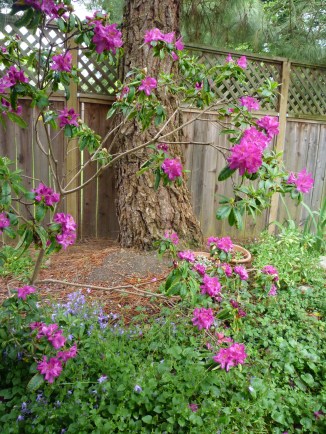
But I’ll be a little sad to see the rhododendron go, thought I didn’t care for its color. And the campanula, and sweet woodruff! They will probably be history. So just for memory’s sake — which of course is the purpose of all these pictures — here is a last view of the Woodland Garden patch of yard.
I’m looking forward to some new garden scenes to take pictures of, but glad to have Margarita Manzanita still in view. And come to think of it, I am waiting for tomorrow, waiting in Hope of the Resurrection. But as Martin Luther said, “If I knew that Christ were going to return tomorrow, I would plant a tree today.”






 and precision of our thoughts that float by also seems to me lofty and unrealistic.
 Church, and for that many years I have attended Liturgy on Christmas morning, and I keep the Nativity Fast; those practices will be unchanged. I would suppose that after all these years Christmas would have its own richness and momentum supported by the Church and by all the Glad people loving each other, and that I would be carried gently along in the flow.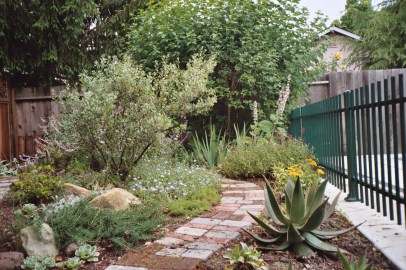

 Spiritual Guide to Coping with Loss by Sameet M. Kumar, a book that tells me to pay attention to what is going on and not to try to escape it.



 .
. Gladsome Lights