Category Archives: history

Pagans and Inverted Victorians

This short piece from the Touchstone journal compares the perspectives and lifestyles of pagans, early Christians, and feminists regarding home and virtue — and disconnections that rob us of our full humanity.

Home Remodeling by Peter Leithart

In the ancient world, household and city were confined to opposite corners. The inner space of the household was for women and children, while the open space of the city was for men. Men gained honor and displayed their prowess in the forum and on the battlefield, places where only men could go. Alasdair MacIntyre has pointed out that virtue for Homer was military prowess, and the etymological connection between the Latin “vir” (man) and “virtus” (virtue) is no accident.

English theologian John Milbank has argued that the social revolution of Christianity broke down this distinction. The church is both household and city, Christians both brothers and fellow citizens. As the gospel penetrated late antique culture, the household itself, along with its work and its child-rearing, was increasingly valorized, producing what to ancient paganism would have been the oxymoron of the “virtuous woman.”

The deep paganism of modern feminism is evident in the effort to reverse that Christian achievement. Many feminists feel that they cannot flourish in the cramped space of the home. To be fully human, they must abandon the hearth and crib to take part in the agon [contest] of the male world outside.

In developing this neo-pagan social cartography, however, feminists are often reacting against a reversal that had taken place earlier within Christian culture. Nineteenth-century sentimental domesticity joined with fascination for the classics to re-divide household and city. From this angle, feminists look less like radicals than like inverted Victorians.

In any case, the Christian response to the whole mess seems clear: to reaffirm the original Christian revolution by insisting that, for both men and women, the household is a school of virtue.

Touchstone, Sept-Oct 2010

Sweet (Pea) Melancholia

I picked enough sweet peas to compose a bouquet yesterday. It’s been a few years since the last time I was able to drink deeply of that ultra-sweet and unique, some say old-fashioned, flower scent.

sweet peas first bouqet 4-29-14

When I mention my sweet-peas, many people think at first that I am talking about sugar snap peas, the edible-podded peas that were developed only within the last 50 years or so. They are sweet to eat, while these ornamental cousins are sweet to sniff. If the seeds are allowed to develop, one can see by how tough, dry, and stringy they and their pods are that they are not anything you’d want to put in your mouth.

Our sunny garden space is at a minimum, which is why I don’t often plant cool-weather crops that will take up space into the months when I want to plant tomatoes or peppers.

In this particularly bad drought year, I’ve been thinking more seriously that the swimming pool should go. We could fill it in with good soil and immediately double our full-sun gardening potential. We may yet do that, but it’s a big project for which we’d have to get a permit, and this summer will already be quite busy with other events.

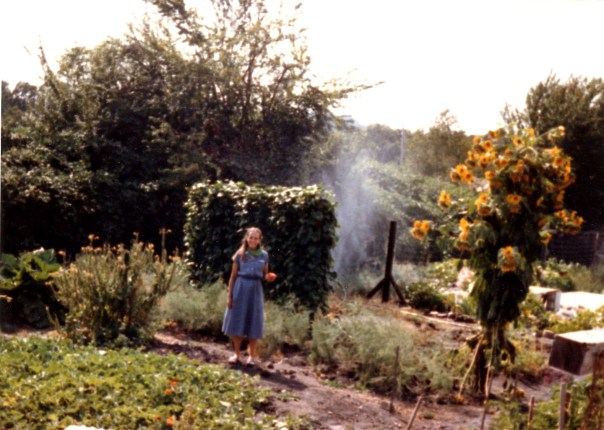
The smell of these flowers took me back to my first experience of sweet peas, sometime in the 70’s or 80’s when we lived on 1/3 acre with more than enough sunshine for anything I could set my fancy on. Among the many things I left in the past are my plantings of soybeans and chicken greens, okra and Ogallala strawberries with their foxy Rocky Mountain flavor, asparagus and artichokes. Here is a photo of me standing between the asparagus and the melons.

G garden 82

I am a firm believer in digging in the soil of contentment to find happiness, but I do have my periods of homesickness, the worst of which came on me within a couple of years of moving from our country place into town. I missed my garden so!

More recently I’ve had the good sense to realize that I could never keep up with that much garden or all of the choices I had in that season of life. I seem to need even more restrictions on my opportunities than I ever did, or I get overwhelmed by the decision-making, not to mention the work. I’ve even thought at times how nice it could be to have — gasp! — no garden at all.

I wonder if the time I spent this week, poking around for sad feelings in parched soil, has actually helped me to get over my losses again. Maybe it wasn’t a complete waste of time. I’ve decided to just enjoy sniffing this Spring’s sweet peas. (And I wish this could be a scratch-and-sniff picture I’m sending your way!)


On the ground with the White Horse.


Last week The Garners posted about G.K. Chesterton’s Ballad of the White Horse, which caused me to dig out my cassette tapes of the author reading his own poem — how thrilling! Too bad they were made from a scratchy recording so that it’s very hard to appreciate the poem itself. Still, the directness of the connection to the very voice and person of the poet mean a lot to me.

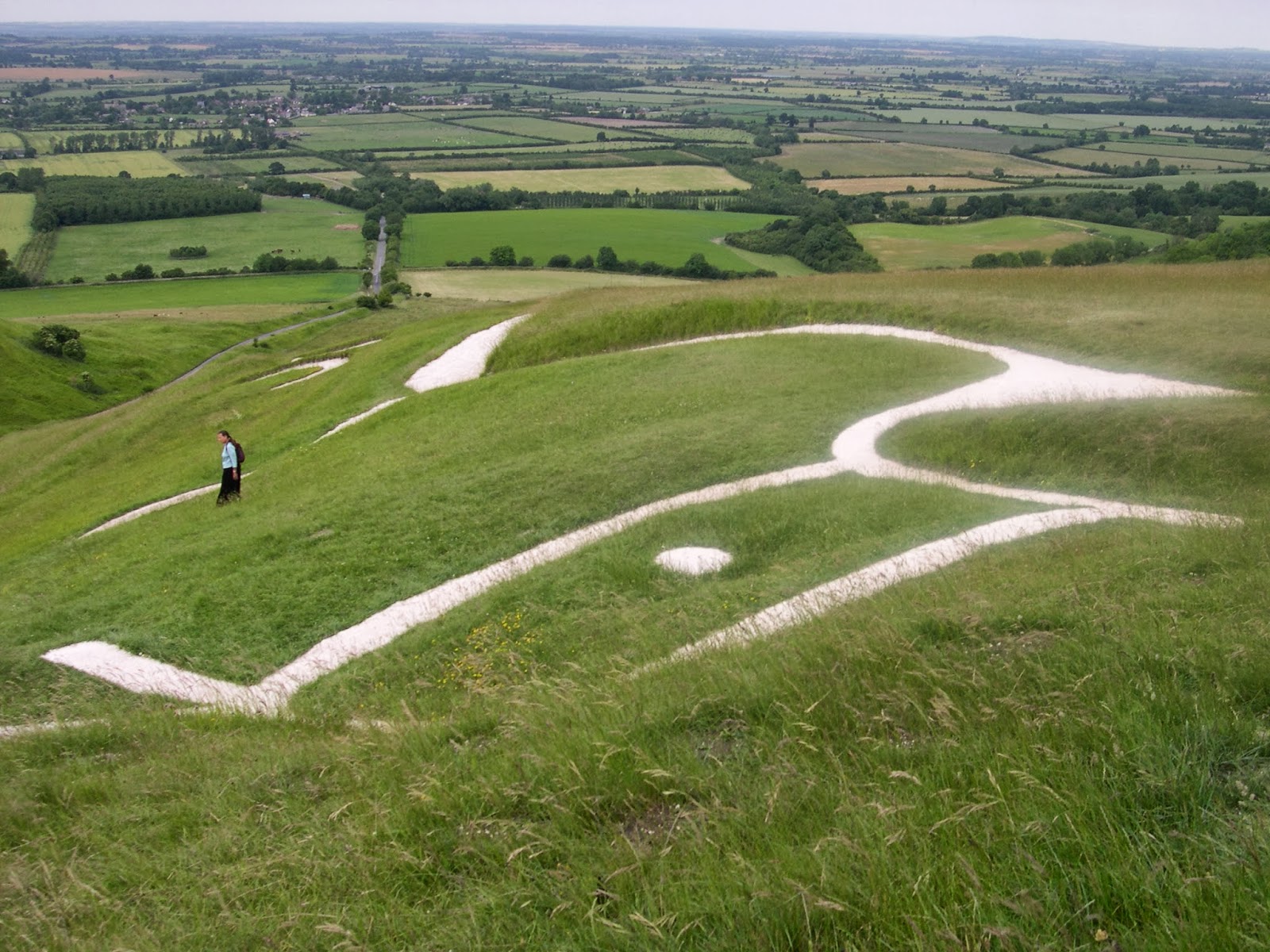
What made me interested in the Ballad in the first place was taking a trip to Britain with daughter Pippin nine years ago. We both very much wanted to see White Horse Hill in Uffington while we were there, and we found it quite empty of any other humans the day we visited. We hiked up the hill to the chalk art that is thought to be 2,000 to 3,000 years old, and wandered around the horse’s anatomy. We couldn’t pull ourselves away. I just could not get over — here it is again — the earthy material link to ancient peoples and the mysteries of their culture and history.

One thing we share with the ancient people who carved the trenches of this design is human nature, the gifts of the Creator who made us in His image, glorious even in a tarnished condition. The horse reveals the creative aspect of that image, and Chesterton’s ballad shows his own artistry while it tells a human and Christian tale set in King Alfred’s day. The imagery in this stanza, which I think pertinent to the Lenten season, illuminates another aspect of our humanity that we share with our ancestors: the impulse to stand before God in worship, fighting with the desire to be God:

Pride juggles with her toppling towers,
They strike the sun and cease,
But the firm feet of humility
They grip the ground like trees.

–G.K. Chesterton, The Ballad of the White Horse                 

Thinking again about this world history and my history, I want to revisit the horse vicariously, by means of the poem slightly more removed from the poet than my old cassettes. So I just ordered this edition of the book, which I think is the one I bought two copies of in the past for gifts. The American Chesterton Society will be sending me this CD, read by Aidan Mackey, who sounds as though he is very likely, once I put that disk in the player, to send me right back to England and White Horse Hill.
[update: the recording was annoyingly scratchy and almost as bad as the old one of GKC himself. 😦  ]

Linking up to Weekends With Chesterton