Of Cape Cod and summering there, one man generations ago said, “It is the dullest, flattest, stupidest, pleasantest, most restful place on the whole coast. Nothing to do and we do it all the time.”
Sometime back I succumbed to a book on a topic pretty far removed from my usual interests or experience: the life and history of a summer house on Cape Cod in Massachusetts. This book sat on the shelf for five years or so until for some reason I took it down and put it in my suitcase to read on a trip. How and why I ever came into possession of it, I couldn’t remember. Then inside the back cover I discovered a remainder sticker I had removed and put there, which showed that I had found it in the $1 bin at a local bookstore.
The author is George Howe Colt, who as I figured out after some chapters is married to Anne Fadiman, writer of essays I first read in her delightful book Ex Libris. As his story opens, he and Anne and their two children are opening up the eponymous Big House for the season, in what might be their last summer as its owners.
Colt writes richly about the history of Cape Cod and summer homes generally, and about his particular family’s particular house on the Cape. It hasn’t been that long, really, that people have lived this Cape-Cod-summer lifestyle that was already near to extinction when the author told his tale more than ten years ago. In the early 19th century Bostonians started building summer homes there where previously it was thought most unsuitable, as Thoreau wrote: “It is a wild, rank place, and there is no flattery in it.” In previous eras homes were built in more sheltered locations inland from the sea.
I learned that many of our forbears used to think of the ocean unkindly, as a symbol of spiritual barrenness, and they did not want to go into or live near it — and then over the course of a century they had changed, to the point where they thought that living close to the sea, swimming in it, and even drinking buckets of sea water the most healthful things they could do.

I was interested in the architecture and construction of the Big House, so much larger than many summer houses that no way could it be called a cottage. Size is the only luxurious thing about it, though. Residents and guests must wash dishes by hand in a kitchen where crickets abound, sleep between old mismatched sheets, and prop open many of the sixty-seven windows with a wooden coat hanger or a copy of Greyfriars Bobby.
The whole phenomenon of Old Money and what Colt calls the Boston Brahmin is explained: “If one had old money, it followed that one had old things: the wealthier the Bostonian, it has been said, the more dents in his car and the more holes in his clothes.” I know this is common knowledge to many people but the concrete example of Cape Cod lifestyle brought it all home to me.
Of course, summer somehow relates to everyone’s childhood, too, and that keeps the traditions going: “We would never tolerate the Big House’s inconveniences in our winter homes, but this is different: we change in the winter, but during the summer — a season in which we regress to an innocent, Edenic state by replicating the experiences we had as children — change is heresy.”
For the author, the place was such a keystone of his youth that it seems reasonable to him to include in the book many stories and details about the family members who spent their summers there, information that seemed to me often inappropriate, and detracted from the book as a whole. When I read the subtitle, A Century in the Life of an American Summer Home, I did not anticipate hearing details about adolescent sexuality, Colt’s grandmother’s Alzheimer’s, and his uncle’s bunions. A little more focus would have been appreciated.

He obviously cares very much for his whole family and wants to remember every detail for posterity — or is it for the sake of his own sentimentality that he cannot edit out anything? Seemingly no indescretion committed or indignity suffered by any relative can be omitted, and I was very uncomfortable reading much of this material. This kind of authorial behavior kept inserting Colt and his personality front-and-center for me, and I mused that he was really writing not merely The Big House but George’s Big Loss.
I admit that if Colt had strained out more stories not directly related to the house, I would have missed hearing the wonderful tale of how his father during the war was hidden from the Germans by a French family, whose daughters later made their wedding dresses out of his white silk parachute. That was one little part I really loved and had to mention!
And I kept reading because Colt is a very good writer and I was imagining myself there in those halcyon summer days the family spent recreating, whether they were washing dishes or playing outdoors. Fishing, sailing, and tennis each have a chapter dedicated to them. And in a chapter titled “Rain” we get a tour of many of the books that were available and savored, and not only on rainy days. After a mention of board games, Colt writes,
“Best of all, there were books. Although it didn’t take rain to get us reading in the Big House (in fact, reading inside on a sunny day gave us a deliciously guilty feeling), on an overcast afternoon people would be curled up with a book in almost every bedroom, with three or four of us draped over the sofas in the living room, physically proximate yet in separate worlds.”
It’s been almost two years since I finished reading The Big House, but as I worked on wrapping up this review that I began back then I am tempted to start reading it through from the beginning again — well, maybe I could skim over those indecorous parts. Because it is just that kind of book, to be read in summertime as a delicious seaside vacation.
 My mother’s brother Bill died before she was married, so I didn’t know him. He was a pilot who died in a plane crash during wartime, after having flown many successful bombing missions over Europe.
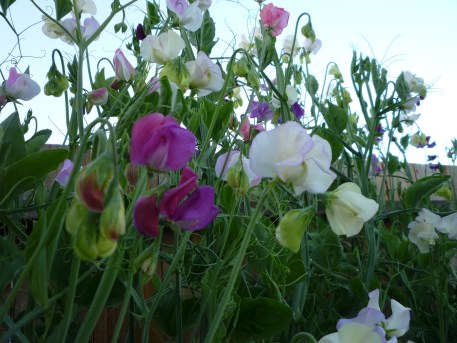 Every two or three days I try to cut all of the flowers off my sweet pea vines. I have to stretch way up now to reach the top ones, because they are seven feet tall and still growing.


 Gladsome Lights