Long, long ago, I lived in Turkey for most of a summer as an exchange student. My host family lived in a house in an older neighborhood of Izmir, the district of Bayraklı. Three years later when I visited them they had scaled up and moved to a high rise apartment at the other end of the city.
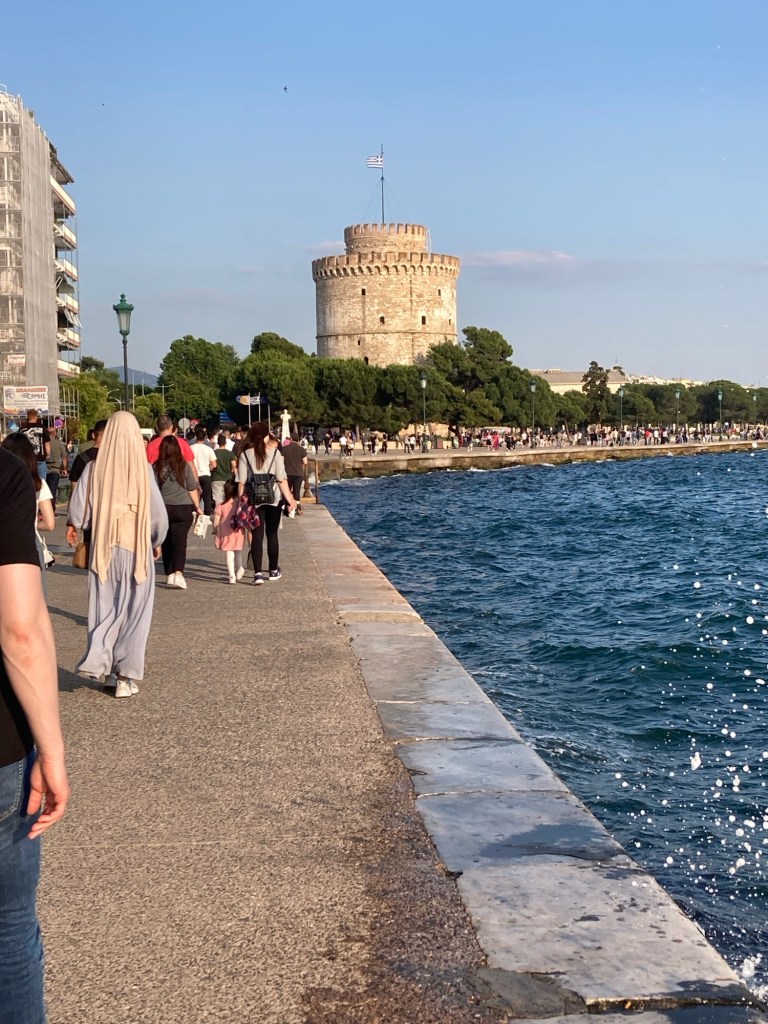
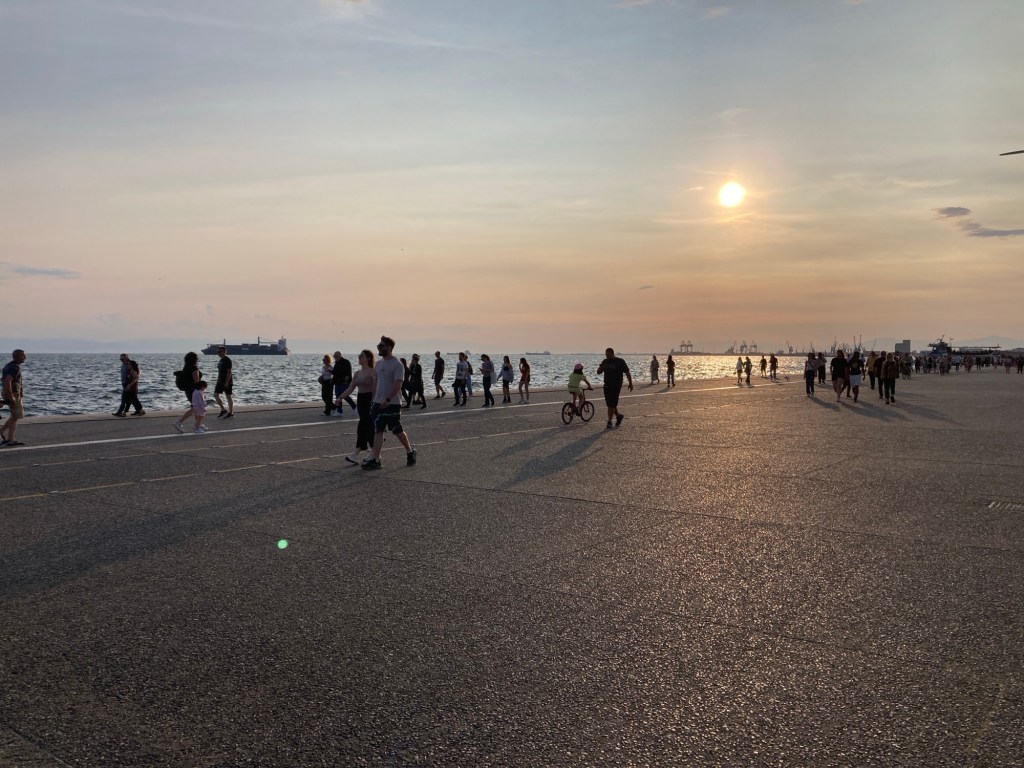
The New Waterfront in Thessaloniki
One thing that was the same both times I was there was the custom of strolling along the wide walkway next to the sea that is called the Kordon.
On summer evenings especially it was the place to be, refreshed by the breezes off the Aegean. But at any time of day you might run into friends, or intentionally meet up with them there; it was a simple pleasure for families. Street vendors sold snacks from their carts, such as roasted corn and nuts. As the sun was setting we’d buy a cup of the pudding-like warm drink called salep.
Thessaloniki
Over the years since I have often thought about how that city had so wisely made the most of its setting for the health and prosperity of its inhabitants.
I saw in advance that Thessaloniki had a similar recreational strip, called The New Waterfront, and last night I walked there for an hour.
I learned this morning when looking for a picture of Izmir’s promenade that some people have called these two “twin cities,” because of various historical and demographic aspects they share, besides their seaside location and pleasing waterside parks. Wouldn’t it be fun to spend time in both cities for a year or two while researching and writing a book comparing the two? Hmm… I should have thought of that about twenty years ago, but I suppose I was busy with something else.
Alexander the Great
Well, it felt very strange and dreamy to wander along that walkway last night, like going back to a different life in a different place that was somehow the same place, an existence that belonged to a different person. But no, it was me, and it is me. It’s a mystery for sure.
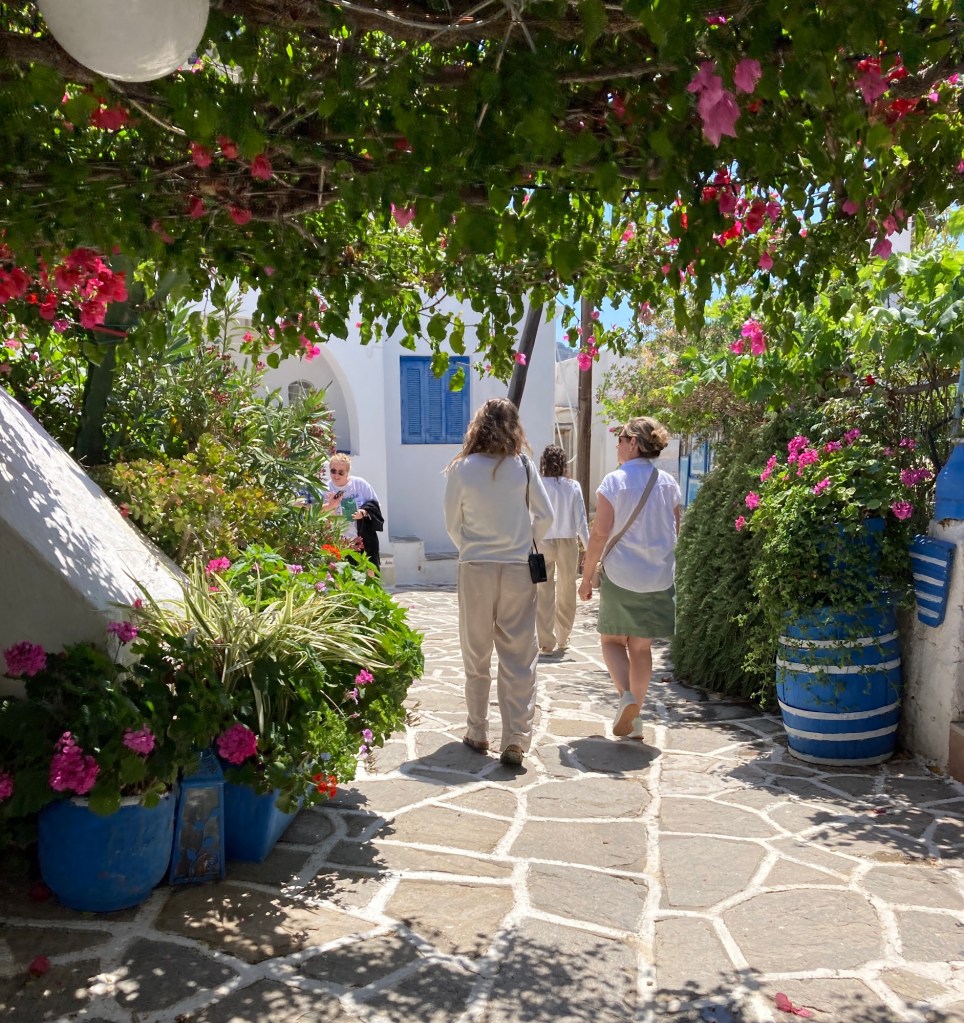
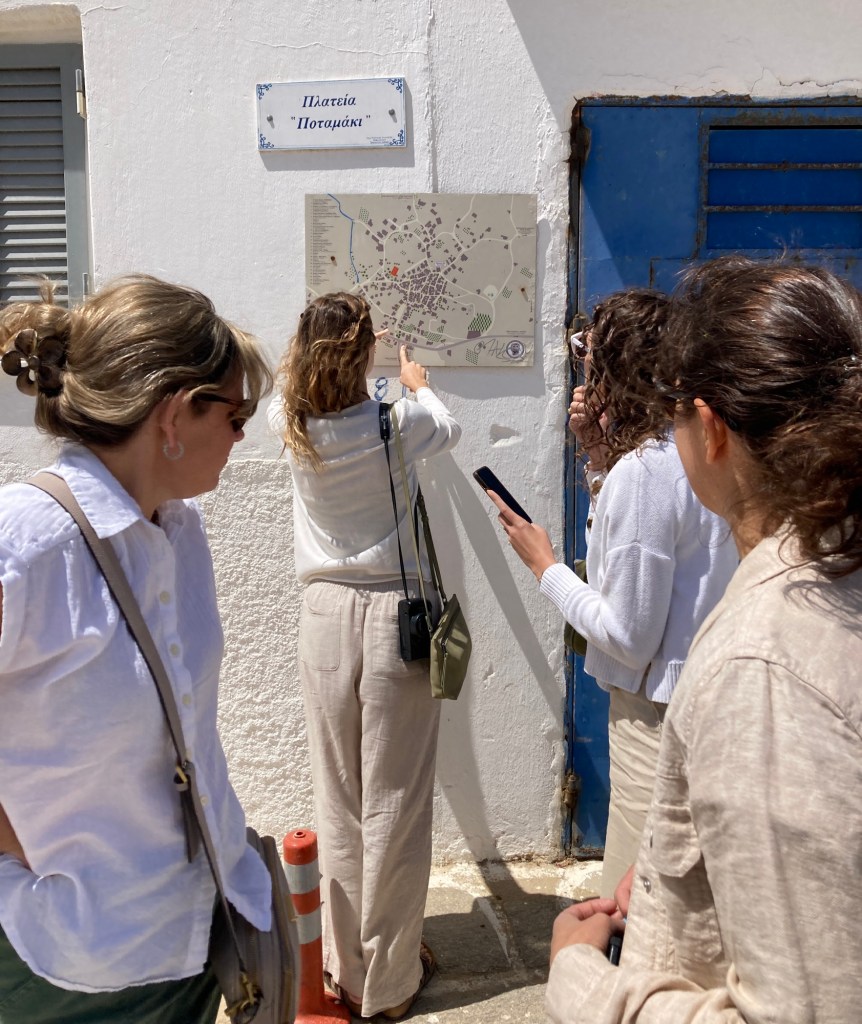
The skies had cleared and the wind was still blowing when we set off for the high country of Paros, on our first whole day here. In the village of Prodromos signs for Public Parking led us to a dirt lot, and the bus stop a short walk from there, where we hoped to catch a bus up to the town of Lefkes.
We could make out from the roadside sign, conveniently right outside a bakery, that our bus would not arrive for another hour and a half, so we did a little shopping —yes, including of pastries — and found a taverna where we could have an unfortunately quick lunch in the meantime.
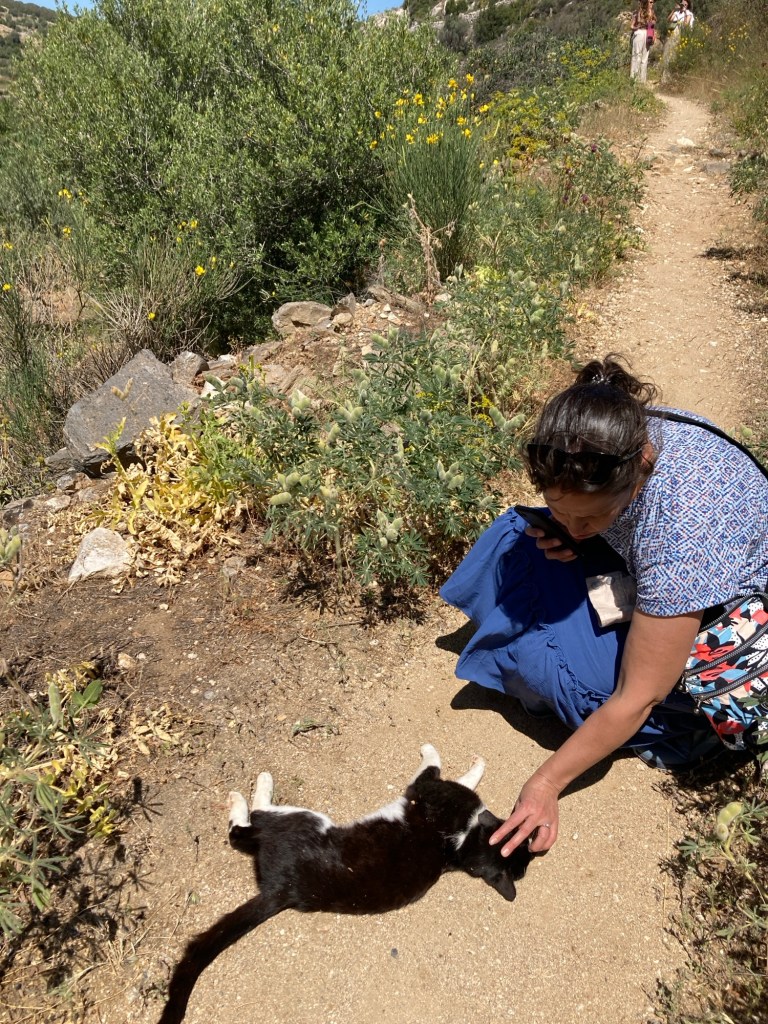
The only other people in the restaurant were five older Greek men in a traditional and more relaxed midday gathering, for whom the five of us chatting and laughing over our menus clearly provided an interesting diversion; they couldn’t stop watching us. We petted the cat while waiting for our orders, and kept an eye on the time so we wouldn’t miss the one bus that we needed.
At every restaurant in Greece so far we’ve found that restaurant wait staff are reluctant to bring the check, which applies a gentle pressure to linger, and enjoy to the max the great food and ambiance. We felt ourselves to be rude and unappreciative of the chance to experience a village taverna complete with cat, and old men gossiping over their coffee.
We even had to leave an entire kebab untouched, but I stuffed the extra bread in my shoulder bag to take along, with breakfast toast in mind.
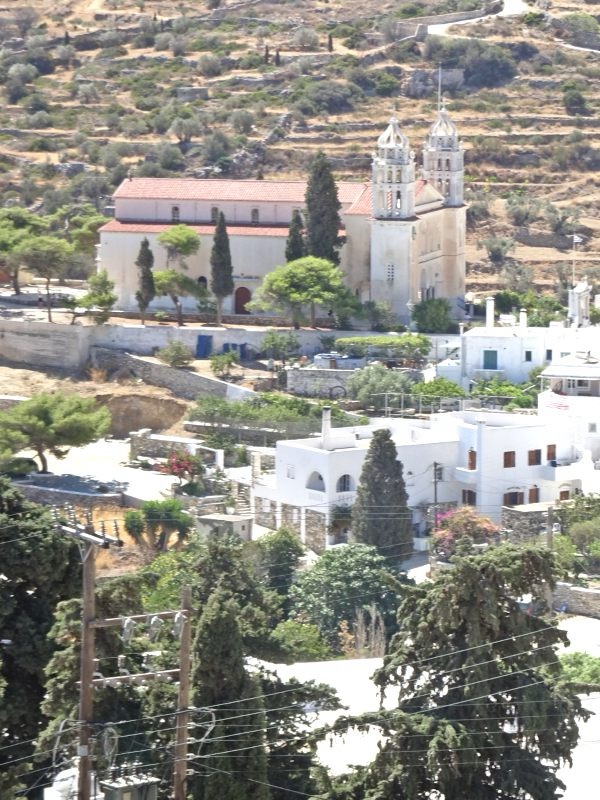
After a quick bus ride up to Lefkes, we strolled through the town, always heading gently downhill, on the Byzantine Trail, a thousand year old road that is by modern standards a path between Lefkes and Prodromos. The huge 19th century Agia Triada church that was built of local marble we found closed; reportedly services are held morning and evening every day.
Lefkes, Internet photo
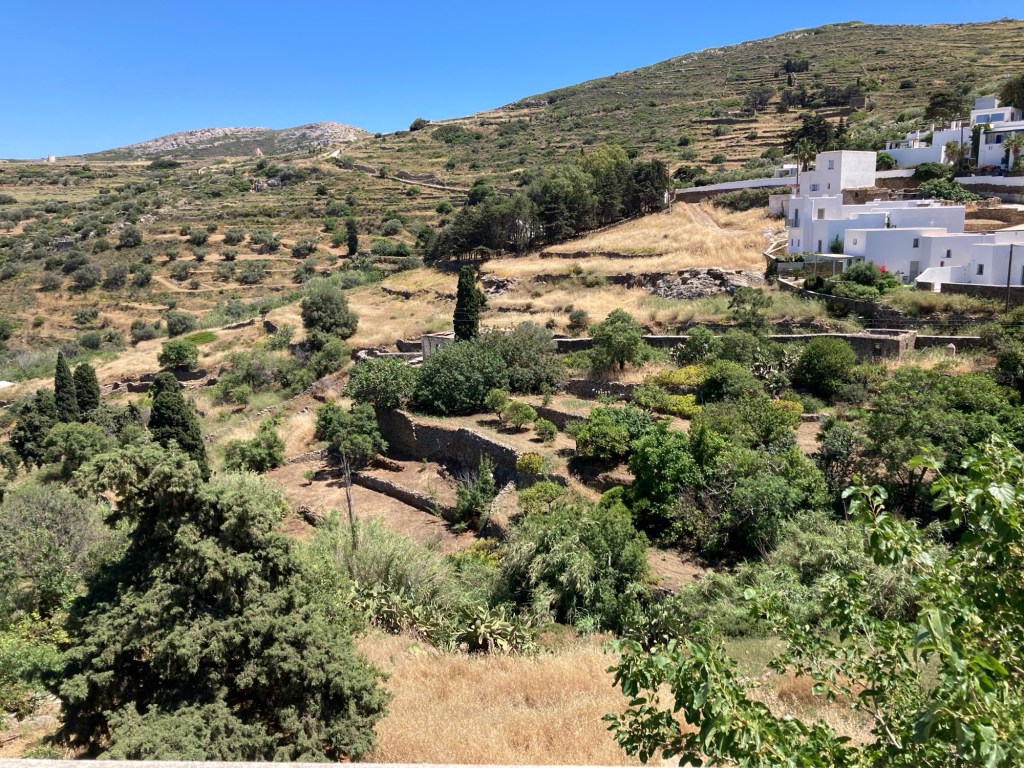
The trail soon left the town and wound on down the hill, with views on all sides of ancient terraces built of stones pulled from the earth that is rich with them, and naturally poor from the stoniness. A few of the thousands of plots are evidently being used again, though tourism has supplanted agriculture in the island economy.
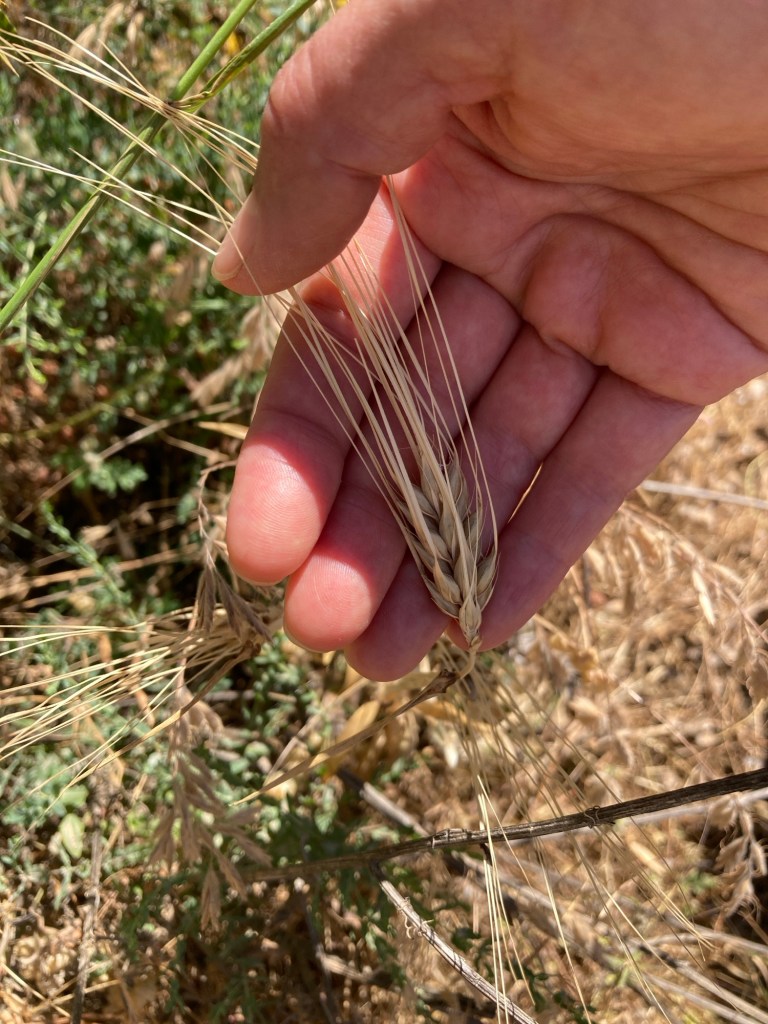
Barley
It is easy to imagine the farmers in the old days growing fava beans and keeping goats on those terraces. We did pass one old man keeping watch over his goats that very afternoon.
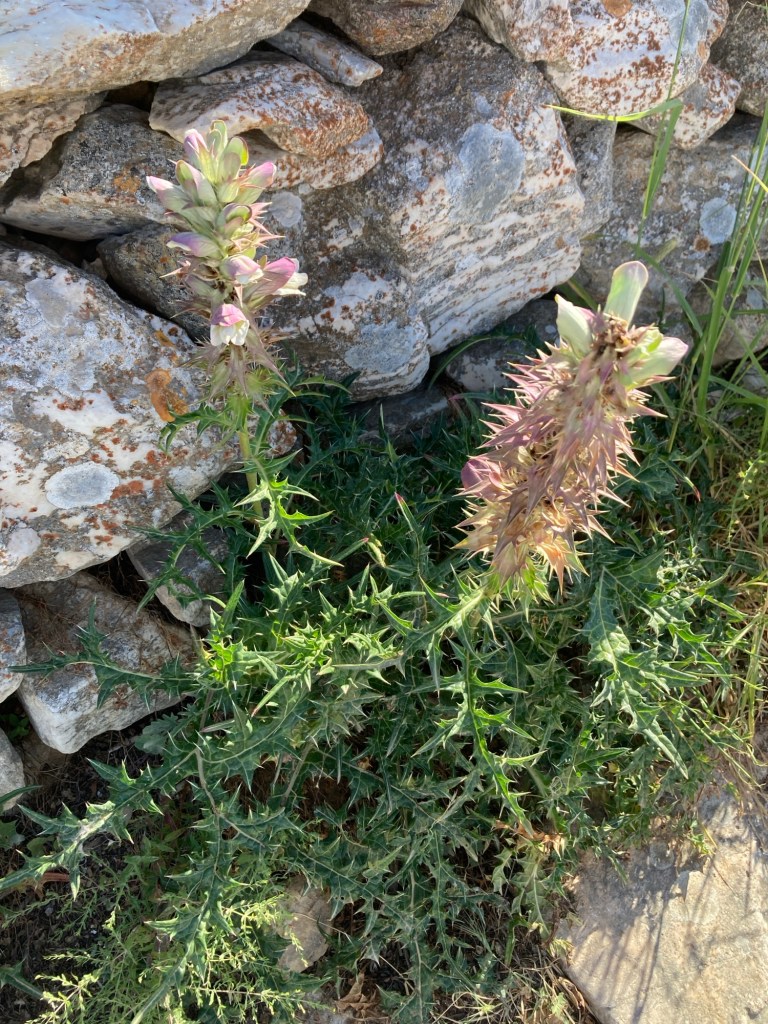
Pippin and I kept lagging behind the others to investigate all the strange or familiar plants along the path, which included at least a dozen species of prickly types.
Common Golden Thistle
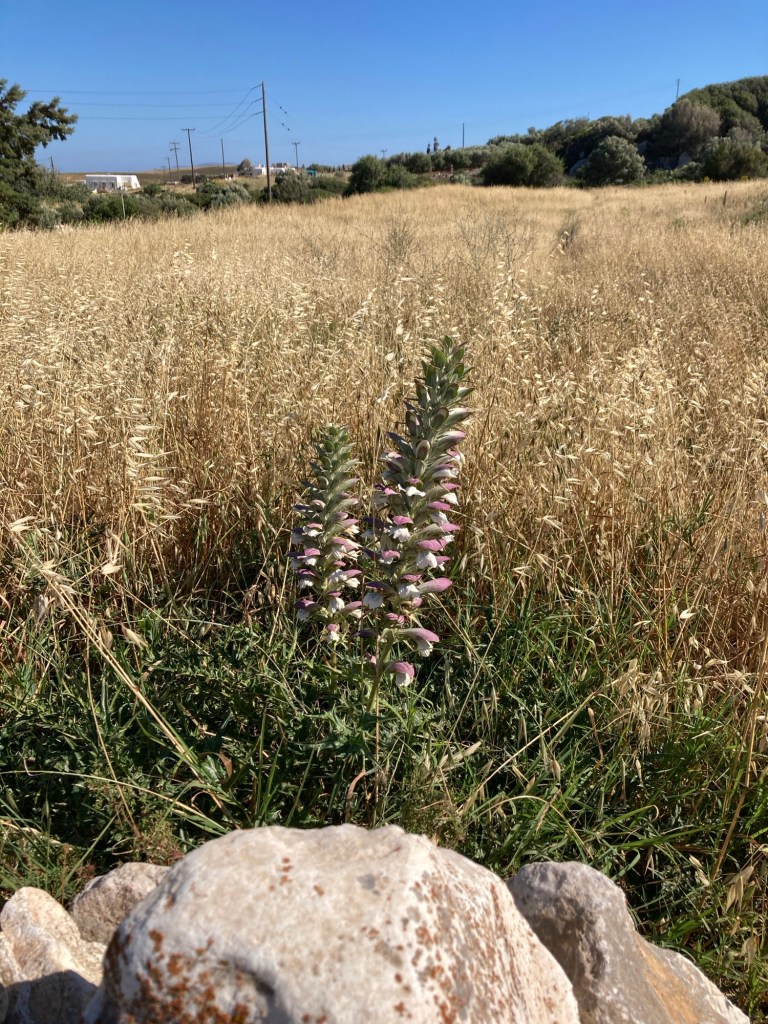
There was even a beautiful but thorny type of acanthus, which it took me a few sightings in different stages of its flowering to recognize as being related to the majestic version in its glory right now, back home in my garden.
Acanthus
I was so happy to be wearing my new hiking boots that kept me comfortable and mostly steady on the road that was sometimes dirt, sometimes roughly rocky and uneven, and often paved with wide and flat marble that had been polished smooth over the centuries.
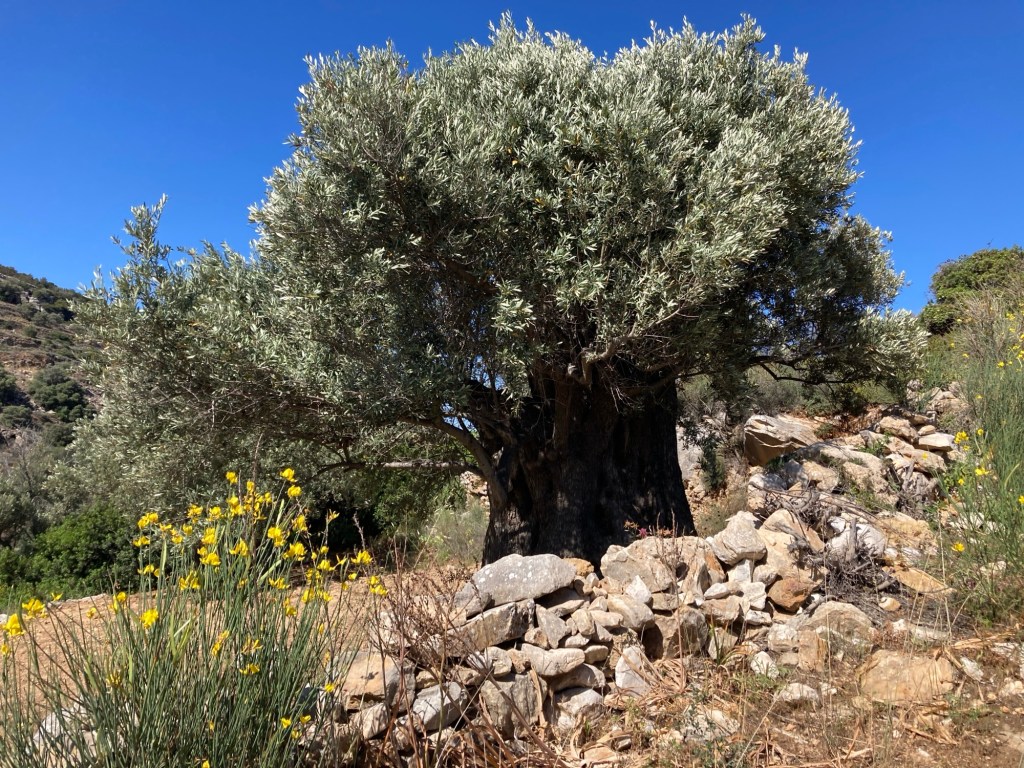
Phoenician Juniper
The ubiquitous cats greeted us on the Byzantine Road, begging attention, which at least a couple of us were happy to give.
I was in my element, under the warm sun, so many interesting plants to see, with my favorite botanist partner and in the company of other family favorites, getting good exercise among terraced hills — it all was so healthy and alive that I could forgive the wind that tangled my hair, and the thistles that grabbed at my legs.
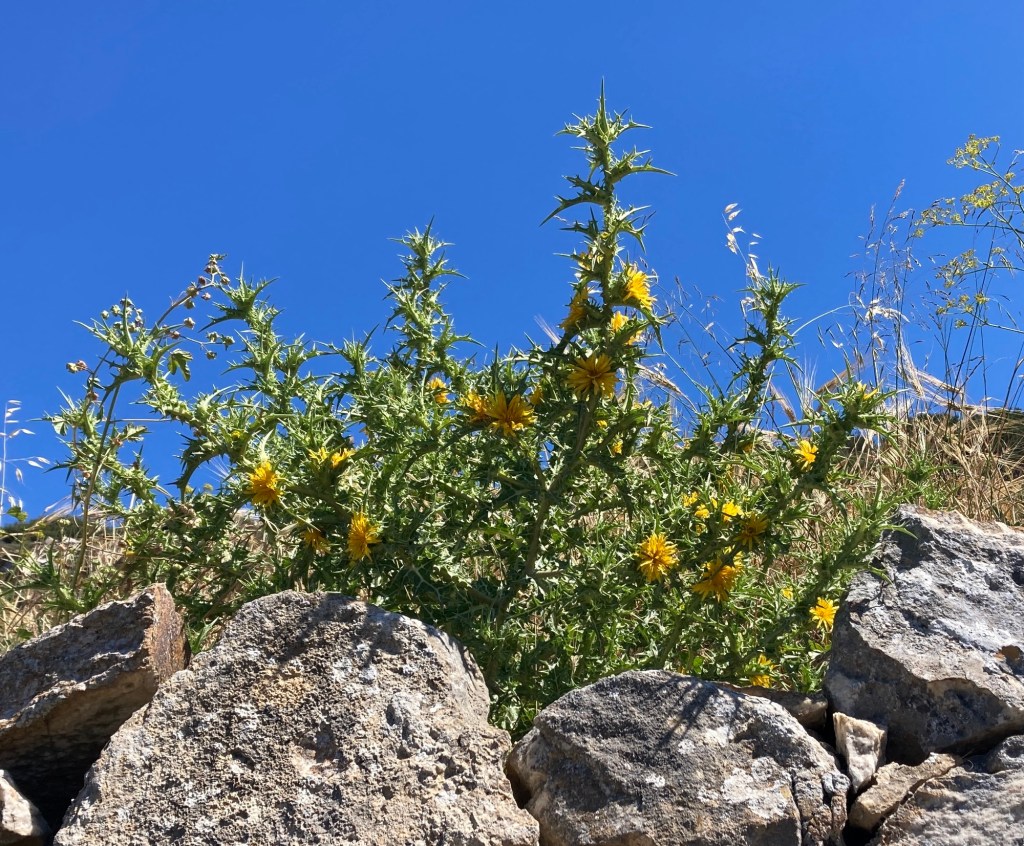
Yellow Spine Thistle
I hadn’t known ahead of time just how much of a nature walk this trail was going to be, and I couldn’t get over my good fortune at being the recipient of this blessing, accomplished through the labors of my girls, from Kate who was willing to drive to Maggie who buys us pastries.
Eventually our walking trail brought us back to our car in Prodromos, and we returned to our house across the island. At the end of the day we had walked more than five miles, and we all slept very well that night under Aegean skies.
My grandmother kisses as if bombs are bursting in the backyard, where mint and jasmine lace their perfumes through the kitchen window, as if somewhere, a body is falling apart and flames are making their way back through the intricacies of a young boy’s thigh, as if to walk out the door, your torso would dance from exit wounds. When my grandmother kisses, there would be no flashy smooching, no western music of pursed lips, she kisses as if to breathe you inside her, nose pressed to cheek so that your scent is relearned and your sweat pearls into drops of gold inside her lungs, as if while she holds you death also, is clutching your wrist. My grandmother kisses as if history never ended, as if somewhere a body is still falling apart.
Most people, even Christians, don’t care whether the date of December 25th derives from a pagan solstice festival, but historians are interested in many aspects of this story; one of these aspects is the way in which earthly powers try to control or use popular religion to further their aims. Williaim J. Tighe is a historian and a Christian whose article “Calculating Christmas” explains how this impulse led one emperor to establish a completely new pagan festival. The last time I posted this “public service announcement” concerning the date of Christmas, I highlighted the historical evidence that Tighe cites for the early church having chosen their date before that pagan festival was ever established.
But there is the other question we might have: How did the Christians choose their date? It seems that Christ’s mother was not of a mind to be keeping a journal, but rather, Luke tells us, “Mary kept all these things and pondered them in her heart.” The author tells us in detail how the dating of Christmas is tied to the effort to figure out when it was that Christ died. It’s not easy to calculate that, either, it turns out:
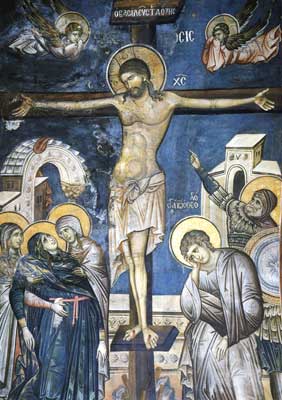
“There is a seeming contradiction between the date of the Lord’s death as given in the synoptic Gospels and in John’s Gospel. The synoptics would appear to place it on Passover Day (after the Lord had celebrated the Passover Meal on the preceding evening), and John on the Eve of Passover, just when the Passover lambs were being slaughtered in the Jerusalem Temple for the feast that was to ensue after sunset on that day.
“Solving this problem involves answering the question of whether the Lord’s Last Supper was a Passover Meal, or a meal celebrated a day earlier, which we cannot enter into here. Suffice it to say that the early Church followed John rather than the synoptics, and thus believed that Christ’s death would have taken place on 14 Nisan, according to the Jewish lunar calendar. (Modern scholars agree, by the way, that the death of Christ could have taken place only in A.D. 30 or 33, as those two are the only years of that time when the eve of Passover could have fallen on a Friday, the possibilities being either 7 April 30 or 3 April 33.)
“However, as the early Church was forcibly separated from Judaism, it entered into a world with different calendars, and had to devise its own time to celebrate the Lord’s Passion, not least so as to be independent of the rabbinic calculations of the date of Passover.”
“…there is evidence from both the Greek East and the Latin West that Christians attempted to figure out the date of Christ’s birth long before they began to celebrate it liturgically, even in the second and third centuries. The evidence indicates, in fact, that the attribution of the date of December 25th was a by-product of attempts to determine when to celebrate his death and resurrection.”
I’ll leave you to decide if you want to get the rest of the story by reading the article itself. Last time I shared it, more than one of my readers said the date was not important to them, and one said this information was important. Many years ago I was briefly influenced against enjoying certain Christian festivals because of things written against them by the uninformed, so I very much appreciate those true historians who love to dig deep. Tighe points us to a longer work on the subject for those who want more details (I haven’t gone further myself). Here’s his own fairly brief summary: “Calculating Christmas.”










 Most people, even Christians, don’t care whether the date of December 25th derives from a pagan solstice festival, but historians are interested in many aspects of this story; one of these aspects is the way in which earthly powers try to control or use popular religion to further their aims. Williaim J. Tighe is a historian and a Christian whose article
  that day.
 Gladsome Lights