“Since the churches could not accommodate everyone wanting to hear the wise preacher, Saint Cosmas with forty or fifty priests served the Vigil in the fields, and in city squares, where thousands of people prayed for the living and for the dead, and were edified by his preaching. Everywhere that Saint Cosmas halted and preached, the grateful listeners set up a large wooden cross, which remained thereafter in memory of this.
“The apostolic service of Saint Cosmas was brought to a close by his martyric death in the year 1779. At 65 years of age, he was seized by the Turks and strangled. His body was thrown into a river, and after three days, was found by the priest Mark and buried near the village of Kolikontasi at the monastery of the Entrance into the Temple of the Most Holy Theotokos. Afterwards, parts of his relics were transferred to various places as a blessing.”
It was from watching a movie about Sophie Scholl (I think it must have been “Sophie Scholl: The Final Days”) that I first heard of The White Rose, a non-violent youth resistance group formed in Munich in 1942. Britannica says of its members:
Coupling youthful idealism with an impressive knowledge of German literature and Christian religious teachings, the students published their beliefs in a series of leaflets under the name “the White Rose” (and later as “Leaflets of the Resistance”).
In the movie we meet not only Sophie and her brother Hans, but also friends and other members of The White Rose, one of whom is named “Alex.” A couple of years ago I learned that this was Alexander Schmorell, an Orthodox Christian and co-founder of the group.
Hans and Alexander
There is a very memorable scene — one of only two that I can bring to mind from that film — in which Hans and Sophie are throwing leaflets from the upper story of a university building. They were seen by a Nazi Party member and arrested, on February 18, 1943.
The leaflets were like nothing the Gestapo had ever seen—not rigid ideological tracts aimed at the working classes, but passionate, erudite manifestos that quoted Friedrich Schiller, Plato and Laozi. “The guilt of Hitler and his accomplices goes beyond all measure,” read the group’s fifth leaflet. “Tear up the cloak of indifference you have wrapped around your hearts. Make your decision before it is too late!” –Smithsonian
Hans and Sophie were beheaded four days later, along with medical student Christoph Probst. In succeeding months, many other people were arrested in relation to The White Rose, and among them was Alexander Schmorell, who was executed on July 13, 1943. In 2012 he was glorified in the Orthodox Church as a saint and passion-bearer.
This year in my parish the birthday of St. John the Baptist, June 24th, falls on Holy Spirit Day, and our youth are also heading off to church camp, so I wasn’t paying close enough attention. Ideally I’d have shared about it last night, on St. John’s Eve, because this year that is the day that has captured my imagination.
Father Malcolm Guite has written more than one sonnet for the celebration of St. John’s Day, the birth of St. John the Baptist. Here is one of them, prefaced by his notes on the feast:
“Now, with the summer solstice, we have come to midsummer and the traditional Church festival for this beautiful, long-lit solstice season is the Feast of St. John the Baptist, which falls on June 24th, which was midsummer day in the old Roman Calendar. Luke tells us that John the Baptist was born about 6 months before Jesus, so this feast falls half way through the year, 6 months before Christmas!
“The tradition of keeping St. John’s Eve with the lighting of Bonfires and Beacons is very ancient, almost certainly pre-Christian, but in my view it is very fitting that it has become part of a Christian festivity. Christ keeps and fulfills all that was best in the old pagan forshadowings of his coming and this Midsummer festival of light is no exception. John was sent as a witness to the light that was coming into the world, and John wanted to point to that light, not stand in its way, hence his beautiful saying ‘He must increase and I must diminish’, a good watchword for all of those who are, as the prayer book calls us, the ‘ministers and stewards of his mysteries’.”
Midsummer Eve Bonfire – Nikolai Astrup
ST. JOHN’S EVE
Midsummer night, and bonfires on the hill Burn for the man who makes way for the Light: ‘He must increase and I diminish still, Until his sun illuminates my night.’ So John the Baptist pioneers our path, Unfolds the essence of the life of prayer, Unlatches the last doorway into faith, And makes one inner space an everywhere. Least of the new and greatest of the old, Orpheus on the threshold with his lyre, He sets himself aside, and cries “Behold The One who stands amongst you comes with fire!” So keep his fires burning through this night, Beacons and gateways for the child of light.
I just now figured out from this Wikipedia entry the source of the word bonfire:
“In England, the earliest reference to this custom occurs in the 13th century AD, in the Liber Memorandum of the parish church at Barnwell in the Nene Valley, which stated that parish youth would gather on the day to light fires, sing songs and play games. A Christian monk of Lilleshall Abbey, in the same century, wrote:
“‘In the worship of St John, men waken at even, and maken three manner of fires: one is clean bones and no wood, and is called a bonfire; another is of clean wood and no bones, and is called a wakefire, for men sitteth and wake by it; the third is made of bones and wood, and is called St John’s Fire.'”
The summer solstice always marks in my mind the beginning of summer, so I’m out of sync with the ancients who called it Midsummer…. even though the other end of the year does seem like Midwinter. Where I am, the heat is just now escalating, and definitely not at its peak, and for that reason I think my personal date for Midsummer would be sometime in July or August. When I get that certain feeling, I’ll let you know what date I choose.
Jules Breton – Midsummer Night Dance in Courrires
Only recently did I learn about St. John’s Eve celebrations at all. [Update: see the video link from Lisa in the comments below, for much more history of the day.] Some online Christian friends in England and Ireland gathered around bonfires last night — while I in California was still at church celebrating Pentecost. I doubt I will ever be able to join such festivities over there… maybe I should try to rouse interest in planning a West Coast Midsummer Fest for 2025. Does that sound fun to you? And do you feel that where you are, it is truly Midsummer — or Midwinter?
The Sun — Giuseppe Pellizza da Volpedo
(If you enjoy the sonnets from Malcolm Guite, remember that most of them have been published in his several collections. The one here can be found in Sounding the Seasons, his cycle of seventy sonnets for the Church Year.)
Today was Ascension Day for the Eastern Orthodox. During his homily our pastor drew our attention to the fresco we could see behind him, of Christ ascending, with the disciples looking up at him, 40 days after his resurrection. He said that in our temple that event is depicted above the altar as a reminder that in the Divine Liturgy we also ascend to Heaven. The icon shows what St. Luke tells in the first chapter of the Book of Acts:
“The first account I composed, Theophilus, about all that Jesus began to do and teach, until the day when He was taken up, after He had by the Holy Spirit given orders to the apostles whom He had chosen. To these He also presented Himself alive, after His suffering, by many convincing proofs, appearing to them over a period of forty days, and speaking of the things concerning the kingdom of God.
“And gathering them together, He commanded them not to leave Jerusalem, but to wait for what the Father had promised, “Which,” He said, “you heard of from Me; for John baptized with water, but you shall be baptized with the Holy Spirit not many days from now.”
“And so when they had come together, they were asking Him, saying, ‘Lord, is it at this time You are restoring the kingdom to Israel?’ He said to them, ‘It is not for you to know times or epochs which the Father has fixed by His own authority; but you shall receive power when the Holy Spirit has come upon you; and you shall be My witnesses both in Jerusalem, and in all Judea and Samaria, and even to the remotest part of the earth.’
“And after He had said these things, He was lifted up while they were looking on, and a cloud received Him out of their sight. And as they were gazing intently into the sky while He was departing, behold, two men in white clothing stood beside them; and they also said, ‘Men of Galilee, why do you stand looking into the sky? This Jesus, who has been taken up from you into heaven, will come in just the same way as you have watched Him go into heaven.'”
St. Paul mentions our own situation when he writes to the Ephesians :
“God raised us up with Christ and seated us with him in the heavenly realms in Christ Jesus.”
In our daily prayers, we no longer start with the Paschal Troparion, “Christ is risen from the dead, trampling down death by death, and upon those in the tombs bestowing life,” but replace that line with the Troparion of Ascension:
Thou hast ascended in glory, O Christ our God, and gladdened Thy disciples with the promise of the Holy Spirit. And they were assured by the blessing that Thou art the Son of God, and Redeemer of the World.
In only ten days we will come to Pentecost, and return to the usual beginning, “O Heavenly King, the Comforter, the Spirit of Truth….” But for now, we are with the disciples, waiting for the Spirit, Whom Christ said would “come upon” them.
“They were looking intently up into the sky as he was going, when suddenly two men dressed in white stood beside them. ‘Men of Galilee,’ they said, ‘why do you stand here looking into the sky? This same Jesus, who has been taken from you into heaven, will come back in the same way you have seen him go into heaven.’
Albrecht Dürer
“Then the apostles returned to Jerusalem from the hill called the Mount of Olives, a Sabbath day’s walk from the city.When they arrived, they went upstairs to the room where they were staying. Those present were Peter, John, James and Andrew; Philip and Thomas, Bartholomew and Matthew; James son of Alphaeus and Simon the Zealot, and Judas son of James.They all joined together constantly in prayer, along with the women and Mary the mother of Jesus, and with his brothers.”
In anticipation of Pentecost, I might revisit the history of that feast in the Old Testament, and in the Book of Jubilees, which Richard Rohlin and Jonathan Pageau discuss in two podcasts, which are also about the giving of the Law on Mount Sinai, and about the Tower of Babel. What — are all these connected? Yes.
Pentecost is traditionally considered an inversion of the curse of Babel. I heard some of these thoughts at the Symbolic World Summit I attended earlier this year, but it is a lot to stretch my mind toward. To consider how “the confusion of tongues is resolved,” explained by a philologist like Rohlin — I have to say, it reveals God’s glory, and His wonderful plan through the ages.
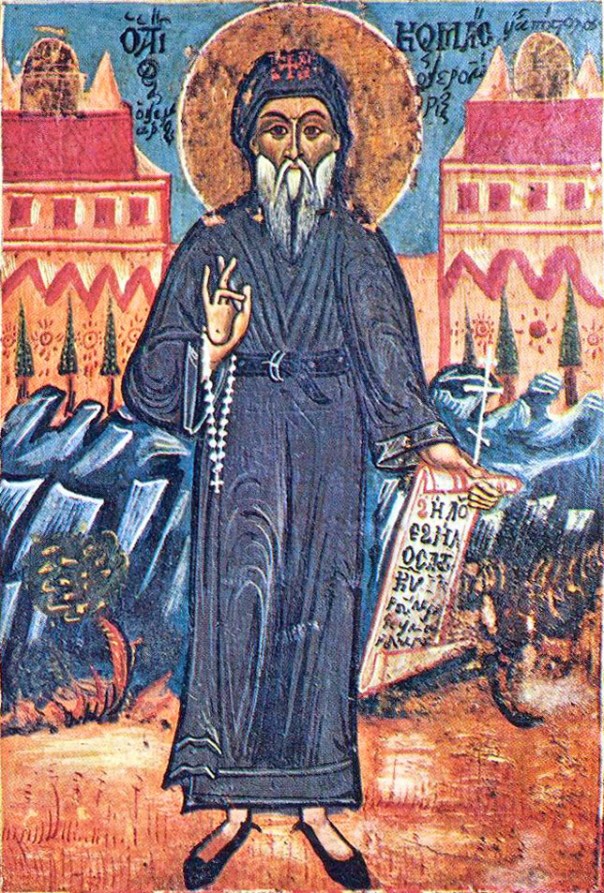 St. Kosmas is commemorated on August 24th.
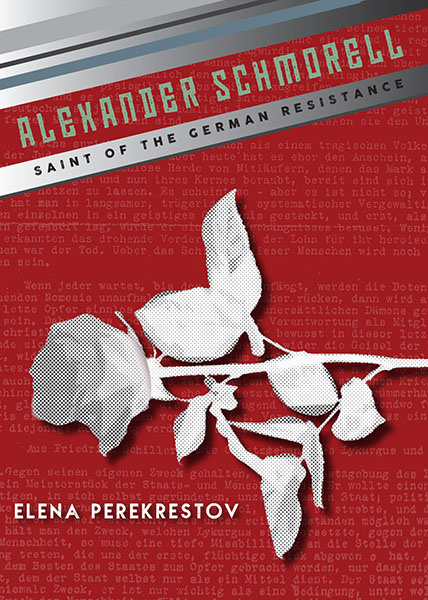 Scholl: The Final Days”) that I first heard of The White Rose, a non-violent youth resistance group formed in Munich in 1942.

 This year in my parish the birthday of St. John the Baptist, June 24th, falls on Holy Spirit Day, and our youth are also heading off to church camp, so I wasn’t paying close enough attention. Ideally I’d have shared about it last night, on St. John’s Eve, because this year that is the day that has captured my imagination.


