Category Archives: history

Words arriving out of some distance.

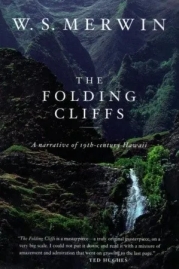
When I recently encountered the W.S. Merwin poem that I posted yesterday, “Losing a Language,” it reminded me of a passage from The Folding Cliffs, which was the first thing I ever read by the author, many years ago. It tells the story of a 19th century native Hawaiian family who did not want to be separated by leprosy, so they escaped into the mountains, where they were pursued by government soldiers.
Back then the book had been lent to me by K., so I had to borrow a copy from the library to find again the passage that had stuck in my mind. It is only one page in this epic narrative of Hawaii that is told in poetic lines. If you have any interest in the history and culture of Hawaii, you might want to look into it. I never would have thought to read it myself, and when I first opened its pages and saw the form Merwin uses, I was dismayed. But I knew I must try at least a few pages, to honor K’s suggestion, and no more that that were needed to hook me into the compelling story.

The particular scene that came to mind recently takes place not long after missionaries arrive on the island of Kauai. They have started a school for the children, and the pastor’s wife had planned to teach them, but she can’t handle the “rough children,” so the pastor himself takes on the job. Here is most of the section “20”:

Whatever the pastor pronounced to them in that voice
……..that was not the one he talked in and not the one
he spoke in when he stood up during the church service
……..and not the one he used for English with other foreigners
whatever words the pastor uttered from the moment
……..they walked through the door onto the dead wood each syllable
of their own language articulated so carefully
……..that it did not sound like their own language at all
not only because every sound that he uttered
……..with that round deliberation was always wrong in his
particular way but because it was coming from those
……..particular clothes that face mouth regard that way of turning
and staring at them and because those words although they
……..were like the words of their own were really arriving
out of some distance that existed for him but not
……..for them and they could hear it echoed in his children…

………………………………………………….…but they repeated
the names of the solitary letters that they
……..said every day the threads of a seamless garment
and he showed them what each letter looked like it was
……..white whether large or small straight or flowing and it was
in itself silent in a black sky where his hand drew it
……..and it stayed there meaning a sound that it did not have

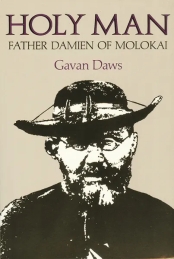
As I say, this scene was memorable for me, capturing my imagination on the subject of indigenous children trying to learn the language of strangers, from someone who makes even their native language strange to them. I was affected by the whole story such that it changed my overall perspective on Hawaii; whereas it had been in the back of my mind as a tourist-y place I didn’t care about, it became full of people and stories. I went on to read the story of Father Damien, the Catholic saint “of lepers and outcasts” — and about other related topics I don’t remember at this remove.

After reading yesterday’s poem and having my interest in The Folding Cliffs renewed, I saw an article criticizing Merwin for cultural appropriation and for changing important parts of the story, a story that is well documented in its historical facts, in publications that Merwin doesn’t give credit to. I wrote a comment about that article, responding in particular to one section of it:

“I still think that The Folding Cliffs overall is wonderful. Poetic license is one thing, but this seems to be going too far: ‘Merwin implies that Pi‘ilani is only superficially Christian and that desperation causes her to reveal a more deeply held set of native beliefs. This is nonsense…. There is no mention in any of Kaluaikoolau! of Pi‘ilani’s faith in anything other than the Christian God.’

“I wonder if Merwin was trying to rectify the harms of colonialism by suggesting that there was no reality to the faith the indigenous people acquired. I doubt he was trying to ‘cash in on’ the story, and the term ‘cultural appropriation’ I think meaningless, but it’s unfortunate that the telling of the whole story of the protagonist was beyond the scope of his sensibilities.”

The offended critic included this information I want to pass on, about factual historical sources, books in which one can read the story of Pi‘ilani:

1) Pi‘ilani Ko‘olau’s Kaluaikoolau!, published in Honolulu in 1906 by John G. M. Sheldon and available in the Archives of Hawaiʻi

2) Helen N. Frazier’s translation of Pi‘ilani’s memoir, The True Story of Kaluaikoolau, or Ko‘olau the Leper, published in the Hawaiian Journal of History, vol. 21 (1987) and available in libraries everywhere.

My readings back then created a desire to visit the island of Kauai. But when my late husband and I did vacation in Hawaii for our 40th wedding anniversary, we stayed on Maui instead. Those rugged mountains where lepers hid from soldiers are still waiting for me.

Kalalau Valley on Kauai

Images of 2023

I’ve enjoyed the very customized compilations on other blogs, of images and stories from the year just behind us. In attempting my own collection, I found it hard to choose just one picture from each month, of those already in my blog files. But as the year went…

In January, this fellow exercised himself very impressively to get at my suet feeder:


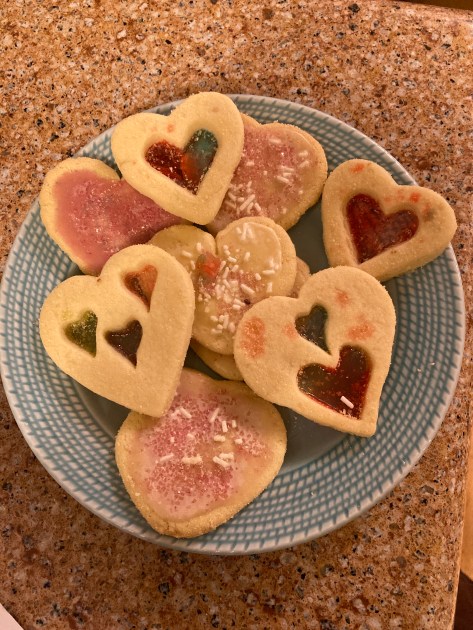
In February, I received a Valentine cookie gift from Colorado grandchildren. ❤


In March, my potted tarragon sprang up:

In April, a hike to the beach with family:

In May, our book group drank goat milk and ate goat cheese (yes, and pizza) while discussing Heidi:


In June, my garden bathed in the sunshine:


In July, I watched the rain from the porch of Kate’s Washington, D.C. home:


In August, I continued my (seeded) sourdough experiments:


In September, I played with my great-granddaughter at her uncle’s wedding:


In October, I went exploring in the woods with Pippin’s family:


In November, the zinnias kept blooming and blooming…


And in the last month of the year, my soul was filled by the Christ Child:

Happy New Year to you all!

Christmas in the Trenches

Maria Horvath (blog now inactive) posted this song, scripture and video together many years ago:

We begin this month’s look at the different forms of love with one of the most thought-provoking statements ever made about love.

In the Sermon on the Mount, Christ tells his followers, “You have heard that it was said, ‘You shall love your neighbor and hate your enemy.’ But I say to you, Love your enemies and pray for those who persecute you, so that you may be sons of your Father who is in heaven; for he makes his sun rise on the evil and on the good, and send rain on the just and on the unjust. For if you love those who love you, what reward have you? Do not even the tax collectors do the same? And if you salute only your brethren, what more are you doing than others? Do not even the Gentiles do the same? You, therefore, must be perfect, as your heavenly Father is perfect.” ~ Matthew 5:43-48

The lyrics below tell the true story of a truce between British and German soldiers on the Western Front in 1914. It is told from the perspective of a fictional British soldier.

CHRISTMAS IN THE TRENCHES

Oh, my name is Francis Tolliver, I come from Liverpool,
Two years ago the war was waiting for me after school.
From Belgium and to Flanders, Germany to here,
I have fought for King and country I love dear.

’Twas Christmas in the trenches and the frost so bitter hung,
The frozen fields of France where still no songs of peace were sung.
Our families back in England were toasting us that day
Their brave and glorious lads so far away.

I was lying with me mess mates on the cold and rocky ground
When across the lines of battle came a most peculiar sound.
Says I, Now listen up me boys, each soldier strained to hear
As one young German voice sang out so clear.

He’s singing bloody well, you know, my partner says to me.
Soon one by one each German voice joined in in harmony.
The cannons rested silent and the gas cloud rolled no more,
As Christmas brought us respite from the war.

As soon as they were finished and a reverent pause was spent,
“God Rest Ye Merry Gentlemen” struck up some lads from Kent.
The next they sang was “Stille Nacht.” ’Tis “Silent Night,” says I,
And in two tongues one song filled up that sky.

There’s someone coming towards us now, the front line sentry cried.
All sights were fixed on one lone figure trudging from their side.
His truce flag like a Christmas Star shone on the plain so bright
As he bravely trudged unarmed into the night.

Then one by one on either side walked in to No Man’s Land
But neither gun nor bayonet, we met there hand to hand.
We shared some secret brandy and we wished each other well,
And in a flare-lit football game we gave ’em hell.

We traded chocolates and cigarettes and photographs from home,
These sons and fathers far away from families of their own.
Tom Sanders played the squeeze box and they had a violin,
This curious and unlikely band of men.

Soon daylight stole upon us and France was France once more.
With sad farewells we each began to settle back to war.
But the question haunted every heart that lived that wondrous night,
Whose family have I fixed within my sights?

’Twas Christmas in the trenches and the frost so bitter hung.
The frozen fields of France were warmed, the songs of peace were sung.
For the walls they’d kept between us to exact the work of war
Had been crumbled and were gone forever more.

Oh, my name is Francis Tolliver, in Liverpool I dwell.
Each Christmas come since World War I, I’ve learned its lessons well,
For the one who calls the shots won’t be among the dead and lame,
And on each end of the rifle we’re the same.

~ John McCutcheon, born 1952, American singer, musician, and composer

Our silence tries but fails.

On Remembrance Day in Britain, many people join in two minutes of silence to memorialize the dead. When Malcolm Guite did that, it prompted this response:

“There was something extraordinarily powerful about that deep silence from a ‘live’ radio, a sense that, alone in my kitchen, I was sharing the silence with millions. I stood for the two minutes, and then, suddenly, swiftly, almost involuntarily, wrote this sonnet.” 

SILENCE

November pierces with its bleak remembrance
Of all the bitterness and waste of war.
Our silence tries but fails to make a semblance
Of that lost peace they thought worth fighting for.
Our silence seethes instead with wraiths and whispers,
And all the restless rumour of new wars,
The shells are falling all around our vespers,
No moment is unscarred, there is no pause,
In every instant bloodied innocence
Falls to the weary earth, and whilst we stand
Quiescence ends again in acquiescence,
And Abel’s blood still cries in every land.
One silence only might redeem that blood —
Only the silence of a dying God.

-Malcolm Guite

Please hear Fr. Guite read his sonnet here: “Silence”

Silent Cross, by Margot Krebs Neale