
Category Archives: humanity
A total and degrading rush.
Friends of mine were chatting over tea this week about how, if your neighbors are actively cooking up crystal meth in their garage, it creates a strong chemical smell that will accost you when you’re strolling by. In my neighborhood we have been aware of more than one such small industry in the last 30 years, but I didn’t know about the strong “flavor” that might have been wafting down the street back then.
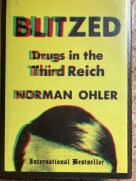
Our conversation reminded me to tell about a book I read last month, on the subject of drug use in Nazi Germany. Normal Ohler’s book Blitzed: Drugs in the Third Reich, published five  years ago, is not the first that has ever been written on the subject, but it’s the only one I’m likely to read. The story about how I came to delve into that depressing topic is a meandering one; I’ll return to it another time.
As I read in a brief interview with the author: A Fresh Light on the Nazis’ Wartime Drug Addiction, the original German title of the book is Der totale Rausch, or “Total Rush,” a play on the phrase “total war” that the Nazis used. The first substance discussed in the book is Pervitin, a drug that contains methamphetamine, which by the late 1930’s people all over Germany were using like coffee, to boost their energy. “Pervitin became a symptom of the developing performance society. Boxed chocolates spiked with methamphetamine were even put on the market. A good 14 milligrams of methamphetamine was included in each individual portion — almost five times the amount in a Pervitin pill.”
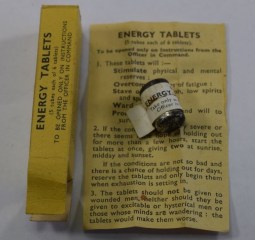 Soon it was being distributed to German soldiers in large quantities to help them stay awake for days at a time. Official records on how many millions of pills were manufactured and delivered to the troops during the war years, and references in correspondence and official directives, all testify to how pervasive the use of this addictive upper was. One military report after the invasion of Poland in 1939: “Everyone fresh and cheerful, excellent discipline. Slight euphoria and increased thirst for action. Mental encouragement, very stimulated. No accidents. Long-lasting effect. After taking four tablets, double vision and seeing colors.”
Music is sometimes really a great consolation to me
(not forgetting Pervitin, which provides a wonderful service —
particularly during air raids at night).
-Heinrich Böll
At first it was considered a medicine, but after the Reich health officer Leonardo Conti warned that the use of Pervitin was actually “terrible abuse being practiced in the widest circles of the population,” in 1941 it was outlawed, and from then until the end of the war only military doctors had access to it. Conti kept speaking out, but he was fighting a losing battle. The military found the stimulant essential, in spite of it not being in line with the Nazi propaganda about the superior Aryan race being morally superior and physically fit, certainly not drug users.
Either you give up smoking or you give up me.
-Adolf Hitler to Eva Braun
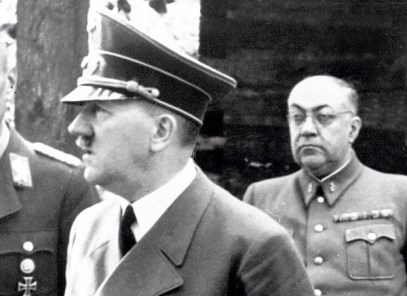
Hitler himself, however, needed something to boost his own performance, and he became increasingly dependent on the pills and injections provided by his personal doctor, Theodor Morell. Ohler concludes that Eukodal (oxycodone, OxyContin) was Morell’s narcotic of choice for his patient, and maybe it was the most destructive one in the long term; but from the doctor’s detailed notes Ohler calculated that Hitler, listed as “Patient A,” was given “methamphetamines, steroids and other substances 800 times in 1349 days, and took 1100 pills.” The eventual challenge of finding a fresh injection site was also noted.
You must be healthy, you must stay away
from that which poisons your bodies.
We need a sober people!
In future the German will be judged entirely
by the works of his mind and the strength of his health.
-Adolf Hitler
In the interview linked above, Ohler recounts: “Hitler loved Eukodal. Especially in the fall of 1944, when the military situation was quite bad, he used this strong drug that made him euphoric even when reality wasn’t looking euphoric at all. The generals kept telling him: ‘We need to change our tactics. We need to end this. We are going to lose the war.’ And he didn’t want to hear it. He had Dr. Morell give him the drugs that made him feel invulnerable and on top of the situation.'”
When Germany did indeed begin to lose the war, and supplies of drugs dwindled, then Hitler may have suspected what was happening to him, and that he was going through withdrawal. Descriptions of his last days are painfully graphic:
 “At six o’clock in the morning, after the military briefing, during which he had fumbled ceaselessly with his empty pillbox, Patient A lay completely exhausted and apathetic on a small sofa, filled only with the single thought that the best meal of the day was on its way: a mug of hot chocolate and cakes, three plates full of them. Sugar was the final drug: one more minute release of dopamine, one more small reward for the soul. Those bright blue eyes, once so hypnotic, were now dull. Crumbs stuck to his purple lips: a sweet-eating human ruin wrapped in slack skin. His body felt numb, as if he were no longer present in it. His temperature was always high. Every so often he’d go into the oxygen tent.”
You have all agreed that you want to turn me into a sick man.
-Adolf Hitler
Before I read this book, I had no idea about the use of stimulant drugs in the wars of the 20th century. Evidently the British and American forces also made use of amphetamines, primarily the somewhat less harmful Benzedrine. In the Korean War soldiers concocted an injectable mixture of amphetamine and heroin and called it the speedball.
The only military drug-use-abuse I’d heard of was in Syria, where I.S.I.S. was giving drugs including the amphetamine Captagon to soldiers, who reported that it “gives you great courage and power.” It helped explain how they could make human boys into killing machines.
 A long time ago I came across some discussion of military history that I think must have originated with S.L.A. Marshall and his book, Men Against Fire: The Problem of Battle Command. He concluded from studying multiple wars that fewer than 25% of soldiers ever fire at the enemy, and he thought that part of the reason was, they did not want to kill their fellow humans: “He will not…take life if it is possible to turn away from that responsibility, and at the vital point, he becomes a conscientious objector.” Many people discredit his particular research data, but his conclusions have been confirmed by other studies going back to the 18th century.
I don’t know if he compared the firing ratio of different cultures and nations, or considered their possible intake of mind-altering substances; but considering that humans are made in the image of God, I do believe that deep down we are averse to killing. The concoctions of drugs that contribute to the alienation of men from their true natures, at the same time injuring their beautiful bodies, are a regrettable accomplishment of modern technology.
The real war will never get in the books.
-Walt Whitman
Touring a house of endless rooms.
BOOKS
From the heart of this dark, evacuated campus
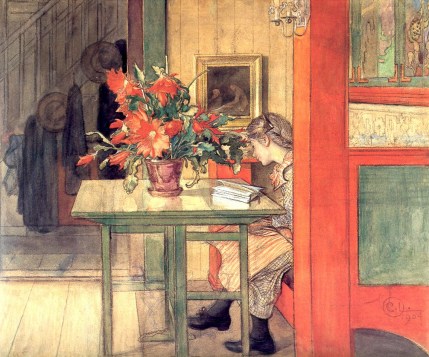
I can hear the library humming in the night;
a choir of authors murmuring inside their books
along the unlit, alphabetical shelves,
Giovanni Pontano next to Pope, Dumas next to his son,
each one stitched into his own private coat,
together forming a low, gigantic chord of language.
I picture a figure in the act of reading,
shoes on a desk, head tilted into the wind of a book,
a man in two worlds, holding the rope of his tie
as the suicide of lovers saturates a page,
or lighting a cigarette in the middle of a theorem.
He moves from paragraph to paragraph
as if touring a house of endless, paneled rooms.
I hear the voice of my mother reading to me
from a chair facing the bed, books about horses and dogs,
and inside her voice lie other distant sounds,
the horrors of a stable ablaze in the night,
a bark that is moving toward the brink of speech.
I watch myself building bookshelves in college,
walls within walls, as rain soaks New England,
or standing in a bookstore in a trench coat.
I see all of us reading ourselves away from ourselves,
straining in circles of light to find more light
until the line of words becomes a trail of crumbs
that we follow across a page of fresh snow;
when evening is shadowing the forest
and small birds flutter down to consume the crumbs,
we have to listen hard to hear the voices
of the boys and his sister receding into the words.
-Billy Collins
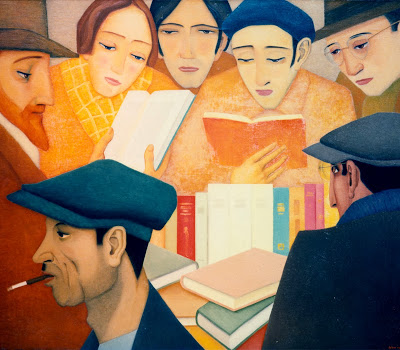
This poem was the perfect one for me to find right now, because I myself have been acting out all the verbs: following, straining, hearing and touring… and listening hard, to the humming of a choir. This choir of authors aren’t all consciously “singing” in harmony, or even intending to write about the same things, but their voices, the sounds, the crumbs I am following “across a page of fresh snow” all seem to be parts of a whole. The rooms I am touring are all in one house; it must be the place where the human soul lives.
My “circles of light” sometimes seem like a 60’s light show, beautiful and confusing, when I am waiting rather for illumination and clarity. So many authors have shined their little lights out into the world, but how many reveal the reality of things?
Over the last several months I have been reading a lot, with no resulting book reviews and few even small illuminations of the sort I might write about here. The Eucharist was very focused and wonderful and I do want to say some things about it eventually, but instead of stopping for that I kept working my way through Irrational Man, which is such a tour de force that it’s hard to know what to say about — everything. It mostly makes me want to read more books that William Barrett reminds me of.
 Like Flight From Woman by Karl Stern, which I read some years ago and thought brilliant; but at the time I knew I needed to read it a second time to digest it. Barrett explains the duality of selves in Sartre’s philosophy, how he considers not the “fruitful, excessive, fruitful blooming nature” to be the true self, but only that of the radically free and active man who has projects. Now I want to go back and read Stern on this topic.
But I am determined to finish a couple more books first. The Rise and Triumph of the Modern Self is like another long chapter, maybe the closing chapter, of Western Philosophy, so it will be good if I can move right on to finishing it after Barrett.
On my recent road trip I listened to Come on Shore and We Will Kill and Eat You All: A New Zealand Story, by Christina Thompson, a title so embarrassing on several fronts that I considered leaving this accomplishment unrecorded. But even this book, which was about as deep as I could go on all that freeway driving, provided a few revealing glimpses of how ideas from the other books I mentioned play out in real life, especially the central one: What is the self?
About halfway through The Cross of Loneliness I began to have a difficult time knowing what these two men were talking about, but I will finish that book, too, before long. My really easy, small book to read under the covers right now is The Bookshop by Penelope Fitzgerald, which I found in the little free library up at the lake.
 And then, the sweetest, which will be easy to finish, as it’s like swimming slowly through a small and refreshing pond to the other side: The Scent of Water, which our book club is reading together. It is coming to an end way too fast.
Oh, yes, there are a dozen more sitting nearby, that I plan to continue with eventually, but they are not at the moment as current as these, these rooms full of delicious crumbs that I trust are leading me always to brighter places.
In regard to my own life and reading, I don’t relate to the progression of Collins’s poem, in its hearkening back to the experiences of childhood and youth, and the mood of evening and shadow descending. I am just very thankful for all the good writers I have at my disposal, and for the lovely song that they are trying to learn and to sing.
He will roll in their nets and sleep.
“His soul will never starve for exploits or excitements who is wise enough to be made a fool of. He will make himself happy in the traps that have been laid for him; he will roll in their nets and sleep. All doors will fly open to him who has a mildness more defiant than mere courage… [He] will always be ‘taken in.’ To be taken in everywhere is to see the inside of everything. It is the hospitality of circumstance. With torches and trumpets, like a guest, the greenhorn is taken in by Life. And the sceptic is cast out by it.”
G.K. Chesterton, in Charles Dickens

 Gladsome Lights