Category Archives: Lent

Rejuvenating Feast

In my reading through the Gospel of Mark I came yesterday to the account of the crucifixion of our Lord. I wasn’t thinking at the time of how it was the eve of the Sunday of the Veneration of the Cross, because I was soon on my way to yet another birthday party, this time to celebrate Laddie’s turning two.

Later, I thought about how appropriate it was that I contemplate Christ’s being forsaken by his Father, taking that cup of death and thereby conquering and destroying death, so that we can drink from the cup of joy, and have a feast. This is truly a spiritual feast, and not the kind where we delight in earthly food. And for that reason it’s set right here in the middle of the Lenten fast. The following is from our church bulletin.

ON THE CROSS:

As they who walk on a long and hard way and are bowed down by fatigue find great relief and strengthening under the cool shade of a  leafy tree, so do we find comfort, refreshment, and rejuvenation under the Life-giving Cross, which our Fathers “planted” on this Sunday.

Thus, we are fortified and enabled to continue our Lenten journey with a light step, rested and encouraged. Or, as before the arrival of the king, his royal standards, trophies, and emblems of victory come in procession and then the king himself appears in a triumphant parade, jubilant and rejoicing in his victory and filling those under him with joy, so does the Feast of the Cross precede the coming of our King, Jesus Christ. It warns us that He is about to proclaim His victory over death and appear to us in the glory of the Resurrection….

The present feast has been placed in the middle of Crucifixion wikimediaGreat Lent for another reason. The Fast can be likened to the spring of Marah whose waters the children of Israel encountered in the wilderness. This water was undrinkable due to its bitterness but became sweet when the Holy Prophet Moses dipped the wood into its depth. Likewise, the wood of the Cross sweetens the days of the Fast, which are bitter and often grievous because of our tears. Yet Christ comforts us…
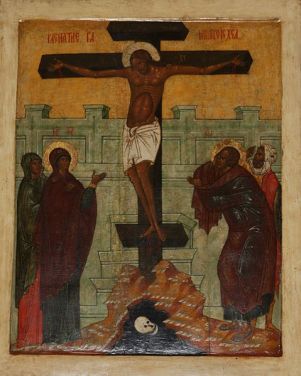
Moreover, as the Holy Cross is called the Tree of Life, it is placed in the middle of the Fast, as the ancient tree of life was placed in the middle of the garden of Eden. By this, our Holy Fathers wished to remind us of Adam’s gluttony as well as the fact that through this Tree has condemnation been abolished. Therefore, if we bind ourselves to the Holy Cross, we shall never encounter death but shall inherit life eternal.
What to eat during Lent.

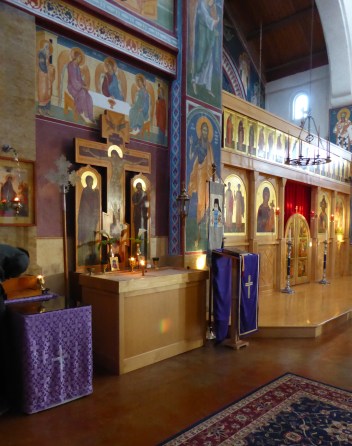
gl P1030688During the Vespers of Forgiveness last Sunday, the vestments were changed to purple. We began this season of the year — approximately a tithe? — that seems to convey the heart of Orthodoxy, because it calls us back to our First Love and to real Real Life. As someone reminded me this week, Normal Life is what Adam and Eve had in Paradise, when they walked and talked with God in the garden. It can take a lot of effort to put aside the usual cares and concerns for a season, and to do whatever is necessary to reach an awareness of our great need for Christ, and to receive His love and forgiveness, which is the healing of our souls.

My heart has been full-to-bursting, or to weeping, especially in the extra services that we have during Lent, and extra-extra during this first week. I’m learning more about kairos, that time that is timeless, and that gives us a taste of Heaven. This is my view when I look up. I can read, in the circle around the icon of the Savior, “He hath looked out from His holy height. The Lord from Heaven hath looked upon the earth to hear the groaning of them that be in fetters.”gl dome clean week

I’ve never been able to attend the services of the Canon of St. Andrew of Crete as much as this year, and it has been the greatest blessing. On Thursday evening I arrived early enough to get a picture before the service began, and then another toward the end, during Great Compline. I wish you could hear the choir, who sang like angels.gl P1030689gl P1030693

Along with my heart, but in the chronos kind of time that won’t stop ! my to-do list is full-to-bursting as well. The garden is ready for me to plant some spring vegetables, and every day is a new scene out there. I’m behind as usual, and glad that the flowers and sprouts don’t wait for me, but they go on springing.  New miniature Dutch irises emerged in the pouring rain, because they didn’t want to be late in showing their own Lenten vestments.P1030674

Three of the children and their families are coming a various times in the next week, starting this very morning. I can’t wait to see the grandchildren, and I hope they can play in the garden without having to play in the rain.

I made about twelve quarts of satisfying soup yesterday, and next weekend I’ll be preparing an agape meal for 100 as a memorial to my husband. I’ve never done that kind of event before, and I’m glad I’ll have some helpers.gl soup 3-16

So there is much to ponder and write about, but not much time (chronos), it seems, for the writing part.

I will post some links from my files to a few Lenten recipes, at the bottom of the post, but first I want to share something that has been going around for a couple of weeks, but bears repeating, a message from Abbot Tryphon reminding us about the kind of feasting we can enjoy during Lent:

FAST from self-concern and FEAST on compassion for others.
FAST from discouragement and FEAST on hope.
FAST from lethargy and FEAST on enthusiasm.
FAST from suspicion and FEAST on truth.
FAST from thoughts that weaken and FEAST on promises that inspire.
FAST from shadows of sorrow and FEAST on the sunlight of serenity.
FAST from idle gossip and FEAST on purposeful silence.
FAST from problems that overwhelm you and FEAST on prayer that sustains.
FAST from criticism and FEAST on praise.
FAST from self-pity and FEAST on joy.
FAST from ill-temper and FEAST on peace.
FAST from resentment and FEAST on contentment.
FAST from jealousy and FEAST on love.
FAST from pride and FEAST on humility.
FAST from selfishness and FEAST on service.

Thank you, Father Tryphon! Now, as to earthly food, some recipes I have posted in the past that are suitable for Orthodox fasts are these:

Italian Flag Soup

Indian Chickpea and Spinach Stew

Vegetable Bean Soup

Turkish Green Beans

Korean Kale Salad

Yams Roasted with Coconut and Curry

Gingerbread Pear Bundt Cake

Pat-in Pie Crust

God bless you all, my Dear Readers. And to those of you who may be celebrating Western Easter soon, may you have much grace during Holy Week.

Why do we eat?

SOME REMARKS ON FASTING by Fr. Stephen Freeman:

…. I have seen greater good accomplished in souls through their failure in the fasting season than in the souls of those who “fasted well.” Publicans enter the kingdom of God before Pharisees pretty much every time.

Why do we fast? Perhaps the more germane question is “why do we eat?” Christ quoted Scripture to the evil one and said, “Man does not live by bread alone but by every word that proceeds from the mouth of God.” We eat as though our life depended on it and it does not. We fast because our life depends on the word of God.

I worked for a couple of years as a hospice chaplain. During that time, daily sitting at the side of the beds of dying patients—I learned a little about how we die. It is a medical fact that many people become “anorexic” before death—that is —they cease to want food. Many times family and even doctors become concerned and force food on a patient who will not survive. Interestingly, it was found that patients who became anorexic had less pain than those who having become anorexic were forced to take food. (None of this is about the psychological anorexia that afflicts many of our youth. That is a tragedy)

It is as though at death our bodies have a wisdom we have lacked for most of our lives. It knows that what it needs is not food—but something deeper. The soul seeks and hungers for the living God. The body and its pain become a distraction. And thus in God’s mercy the distraction is reduced…Why do we fast? We fast so that we may live like a dying man, and in dying we can be born to eternal life.

Read the whole article here.

Adam wept.

And we’ve got to get ourselves back to the Garden…     Joni Mitchell (1969)

expulsion Adam & Eve - Decani Monastery

“And it is prayer that leads us back to Paradise. It is said that when a priest stands before the closed gates of the altar at the beginning of Vespers, he represents Adam weeping before the closed gates of Paradise. I think of that image often as I stand quietly waiting for the Reader to end the prayers of the ninth hour. For as I stand before those holy gates, all humanity stands in me. We all stand before the closed gates of paradise. Many times I find the gates closed even to the Paradise of the heart. My thoughts swirl with a thousand distractions and the gates of hell threaten my undoing.

“But it is good to stand still and to bow the head and to weep with Adam. For the doors that are shut will be opened. The gates that are closed will be lifted up. In the wonder of the Divine Liturgy the fruit of the Tree of Life will be brought forth with the invitation, ‘In the fear of God and with faith, draw near!’”

I’m posting this because today is the Sunday of Forgiveness, the day before Orthodox Lent begins, when we remember how Adam and Eve were expelled from Paradise.  Read more of this article by Fr. Stephen

(Fresco above is in Decani Monastery in Kosovo.)