Category Archives: mountains

California Mountains – Tahoe

( 2nd of many posts in a series. 1st post: Getting Over )

Our neighbor camper played his lonely and cheery mandolin for hours each day that we were at the Meeks Bay Campground.

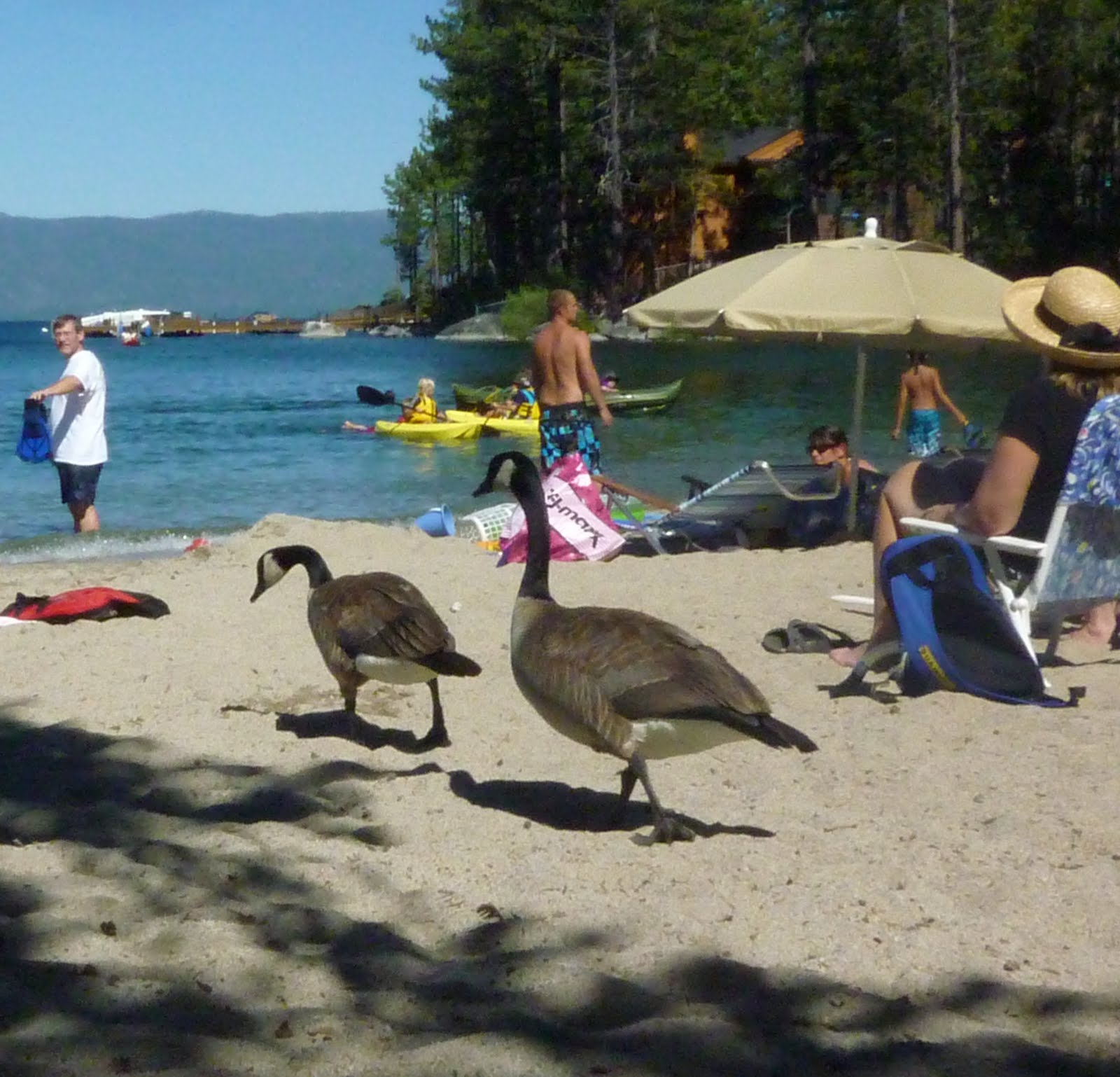
We had pitched our tent within walking distance of the beach, where we were surprised to see three or four Canada geese looking for handouts or taking a dip with the other bathers. The many children liked to chase them in the water occasionally, but the geese always swam faster than the children could run through the chilly waters.

The lake is high this year, the beaches shrunken, but we found a spot to plunk our chairs down in the sand with a view to people-and-geese-watch, glancing up often from our summertime reading.

GJ above Emerald Bay

Mr. Glad casually and calmly swam in the lake for ten minutes at a time, completely disguising the fact that it was cold — he estimated 60°.

I was content to wade fairly quickly out to a rock where I could sit and admire my manly husband, whom I compared to a younger, fatter guy who no sooner entered the lake than he headed right back to the dry sand moaning and sputtering and making a scene.

Bridges’ Gilia

The quaking aspen trees shaded our tent and made a lovely shadow picture on the roof in the mornings, and Indian Paintbrush flowers waved at the front door. Steller’s jays helped to wake us up early with their raspy voices.

Lake Tahoe lies at about 6,000 feet elevation, which makes for chilly nights and mornings, but a noontime picnic can be plenty hot if your site’s table is in the full sun.

We took a short hike to Eagle Lake, above Emerald Bay, and captured some wildflower images. The purpley one Pippin and I think is Bridges’ Gilia or Gilia leptalea, though it also seems to have a new and updated botanical name for some reason: Navarretia leptalea.

Photo by Mr. Glad

I especially liked to visit the beach at night when it was empty and the water was shimmering. Little waves were going blip-blip-swish on the sand, where by their tracks you could see that the geese had been the last creatures to go to their rest.

California Mountains – Getting Over

I posted this photo last summer, too!

My husband and I drove our car back and forth over the Sierra Nevada mountains this month. We had several highway options, but no matter which pass we choose to chug up I am always reminded of the forebears in covered wagons going cross-country, and the more recent grandparents driving cars like this on one-lane roads. That’s my mother in the middle of this photo taken in Yosemite.

On the Monitor Pass south of Lake Tahoe
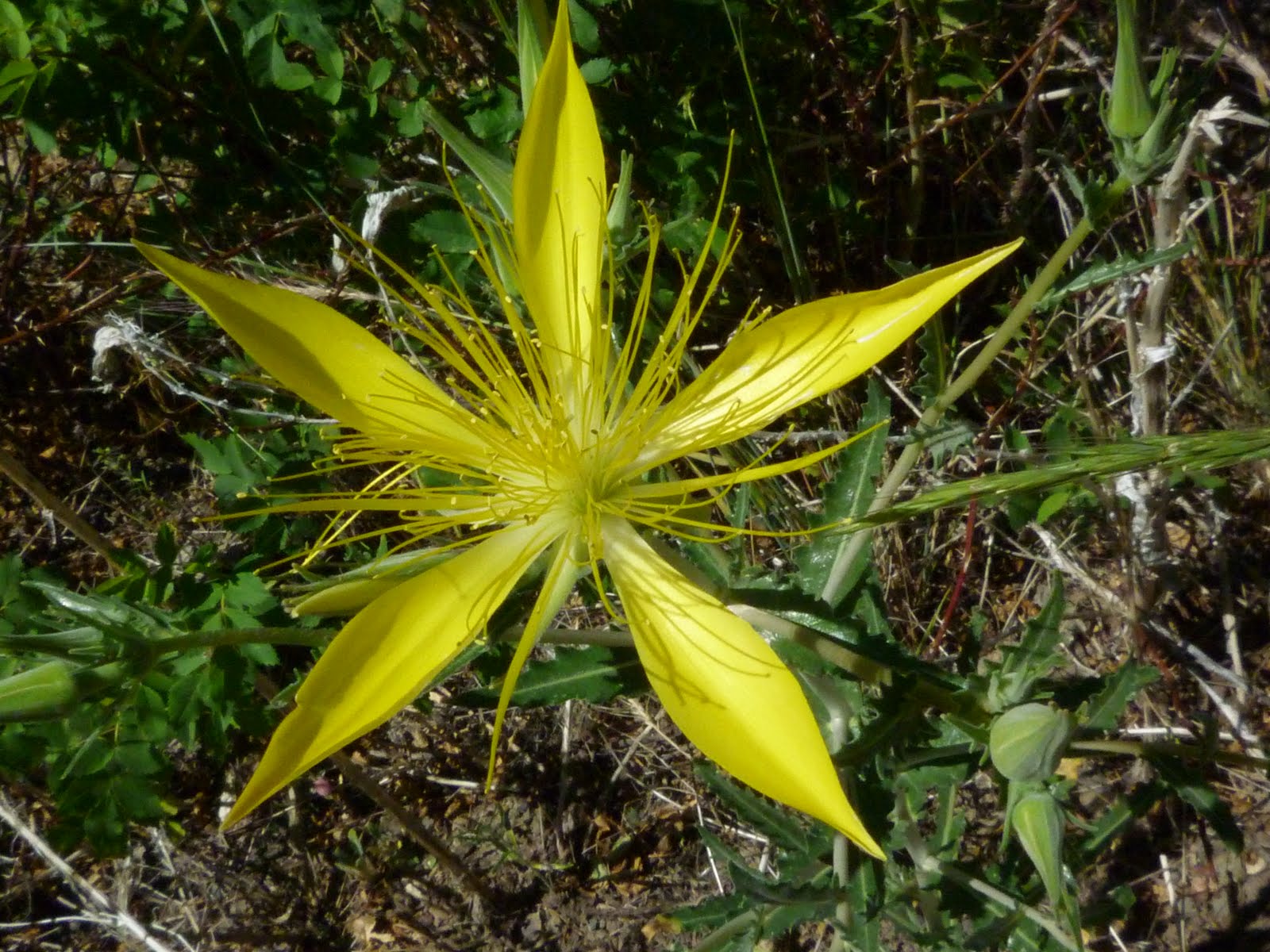
Giant Blazing Star on Monitor Pass

My little SUV has four cylinders to propel it forward, which sometimes ends up a bit slow on the steep grades, but at least we have no worries about our horses struggling through raging streams, or the possibility of our wagon tipping over or breaking a wheel on the rocks.

That is, if I can stay on the road — it’s so easy to get distracted by the wildflowers and swerve too wildly at the turnout for a photo op.

We passed over the Sierras by way of three different routes and summits this trip, and also drove over another pass that doesn’t cross those mountains.

We came at our first stop, Lake Tahoe, from the northwest, over Donner Pass. Ah, the Donner Party — what an uncomfortable story, one that raises severe ethical questions. My heart breaks for those pioneers who got bogged down and starved in the snow. Patty Reed’s Doll is a book that somehow manages to tell the tale for children. I recently gave it to granddaughter Annie for her birthday.

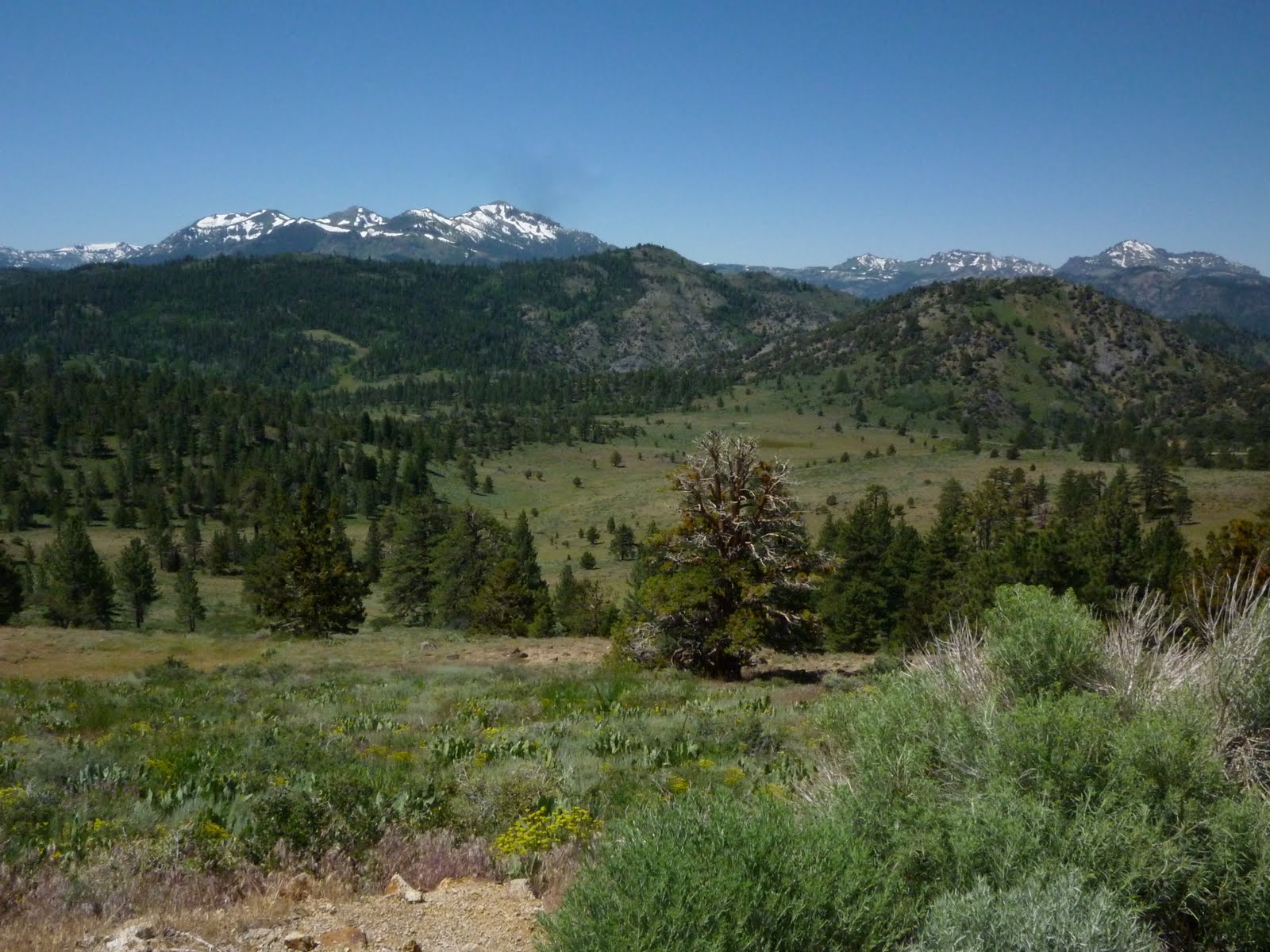
Leaving Tahoe after camping for two days, we took the Monitor Pass to the eastern side of the Sierras. Its summit is over 8,000 ft. At the top one drives through rolling “hills” as pictured above, with a mixture of meadows, conifers and sagebrush, and wildflowers galore.

Continuing south on Hwy 395 we rose above 8,000 feet again to get over the Conway Summit, a pass that doesn’t take you as the others do in a generally east-west direction, but gets you over a plateau just north of Mono Lake.

One might ask why we would want to go to all the trouble of climbing mountain passes on pavement, just to go on a hike…Why not ascend on the closer, western side? Well, if one likes to visit the highest altitudes, but doesn’t want to get sore feet walking for days, the smartest thing is to let your car do the work of getting part way up, by going over. The eastern approach is quite steep, and the Owens Valley floor itself is already aound 4,000 ft. elevation, so you’ve got a good head start if you come at the peaks from that side.

To get to our trailhead, we only had to steer upward and our four cylinders climbed over 5,000 ft. in less than half an hour. Yes, it does take us most of a day’s drive to get to the eastern side, but it would take me a week — or more likely I’d never go — to get to the same places by way of the more gradual western approach.

After our adventures on either side of the Owens Valley, we drove back up Hwy. 395 to the Sonora Pass to get home.  The sign at the top reads “9,624 feet.” It’s the second-highest pass in the Sierra Nevada, after Tioga Pass which runs through Yosemite National Park and which we won’t be traversing this year.

On the Sonora Pass, July 2011

It was quite beautiful up there. For the first hour or so on the highway we hardly met a car. By lunchtime we’d descended to hot lands again, and felt the mountains slipping behind us.

But I am so far ahead of myself, talking about the end of the trip when I’ve only begun to tell about the beginning. More to come soon, about our summer mountain adventures.

(next in the series: Tahoe, Rivers and a Song, Directions and Points )

New Friends on the Way

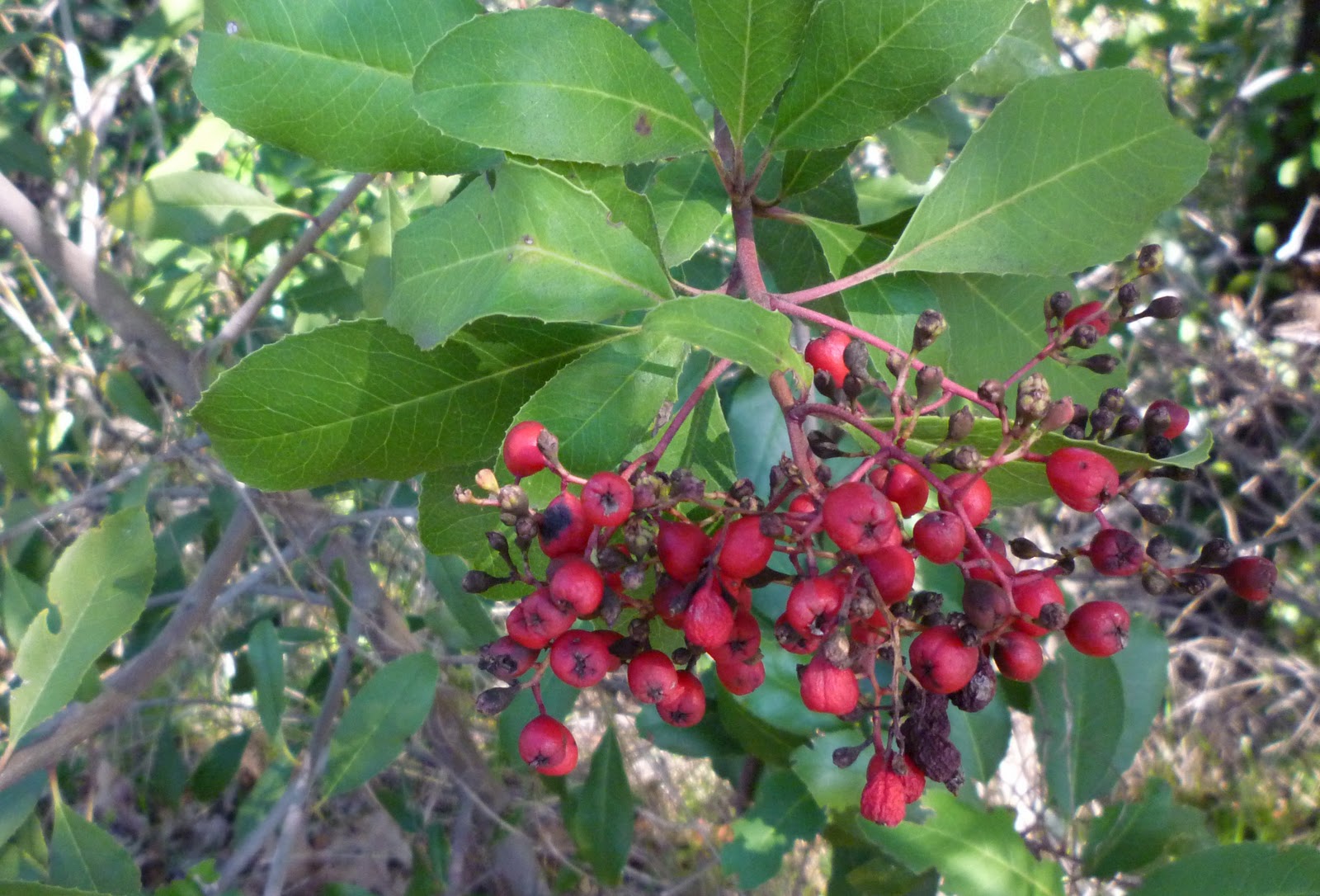
Heteromeles arbutifolia – toyon

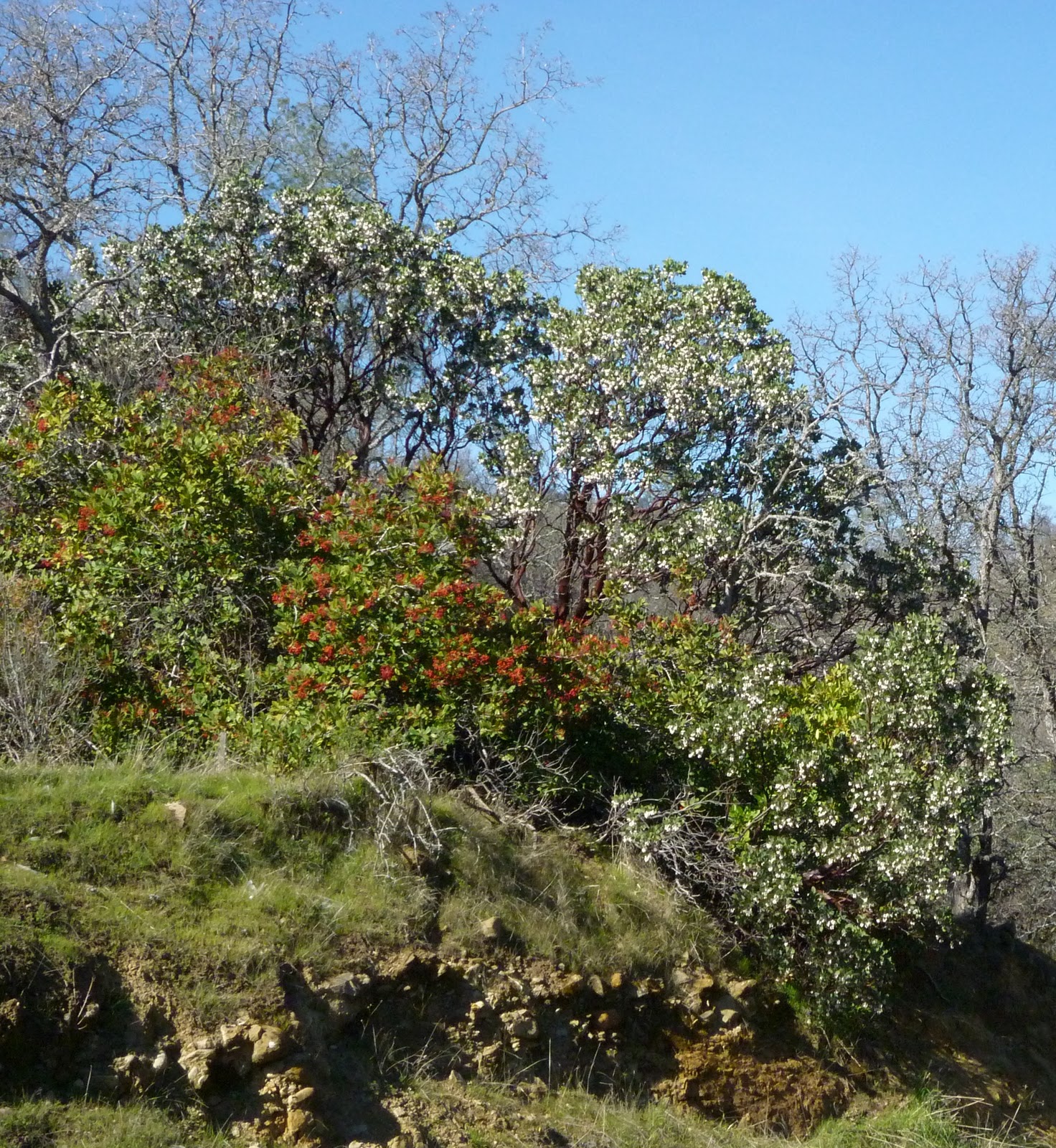
On my way to visit Pippin, The Professor, and Scout last week I stopped to see some of my tree friends. The lovely bay tree was blooming, all tangled up with the madrone, whose berries were almost gone.

toyon with manzanita behind

Also in the jumble was the toyon, with slightly fresher berries. I read in Pippin’s tree book that toyon is the only species in its genus, and it grows only in California and Baja California. Though I’d been introduced to Mr. Toyon many times in the last 40 years, I didn’t seem to pay much attention to him. I think we’ll be friends now. On this occasion I had the time and Google to help me focus and learn more, and I also have a blog where I can find him again if my memory fails.

another view of toyon

I did see quite a few of my most beloved manzanitas as well. Manzanita means “little apple.” The botanical name arctostaphylos means “bear berry,” though of course other animals also feed on these fruits. The common name of some varieties is also bearberry.

Right now the bushes are in bloom (so is the one in my yard); I saw pink- and white-flowered variations. There are about 60 species total, and most of those are native to California, so it’s a hard one to pin down as to which species you are seeing.

manzanita

Many of the trees I saw on this outing are growing on the slopes of that volcanic mountain I told about before, Mt. Saint Helena, in Napa County. On the weekend scores of cars were parked at the trailhead for hikes up to the top. The spot is in Robert Louis Stevenson State Park, so named because the author and his wife honeymooned on this mountain in 1880. He went on to use it as the model for Spyglass Peak in Treasure Island. One New Year’s Day a decade ago our whole family made the trek up and got amazing views.

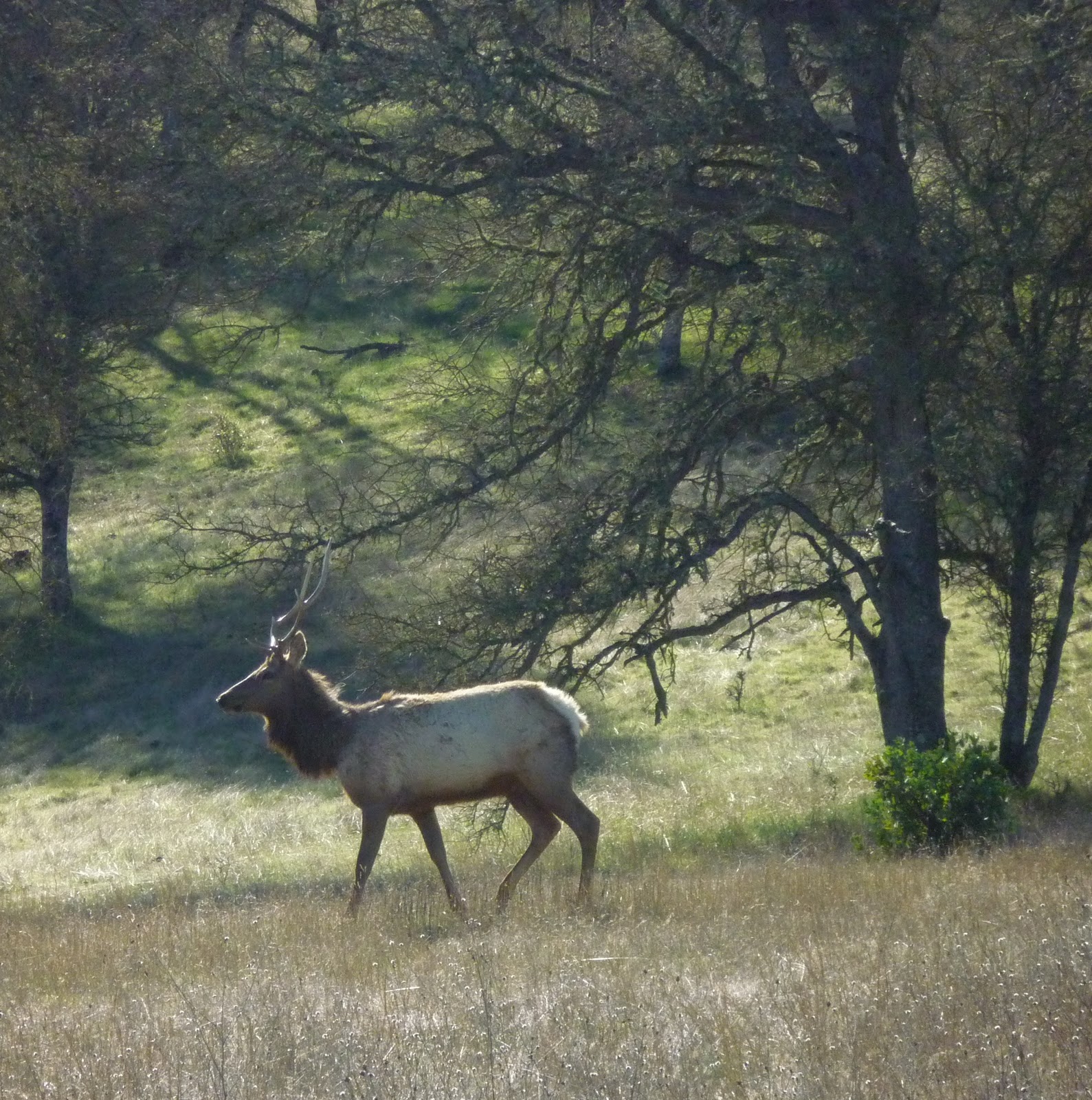
I left the forest and after driving a while longer I caught a glimpse of something off the highway that made me flip a U across three lanes to go back and take a second look. I was lucky there was a turnout right opposite the meadow where 20 elk were grazing!

Later The Professor told me that he had seen this herd of tule elk many times over the years, in this their winter home; it is the largest migratory elk herd in California. Tule elk are a subspecies of elk only half the size of Roosevelt elk, whose habitat is even more narrow than the toyon: they only live in California. I stumbled through the star thistles and got my socks full of prickles, trying to get as close as possible and watch them for a few minutes before they escaped.

On the way home I looked and looked for the spot where I’d pulled over three days before, but I couldn’t even find the turnout across from the meadow, much less see any animals. If I can get a view of the elk another time or two, I might put them in the category of friends, though they didn’t show any signs of wanting to get to know me. So far I’m content to thank God for this happy meeting.