Category Archives: my garden

Sweet (Pea) Melancholia

I picked enough sweet peas to compose a bouquet yesterday. It’s been a few years since the last time I was able to drink deeply of that ultra-sweet and unique, some say old-fashioned, flower scent.

sweet peas first bouqet 4-29-14

When I mention my sweet-peas, many people think at first that I am talking about sugar snap peas, the edible-podded peas that were developed only within the last 50 years or so. They are sweet to eat, while these ornamental cousins are sweet to sniff. If the seeds are allowed to develop, one can see by how tough, dry, and stringy they and their pods are that they are not anything you’d want to put in your mouth.

Our sunny garden space is at a minimum, which is why I don’t often plant cool-weather crops that will take up space into the months when I want to plant tomatoes or peppers.

In this particularly bad drought year, I’ve been thinking more seriously that the swimming pool should go. We could fill it in with good soil and immediately double our full-sun gardening potential. We may yet do that, but it’s a big project for which we’d have to get a permit, and this summer will already be quite busy with other events.

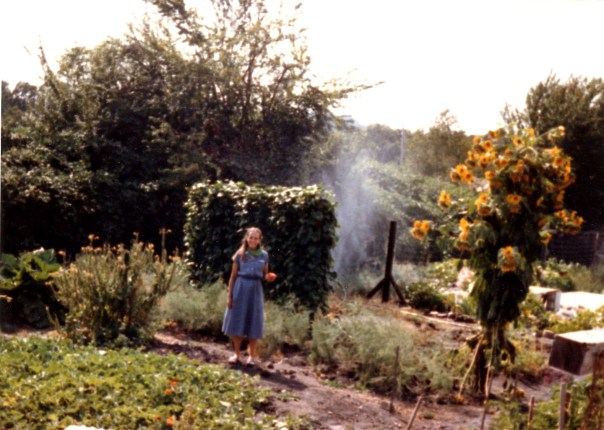
The smell of these flowers took me back to my first experience of sweet peas, sometime in the 70’s or 80’s when we lived on 1/3 acre with more than enough sunshine for anything I could set my fancy on. Among the many things I left in the past are my plantings of soybeans and chicken greens, okra and Ogallala strawberries with their foxy Rocky Mountain flavor, asparagus and artichokes. Here is a photo of me standing between the asparagus and the melons.
G garden 82

I am a firm believer in digging in the soil of contentment to find happiness, but I do have my periods of homesickness, the worst of which came on me within a couple of years of moving from our country place into town. I missed my garden so!

More recently I’ve had the good sense to realize that I could never keep up with that much garden or all of the choices I had in that season of life. I seem to need even more restrictions on my opportunities than I ever did, or I get overwhelmed by the decision-making, not to mention the work. I’ve even thought at times how nice it could be to have — gasp! — no garden at all.

I wonder if the time I spent this week, poking around for sad feelings in parched soil, has actually helped me to get over my losses again. Maybe it wasn’t a complete waste of time. I’ve decided to just enjoy sniffing this Spring’s sweet peas. (And I wish this could be a scratch-and-sniff picture I’m sending your way!)


Every tongue and flower.

My first sweet pea opened on Pascha. At church the roses are abundant, and I’m grateful to be in a temperate area of the Northern Hemisphere where we can be extravagant with our flowers.

Here at home our snowball bush is going all-out for Easter. When he was a boy, Mr. Glad and his sister often had their Easter Sunday photo taken in front of a snowball bush; today I brought some of the blooms in to put on the dining table.

snowball etc Apr 21 2014

Of course, if we lacked flowers, we would still have eggs to color, and white/bright clothes to wear with our smiles and beaming faces.

I surprised myself with a desire to color eggs this year, but time ran Paschal_Egg_ Bolton Ontario Canadaout, and I displayed our small collection of pysanky for the holiday. This red egg is not one of them – I found its picture on the Web.

Another tactile and tasty symbol associated with this week is the loaf of bread called the Artos, about which I wrote last year when I was for some reason blessed to carry it in the Bright Monday procession.

Artos Bright Monday 14
Today’s Artos

But this morning what most impressed me was the sounds of worship, because our parish had many guests from two other Orthodox parishes in the area, from the Antiochian and Bulgarian patriarchates. Our Orthodox Church in America made the third. Historical events and migrations of peoples have led to the development, over centuries, of these ethnic distinctions between parishes, and we look forward to the day when the situation can be rectified.

In the meantime, we have the opportunity locally to demonstrate our unity and the glorious historicity of our common liturgy by gathering on this brilliant and shining day to pray, and to sing “Christ is risen!” in more languages than I could identify or count, not just in the Arabic, Bulgarian and English of the clergy, but others including Russian, Spanish, German, and of course Greek. Not only the words, but the tones of the hymns and the styles of chant vary quite a bit, and maybe just because it is more exotic, to my ear the Arab-style chant is especially soul-stirring.

This 10-minute YouTube sampler of many styles of Orthodox Easter hymns includes some in English, some with the lyrics displayed on the screen with the icons, and quite a few are of the sort we might typically sing in our parish, but it doesn’t include anything like what I have heard in the Arab churches near here. This one comes the closest to the deep baritone voice and style of the cantor who has often led us in worship as he did this morning. But for today’s congregation of a majority of American-born converts, I was thankful that he sang most of the hymns assigned to him in English.

Truly the Kingdom of Heaven comes to us in the Divine Liturgy, and at Pascha, as is described in the scriptures:

After this I beheld, and, lo, a great multitude, which no man could number, of all nations, and kindreds, and people, and tongues, stood before the throne, and before the Lamb, clothed with white robes, and palms in their hands; And cried with a loud voice, saying, ‘Salvation to our God which sitteth upon the throne, and unto the Lamb.’

 Christ is risen! Indeed He is risen!

P1090660

Things that might – and did – happen in March.

1 – My sister might send us a box of mandarins from California’s Central Valley. She and her husband grow these very fancy Dekopons, as they are known in Japan, under the label Sumo. You aren’t likely to see many of them in our U.S. stores for a while, but I just read that in Japan they already have Dekopon chewing gum.

They are awfully good, large and seedless and easy to peel, with a taste that reminds me of the fruits that we children gorged on from our father’s trees many decades ago, and which I still will savor if I get down there at the right time of year.

2 – I might decide to make a giant pot of vegetable and bean soup to last us through Lent and beyond. This is the Bean Soup Mix after soaking all night. The small brown beans are Tepary beans I bought at a farmers’ market years ago; I found them in the pantry and threw them into the lot.


3 – My CSA box might contain a pale green and spikey cauliflower, which they call Romanesco. I chopped it up put it into the soup, so I don’t know if it tastes any different from the usual cauliflower. But it looks interesting.

4 – The osmanthus might bloom, so that when I come up the sidewalk to the front door I swoon over its sweetness, and decide to cut some branches to bring inside.

It’s warm enough now that I felt safe sticking two of my old orchids out on the patio; the only one that bloomed I put in the garage. I’ve gotten so used to them, I might buy a blooming plant to have in the house if Costco is still selling them.

All these things DID happen. I’m loving Lent and Spring.

A little dancing sister.

>

…Nature is not our mother: Nature is our sister. We can be proud of her beauty, since we have the same father; but she has no authority over us; we have to admire, but not to imitate. This gives to the typically Christian pleasure in this earth a strange touch of lightness that is almost frivolity. Nature was a solemn mother to the worshipers of Isis and Cybele. Nature was a solemn mother to Wordsworth or to Emerson. But Nature is not solemn to Francis of Assisi or to George Herbert. To St. Francis, Nature is a sister, and even a younger sister: a little, dancing sister, to be laughed at as well as loved. -G.K. Chesterton

I’ve been enjoying my little sister in the garden this week. It started with a long weeding session, during which I rescued the sweet peas from a weed of which I don’t know the name. Does one of you know it?


It’s been growing taller than the peas, and even though I made some nice trellising for them, they have been confused by these weeds and are trying to climb on them instead.

The green and trailing weed is also flowering before the sweet peas bloom, and is not in any way an unpleasant weed to deal with.

How about this weed? Maybe someone can tell me its real name. We call it The Scattery Weed, because before the seeds are obviously ripe, when the plant still looks small and innocent, it waits with secret menace for the gardener to stroll by and brush it with her shoe or hand, then !!explosion!! of seeds in a several-foot radius.

I probably shouldn’t use the word menace when talking about my little sister. In this case she is only doing what is in her nature, and doing a good job of bearing many children for next year’s springtime.

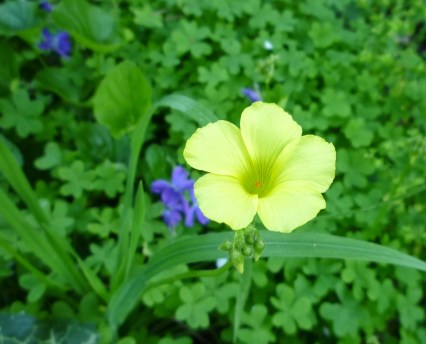
I found more signs of spring while I was out there, like this oxalis blooming among the violets…

…plum blossoms decorating violets, and the violets springing up tall to decorate an irrigation head.

Above is a field of manzanita blossoms fallen from the bush to make way for berries, and hanging over them are snowdrops, truly looking like little sisters dancing in their pretty spring petticoats.

I finished my garden work just ahead of the steady rain we’ve been getting today. God is watering the earth and sending His rain “on the just and the unjust.” Thank You, Lord!

Linking up to Weekends With Chesterton.