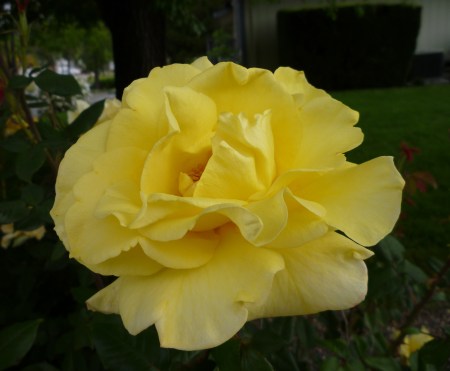
I’ll let G.K. Chesterton’s comments accompany this rose
that was on my path through the neighborhood:
“White is a colour. It is not a mere absence of colour; it is a shining and affirmative thing, as fierce as red, as definite as black. When, so to speak, your pencil grows red-hot, it draws roses; when it grows white-hot, it draws stars.
“And one of the two or three defiant verities of the best religious morality, of real Christianity, for example, is exactly this same thing; the chief assertion of religious morality is that white is a colour. Virtue is not the absence of vices or the avoidance of moral dangers; virtue is a vivid and separate thing, like pain or a particular smell. Mercy does not mean not being cruel or sparing people revenge or punishment; it means a plain and positive thing like the sun, which one has either seen or not seen. Chastity does not mean abstention from sexual wrong; it means something flaming, like Joan of Arc.
“In a word, God paints in many colours; but He never paints so gorgeously, I had almost said so gaudily, as when He paints in white.”
-G.K. Chesterton, “A Piece of Chalk,” in Tremendous Trifles
I’ve been up in the mountains, at Mr. and Mrs. C’s cabin. Several times I’ve written about our cabin stays at Lake Tahoe, and the previous posts had more interesting photos and reports. They are from May 2013, May 2012, and Sept 2011. This time I couldn’t seem to focus my documentarist skills, but I did have some noteworthy experiences.
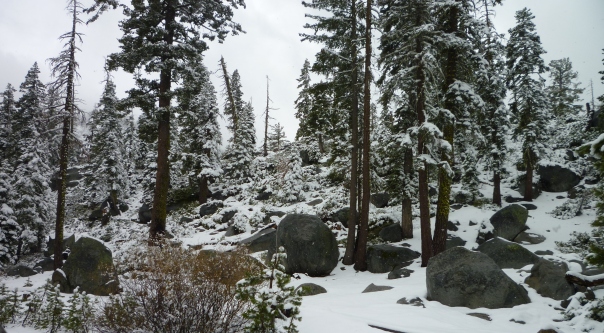
This was the first time to have snow! As we reached Echo Summit on Highway 50 (7382 ft.) the snow began to fall, while clumps of older snow were at the same time dropping from the trees because of the recent rain.
We couldn’t hear the clumps fall, though – Everything was too soft and fluffy to make an impression on our ears.
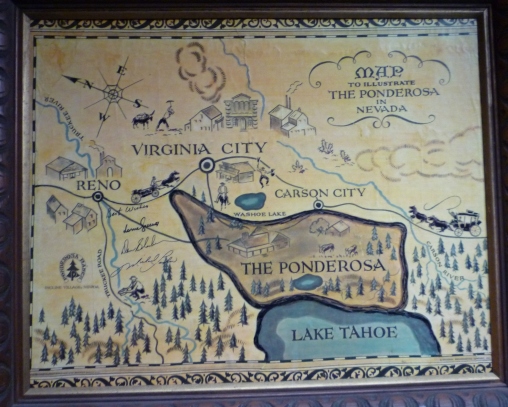
We two couples drove to the Nevada side of the lake to Virginia City, as we had done in 2011. It’s not very photogenic, because the interesting old buildings are full of too many shops full of junk. But if you used to enjoy the “Bonanza” TV show, you might remember that Virginia City was the closest town to the fictional Ponderosa Ranch. This map that I photographed in the cabin is confusing in that North is not at the top of the image.
We didn’t come up completely short as we strolled through town, because we all found some treasures in a rock shop: bracelets, bookends and an onyx box made from stones that came from all over the world. We drove around the residential area down the hill from the rickety old boardwalk and the most beautiful things were the many lilac bushes in full bloom of every possible color.
Back down in the forest by the lake, the squaw carpet is in bloom, and most of the mule’s ears are still babies. I thought their little fuzzy leaves were very dear.
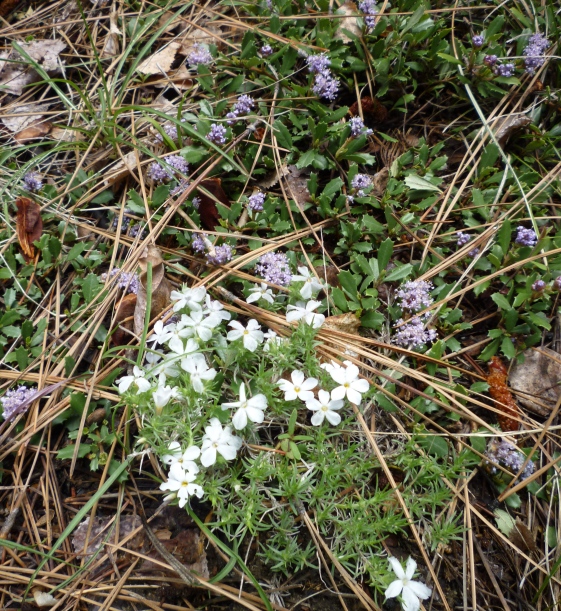
I liked walking around the neighborhood of the cabin, where tall Ponderosa and Jeffrey pines have dropped big cones all over the yards and streets. In every place that squaw carpet was blooming, spreading phlox (Phlox diffusa) was right there trying to steal the show.
(purple) squaw carpet and (white) spreading phlox
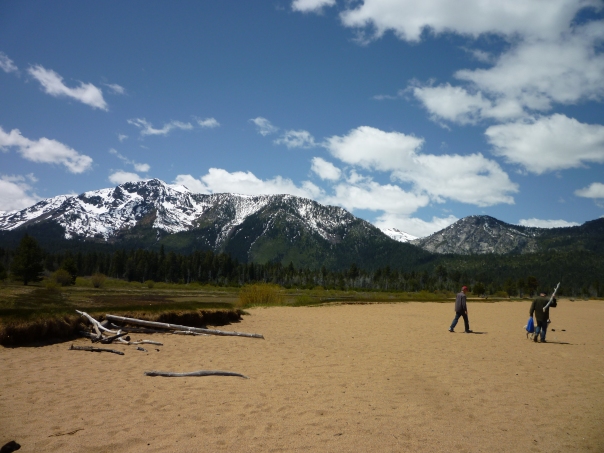
Many of the public beaches on the lake are still closed, but one day we parked on the highway and walked through the forest on to this beach so that we could throw sticks – or actually, small logs — to the dog Cali.
The mountains above still have their frosting of snow, but spring is here, and the weather is warming up. Soon the tourists will arrive, but we are gone….and home again.
Roses are just the best! Last week I began exploring the roses of my neighborhood, claiming them as my own to the degree to which I enjoy them as gifts from God, with thanks also to whoever planted them and whoever cares for them.
To satisfy my rose-love, I had originally thought of taking a friend to visit a public rose garden, and I would still like to do that sometime. But right now that would add to my very long Projects list, and probably make me more gloomy, as getting behind-er in my tasks tends to do, no matter if they are special or mundane items on the lists.
To fulfill the rose garden idea I would need to research and find the destination, think of whom to ask, find a date, phone the friend, and generally obsess over the plan while neglecting more important work, like getting fresh air and exercise.
So I came up with this better idea, which is just a focusing of a very old plan indeed, merely to get outdoors earlier and go walking alone with my camera. I’ve gathered enough rosy material that I want to share it here, I hope in a series of weekly posts that will often be little more than a photo.
To start with, yellow roses that are at an intersection so close to our house that we drive past them at least once nearly every day, and at other times we walk close enough to pause and inhale deeply. Ahhh…
The Day of Rejoicing is a tradition in some Orthodox churches, on which we visit and bless graves on the second Tuesday after Easter. Last year I posted about this happy day, when we visit the cemetery and sing “Christ is risen!”
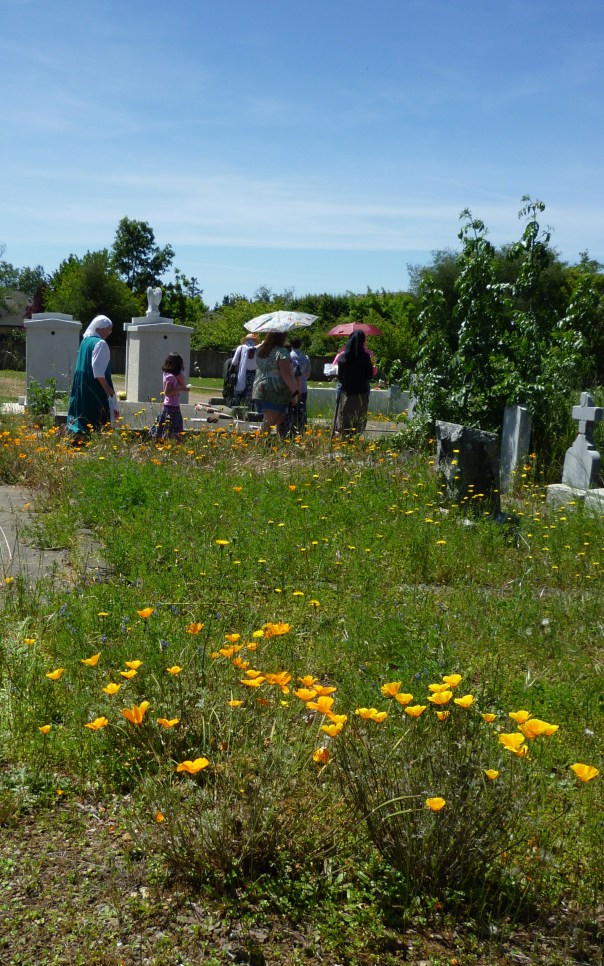
Our priest blesses graves at four cemeteries this day, but I was present at only one. I got a ride with my godmother and another friend, and we had in the car roses, eggs and eggshells that we would later place on the gravestones. It was a hot day, so we also carried umbrellas, and as we made our way to the service the smell of roses was ever present from within and without.
In the upper part of the cemetery is the grave of a very beloved priest who founded one of the local monasteries, so the nuns always come from there to sing at his grave. It’s the one with the exuberant rockrose, which this year was in all its glory. Father accepted a sunhat from the nuns, which he only removed during the reading of the Gospel.
We walked down to the newer and flatter area that has lawns instead of weeds, and completed the service there. Lots of bouquets, mostly of pretty artificial flowers, had been placed on various markers, but I liked best the California poppies that were decorating the older section.
One of the last prayers includes a phrase that I love, referring to our “quickly flowing, brief and temporal life,” after which our bodies will also sleep in the grave. We blessed the cemetery that it might be “a place of sweet sleep” for the bodies of these souls who wait for the time when they will receive them back, when all the dead will be resurrected, some to condemnation, and some to a Resurrection of Life.
Even now, with God’s help, we can live in that Life that Christ has given us, as we wait for the fullness of our own redemption, when we also will put on incorruption and immortality. We have much to be glad about on this day of rejoicing.


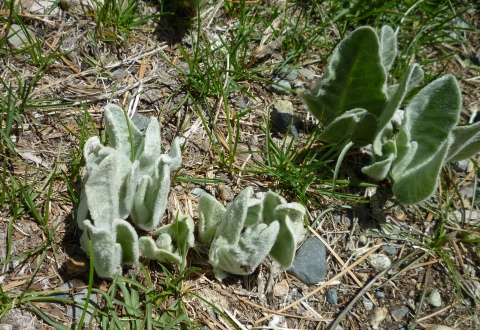 squaw carpet is in bloom, and most of the mule’s ears are still babies. I thought their little fuzzy leaves were very dear.