Category Archives: nature

New friends stopping by…

The carpenter who was hanging doors today brought his nine-year-old son August along with him, with my permission, with the idea that he would stay near his father upstairs. The dad didn’t mind that I set August up by the fire instead, to eat his lunch; I really like the dad and I was glad to meet one of his children, and to make him comfortable. He liked to chat.

Lesser Goldfinch in winter

I got a break from that socializing when they had to go briefly to another job, and I ran some errands having to do with the remodeling and the Christmas celebrations upcoming. When I got back August was glad to see me. He asked whether I had pets, and started advising me that I needed a cockatiel to talk to. I explained about my love for watching the wild birds, and as we looked out at the garden I told him that contrary to present appearances, the birds often came by the dozens, most recently goldfinches. He said, “Look, there’s a hummingbird… it’s a small one.” And suddenly, a flock of birds surprised him by arriving all at once at the seed feeder, and we began to study them.

The yellow-headed birds did not look like goldfinches. I stumbled over boxes of Christmas decorations and faucets to pull the Peterson’s Guide off the shelf, and paged through the colored plates with August looking on, and we determined that this bird is a Townsend’s Warbler. How convenient it was, a few minutes later, when a Lesser Goldfinch, one of those birds I’ve been seeing for years, joined a warbler on the feeder so we could compare them side by side. Of course, the warbler is larger, and different in many ways.
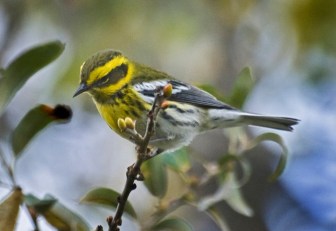
Townsend’s Warbler

August really wanted me to take a picture of the birds, but I explained that I never can get good pictures through the window, and if I open the door, they all fly away. So I am posting here two pictures I found online.

I am pretty pleased at the double gift, a boy and a new bird sighting, all in one day. Thank You, Lord! Now I must get back to my cookie-baking…

Dancers in the wind.

My reward for eating breakfast in a civilized manner was a first-row seat at the birds’ impromptu gala. Every species of little bird I’ve ever seen was in my garden at once, even the titmouse and bluebird, and the Bewick’s wren, those three that I rarely see. In whatever direction I looked, one was hopping around a tree or a path or in transit across the garden.

Instead of carrying my bowl to the computer in the corner, I sat at the table looking straight through the glass across the patio where I could take in the chapel feeder rocking more violently than usual in the wind, and the wisteria vine above it, gently dropping long yellow leaves to pirouette all the way down. The birds who like seeds flitted and flew from their chapel to their fountain spa and made up their aerial choreography on the fly, riding the current of every sudden gust and gale.
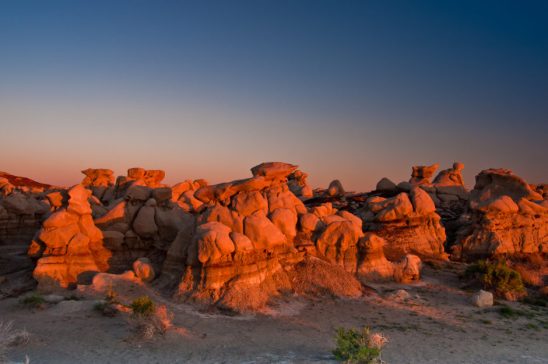
Sparrows and juncos, house finches and goldfinches, scribbled wild and invisible designs in the air as they swooped from the plum tree down to the birdbath, and to pots under the fountain to peck around for a few seconds among the hens and chicks, and or newly-planted violas.

It seemed that even their pushing each other off their perches was part of the joy of the morning, and occasionally two or three would do a synchronized pattern of fancy footwork that carried them a distance around the fountain’s rim in a chorus line. One sparrow hopped off a pot down to the ground, but made the trip by means of a high arch — maybe just to feel the lift under his wings. Because it’s fun.

Enjoy the weather!

Bishop Latour meets the elegant goats.

I’ve read Death Comes for the Archbishop by Willa Cather three times, including an audio recording narrated by David Ackroyd which I only recently completed. These three readings were so far apart that each time seemed a fresh introduction to the characters and the setting. And yet, I do think that the first two readings helped to form a love in my soul for the Southwest territories of the United States, so that this third time I found it there waiting for me, like the warm sand beneath a red rock butte, a place where I might bed down for the night under the stars and feel whole.

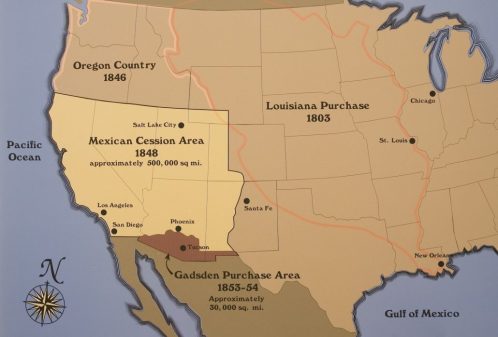
Ackroyd’s voice and narrative style seem perfect for the story. There is a steadiness and a lack of hurry that aligns with the faithful dailiness of the lives of the two missionary priests as they try to meet the spiritual needs of a vast diocese that had just enlarged by nearly 30,000 square miles with the Gadsden Purchase.

They are based in Santa Fe, New Mexico, but make frequent trips by horse or mule of hundreds and thousands of miles, even into Old Mexico, to take care of ecclesiastical affairs, to baptize babies and perform marriages, and to serve Mass. Their characters are sympathetic and rich; the story of their friendship over the decades is a thread woven through the novel, made up of small stories scattered through the years.

I’m using this audio book now the way I have two or three others in the last years since I sleep alone, for the times when I don’t sleep. I put a well-known story to play on my phone, set the timer for 30 minutes, and let David or another nice person read me to sleep. This only works with voices that do not draw attention to themselves in various ways, usually by being overly dramatic.
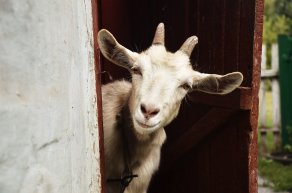
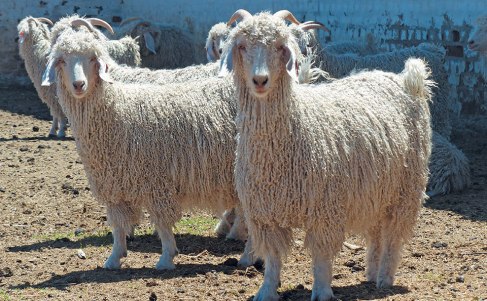
That means I am reading/listening to the book, based on a true story by the way, a fourth time. Because every anecdote and scene seems more luminous and meaningful than ever when it is told or described by a warm human voice, I may post here some passages that appear plain and dry to you poor people who may never have breathed the air of New Mexico or seen the Arizona desert in bloom. But today, it’s only goats we will consider, and I imagine that they are goat-ish the world over.

“After the feast the sleepy children were taken home, the men gathered in the plaza to smoke under the great cottonwood trees. The Bishop, feeling a need of solitude, had gone forth to walk, firmly refusing an escort. On his way he passed the earthen threshing-floor, where these people beat out their grain and winnowed it in the wind, like the Children of Israel.

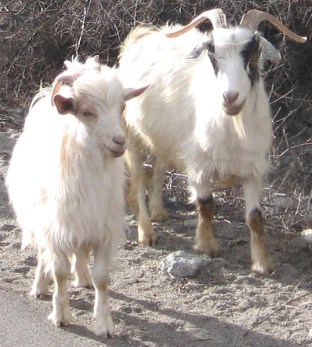
“He heard a frantic bleating behind him, and was overtaken by Pedro with the great flock of goats, indignant at their day’s confinement, and wild to be in the fringe of pasture along the hills. They leaped the stream like arrows speeding from the bow, and regarded the Bishop as they passed him with their mocking, humanly intelligent smile. The young bucks were light and elegant in figure, with their pointed chins and polished tilted horns. There was great variety in their faces, but in nearly all something supercilious and sardonic. The angoras had long silky hair of a dazzling whiteness.

“As they leaped through the sunlight they brought to mind the chapter in the Apocalypse, about the whiteness of them that were washed in the blood of the Lamb. The young Bishop smiled at his mixed theology. But though the goat had always been the symbol of pagan lewdness, he told himself that their fleece had warmed many a good Christian, and their rich milk nourished sickly children.”

-Willa Cather in Death Comes for the Archbishop

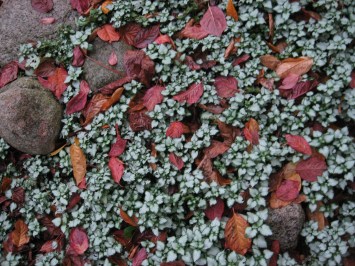
The air is full of falling.

XV.

Again the air is full
of falling: the fall of the leaves
in the weighty season that brings
all home again to the lowly
miracle from which they came.

Nature, the mother and maker,
requires that life take form,
enflesh itself in the shapes
and habits of the world’s unnumbered
kinds. And then she requires
each one at last to shed
its guise, giving up
its matter to the life to come.

Think of a world of no fall,
no gravity, calling downward,
homeward, bringing all
by the light uprisen down
to rest in the resting land
— a world, instead, where all
that dies would fly upward
and outward, nameless and alone.
How sterile then would be
the earth, seasonless the year.

The year is the showing forth
of the heavenly love that is
the being of the present world.
The leaves, opening and at last
falling, hold a while
the beauty of God who made them
by the work and care of Nature,
His vicar and our mother.
His only is the light
of which all things are made,
the beauty that they are,
the delight that is our prayer.

-Wendell Berry in A Small Porch