Category Archives: nature

Earth, sky, and symphony.

It’s a wonder, all the fascinating things I get to discuss and learn about, inspired by reading books to boys who range in age from two to six years old. Before they’d even shed their pajamas this morning they brought me a book found on the shelf here at the temporary house, a worn 1966 school discard by Isaac Asimov titled The Moon.

What instantly got my attention was the picture on the first page, a closeup of the moon showing its topography, with many names of craters, valleys and mountains. Where did these names come from? When were they given? Who is Piccolomini? Astronomy has never exactly sparked my interest; maybe because of my inability to grasp the spatial arrangement of bodies and trajectories in the Universe. But show me a map, and names that carry historic or literary or philosophical meanings as these seem to, and I’m intrigued.

Mr. Asimov doesn’t get into all that. He goes right to theories of ages and descriptions of orbits. Liam was happy to stay with me a while on the names — remember, we both love words — and pointed out that Piccolomini has two words in it: piccolo and mini. This name is significant to our other “studies” as I will come back to later.

Before we could turn the page of this book, we had to sit down and eat the breakfast I’d made, and then the rest of the household who weren’t at work went to visit another new friend, and as I was simultaneously working on some oatmeal muffins for lunch I read about lunar topography. The man who came up with the first nomenclature for the moon, much of which is still used, was a Jesuit priest of the early 17th century, Giovanni Battista Riccioli. Riccioli considered himself first a theologian, but spent the vast majority of his long life researching and teaching about astronomy, as well as logic and physics, especially pendulums. What a learned and productive human, who lived in a challenging time for a natural philosopher. People debate about his possible secret beliefs, based on how he chose and arranged names of lunar features.

“He said that once the enthusiasm for astronomy arose within him he could never extinguish it, and so he became more committed to astronomy than theology. Eventually his superiors in the Jesuit order officially assigned him to the task of astronomical research. However, he also continued to write on theology…”

Will I integrate these evocative moon names into the tangled web of my mind’s musings? Perhaps the only thing I will have gained is another name for what’s in my head: “Sea of Vapors.” That name is from this newer map, featuring the waters of the moon, which I will leave at closing of this subject. Oh, and Piccolomini was an Italian poet and astronomer.

Soldier and Joy did bring along a big bag of their own books for the children, including several titles I wasn’t familiar with before, like this one about orchestral instruments. It made me think of the song I used to sing with my children, “Nous Sommes à la Musicale.” (“We are at the musical,” in French.) I couldn’t remember much of it, but Pippin came to my rescue and sent me a cute video of herself singing it. It’s ultra simple and catchy — there are no other French lines other than the names of the instruments — and you can hear a clip of it on this Folkways recording. Perhaps I borrowed the LP from the library once in the distant past.

More singing: here is Liam sweeping while singing “I love the mountains, I love the rolling hills,” etc.

I wanted the children to be able to hear the sounds of all the instruments pictured in the book above, and  I found quite a few good videos on YouTube, including a half-hour performance without any lecturing, from Benjamin Britten’s Young People’s Guide to the Orchestra. I loved it because it showed nearly every instrument and closeups of the musicians playing, and the conductor was fun to watch as well. There were many shots of the piccolo player!

The boys had heard “Peter and the Wolf” many times, but never seen it played. I found a charming ensemble of seven musicians from Qatar performing to a backdrop of a sort of shadow puppet show of the story, and that was a hit.

Browsing the library shelves last week with Laddie, I came across this beautiful book, Behold the Trees, by Sue Alexander, illustrated by Leonid Gore. It is a simple telling of the story of “living, life-giving trees” in the Holy Land, from ancient times when they were plentiful, to the 20th century when Jews all over the world contributed funds for planting trees to replace those that had been over the centuries and for various reasons cut down.


“They grew in stands and groves and great forests. They held back the sea, cooled the air, and protected the earth for the people and animals who lived there… So it was, for hundreds and hundreds of years….”

But then, people needed cleared land for farms and doors for shops; armies “cut down trees to build fortresses and palaces, shrines to their gods, cities and towns.” Whole forests were burned to remove hiding places for enemies. Eventually “the land became salt marsh and sand,” and animals disappeared.

I love the illustrations in this book showing these events and the people planting trees. And the names of the trees listed simply, and as elegant as a poem. I wanted to know more about the history of this re-greening effort, and I learned a few things online that were fascinating and encouraging.

As recently as the 1960’s the project was begun to plant Yatir Forest on the edge of the Negev Desert. A long Wikipedia article tells much about this “living laboratory” that is the largest forest in Israel, and on another site I found a succinct explanation of one way that the trees survive the climate that they are not suited to:

“Partial results of the research by Professor Yakir and his team show that the forest’s trees have adapted themselves to arid environmental conditions by naturally smart use of the high level of carbon dioxide in the air.  Professor Yakir explains that because of the rise in the level of carbon dioxide in the air, the trees absorb all the carbon dioxide they require without needing to fully open all the stomas (apertures) in their leaves’ membranes. Partial opening of the stomas reduces the evaporation of the water on the leaves and so a tree uses less water without any damage to its development.”

The last of the recent book discoveries was one I found at a used bookstore just yesterday. I was headed straight toward Target, but when my eyes saw a sign declaring “BOOKS,” my feet veered that way. When I finally escaped I had bought several used books for me and for the children. The illustrations in Once There Was a Tree are rich, and do justice to the beauty of the forest, where the main character is a tree stump, and the questions are philosophical.

It might have been titled “Whose Tree is It?” or “Who owns the earth?” The fundamental message is gently told, of how countless numbers of us creatures benefit from as humble a piece of earth as nurtures a stump in the woods, and we should share. I intend to write on the end page Psalm 24:1: “The earth is the Lord’s, and the fulness thereof; the world, and they that dwell therein.”

Because truly He is the beginning and end, the source of all the wealth of gifts and resources that surround us, and of which I have been partaking by means of the sharing of so many of His creatures, from tree-planters to musicians, from a scientist-priest to a children’s book illustrator.

The world — my world — His world — is full of delights.
And I’m looking forward to tomorrow’s offering.

Rabbitbrush and butterscotch.

Last week was full of rocks and trees and even flowers. Joy and I took the children to Garden of the Gods, where red sandstone in ragged forms towers above the walking paths. Even the littlest guy walked more than two miles among the juniper and mountain mahogany, and wildflowers mostly gone to seed. The Gambel oaks, also known as Rocky Mountain white oak or Colorado scrub oak, had probably displayed more varied shades of orange and yellow a few weeks ago, but when we encountered them the leaves had aged to a rich, mellow gold.

We saw the rabbitbrush in many forms and places, but didn’t know what it was until just before we left the park and saw its picture in the visitor center. I have known of rabbitbrush for decades and I hope that after this extended encounter I will not forget it so easily. We saw its flower, two sorts of galls on the plants, and noticed its needly leaves and how they are softer than conifer needles. One of the galls is cottony gall; the other I haven’t been able to identify.

The very next day the whole family drove up to Woodland Park; it’s less than an hour to this town that lies at 8500 feet. We walked along Lovell Gulch Trail, among several species of conifers and groves of aspens. We suspected they were aspens, but we knew that birch have similar bark, so when we got home I googled around and it became clear that yes, what we saw were aspens, so plentiful in the Rockies and in dry places high up, while birches like floodplains and shade. And the few leaves that we saw  — most had fallen after turning bright yellow — matched the pictures of aspen. I only saw one bright leaf, of another species.

We admired the bark of other trees, especially one that had lots of texture, and fresh sap flowing. Soldier had a sudden thought, came close to get a whiff, and concluded, “Oh, it must be a Jeffrey pine — they smell like butterscotch.” Indeed. Oh, that was delicious! I made up a mnemonic story for myself about a boy named Jeffrey who was walking down the trail and discovered a butterscotch drop on a tree trunk.

The view of the mountains is striking from there, a different perspective from our daily one. We have seen Pikes Peak from several angles now, and don’t know the names of any of the other peaks visible from here. Soldier just read that Colorado has more than 50 peaks over 14,000 feet. Colder temperatures are coming this week, and yes, snow is on the forecast, too. So our views will grow even more spectacular.

Bright day and shining friend.

After two cloudy days, one of which was a little drizzly “down here,” we woke this morning to bright blue skies. As I was sitting at the breakfast table I noticed that the mountains in the distance had snow on them, and were transformed. Their changed appearance added contrast and texture to the entire landscape. 🙂 I would go on the deck and take a picture of Pikes Peak as soon as I ate the last bites of scrambled egg.

I forgot to do it, but I did take a picture of my sourdough sponge that I had put to ferment the night before. There isn’t a large enough bowl here for it so I had put it in a casserole and then set the lid on. It was nice and bubbly this morning and I put the lid back on. In a couple of days it will be sour enough for me to want to make some kind of bread with it.

I forgot to take that mountain picture because I was so excited about my trip to the Denver area today to see blogger Pom Pom! She and I have known each other through our blogs for nearly ten years, but this was to be our first in-person encounter.

It took me 45 minutes to make the drive, in Soldier’s little Honda Fit with its stick shift. It makes me feel younger to drive a manual transmission; when my back is not out it is fun. The short trip was pretty nice, watching the sky and few clouds, and the fascinating and varied terrain, which I resolved to read more about. What is this — the high desert, the high prairie, a high mountain valley, or something else? I got more views of the snowy peaks on my drive there, and again late in the afternoon on my return. The topographic high point of the drive was Monument Hill, 7300 ft.

My time with Pom Pom was quite lovely. Of course she is a much fuller and whole person when encountered altogether and not just through words, and I already knew that I loved her. We did talk and talk, and we took a walk around her neighborhood that is very colorful with turning leaves. She gave me a yummy lunch, with the slenderest candles burning like sun rays out of apples decorating our table. I wanted to take pictures of everything in her house, but I didn’t take one picture, because she in her shining self commanded my interest — my very self-centered interest, it appears, because I do believe she got me to talk about me 80% of the time. Well, we will meet again and I hope again, when I visit Soldier and Joy in the future.

Here is something so surprising, that Pom Pom and I found out today. We talked about our book groups, and what we had been reading, etc., and discovered that the current selection for each of them is a collection of Flannery O’Connor’s stories. How unlikely is that? Her group is meeting before mine so she may help me prepare for a challenging discussion.

This evening I interrupted my dinner when I saw the sunset, already fading, and took its picture. Next week we may get some snow, before I return home. And one day maybe I’ll get an image of the snowy mountain view posted here. For now, to you, a Colorado evening turned to “Good-night!”


The beauty of souls and red rock.

Colorado Springs – I am still here with Soldier and Joy’s family, but having a quiet and slow morning, as Joy has taken the children to visit an old friend she ran into at church. Today is cold again, after a week of warm and sunny weather, and the winter season will settle in before the end of the month with freezing temps every night. The town lies at 6300 ft. elevation, with Pikes Peak in view, so one would expect a mountainous feel to the air and the seasons.

I’m a little homesick for my usual mild climate and the abundance of beautiful plants all year long. This Airbnb house is in a neighborhood that appears a little drab to me. Is the relative dryness of the region the region the reason that the leaves on the trees don’t turn beautiful colors, but merely shrivel and lose their color before falling? Out the window we see a broad and flat expanse of dirt and dry weeds between 40-yr-old housing tracts, where it seems more houses are now going to be built, so if you are a little boy who likes to identify excavators and cement mixers you will enjoy that view. I tire of it and lift my eyes just a bit to the large sky, and one morning, there was a sunrise palette.

All the males and I went on an outing to Manitou Springs on the weekend, where more than a hundred years ago bricks from ancient Anasazi ruins in the Four Corners area of the Southwest were used to build a full-size replica of cliff dwellings. It was fun for the boys to walk through the passageways and explore rooms cut into the rock, and there was even a small arrangement of native plants by way of a botanical garden for me to investigate while they went through the dwellings a second and third time. I love that red rock!

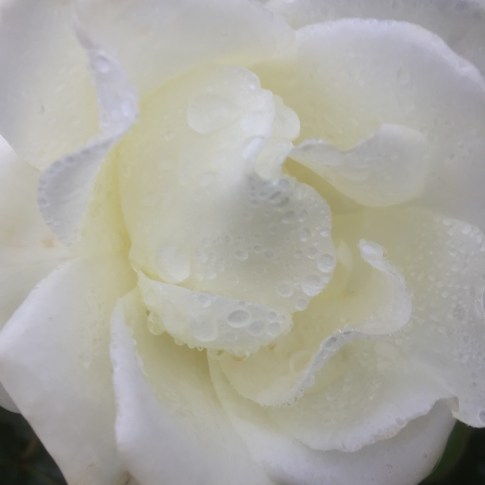
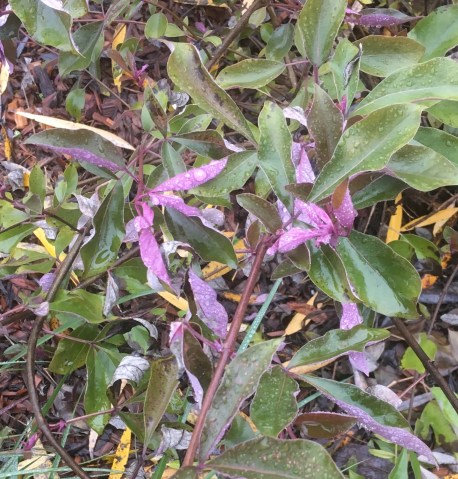
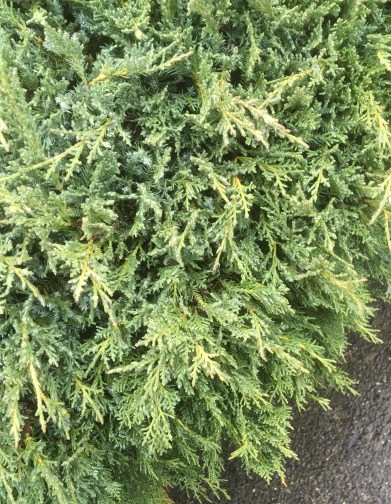
The natural beauty I have most appreciated has not been of the broad landscape, but what I’ve found close up, like the above, and the ubiquitous junipers and blue spruce that will stay fresh and green all winter, and which are a  clean contrast to the nearly aways blue sky. The town is known for the way the sun shines all or part of the vast majority of days. Yesterday I had the boys to myself for a few hours and they ran outside on the green grass; we scooped up leaves with a snow shovel and I taught them to run and jump in our little pile. The leaves smelled sooo good.

The most sublime images of creation I encounter day by day are the humans, with their souls that glow with the life God gave them, and who have the potential to be changed into His likeness as they follow the desires of their deepest longings. I am in awe of the parents’ conscientious care of the children, the thousand responsive decisions they must make every day about how to answer questions, how to deal with squabbles and tantrums and meltdowns — after they have already made many intentional and pro-active planning decisions.

I know, I also used to do that same job day after day, and I wonder at the person I was! It’s all of God’s grace, that we have the strength to do it again the next morning, and that the children grow up at least somewhat prepared to live without the constant supervision and training that they need early on. If they can learn to return to God time after time after time, to receive forgiveness and everything else they need, that will be the best thing.