Cold winds can never freeze, nor thunder sour
The cup of cheer that Beauty draws for me
Out of those Azure heavens and this green earth —
I drink and drink, and thirst the more I see.
To see the dewdrops thrill the blades of grass,
Makes my whole body shake; for here’s my choice
Of either sun or shade, and both are green —
A Chaffinch laughs in his melodious voice.
The banks are stormed by Speedwell, that blue flower
So like a little heaven with one star out;
I see an amber lake of buttercups,
And Hawthorn foams the hedges round about.
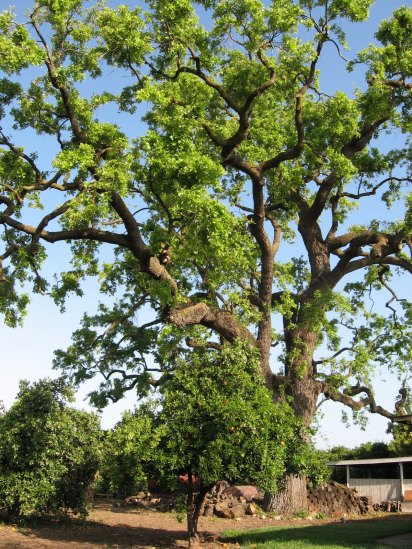
The old Oak tree looks now so green and young,
That even swallows perch awhile and sing:
This is that time of year, so sweet and warm,
When bats wait not for stars ere they take wing.
As long as I love Beauty I am young,
Am young or old as I love more or less;
When Beauty is not heeded or seems stale,
My life’s a cheat, let Death end my distress.
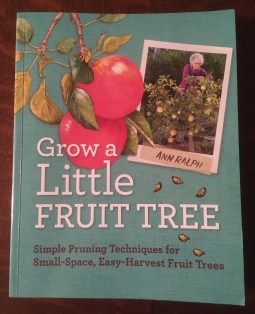
Ann Ralph does make it seem easy. She is all about the backyard gardener being the one in control, managing the tree, and not letting it decide on its own how big to get.
If you didn’t have to climb a ladder to tend your fruit trees or pick the fruit, wouldn’t you find it simpler to keep up with the maintenance and to enjoy the harvest? Most of us don’t need bushels of fruit from one tree, so it’s good stewardship to reduce the quantity of fruit likely to go unused anyway.
I read her book in the fall, and wished I had known about it when we were choosing trees at the nursery two years ago, because you can make the most of this method if you start with a specimen that has a couple of lower-than-average limbs to begin with. Mine are not ideal that way, but I think I can still be the boss. I pruned my plum trees severely before Christmas; but at the summer solstice, according to her plan, they should get their second pruning. I did that a day late, this morning. It took me exactly 50 minutes – I know, because I had set my timer so I wouldn’t be late for an appointment.
I had reviewed the pertinent paragraphs right before I set to work, so as I walked around the tree and made some preliminary cuts, and circled around to the other side to look from that perspective, and on and on in that fashion, I had some phrases lingering in my mind to guide me and give me confidence:
If you see something that cries to be corrected or pruned away, prune it. As always, prune out limbs that annoy you. Picture the height of the tree you have in mind. Don’t allow the tree to get taller. As Scenic Nursery’s Jim Rogers would remind us, “insist.”
Limbs that annoy me? Well, yes, I did find a few of those, that were angled down, or toward the center of the tree; maybe there were a couple that just seemed a little pushy in the wrong direction and not beautiful…. Must we analyze every annoyance?
I wish I had taken a Before picture. In this After picture you can see I hadn’t really finished, because the clippings are lying all over. But I have just hired someone to help me in the garden on a continuing basis — my heart is dancing for joy about it — and will let him do that part (as well as trim the wisteria vines which are coming into the picture from above, hoping to twist on down into the tree).
In the foreground below are yarrow, lavender, and hummingbird mint, favorites of the birds and bees. The picture is taken from a different angle on the same tree. Both of these pictures make me wonder if I shaped my trees enough… those gangly limbs… I trimmed them less because they had the nice curve and direction I am encouraging. They are small and not getting out of hand, so I thought they could wait until the main pruning in winter.
I’m feeling so relieved and restful about the garden now that I’ve engaged my Helper Gardener, cleaned the greenhouse, and pruned the plums. I can think about tackling a few other categories of projects and tasks on my to-do list. And also, sit down in the garden with a book, listening to the hum of contented pollinators.
The butterfly, the cabbage white,
(His honest idiocy of flight)
Will never now, it is too late,
Master the art of flying straight,
Yet has — who knows so well as I? —
A just sense of how not to fly:
He lurches here and here by guess
And God and hope and hopelessness.
Even the aerobatic swift
Has not his flying-crooked gift.
-Robert Graves
First I laughed out loud, and I know I was laughing at myself, because the poet had already communicated to me in the poem what he is quoted as saying at the bottom of the page of Poem A Day Volume 3: “Robert Graves discussed this poem in an unposted letter of 1933; he lamented that scientists ‘fail to understand that the cabbage-white’s seemingly erratic flight provides a metaphor for all original and constructive thought.’”
This particular cabbage white of whom I found a photo seems to be resting on a flower very similar to the one my recent honeybee was drinking from.
Liam was with me for a couple of days last week. He is almost six and suddenly reads with astonishing fluency. Reading is downright fun for him, I guess that’s why, and the more you do something you love, the better you get at it. I was pleased to realize that he would be just the person at just the stage to appreciate The Disappearing Alphabet by Richard Wilbur, so I searched through my bookshelves to find it. We read it together with many giggles.
The artwork, by David Diaz, is much more pleasing to me than that in The Pig in the Spigot, another of Wilbur’s books for children which I wrote about here once. Each page is devoted to a letter of the alphabet, with a short verse musing on what would happen to our beloved world if that letter were no more.
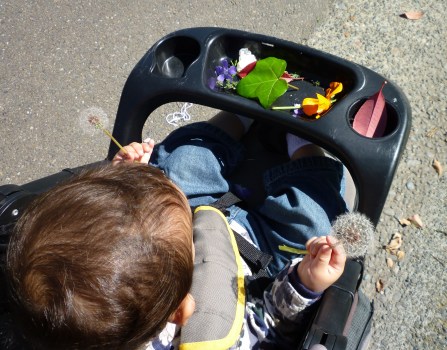
After reading the book, then eating dinner, we went on one of my creek walk loops. Immediately we began to practice our mutual love of plants and their names. My grandson is starting to understand that I don’t know every plant, and our nature study is more of a joint effort now, with him not saying, “What is this?” so much, and saying, “Grandma, look!” more.
But he brought up the subject of the alphabet also, as we walked along, saying, out of the blue, “If there were no letter N, we wouldn’t have pain! or lanes! — or extensions!”
Our walk took longer than I planned, because I had forgotten about how it’s our habit to meander and pick things, as I had started out with Liam in Flowery Town years ago.
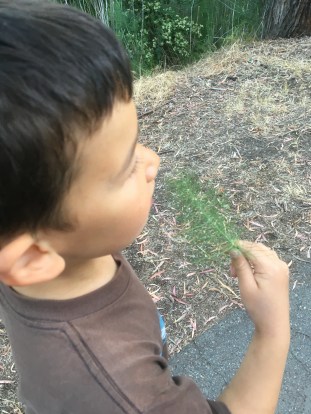
We ate quite a few new-green wild fennel fronds on this walk, and even some slightly older ones, comparing the flavor. And several times he reminded me that we must take the route home that passes by the pineapple guava hedge, because he was eager to taste the flowers I’d mentioned.
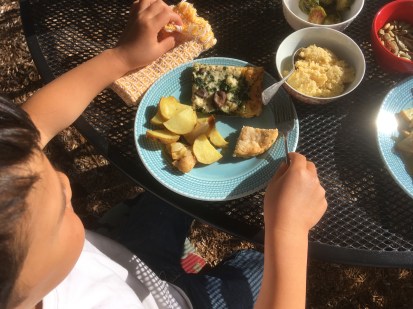
We ate flower petals, and got to bed late, and the next morning the boy picked more right next to my garden dining spot, which he added to our breakfast feast. Rarely is it truly the right weather to eat breakfast outdoors here in my city, and this may have been my first time to do it with company so agreeable.
The middle of this second day was spent at my church, where the end of the children’s week-long summer program featured a long session of water play, and Liam was delighted to get all wet and to eat a popsicle.
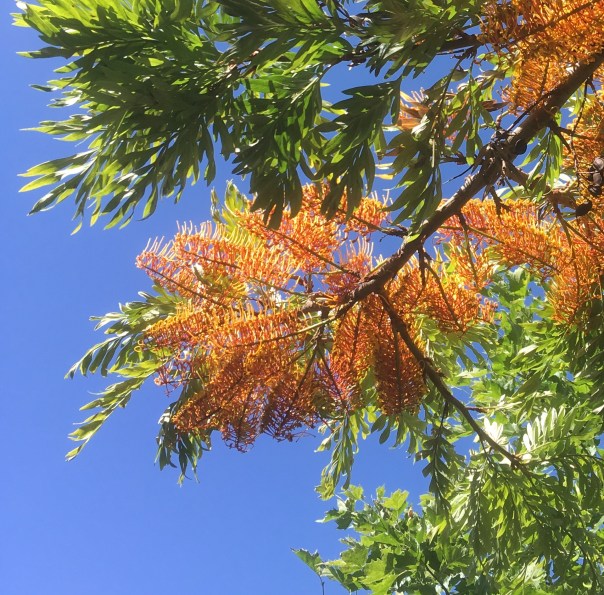
Even here, he drew my attention to a tree blooming right above, which I’m sure I’d never noticed before. Our rector said he planted it himself “way back.”
Australian Silver Oak or silky oak, Grevillea robusta
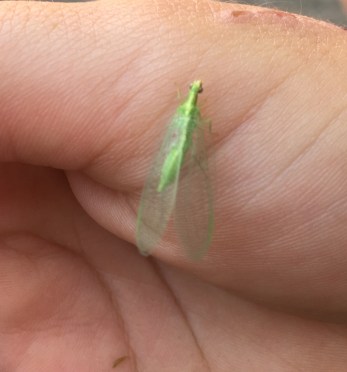
While children were settling down for the Bible lesson that morning, another boy showed me this fly that he was admiring on his hand. I think Liam was already waiting patiently on the other side of the circle so he didn’t see it.
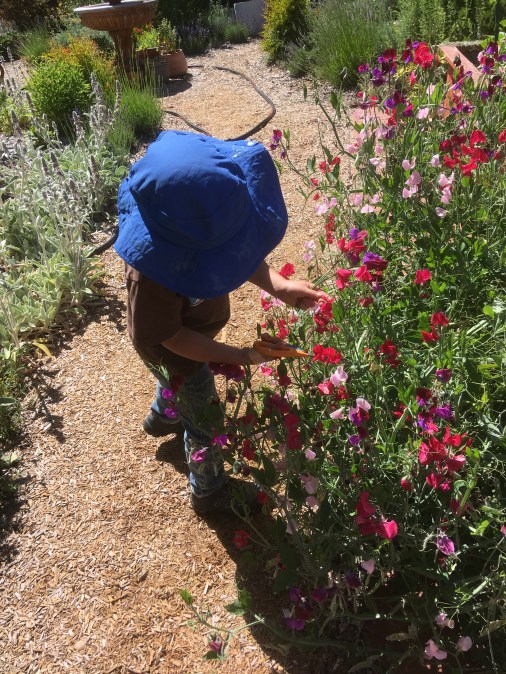
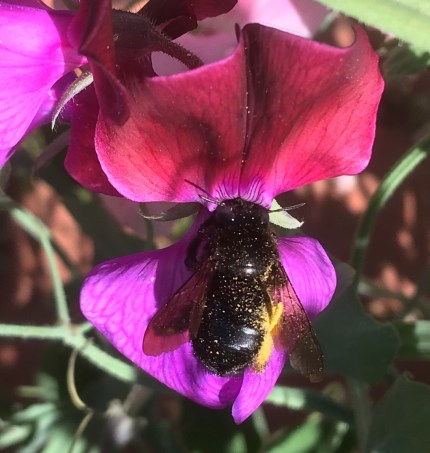
Later that afternoon I had planned to have him help me clean the greenhouse, but then realized he’d like better to pick sweet peas to take home to his mother. I have only a little patch that I didn’t pull out yet. He was diligent about that task for nearly an hour, and collected a large jarful. I made headway on the greenhouse, and we took breaks to study the bumblebees that only recently decided to mob those flowers.
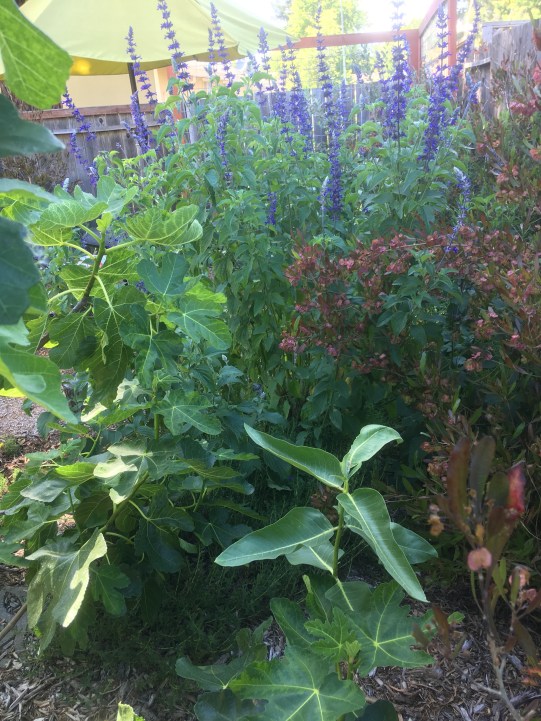
One day we had read Monarch and Milkweed, and the other, I showed him my milkweed plants; the Showy Milkweed is in a jungle behind the fig tree, where I hope, if Monarch caterpillars hatch out, the birds might not notice them…?
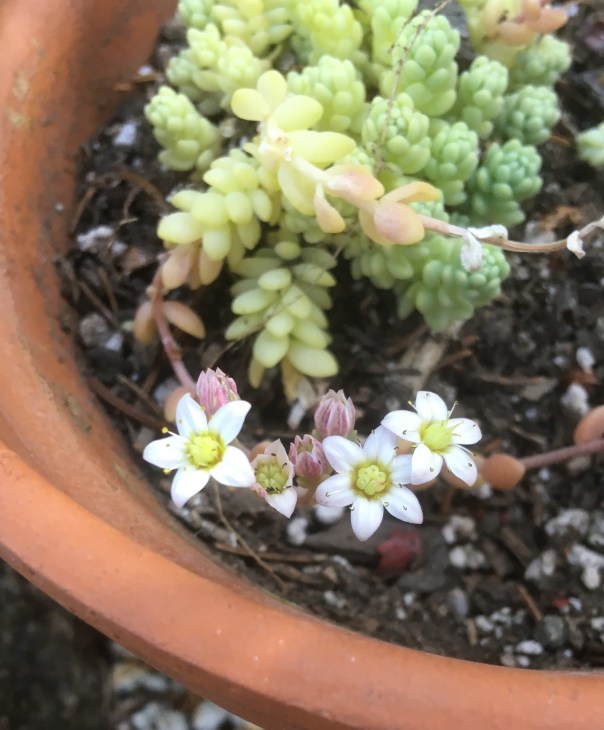
Liam helped me to see my flowers without a magnifying glass. As we were looking at some tiny succulent flowers, and I was trying to get a good picture of them, I began to notice little black dots on them. “Are those holes in the petals, can you see?” I asked him. He squatted down and looked hard, and told me that they were things on the ends of hairs coming out of the middle of the flower. Ah, stamens! When I enlarged the photo, I could see, too:
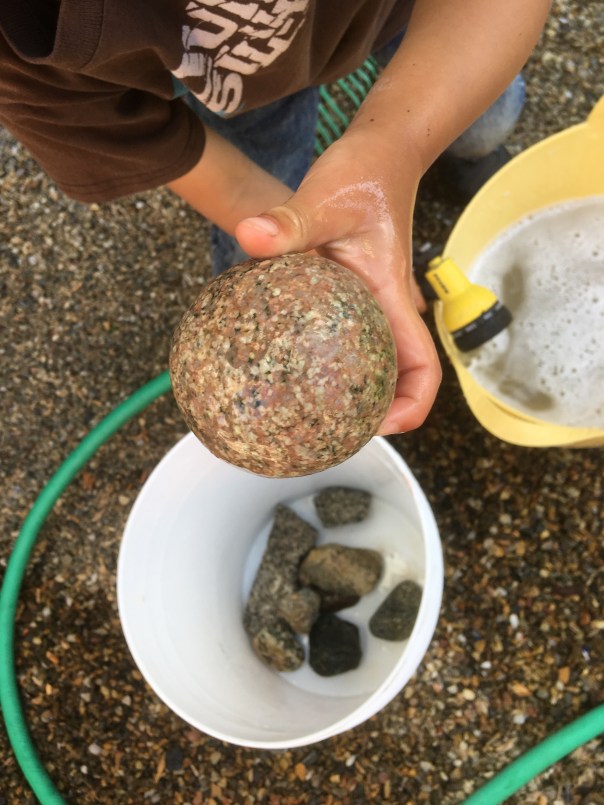
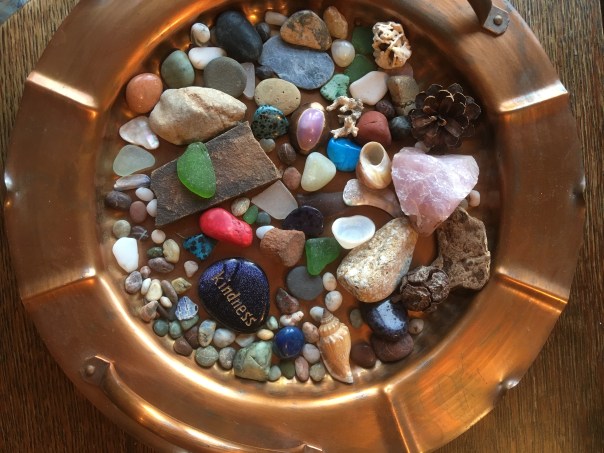
We washed rocks! Liam had been examining and organizing one of my collections of pebbles and stones and such in the house, and out here I had him put these larger stones from the Sierras and from the Sacramento River through some sudsy water and a rinse, so they could wait presentably until I find a use for them.
What other things did we both like to do while he was visiting? Eat ice cream cones, and judge matchbox car races, and read Winnie-the-Pooh. Many times during his last hours with me, lines from Pooh or The Disappearing Alphabet would come to his mind and he would say them again, looking at me with a twinkle in his eye, knowing I liked them, too. He especially liked these from the page about the letter L:
“Any self-respecting duck would rather be extinct than be an uck.”
I was so grateful to Liam’s parents for making this intimate visit work out. Next time I see him, he will be more grown up, and a different boy. But probably not all that different. I hope we can always find a way to share our love for words and plants and many more details and gifts of this vast world in which our loving Father has placed the two of us as grandma and grandson.
 Ann Ralph does make it seem easy. She is all about the backyard gardener being the one in control, managing the tree, and not letting it decide on its own how big to get.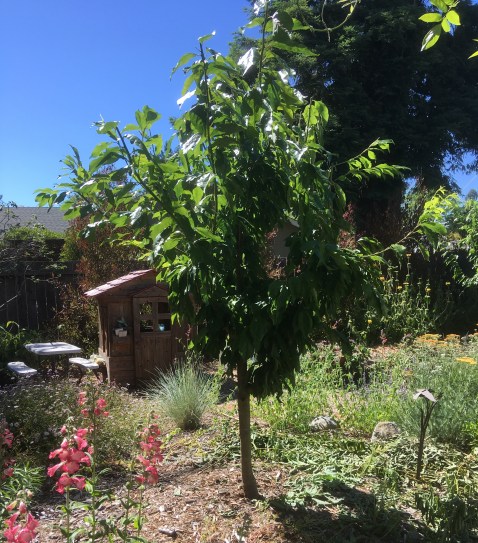


 The artwork, by David Diaz, is much more pleasing to me than that in The Pig in the Spigot, another of Wilbur’s books for children which I wrote about here once. Each page is devoted to a letter of the alphabet, with a short verse musing on what would happen to our beloved world if that letter were no more.





 Gladsome Lights