Category Archives: nature

A boy and his loves.

Liam was with me for a couple of days last week. He is almost six and suddenly reads with astonishing fluency. Reading is downright fun for him, I guess that’s why, and the more you do something you love, the better you get at it. I was pleased to realize that he would be just the person at just the stage to appreciate The Disappearing Alphabet by Richard Wilbur, so I searched through my bookshelves to find it. We read it together with many giggles.

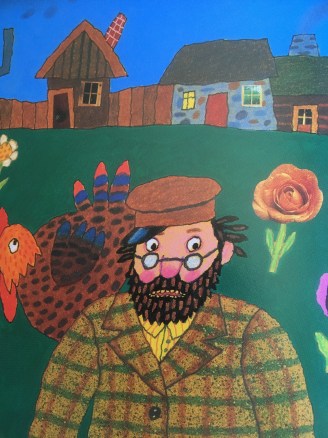
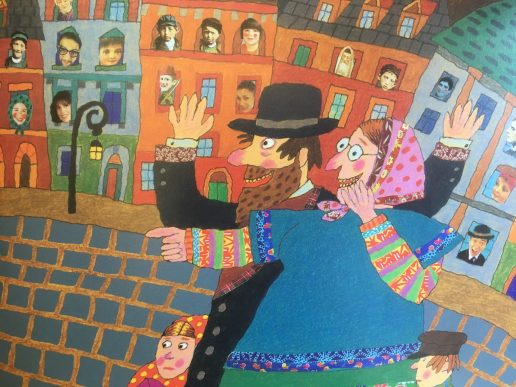
The artwork, by David Diaz, is much more pleasing to me than that in The Pig in the Spigot, another of Wilbur’s books for children which I wrote about here once. Each page is devoted to a letter of the alphabet, with a short verse musing on what would happen to our beloved world if that letter were no more.

After reading the book, then eating dinner, we went on one of my creek walk loops. Immediately we began to practice our mutual love of plants and their names. My grandson is starting to understand that I don’t know every plant, and our nature study is more of a joint effort now, with him not saying, “What is this?” so much, and saying, “Grandma, look!” more.

But he brought up the subject of the alphabet also, as we walked along, saying, out of the blue, “If there were no letter N, we wouldn’t have pain! or lanes! — or extensions!”

Our walk took longer than I planned, because I had forgotten about how it’s our habit to meander and pick things, as I had started out with Liam in Flowery Town years ago.

FT P1090307

We ate quite a few new-green wild fennel fronds on this walk, and even some slightly older ones, comparing the flavor. And several times he reminded me that we must take the route home that passes by the pineapple guava hedge, because he was eager to taste the flowers I’d mentioned.

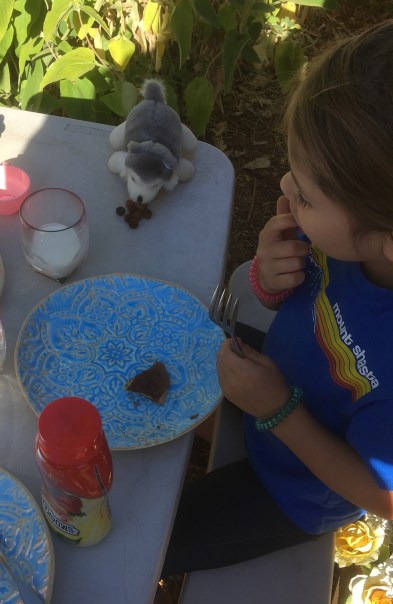
We ate flower petals, and got to bed late, and the next morning the boy picked more right next to my garden dining spot, which he added to our breakfast feast. Rarely is it truly the right weather to eat breakfast outdoors here in my city, and this may have been my first time to do it with company so agreeable.

The middle of this second day was spent at my church, where the end of the children’s week-long summer program featured a long session of water play, and Liam was delighted to get all wet and to eat a popsicle.

Even here, he drew my attention to a tree blooming right above, which I’m sure I’d never noticed before. Our rector said he planted it himself “way back.”

Australian Silver Oak or silky oak, Grevillea robusta

While children were settling down for the Bible lesson that morning, another boy showed me this fly that he was admiring on his hand. I think Liam was already waiting patiently on the other side of the circle so he didn’t see it.

Later that afternoon I had planned to have him help me clean the greenhouse, but then realized he’d like better to pick sweet peas to take home to his mother. I have only a little patch that I didn’t pull out yet. He was diligent about that task for nearly an hour, and collected a large jarful. I made headway on the greenhouse, and we took breaks to study the bumblebees that only recently decided to mob those flowers.

One day we had read Monarch and Milkweed, and the other, I showed him my milkweed plants; the Showy Milkweed is in a jungle behind the fig tree, where I hope, if Monarch caterpillars hatch out, the birds might not notice them…?

Liam helped me to see my flowers without a magnifying glass. As we were looking at some tiny succulent flowers, and I was trying to get a good picture of them, I began to notice little black dots on them. “Are those holes in the petals, can you see?” I asked him. He squatted down and looked hard, and told me that they were things on the ends of hairs coming out of the middle of the flower. Ah, stamens! When I enlarged the photo, I could see, too:

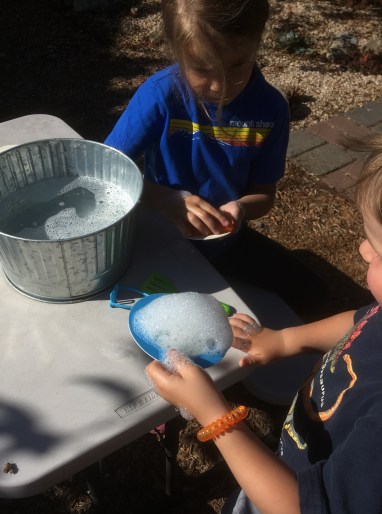
We washed rocks! Liam had been examining and organizing one of my collections of pebbles and stones and such in the house, and out here I had him put these larger stones from the Sierras and from the Sacramento River through some sudsy water and a rinse, so they could wait presentably until I find a use for them.

What other things did we both like to do while he was visiting? Eat ice cream cones, and judge matchbox car races, and read Winnie-the-Pooh. Many times during his last hours with me, lines from Pooh or The Disappearing Alphabet would come to his mind and he would say them again, looking at me with a twinkle in his eye, knowing I liked them, too. He especially liked these from the page about the letter L:

“Any self-respecting duck
would rather be extinct
than be an uck.”

I was so grateful to Liam’s parents for making this intimate visit work out. Next time I see him, he will be more grown up, and a different boy. But probably not all that different. I hope we can always find a way to share our love for words and plants and many more details and gifts of this vast world in which our loving Father has placed the two of us as grandma and grandson.

Recipe with bees and thyme.

One recipe for a Satisfying Day just fell together starting as soon as I woke up yesterday.
It included:

*Waking up early enough to take a walk before church.

*Picking pineapple guava petals from a hedge down the block
and sharing them with a neighbor who was also out walking.
My cousin Anne told me that you can eat them,
and they truly are as sweet as candy.

*Not putting off drudgery such as stretches and floor exercises.

*Managing to stand through most of church (this was easier after having walked, etc.)
and receiving Holy Communion, on the Sunday of All Saints of America.

*Wowing over the catalpa tree at church. Each flower is like an orchid…

*Shopping for garden twine at the nursery across the road from church
and finding seeds as well 🙂


*Talking to my dear cousin Renée  on the phone
while sitting in the garden with the sun on my back.

*Taking pictures of bees on the thyme while talking.

*Sorting through pictures of bees I took before and finding some good ones.

bee on echium
bee on privet

*Eating vegetables.

*Taking more pictures of bees on the echium.

*Sorting through more pictures.

“Friendliest Weed” in my garden is blooming prettily.

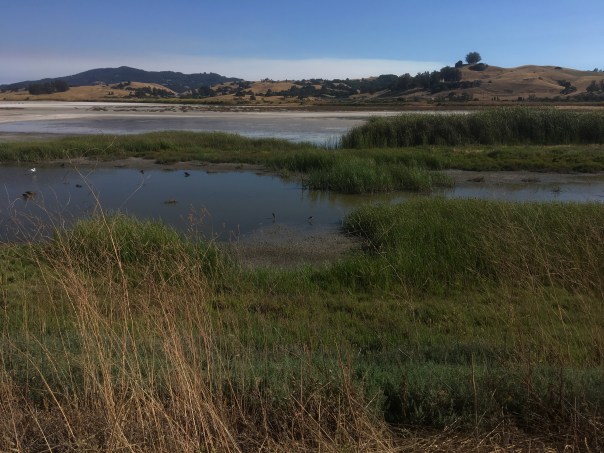
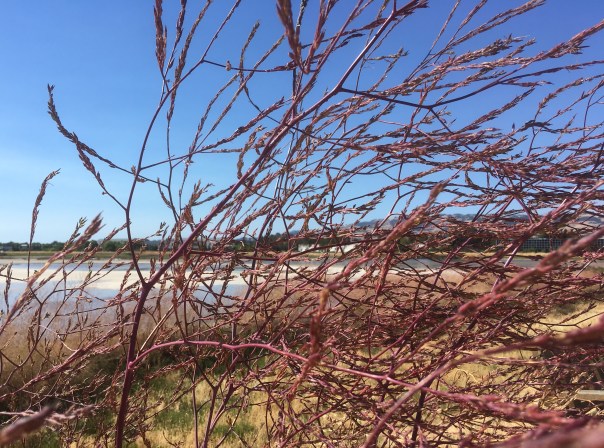
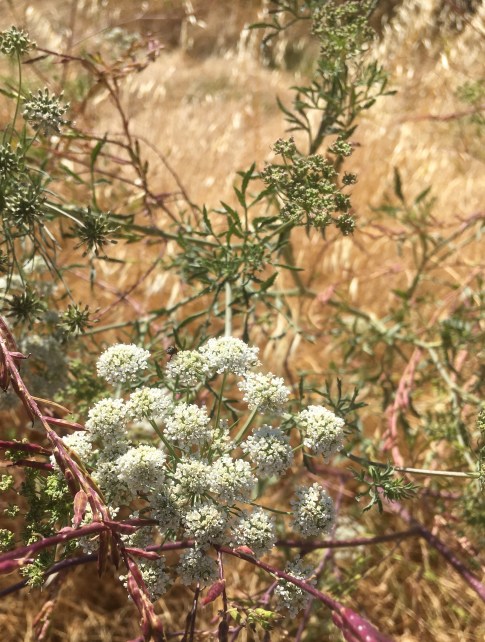
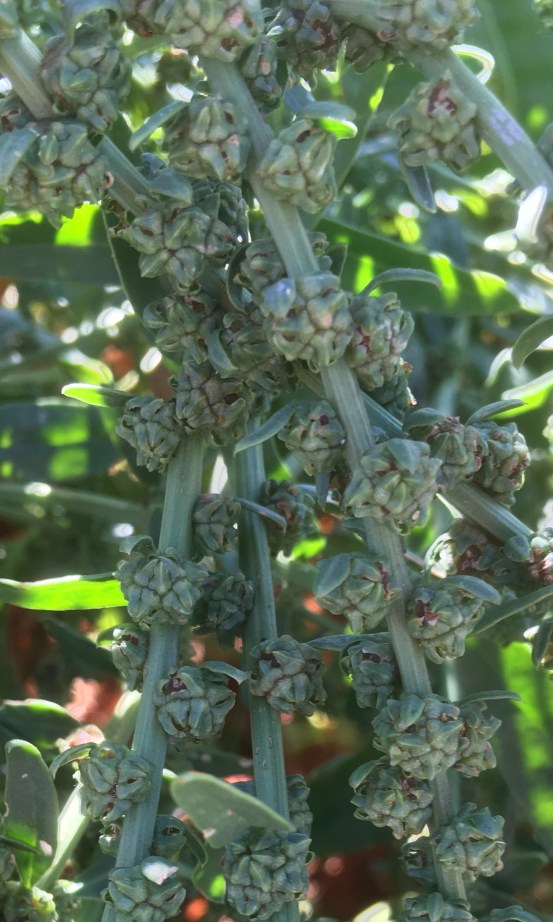
*Taking an evening walk beside the creek and studying the mystery grass again.

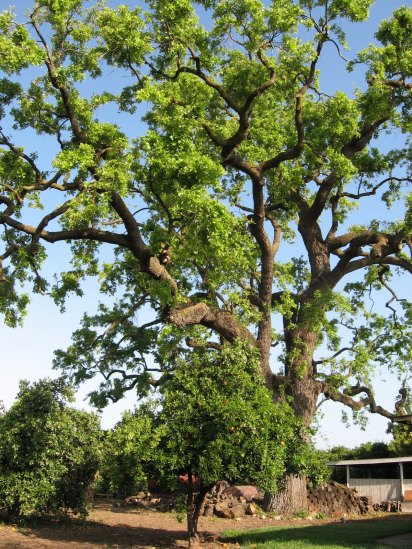
*Identifying a plant in the creek: It’s buckeye! I know buckeye, but only as a tree; I wasn’t used to seeing leggier growth in the creek. This picture shows some of the lighter green leaves of buckeye in the creek, a mature tree above, and even some mystery grass in the middle. I don’t think it’s Timothy grass, which one of my commenters suggested, but it looks more like Timothy than anything else so far:


*Going to bed too soon to finish this post last night,
but early enough to contribute to a new recipe for yet another Good Day!


Her head in the nest.

My latest bee study was this morning, and this busy girl won the contest after I sorted and cropped and compared my many photos. It’s the first picture I have taken of a bee on a blackberry flower. When I realized that, it made me curious as to what all bee-flower interactions I’ve captured before, and I started hunting through my files to create a list of bee pictures. Right next to this one, more bees were drinking at the privet flowers. Soon I will show you one of them, too! But now it’s past my bedtime, and I’m sure the bees turned in a while ago.

Moles fly, and sparrows sweep the sky.

IMG_3260Preface:  I drafted this post yesterday, not expecting to publish it this soon, but today, the occasion of a statewide election day, I was pained to see public pleas and even poems put forth drawing attention to the needs of “art” and “artists” for money and support. I am all for supporting artists whom I admire, but I am also realizing that in the minds of some professional artists, art has become just another “spiritual practice” to support and be supported by that new religion of modernity, politics. So I decided to share this poem, and my short response, on behalf of all you creative people out there, who may or may not know that you are. Art will never not be, and that is a gift.

PRAISE in SUMMER

Obscurely yet most surely called to praise,
As sometimes summer calls us all, I said
The hills are heavens full of branching ways
Where star-nosed moles fly overhead the dead;
I said the trees are mines in air, I said
See how the sparrow burrows in the sky!
And then I wondered why this mad instead
Perverts our praise to uncreation, why

Such savor’s in this wrenching things awry.
Does sense so stale that it must needs derange
The world to know it? To a praiseful eye
Should it not be enough of fresh and strange
That trees grow green, and moles can course in clay,
And sparrows sweep the ceiling of our day?

-Richard Wilbur

This poem was part of Wilbur’s first collection published when he was 26, just returned from World War II. I read it in Poem A Day Volume 3, where it is accompanied by comments from Wilbur himself:

“Aristototle once said, ‘The making of metaphor is the peculiar gift of the poet, the mark of poetic genius.’ This early poem of mine — a Spenserian sonnet, by the way — begins as an impatient attack on metaphor, but by the close has capitulated and become helplessly metaphorical. That’s as it should be, because the likening of all things, the implication that all things are connatural, is of poetry’s essence.”

I like that in the poem, he refers to “uncreation,” i.e., the One who has made “all things visible and invisible,” and from which Source they also come by their likeness one to another. God is the supreme metaphorical Poet from whom we all receive this gift of making metaphors, and most of us think and speak in metaphors all day long. When in the poem we read, “summer calls,” is that not likening summer to a being that can beckon with a hand or voice? To think of our senses as “stale” links them in our mind to flat beer or dry bread. It’s part of the gift of imagination which has the same Source, and another way that we are made in the image of God. Glory to the Father, and to the Son, and to the Holy Spirit!