Category Archives: nature

Looking at snakes.

Having two boys of my own, and eleven grandsons, I have done my share of reading to them books about snakes, a topic on which I probably would never have read one word if left to myself. I’m so accommodating. Last week I even read many pages of a giant book about dinosaurs.

That book mysteriously appeared in my house a year or more ago and I didn’t pay much attention to it until Scout asked me to read it last week. It may have been the most boring read-aloud I have ever agreed to, and finally I said I’d had enough. After he went to bed I threw it in the trash.

Snakes are more interesting, I admitfree-green-snake-wallpaper-hd-wallpaper, because they live on the earth with us and can be observed as they really are. But still….

I sat with the grandchildren twice last week to read the snake book that is in our home library, and I re-learned several things about the reptiles. Doubtless I will re-forget most of the facts we read, too, as I always have done, even when my brain was younger and more flexible. I have read stuff like this for so many years: “Would you believe that a python can swallow a whole goat?…The snake doesn’t chew or swallow the way we do. It simply moves its body forward with its jaws wide open and ‘walks’ the animal down its throat.”

When I imagine this scene, or look at pictures of it, I think about how the snake itself is consumed by the task of consuming. Even the egg-eater, who takes only 15 minutes to finish the job and spit out the shell, can’t go anywhere or sleep or drink water, for the duration. The beautiful green flying snake can’t sense a hawk threat and take off like a spring to escape.

After Scout had gone home I came across a poem about the way a snake eats, and I started reading it with the idea of someday sharing it with him. But when I got to the last stanzas I realized that it was for me, much more than for a snake-fascinated boy. Through this poem’s impact, what I learned of snakes I won’t be forgetting. It might take a python a few hours to eat a goat. My portion is of a different calibration and I only know that I’ll be at it a while.

SLOWLY

I watched a snake once, swallow a rabbit.
Fourth grade, the reptile zoo
the rabbit stiff, nose in, bits of litter stuck to its fur,

its head clenched in the wide
jaws of the snake, the snake
sucking it down its long throat.

All throat that snake—I couldn’t tell
where the throat ended, the body
began. I remember the glass

case, the way that snake
took its time (all the girls, groaning, shrieking
but weren’t we amazed, fascinated,

saying we couldn’t look, but looking, weren’t we
held there, weren’t we
imagining—what were we imagining?)

Mrs. Peterson urged us to move on girls,
but we couldn’t move. It was like
watching a fern unfurl, a minute

hand move across a clock. I didn’t know why
the snake didn’t choke, the rabbit never
moved, how the jaws kept opening

wider, sucking it down, just so
I am taking this in, slowly,
taking it into my body:

this grief. How slow
the body is to realize.
You are never coming back.

–Donna Masini, from Turning to Fiction

 

I soak up homey and farmy vibes.

gl3 NL hat weddingMy travels over a long weekend were for the purpose of attending my nephew’s wedding, held very near my old high school and home in the agricultural middle of California, the Central Valley. If the event had begun any earlier than 4:00 in the afternoon, much sunburning would have occurred; as it was, the two sunhats I retrieved from my car were traded around for a few hours among several of our family group, of both sexes.
At the reception, descendants of my parents, with their spouses, were seated all together at one of the long tables on the grass, and my own clan took up two-thirds of those chairs. No seat assignments had been made beyond assigning us a table, and as I was the oldest — the matriarch? — I sat at one end, what might have been the head of the table. But truly I didn’t sit there very much. The three-year-olds Liam and Ivy kept me busy, fetching drinks or wedding cake, or taking them up front to dance in a circle with me. Do the books on how introverts can survive parties ever talk about the strategy of hanging out with the preschoolers?

It was fun to introduce those two to the aunts and uncles and cousins they hadn’t met since they were old enough to be introduced. “Ivy, this is your Aunt Cairenn. She is my sister; we used to be little girls like you….”  The children were all happy to shake hands and be cordial, though reserved. And my heart filled and was satisfied to see all the love shared among the younger generationsgl3 wedding trees and across generations, even though many of them rarely see each other.
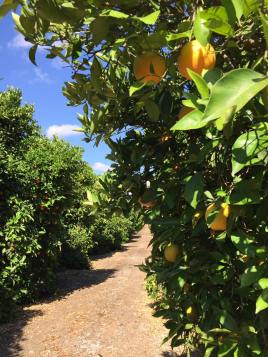
Over the two layover days I spent time at three houses, each situated in the middle of a different citrus grove. Two belonged to my siblings and one was the home of a man I grew up with in a bygone era that seems a short while ago; we used to ride our bicycles between the rows of orange trees and slide down the golden hills on pieces of cardboard. While I wasn’t paying attention, my brother and sister and my friend Dick were learning the art of farming, so that now they can carry on in their parents’  tradition and even in some of their groves.

I had the chance to play among the trees again, this time with Liam and Ivy and Scout, who in the absence of store-bought toys were making do with old oranges that had fallen off the trees, with snails among the dead leaves, and with a trowel in the dirt. The smell of the trees and of the Bermuda grass lawn, and of the soil, and the air that stayed warm into the evening when we watched the Black Phoebes swooping and scooping up insects… All of these sensations and moments added up to create in me a dreamily contented mood.

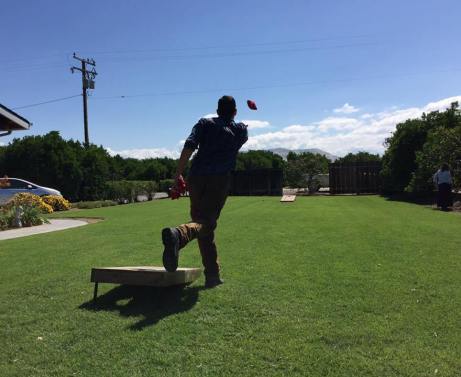
2016 wedding Soldier corn hole DL

mt view-by K crp

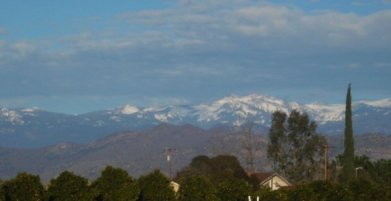
My nephew the groom partly grew up in the same house that I mostly grew up in, that his grandfather built. I stayed three nights with my sister who is another of his aunts; she and her husband farm mandarins and oranges for his mother and for themselves, and live in a house they designed to have a view of the Sierra Nevada much like this one from her neighborhood (taken by someone else).

It was fun to be with country people who are daily involved with plants and animals different from my usual. In addition to the snails and phoebes mentioned above, I learned about or interacted with:

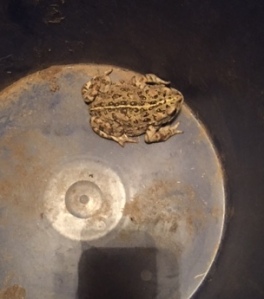
—A frog that I met in the bathroom. It was at midnight and I didn’t want to frog in bucket at nancy's cropbother with him right then, so I went back to bed and he disappeared for two days, during which time everyone teased me about my tall tale. Then he was found in a different bathroom, and I was judged to be sane after all. Here he is in a bucket.
—A house finch who flew down the chimney into the ashes; I helped Nancy use an old towel to surround and collect the tiny bird and carry him outdoors.

—Gophers come down from the foothills in droves to feast on the roots of all the watered orange trees and vegetables, etc. that my friend Dick grows on 50 acres, and their tunnels contribute to the erosion of the sloping orchard land. His son explained all this to me and showed me the traps they put into the tunnels, trying to keep the population of pillagers at bay. It’s a constant and fairly hopeless battle that must be fought nonetheless.

—More snails: Did you know that some snails are carnivorous and eat other species of snails? Yep. The brown snail is a pest in the orange groves, but the Decollate snail ignores the trees and goes after the brown snails. My brother is in the field of citrus research and one nephew is a farm advisor on such matters. I lured them into the grove with my questions and we scratched around under the trees trying to find some Decollate snails so I could remember how they look different. Later I did find an empty shell at my sister’s. You can see one on Wikipedia’s page about them.cara cara vs blood

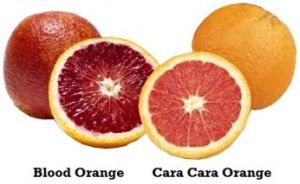
—Pink oranges. Have you heard of Cara Cara oranges? I hadn’t; I must not have been spending enough time with all the citrus growers, because already Sunkist is selling lots of Cara Caras — they are mainstream. Friend Dick is growing them, as well as…

—Berries: I had brought with me boxes of blueberries from Costco for a family breakfast, fruit that seems to have been grown in Salinas, California, not far from the coast. But even in the hot Central Valley they are growing blueberries now, more of them than are produced in any other area of the U.S. I learned about this from Dick as we stood on a patio overlooking his garden, and I could well imagine how the earlier spring might sweeten up the fruit. His son ran down and brought back some blackberries bigger than my thumb and mm-mm….yes. The flavor lingered on my tongue as I drove away.

Another nephew is marrying in October, so I will have a good reason to visit again and soak up the vibes of my childhood stomping grounds, and chat with farmers about their crops and the weather and the birds. I know that time will be here before I know it; I should read this post again about a week before my departure, to remind me of the joy I am likely to have once again.

Xerophytes

GL P1020377
manzanita


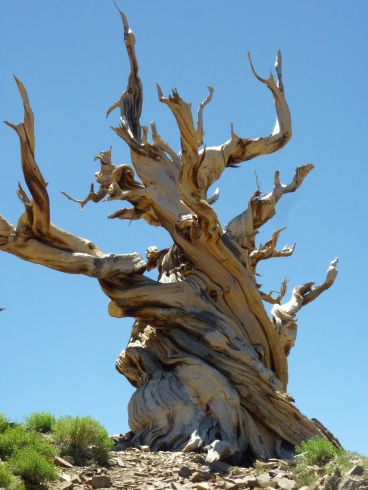
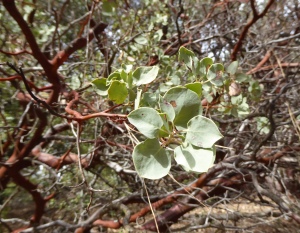
Xerophytes are plants that are xerophilous, which means they have special features that enable them to survive in very dry environments. One of my favorite xerophytes is the Bristlecone Pine, which I wrote about some years ago, calling them Gnarly Patriarchs.

P1070019
gnarly patriarch

Some of the plants in my home landscape are considered to be xerophilous, though to maintain a xeriscape such as I have it is not necessary to have nothing but xerophytes. A xeriscape, in addition to featuring drought-tolerant plants, uses deep mulches and other means of conserving water besides those that are built into the plants themselves.

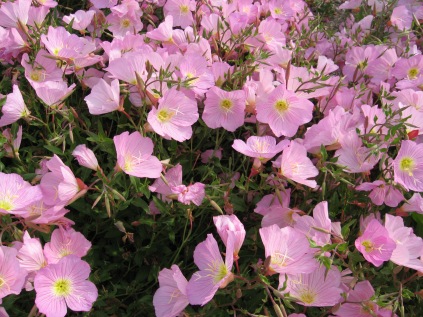
In a patch by my driveway, enclosed on all sides by concrete, Mexican Evening Primrose blooms and thrives all summer with a little water once a month or so. It thrives so well that such an enclosed space as it lives in here is usually the best spot for this plant, unless you are okay with it taking over the whole garden.

Mexican Evening Primrose
IMG_0280 toadflax w warrigal
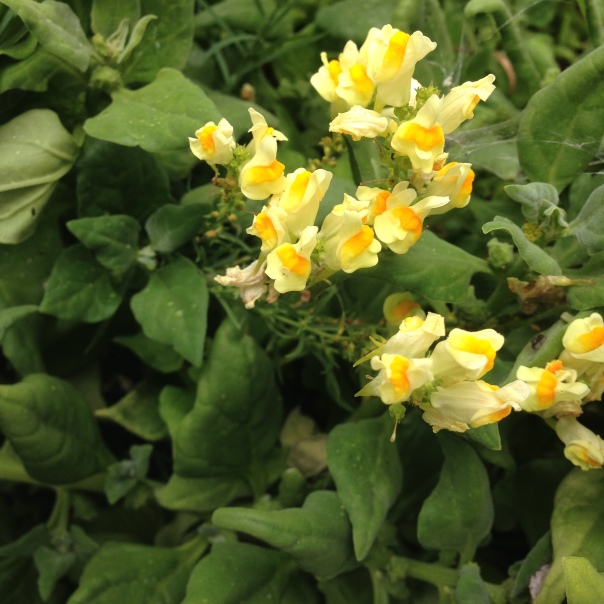
toadflax – Linaria vulgaris, with warrigal

The picture at right is of warrigal or New Zealand Spinach, an edible green, growing alongside a yellow mystery flower [since discovered to be toadflax], both of which I consider quite xerophilous, as they lived in my back yard for months last summer with no water, and never so much as wilted.

That root xeros comes from the Greek, for dry. My current project is to incorporate more of these unthirsty friends into a plan for my front yard, and I hope to have them planted by the fall.


violets

gl P1040398crop2edThe Cape Violet or Nodding Violet Streptocarpella seems to have everything it needs now, in order to be happy. I have the larger, original one that Mrs. Bread gave me as a little start, and its daughter that I grew from a branch that I accidentally broke off.
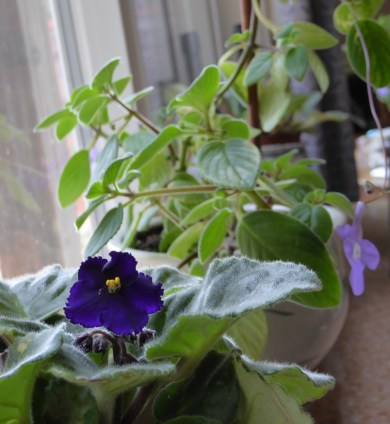
The larger one is on the dining table by the window, where daily it decorates the pysanky below by dropping its yet pristine flowers. Someone decorated the violet itself with a branch from Palm Sunday stuck into the dirt.

It’s hard to find the Streptocarpella online if I look for “Cape Violet.” They seem most often to be known by their botanical name. They are a subgenus of Streptocarpus which are called False African Violet.

The younger plant is on the windowsill near the (True?) African Violet that beautified one of my birthday party tables and is on its second round of blooming since then.

gl P1040401

Currently I am keeping five plants in the house, which is very unusual for me. I’m much more comfortable growing things outdoors where, unfortunately, you can’t grow all things beautiful and expect them to make it through the winter. You can’t expect these violets to make it through the summer in a sunny greenhouse, either, even if I do get a shade for part of the roof.

In the meantime, we get by with a fairly roomy windowsill. 🙂