Category Archives: nature

March colors, surprises and celebrations.

ceanothus blue so hemI took a long walk around the neighborhood this morning. If I had brought my camera, I’d have more pictures to post, but then the prayer and exercise benefits of my outing would have been greatly reduced, so I don’t regret not thinking of it.

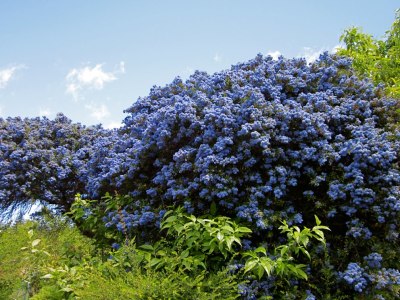
I noticed fuzzy chamomile plants close to the ground, and the cobalt blue ceanothus bushes such as we used to have at our former property. Many types of ceanothus grow wild in California but you can also buy them at nurseries. The picture above shows the color that is blooming around here right now.
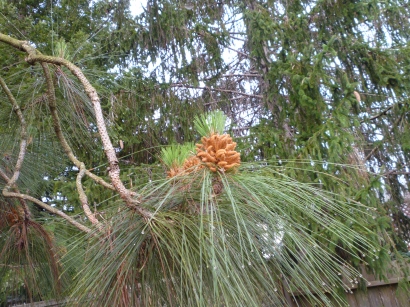
pine cone forming 3-15 March is the month of our wedding anniversary, which makes it the month that we have many times made day or weekend trips within northern California to celebrate. Usually some blue bushes are flowering in the places we are visiting, and we are outdoors a lot walking or looking from highway overlooks. Maybe this is one reason that blue flowers have long been my favorite.

For example, Pride of Madeira (Echium candicans), which I first noticed decades ago in Big Sur. It can grow in our county and we even had one on our church property for a while, but they must not thrive here. The picture at bottom I took last year in Cambria.
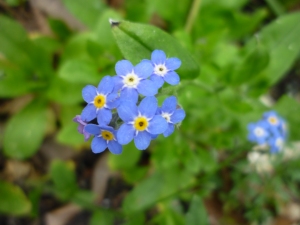
P1120593 forget-me-not 3-12-15
forget-me-nots in the garden

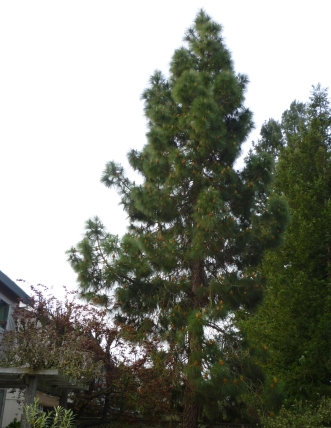
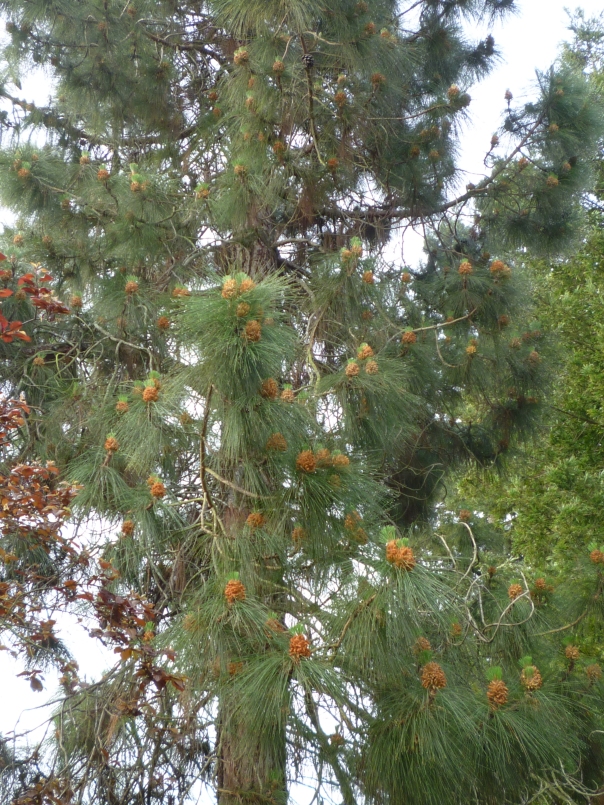
At home this morning the pine cones that are forming in our big tree caught my eye. It seems to me there are double or triple the number of them that have grown there before — or maybe it is just my imagination.
P1120545crp

Is there some climactic condition that could cause this, say, severe drought that makes the tree feel that it is dying, and ought to get busy and reproduce? I’ll have to ask the children if their memories are different from mine. I still don’t know what kind of pine this is. The task of finding out needs to go on a project list that is buried somewhere here. It will be a small project just to find it.
P1120548 cones

The children I want to consult with, all five of them, will be here celebrating with us this month – we’re letting them do the traveling this year. It’s not like the early years when we had to get away to be alone. Nowadays being alone is the usual thing, and we are thrilled when any kids converge on our house.

Mr. Glad and I sat in the back yard this afternoon, on a bench in the sun. If I have many more days in which I accomplish both a walk beside a creek among the trees and sitting in the sun, I may find that I don’t need the Christmas lights that are still shining around my kitchen window.
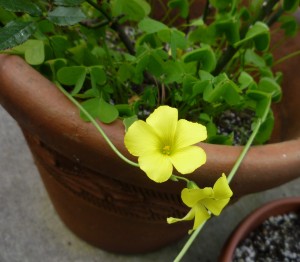
sourgrass 3-15 crp

While we were relaxing and facing my potted plants, it suddenly dawned on me that sourgrass was living and blooming in the miniature rose pot. When did he move in? I don’t remember having sourgrass anywhere on our property in all the 25 years we have lived here. Maybe a bird dropped in a seed.

Another new thing is the Christmas cactus in bloom. The story behind my cactus is long: Friend May and I had both admired the mother cactus in our friend Jerry’s house for decades. It was a prolific bloomer and it was a huge potted plant on wheels, taking up a space about 4′ x 4′, with most of that measured out by long arching stems. When Jerry moved to a retirement home 3-4 years ago, May gave me a big chunk of his cactus plant with roots.

But I don’t have the wall of windows Jerry did, or any sunny and convenient indoor place for houseplants, so I moved my piece of cactus from place to place outdoors, and under the eaves in the winter. I made many cuttings from it and managed to give at least one away before they died of neglect. Last month my sister told me that her grandchild of the Jerry cactus was blooming beautifully on the central California coast, which was a big relief to me — my guilt at not providing a nurturing home for my adopted child was assuaged by knowing that the next generation was prospering.
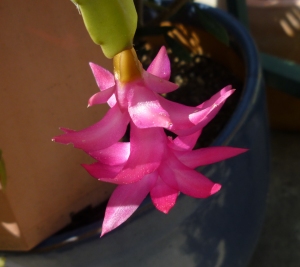
first Thanksgiving cactus bloom 3-15 JerryNot a week later I walked past the corner of the utility yard where my poor peaked plant would have gone unseen as usual if its flower buds hadn’t glowingly called up to me, “Look at us!” I was shocked and blessed no end, and quickly moved “her” to a sunny place. Now that my cactus has shown a desire to perform, I am endeared to her in a new way and have named her “Tylda,” after Jerry’s late wife.

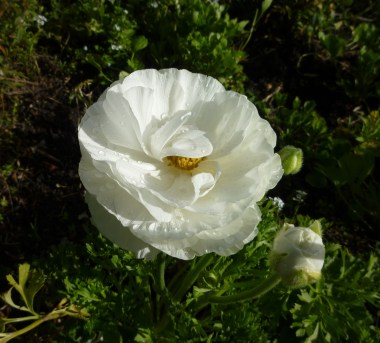
pride of Madeira cambria 14

This site tells how to care for these plants, and it showed me that this one is not a Thanksgiving cactus as I had previously thought, but a Christmas cactus. It also says that they require cold temperatures to spur them into blooming. So perhaps it’s not a bad thing that I left it outdoors. I’m thinking of ways that I can be a better houseplant owner in the future.

But this month, it’s the outdoor plants for me, and I do enjoy whatever colors they are dressed in when they bloom. But especially blue.

Clouds rain and vanish.

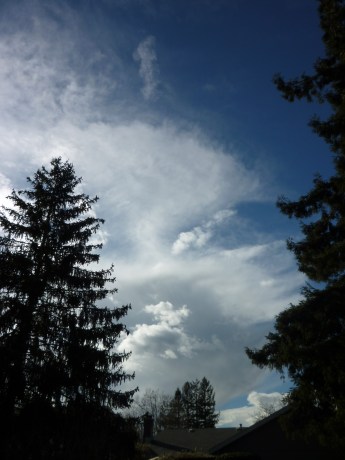
GLP1120486 explosion crpWe got a little rain today, but it was pretty much over by early afternoon, and while driving home from an errand I was feasting on the fantastic cloud formations spread all over the sky.
It might have been nice to go to a hilltop to capture them with my camera, but what turned out to be good about staying on the flats, standing in the middle of the street or in the back yard, was that I didn’t have to take all the pictures at once. I shot a dozen, did some laundry and kitchen work, and then it occurred to me that the clouds would have changed, and I could get different views, so I went outdoors again (also noticing flowers).

GLP1120492Several times I did this and out of the batch I kept a few that are sort of interesting, but really, what is a cloud if you can only experience it out of time, flat and tepid and in the still air of another place not its own?
I took Annie Dillard’s For the Time Being off the shelf so I could look up all the sections labeled “CLOUDS” that are scattered throughout the book. The first one is this:

CLOUDS – We people possess records, like gravestones, of individual clouds and the dates on which they flourished.

In 1824, John ConGL P1120493 cotton & treesstable took his beloved and tubercular wife, Maria, to Brighton beach. They hoped the sea air would cure her. On June 12 he sketched, in oils, squally clouds over Brighton beach. The gray clouds lowered over the water in failing light. They swirled from a central black snarl.

In 1828, as Maria Constable lay dying in Putney, John Constable went to Brighton to gather some of their children. On May 22 he recorded one oblique bluish cloud riding high and messy over a wan sun. Two thin red clouds streaked below. Below the clouds he painted disconnected people splashed and dotted over an open, wide coast.

Maria Constable died that November. We still have these dated clouds.GLP1120480 freesias rain

I don’t think so. Maria and John were made in the image of God; they were from the beginning, and I believe they remain, more Real than clouds, the paintings of which are paltry substitutes for what the real things so briefly were.

On another page Dillard quotes John Muir, who while exploring the Sierra Nevada in California in 1869 wrote about several cloud formations he saw, and mused,

“What can poor morGL-P1120516tunnel & peakstals say about clouds?” While people describe them, they vanish. “Nevertheless, these fleeting sky mountains are as substantial and significant as the more lasting upheavals of granite beneath them. Both alike are built up and die, and in God’s calendar, difference of duration is nothing.”

The poor mortal John Muir certainly did say something about clouds when he made that striking comparison…and some things about God and the nature of earthly and heavenly materials — it’s too crazy much for me to think about at the moment.

But if you like to look at clouds such as Muir would have seen in Yosemite, you can do as I have and visit the Yosemite Conservancy page that features several webcams with frequent gorgeous cloud shows. The Park Service also has these cameras. It’s best to visit when you know a storm is brewing up there, not like today with its view (below) of drifty vapors.

GL turtleback webcam 2-28-15

I liked what my godmother said about clouds when I told her about my cloud pictures. She had just read a Lenten meditation by Elder Nektary of Optina, who was speaking of how on the Last Day we will be “carried on the clouds.” We read the same thing in the Bible in I Thessalonians 4:

…For the Lord Himself will descend from heaven with a shout, with the voice of the archangel and with the trumpet of God, and the dead in Christ will rise first. Then we who are alive and remain will be caught up together with them in the clouds to meet the Lord in the air, and so we shall always be with the Lord. Therefore comfort one another with these words.

I will indeed comfort myself with this word from the Father, so that in the future the cloud shows I see will not only be thrilling but remind me that as fleeting as this life may be, at the GLP1120478 ranunculus rainResurrection of the Dead I will be transported splendidly to my permanent and eternal and most substantial home.

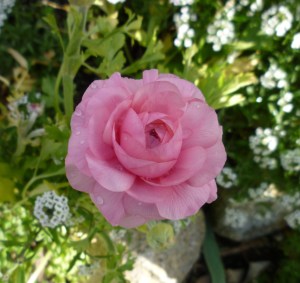
Flowers last a tiny bit longer than clouds (but not nearly as long as granite). This afternoon I “recorded” some of them as well, still sparkling with raindrops.

It turns out that Kim was spending her afternoon in a similar fashion but she was speedier than I at filing her records of blooms and clouds. I hope you all get to enjoy your own living, breathing shows of earth and sky whether or not you try to memorialize them.

GL P1120520 sky 2-28-15

God bless the moon.

I am becoming friendlier with the moon. Our growing relationship is the result of my being prodded by things I read on three different blogs in the last year. Hanging Out the Wash by Adair Lara (recommended by Kim) was the final push that brought it all together, with one simple line in a book full of simple, obvious but needed suggestions as to how to “find more in less” and to “come home to ourselves.” The tip: “Start reading the weather page.” People debate about whether the phases of the moon affect weather patterns, but that is not really why that advice motivated me. It’s just that the moon and its changes are part of my everyday physical environment just as the weather is.

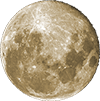
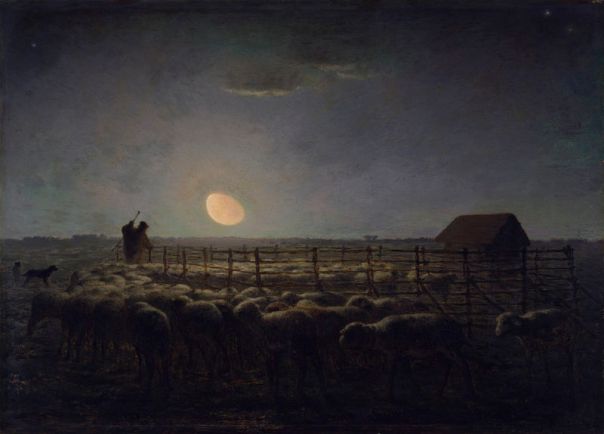
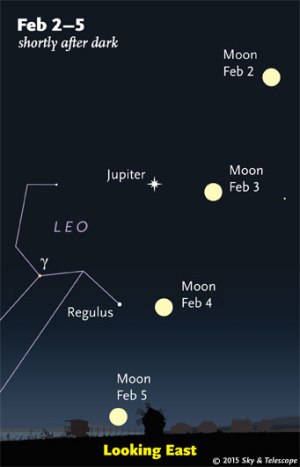
Jody told us about the astronomy site Sky & Telescope on which you can leamoon Feb 15rn what is going on in the sky week by week. I found the lovely painting at the bottom of this page on that expansive website. At left is an example of one of this week’s graphics.
Jody has all around her on the prairie some wide-open spaces without the intrusion of street or city lights, and I can tell from reading her blog that she has made good use of her opportunities.

I don’t think that my urban dwelling is an excuse for ignoring the sky, though. I can at least see the moon, when weather permits, and after I found out when the next full moon would occur it changed my whole week; I have been looking forward to this night (Feb. 3rd in the Western Hemisphere) when the full moon will occur. It so often happens that Mr. Glad and I will say to one another, “Doesn’t the moon look lovely! Do you think it is full tonight?” And we study and try to know if its shape is perfectly round or not, and we never can decide. But this week is different! As I drove home from Vespers on Saturday there was my friend the Man in the Moon smiling down on me, looking just a little lopsided as was to be expected three days ahead of his fullness.

sun moon and earth - heath

Sun, Moon and Earth by Robin Heath I read about on a blog and ordered by mail. It is just a beautiful little book that tells us how “Every organism on Earth responds to four major cycles: the solar and the lunar day, the synodic month, and the year. We all dance to these primary rhythms. This book reveals the poetic cosmology….”

But it is a little book with correspondingly small diagrams of the movements of our huge sky. I discovered long ago that when I am forced to write in a small space it pinches my creative mind, and I am now thinking that my poor brain was similarly unable to process the meanings of these pictures — perhaps if the images and diagrams had been about 10x larger … It’s a nice size to take on a camping trip, however!

I will digress here from talking mainly about the moon, to a philosophical consideration of celestial bodies from G.K. Chesterton, who in his book Orthodoxy compares the sun and the moon.

“The one created thing which we cannot look at is the one thing in the light of which we look at everything. Like the sun at noonday, mysticism explains everything else by the blaze of its own victorious invisibility. Detached intellectualism is … all moonshine; for it is light without heat … that transcendentalism by which all men live has primarily much the position of the sun in the sky. We are conscious of it as of a kind of splendid confusion … a blaze and a blur. But the circle of the moon is as clear and unmistakable, as recurrent and inevitable, as the circle of Euclid on a blackboard. For the moon is utterly reasonable; and the moon is the mother of lunatics and has given to them all her name.”

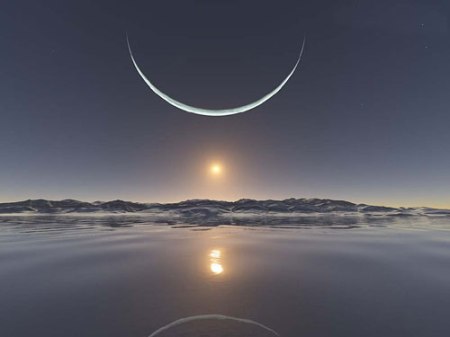
If we want to consider the lack of heat of the moon, here is an image as cold as it might ever appear, above a sunset at the North Pole. It’s one of many downloadable astronomy pictures on this site.

moon north-pole sunset

As to Chesterton’s assertions: I could not stop myself from posting that paragraph because of my fondness for thinking about symbols and metaphors, and he is using the physical realities of the sky to show the richness of our life and faith. As a symbol, the moon may be set against the sun, but as physical things they are both welcome parts of our everyday lives. Right now I am considering — and loving — the moon merely as itself, and a better quote for that is:

I see the moon,
And the moon sees me.
God bless the moon,
And God bless me.

There is nothing cold and intellectual about that. It’s a sort of poetic cosmology I can appreciate, in which every bit of the Creation speaks of our common Creator and Father, and is part of our earthly home — even the moon that is above the earth, looking down on us, as it seems.

au clair de la lune

This picture from the Book House volume Nursery Friends from France that impressed me as a child also evokes the familiarity and even homeyness of the moon for the song, “Au Clair de la Lune.”

Two more places I found to help me learn more about my friend:

pop_full_moon Feb 3

Moon Giant  tells us the exact time of day when the moon is full for each time zone. On this page I had to learn what Coordinated Universal Time (UTC) is; Wikipedia let me know that it is “one of several closely related successors to Greenwich Mean Time (GMT).”

And the almanac shows the calendar for every day of the month, which I like best of all. The sliver of crescent moon, such as Jody caught in her photo, always enchants me, and on this calendar I can see when it will be in that form.

This possibly older version of the rhyme above expands on the meaning of the moon for us humans:

I see the moon and the moon sees me
Down through the leaves of the old oak tree.
Please let the light that shines on me
Shine on the one I love.

This is the moon we have in common with everyone who’s ever lived on the earth, the way we drink the same water that’s been ever recycled. One time when I commented on having seen the moon my husband teased me, “It’s the same moon that’s always been there.” I began to think about how I share the moon with my great-great-grandparents, with John Muir as he saw it from the mountain peaks, with Galileo and with our Lord as He walked the earth.

Of course that light shines on the ones we love.

Jean-François_Millet_-_The_Sheepfold,_Moonlight
Jean-François Millet, The Sheepfold, Moonlight