I have loving gifts and greetings from my dear children all around me today, though I didn’t have any of them present in the flesh. My husband’s taking me out to dinner soon to celebrate — and this morning it was wonderful to be in church, and hear a homily about the Samaritan woman, whose heart was open to Christ and who became a missionary of the gospel.
Cerinthe grows like a weed.
After the Agape Meal that we always have after the service, we heard a guest speaker, a priest who helped translate a recent book about Elder Paisios of Mt. Athos, who reposed in the Lord in the 1990’s.
One thing Father Peter said that impressed me was about the different perspective that an Orthodox ethos gives a person. He said that in Greece, for example, where people are raised with this background, even if they are not currently living out a Christian faith, they may unselfconsciously have Christian ideas about some things.
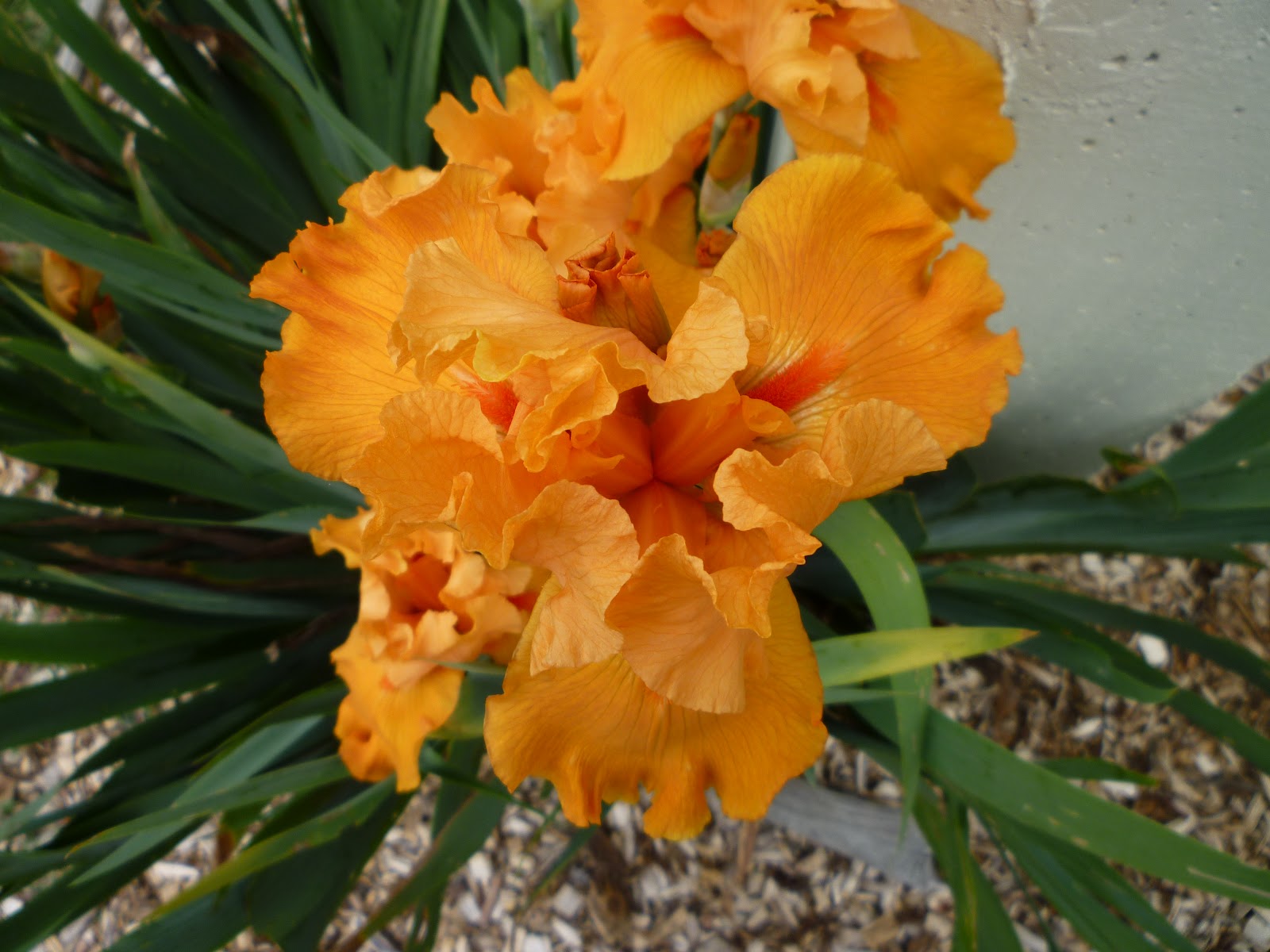
Bearded Iris
Modesty, for example. Here in the United States, the concept of modesty carries for many people connotations of old-fashioned or conservative, but when someone raised in a culture infused by the church thinks of modesty, he thinks immediately of Christ’s mother, the Theotokos — a person, and not a concept. What a blessing God gave me in this word on Mother’s Day!
Before church, and afterward, I couldn’t help but stop to take pictures of the flowers that I no longer have the job of caring for. Pearl sent me a vase of flowers for Mother’s Day, which I have on the table nearby, and God gave me these as well, just a few examples for today of the beautiful gifts he has given me my whole life through, including that of the experience of motherhood, the gifts of five children, and soon-to-be eleven grandchildren. What can I say about this except that it is astounding?
A (probably belated) blessed Mother’s Day to all of you!
The greatest pleasure and thrill of Christmas can’t be had without a little waiting, something like children of yore had to do, when their Christmas trees weren’t even ready for viewing until Christmas Day.
That thought is on my mind as I say Hello! to all the friends I see here at Pom Pom’s Childlike Christmas (blog) Party, a party for which we can show up four times over the next month! I had barely noticed the open invitation, with no time even to lay a finger aside of my nose, when she added me to the published guest list — I was signed up! I am happy to attend, Lord willing, by posting a blog each Wednesday.
It seems to me that the way we Eastern Orthodox Christians get into the Christmas spirit can be combined with the theme of children and simple pleasures that Pom Pom describes:
“Yesterday I asked my students, ‘Why the big greed festival over the holidays? Aren’t we fine right now? Don’t we have enough?’ …Here at Pom Pom’s Ponderings, we are going to think about the simple pleasures of the holidays, the childlike wonder that doesn’t involve the ka-ching ka-ching of the cash register….four holiday Wednesdays of posts that attend to the simple childlike thrills of Christmas. ….that babe in a manger and the children He loves and cherishes.”
The modern world likes to jump into Christmas immediately after Halloween or Thanksgiving, but the more traditional way to celebrate involves some Anticipation and Preparation. Children might think of it as Waiting and Getting Ready. Some of us have been in Advent, which we call the Nativity Fast, since November 15th.
I’m not experienced in helping children to forgo the treats that are pressed upon them in every shop and neighbor’s house at this time of year, but even before I found the Church and its traditions I tried to keep the family thinking ahead to a special Holy Day, and not just because of the presents.
We need some weeks to sing “O Come, O Come, Emmanuel!” and for it to register in our minds that God’s people had to wait many generations and thousands of years for the coming of the Savior. A little bit of suffering in the form of doing without the usual quantity of food, or rich foods, (in the Orthodox Church we eat less, and almost vegan, when fasting) can make it more real for us that the world before Christ was suffering under the curse of sin. We feel our own weakness, too, when eating less, and that can soften our hearts.
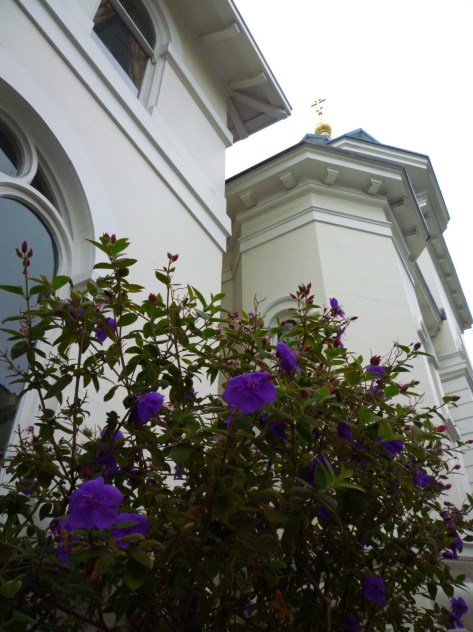
Why the photo of Holy Trinity Cathedral above? My church and sister churches sponsor Advent retreats every year, usually a day or half a day when we can hear a lecture and attend services together to help us focus on the coming feast in a fruitful way. Last year I went to one at Holy Trinity and took the picture. (By the way, I saw the same flowering plant at a winery last week and still don’t know what it is.)
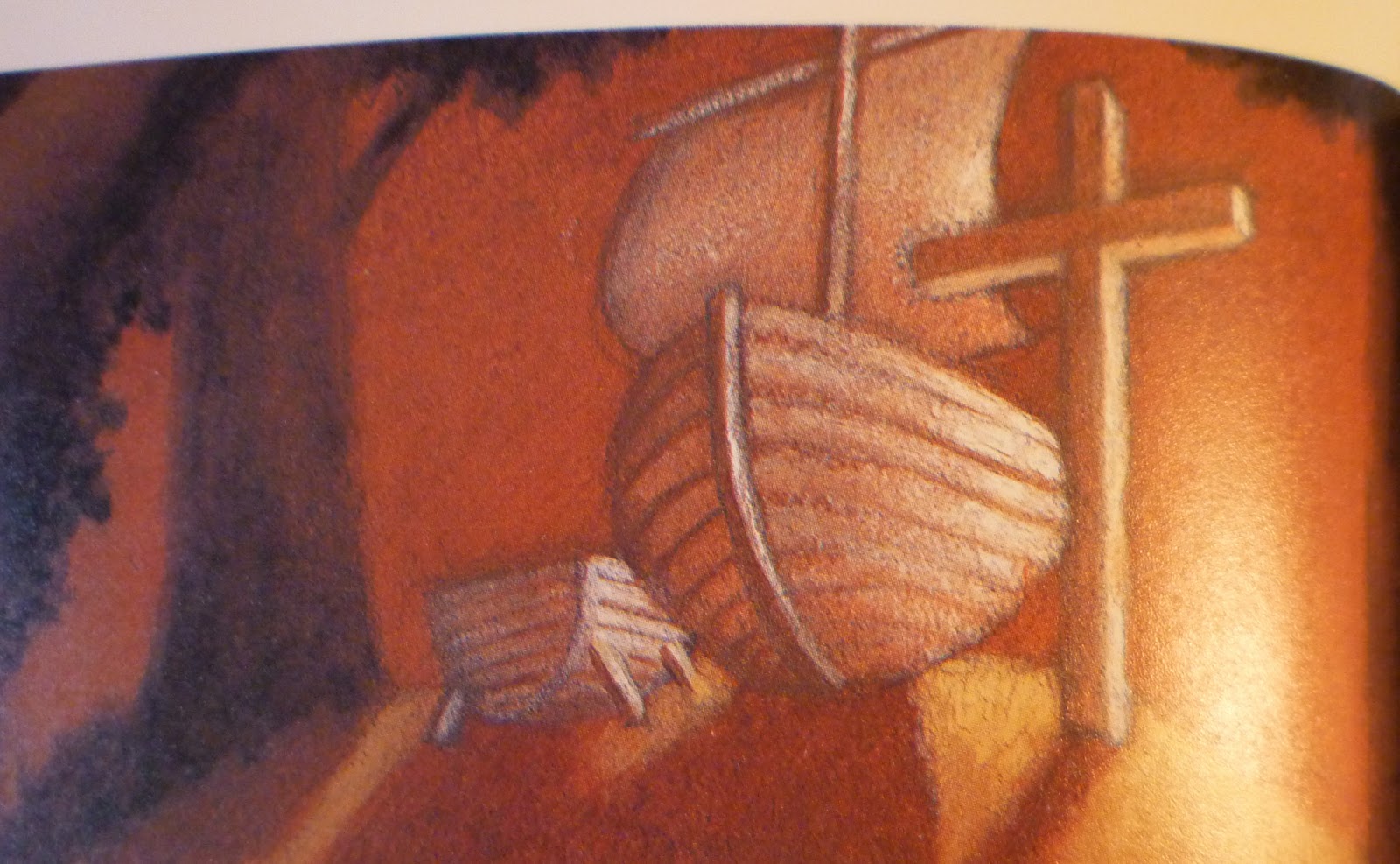
One children’s book that might contribute to a child’s understanding of time and the processes that are necessary preliminaries to accomplishing a goal, in particular a few points on the timeline of our salvation history, is The Tale of Three Trees, “a traditional folktale retold by Angela Elwell Hunt with illustrations by Tim Jonke.”
Three small trees stand on a hilltop and dream about what they might do when they are grown. One wants to be a treasure chest, one a sailing ship that carries kings, and one just wants to stay where it is and point to God.
It takes many years for them to get big enough to be cut for lumber and fashioned into items that play a part in the earthly life of our Lord. The first tree is made into a manger — and this first creation of wood that the Christ Child came in contact with establishes the story as one for Christmas.
All the trees feel initial disappointment and humiliation, none more so than the one that is made into a rude cross and used for violent purposes: “She felt ugly and harsh and cruel.” But in the end all of the trees realize the blessedness of being used for the glory of God, and the young reader is reminded of the reason a Baby was born at Bethlehem.
Even our Lord Jesus went through a period of preparation, growing up as a man for 30 years before He began His ministry, but He surely wasn’t idle during that time. As we wait for Christmas we can prepare our hearts by prayer and fasting and acts of love.
Those of us with families are blessed to have many possibilities under what might be the Acts of Love category. (They might even include some noise of cash registers, but I won’t say any more about that at this party.) I know I have cookie-baking, doll-clothes-sewing, decorating and menu-planning and making up beds on my list.
The truth is, I’m not very good at being child-like before Christmas. I feel so many responsibilities that children don’t have to concern themselves with, and I get pretty busy with all the fun type of preparations.
Somehow, though, all of that, when combined with participation in the church traditions and services, adds up to make me feel some of the longing and the weakness that are appropriate right now.
I’ll post on Wednesdays more about some of the simple pleasures that our family has enjoyed over the years, even while remembering that the fullness of joy, the acting like a child, will start on December 25th. And won’t it be wonderful!
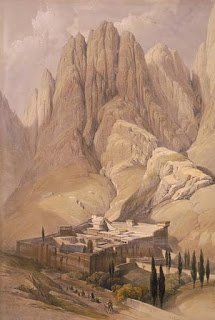
Last night Mr. Glad and I traveled with some friends to Berkeley where we heard a lecture by Father Justin Sinaites, who is the librarian for Saint Catherine’s Monastery in Sinai. Those few words that name his job send me into a realm of thoughts which tumble over each other and in their layering seem too high for me. The history, the theology, the parchments…the prayers in the desert….
St. Catherine’s was founded in the sixth century by the Byzantine emperor Justinian and is the oldest Christian monastery in continual existence in the world. The collection of ancient manuscripts there is surpassed only by that of the Vatican.
Currently Fr. Justin is in charge of the project of digitizing all of these documents and illuminations, including the famous Codex Sinaiticus, written in the 4th Century and considered to be one of the best Greek texts of the New Testament. The monastery’s goal is to eventually make everything available in very high resolution, using such tools as one we heard about at the lecture, a donated camera that is “the size of a small room.” This kind of sharing will also protect the valuables by minimizing the handling of the originals.
The librarian is a native Texan and the first American to be a resident monk at St. Catherine’s, where he has lived since 1994. Before that he was a monk at a monastery in Massachusetts for 20 years. But in spite of his age, experience and technical modernity, he seemed to have a childlike joy about him when speaking about the history of God’s dealings with men, and on the focus of the talk, the typology of the Bible and the Tabernacle in particular.
During his lecture he showed us slides from the 6th-century work Christian Topography, which is full of illuminations of the tent that Moses was instructed to build according to strict instructions from God. Cosmas Indicopleustes, a man who had done quite a bit of traveling compared to most people of that time, wrote the book, and he included all these pictures of the tabernacle and its parts and contents because he was trying to conceptualize the world and was convinced that the Tabernacle was the key to understanding the whole universe.
I’ve heard about the symbolism of the Tabernacle in Bible studies and sermons throughout my adult life. Books have been written on all the meanings of the type of wood used, the colors, the candlestick, the carvings and the cherubim, the mercy seat. In the New Testament it is hinted that there is so much to be said about all of it that the apostle in his letter to the faithful doesn’t have the time even to begin. We do know that it speaks to us of God.
Orthodox tradition sees the Virgin Mary as prefigured in the Tabernacle, because she mystically contained the Son of God, “Light of Light, True God of True God…of one essence with the Father.” And Fr. Justin clarified, “The tabernacle did not confine God, but it was the dwelling place of God as an icon.” So, too, we are all “called to be priests and to offer ourselves as vessels and lamp stands.”
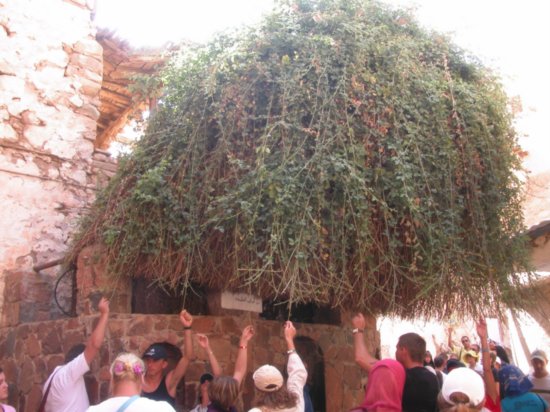
The bush at St. Catherine’s
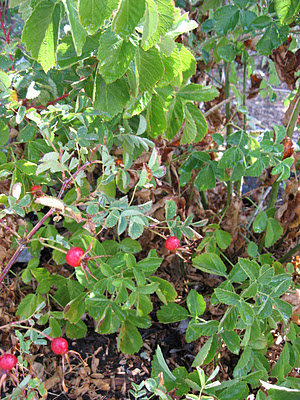
A few years ago there was an article in Parademagazine about Father Justin and the monastery, in which the burning bush is discussed. St. Catherine’s is believed to be the site where Moses beheld the glory of God in what some prefer to call the Unburnt Bush. Last night one of my former fellow gardeners at church took the opportunity to ask the monk what is the binomial, meaning the two-part botanical name, of the bush, of which we have a descendant living on our parish grounds; Fr. Justin said it is rare to have success rooting cuttings from the one at St. Catherine’s.
Below is a photo I took of our burning bush. Its leaves are the larger ones in the picture, and the smaller grayish leaves and hips are of the Nootka rose that grows in a planter with it.
rubus sanctus with Nootka rose
The monks are happy at the potential for more widely sharing the manuscripts with scholars everywhere. And nowadays they welcome numerous tourists and pilgrims to the holy place itself, knowing that the God who has blessed it and them is the spiritual food people need. In fact, in the the last 50 years, as our lecturer put it, “The whole world has come rushing in.” Especially in the winter months the monastery has as many as 1,000 visitors a day. The challenge is “to keep a spiritual tradition that was born in isolation when that isolation has come to an end.”
If I ever journey to Egypt, I hope to join the masses thronging to that place.
The beach cottage is next to a creek that forms a lagoon at this time of the year, cut off from the frigid Northern California ocean water by sand dunes and therefore swimmably warm, if you don’t mind the algae.
The whole place is full of memories for me, going back more than 20 years to the first time I was here with our children, who with their homeschooling friends built rafts of driftwood and punted around, while their baby sister crawled through the sand.
Those are abalone shells lined up on the fence.
We’ve come many, many times to this sleepy village, and this week it was to be with our friends who lived full-time in the house for a spell but now only vacation there. Mr. Glad and I are normally just a couple these days, but they were lucky enough to have four of their five daughters with them.
No sooner had we arrived than I discovered the fuchsias and Chinese firecrackers that had enthusiastically taken over the mostly untended yard. They make you think you are in a tropical paradise, until you look up and notice the fog and the golden hills.
In the background of the third fuchsia pic, you can see the wild fennel reaching for the skies. A lot of it has already dried and is getting mildewed.
The fields of rattlesnake grass a block away also contradict the tropical theme. I picked bundles of the stuff before I came to the conclusion that it’s really past its prime and that I should just come back next June to get it when it is still green and the “rattles” are whole.
Sand Art by Mr. G
We packed up some cheese, French and Italian breads, and watermelon, and drove up the coast to another beach just for fun.
One can’t easily predict how grey and cool the days will be out there, but we expected the sun to come out by the afternoon, and we pointed out the little patches of blue we could see here and there near the horizon.
At least it wasn’t terribly cold, though I did keep my sweatshirt on all day. The fog did not lift, but the sun burned some young chests right through it. And I was so happy and busy smelling the seaweed and the beach plants that I didn’t even notice the weather change that never happened.
Some of us took a walk along the bluffs, where I found so many interesting things to see and click my camera at, including stickers and a minty purple flower that filled the low moist places.
Rattlesnake grass and cow parsnip
When we returned to the cottage it was to cook together and cozy up with a big dinner and loving camaraderie — lively talk and laughing followed by sitting on couches and in rockers. Mr. G and I couldn’t help ourselves, taking lots of pictures of the girls so clearly content and comfortable with each other, tucked in with overlapping arms and legs and smiling so much you wouldn’t believe it.
I didn’t mind the grey skies, because the flowers and friendship made the best kind of sunshine.












 Gladsome Lights