Category Archives: other gardens

Librarian of Antiquities

Last night Mr. Glad and I traveled with some friends to Berkeley where we heard a lecture by Father Justin Sinaites, who is the librarian for Saint Catherine’s Monastery in Sinai. Those few words that name his job send me into a realm of thoughts which tumble over each other and in their layering seem too high for me. The history, the theology, the parchments…the prayers in the desert….

St. Catherine’s was founded in the sixth century by the Byzantine emperor Justinian and is the oldest Christian monastery in continual existence in the world. The collection of ancient manuscripts there is surpassed only by that of the Vatican.

Currently Fr. Justin is in charge of the project of digitizing all of these documents and illuminations, including the famous Codex Sinaiticus, written in the 4th Century and considered to be one of the best Greek texts of the New Testament. The monastery’s goal is to eventually make everything available in very high resolution, using such tools as one we heard about at the lecture, a donated camera that is “the size of a small room.” This kind of sharing will also protect the valuables by minimizing the handling of the originals.

The librarian is a native Texan and the first American to be a resident monk at St. Catherine’s, where he has lived since 1994. Before that he was a monk at a monastery in Massachusetts for 20 years. But in spite of his age, experience and technical modernity, he seemed to have a childlike joy about him when speaking about the history of God’s dealings with men, and on the focus of the talk, the typology of the Bible and the Tabernacle in particular.

During his lecture he showed us slides from the 6th-century work  Christian Topography, which is full of illuminations of the tent that Moses was instructed to build according to strict instructions from God. Cosmas Indicopleustes, a man who had done quite a bit of traveling compared to most people of that time, wrote the book, and he included all these pictures of the tabernacle and its parts and contents because he was trying to conceptualize the world and was convinced that the Tabernacle was the key to understanding the whole universe.

I’ve heard about the symbolism of the Tabernacle in Bible studies and sermons throughout my adult life. Books have been written on all the meanings of the type of wood used, the colors, the candlestick, the carvings and the cherubim, the mercy seat. In the New Testament it is hinted that there is so much to be said about all of it that the apostle in his letter to the faithful doesn’t have the time even to begin. We do know that it speaks to us of God.

Orthodox tradition sees the Virgin Mary as prefigured in the Tabernacle, because she mystically contained the Son of God, “Light of Light, True God of True God…of one essence with the Father.” And Fr. Justin clarified, “The tabernacle did not confine God, but it was the dwelling place of God as an icon.” So, too, we are all “called to be priests and to offer ourselves as vessels and lamp stands.”

The bush at St. Catherine’s

A few years ago there was an article in Parade magazine about Father Justin and the monastery, in which the burning bush is discussed. St. Catherine’s is believed to be the site where Moses beheld the glory of God in what some prefer to call the Unburnt Bush. Last night one of my former fellow gardeners at church took the opportunity to ask the monk what is the binomial, meaning the two-part botanical name, of the bush, of which we have a descendant living on our parish grounds; Fr. Justin said it is rare to have success rooting cuttings from the one at St. Catherine’s.

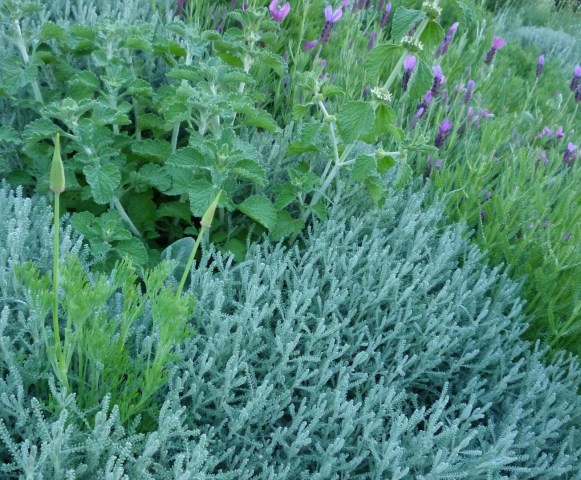
Below is a photo I took of our burning bush. Its leaves are the larger ones in the picture, and the smaller grayish leaves and hips are of the Nootka rose that grows in a planter with it.

rubus sanctus with Nootka rose

The monks are happy at the potential for more widely sharing the manuscripts with scholars everywhere. And nowadays they welcome numerous tourists and pilgrims to the holy place itself, knowing that the God who has blessed it and them is the spiritual food people need. In fact, in the the last 50 years, as our lecturer put it, “The whole world has come rushing in.” Especially in the winter months the monastery has as many as 1,000 visitors a day. The challenge is “to keep a spiritual tradition that was born in isolation when that isolation has come to an end.”

If I ever journey to Egypt, I hope to join the masses thronging to that place.

Sunless and Satisfying Day

The beach cottage is next to a creek that forms a lagoon at this time of the year, cut off from the frigid Northern California ocean water by sand dunes and therefore swimmably warm, if you don’t mind the algae.

The whole place is full of memories for me, going back more than 20 years to the first time I was here with our children, who with their homeschooling friends built rafts of driftwood and punted around, while their baby sister crawled through the sand.

Those are abalone shells lined up on the fence.

We’ve come many, many times to this sleepy village, and this week it was to be with our friends who lived full-time in the house for a spell but now only vacation there. Mr. Glad and I are normally just a couple these days, but they were lucky enough to have four of their five daughters with them.

No sooner had we arrived than I discovered the fuchsias and Chinese firecrackers that had enthusiastically taken over the mostly untended yard. They make you think you are in a tropical paradise, until you look up and notice the fog and the golden hills.

In the background of the third fuchsia pic, you can see the wild fennel reaching for the skies. A lot of it has already dried and is getting mildewed.

The fields of rattlesnake grass a block away also contradict the tropical theme. I picked bundles of the stuff before I came to the conclusion that it’s really past its prime and that I should just come back next June to get it when it is still green and the “rattles” are whole.

Sand Art by Mr. G

We packed up some cheese, French and Italian breads, and watermelon, and drove up the coast to another beach just for fun.


One can’t easily predict how grey and cool the days will be out there, but we expected the sun to come out by the afternoon, and we pointed out the little patches of blue we could see here and there near the horizon.

At least it wasn’t terribly cold, though I did keep my sweatshirt on all day. The fog did not lift, but the sun burned some young chests right through it. And I was so happy and busy smelling the seaweed and the beach plants that I didn’t even notice the weather change that never happened.


Some of us took a walk along the bluffs, where I found so many interesting things to see and click my camera at, including stickers and a minty purple flower that filled the low moist places.

Rattlesnake grass and cow parsnip

When we returned to the cottage it was to cook together and cozy up with a big dinner and loving camaraderie — lively talk and laughing followed by sitting on couches and in rockers. Mr. G and I couldn’t help ourselves, taking lots of pictures of the girls so clearly content and comfortable with each other, tucked in with overlapping arms and legs and smiling so much you wouldn’t believe it.

I didn’t mind the grey skies, because the flowers and friendship made the best kind of sunshine.

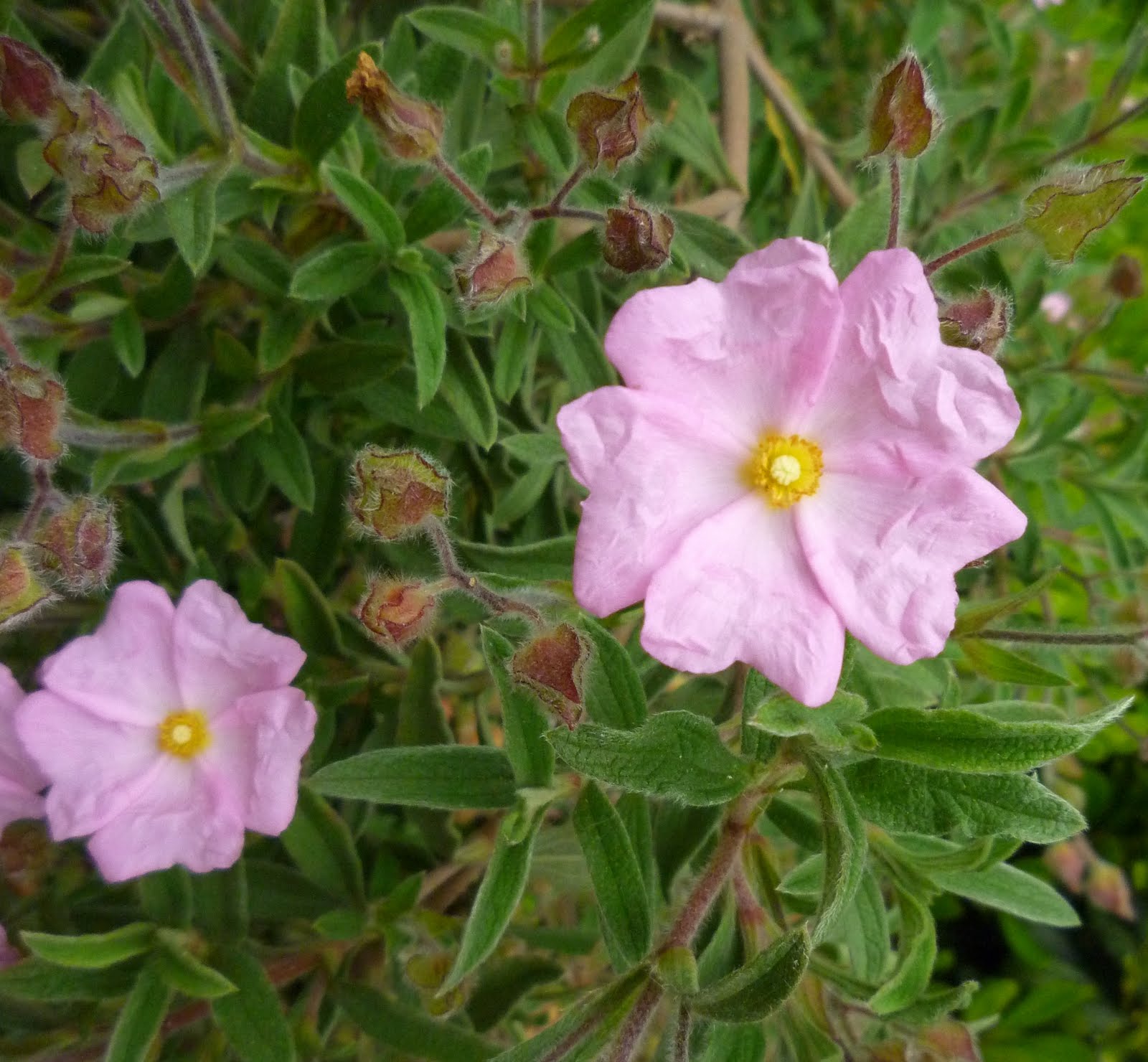
Brilliant but not blotchy helianthemum.

My heart was set on a Chocolate Blotch — it is a variety of the little shrub helianthemum. After browsing nurseries both local and online, I became 95% sure that the one I have growing at church is that type, not that the name made any sense.

These plants are a genus in in the family Cistaceae, as is the cistus, which I’m also fond of. They are both called rockrose, but that confuses me, so this is one case where I think I’ll stick to the botanical name.


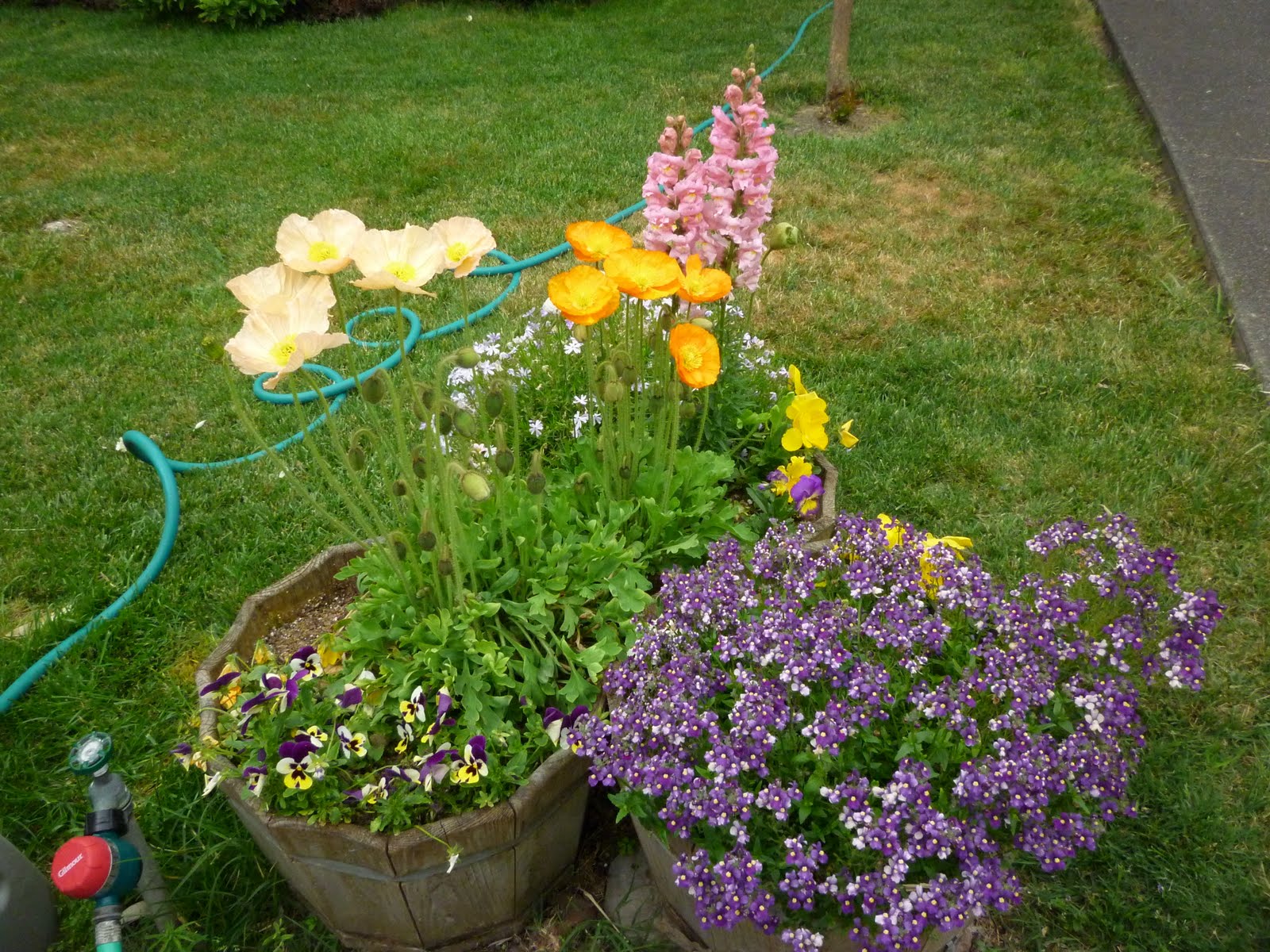
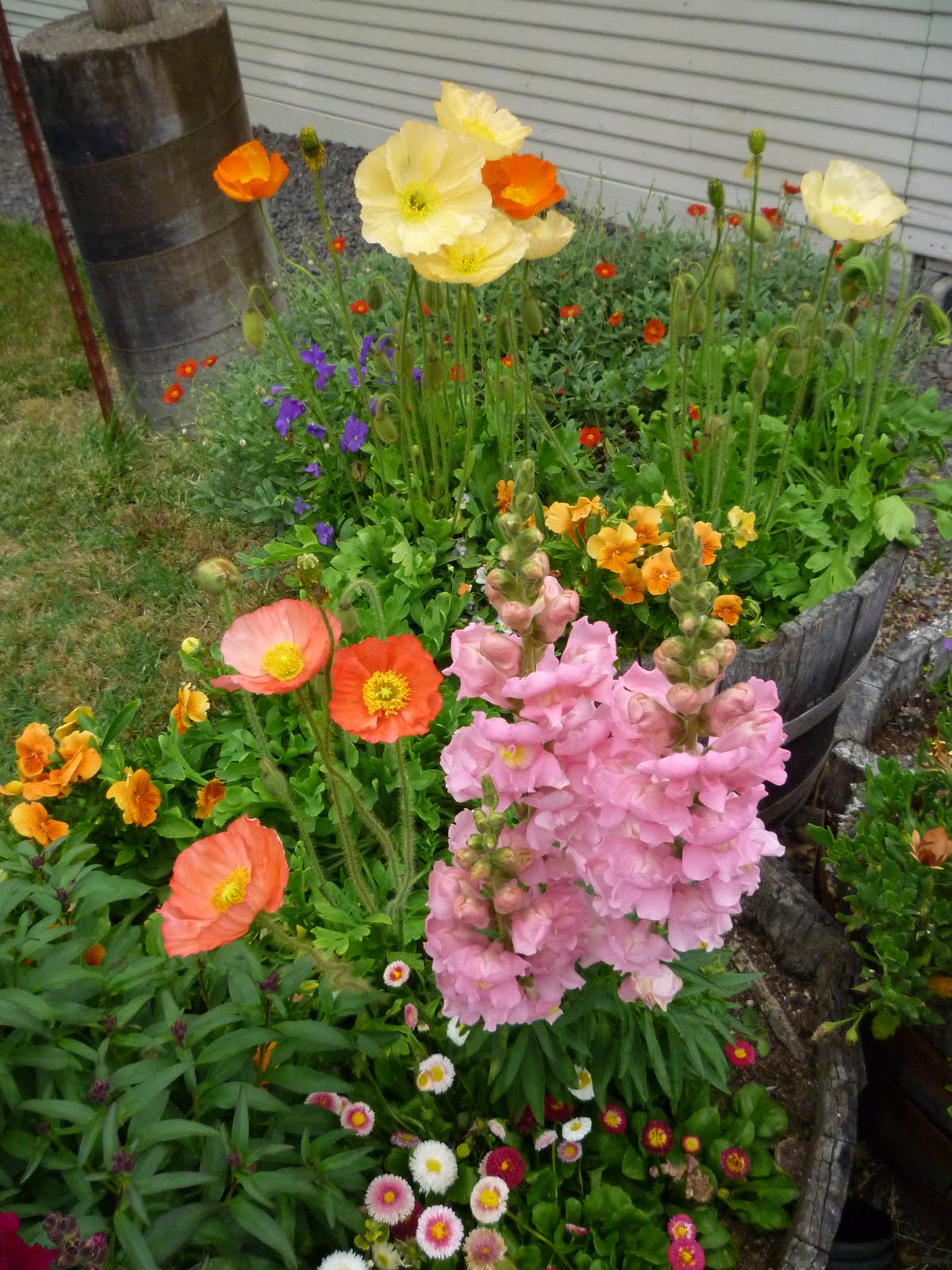
Whatever its name, I couldn’t find one to buy. And I love the way it trails over the side of the half barrel as in this photo where it is way in the background behind the poppies and everything. I wanted one for my garden at home, but my hope dwindled and I cultivated contentment instead of a shrub.

Then when I was fussing over these church plantings recently I noticed that the plant with deep orange flowers was trying to take over the container, not just spreading its branches but sending down lots of new roots, so why not cut it in half and take some home?

I did that just before I got sick, and the clumps of roots sat in a bucket on my patio for several days. I knew they had to be planted before I went to Monterey, so on the eve of my departure I went crazy with pots and trowels and Supersoil.

There are two colors of flowers that cause pain to my sensibilities when they are planted near each other: orangey-red and fuschia. My backyard rhododendron is fuschia, but it is in a corner with only blues close by.

The deep clear orange of this shrub seemed to me just what I need to bring balance to the many places crowded with blues and lavenders, and it won’t confuse things by adding any red tones.

My color ideas are no doubt strange; my husband says that all the colors in nature go together. But one year I had some red-orange bulbs blooming next to the yellow climbing rose and when I looked out the window it seemed to me that the two plants were spoiling each other’s beauty. So I dug up the bulbs.

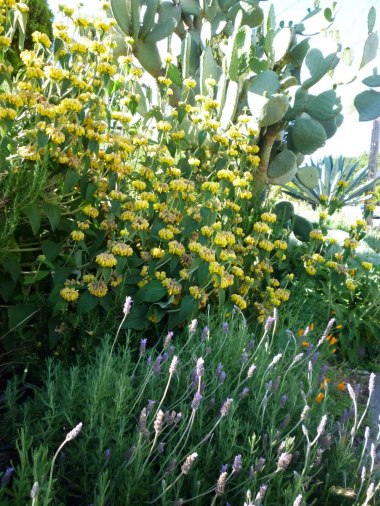
I trimmed the divisions of my helianthemum prize back quite a bit, and planted one clump in the middle of the lambs’ ears and pincushion flowers, next to the lavender and the oregano. Four Oriental lilies have now pushed up in the back of that bed, where it seemed a few weeks ago only one would grow; I had thought that I planted my big bag of bulbs from Costco so late that most of them must have rotted.

I wasn’t in too big a rush that I missed noticing that nasturtiums are coming up here and there, glory to God! Last year I tried various colors of many varieties, plants and seeds, hoping that some would naturalize.

As I was writing this post I looked some more for photos of “my” rockrose, and this time I found many more and helpful photos, broadening the possibilities to include Welsh Flame and Henfield Brilliant. A good photo explains why the name C. Blotch, and makes it clear that I don’t have that. After clicking back and forth among pictures and sites, I’m now 95% sure I have a Henfield Brilliant. This garden detective work is my kind of fun!

Ascensiontide Showers of Blessing

This short season between Ascension and Pentecost — it just seems natural to call it Ascensiontide, even though, until we get to Pentecost, we are still in Eastertide. These ten days are a subset, maybe. All this is The World According to GJ, and probably not kosher — oops, I’m getting more faith traditions mixed up in there.

That I am confused is not surprising, considering how wild and unusual my last two weeks have been, with a heavy amount of visiting with several friends and great busyness leading to brain fatigue. Thank God He gave me the strength to enjoy all the extra love and liveliness in the house. So much has been going on, I wanted to give a brief report of highlights.

plants still waiting to go into the ground….

Rain. It kept us from going on the walks I had anticipated, and also relieved everyone of irrigation duties.

blue lake pole beans

Very odd to get so much rain here in California the first week of June. Most plants don’t mind it, but the basil looks nigh unto death, waiting for summer. Here are the happy beans instead.

flannel bush

Hard as it is to believe, it appears that the rain has finally ceased. No one dared complain about last week’s lack of blue skies, here where an excess of water can can only be counted a blessing, and where tornadoes are rare.

My friend May and I drove over the mountain several times to see our elderly friend Jerry.

close-up of bush

Hail battered my car on one of our trips to his house, but on the way home later on we saw a bush we didn’t recognize by the side of the road and stopped to get its picture. Can anyone identify it right off? [I since have learned it is flannel bush.]

Jerry’s walnut tree and vineyard

Jerry and his late wife lived all over the world before settling in wine country to try their hand at being vintners, and they brought seeds and plants from many countries to plant here. It’s sad, though, to see the garden in disarray, lacking the care of Mrs. Jerry.

Some flowers and trees keep going in spite of neglect, like these orchids, which grow outdoors through the winter.

toasted sesame seeds

I had fun cooking for extra people. We ate Lemon Pudding Cake with Raspberry Sauce, and some Sticky Rice with Mango. Also fresh oatmeal bread, and Duk Guk, a soup whose name does not make you think nice things, but Guk is the word for the odd Korean rice cake ingredient that I like a lot — so much that I probably should not keep it in the house.

I toasted sesame seeds to make Lemon Sesame Dressing for the piles of green salad everyone consumed. Maybe after Pentecost I can post some recipes.

through the monastery gate
koi pond at monastery

In the evening of the Sunday between Ascension and Pentecost, I went to the Holy Assumption Monastery for a Family and Friends event.

First there was a lecture on “The Power of Bones,” referring to all the Bible references to the health that can be in our bones, and to the proper and reverential treatment of human bones. It was a prompting for us to consider in light of Holy Tradition our often irreverent modern funeral practices; I’m sure that in the future I’ll have more to say on this general topic that pertains to all of us.

Not long ago Gumbo Lily posted a blog about where her blog name comes from — it’s actually the name of a flower that grows on the prairie. For her I am putting up this picture of the cousin to her gumbo lily, our Mexican Evening Primrose that grows happily in a rocky spot between our driveway and the neighbor’s. It gets by in the dry summer with only a couple of waterings, but it didn’t mind the good Spring soaking.

Mexican Evening Primrose

I can’t tell about Ascensiontide without mention of the rejoicing to my spirit from having the festal hymns playing in my mind ever since last Thursday. In our daily prayers we have left off beginning with, “Christ is risen from the dead, trampling down death by death…,” and we aren’t yet returning to, “O Heavenly King, the Comforter, the Spirit of Truth…,” because we are still looking forward, liturgically, to the descent of the Holy Spirit.

So we are singing, during these ten days, about the event described in this way: “And it came to pass, while He blessed them, he was parted from them and carried up into heaven. And they worshiped him, and returned to Jerusalem with great joy.” (Matthew 17) The troparion hymn goes like this (now imagine me waking to it and falling asleep in the same joy!):

Thou hast ascended in glory, O Christ our God,
Having gladdened Thy disciples 
with the promise of the Holy Spirit;
And they were assured by the blessing
That Thou art the Son of God,
the Redeemer of the world!