“The common element in all the special forms of contemplation is the loving, yearning, affirming bent toward that happiness which is the same as God Himself, and which is the aim and purpose of all that happens in the world.”
And it was here — it was autumn — When I told Her: “Divine Flower, I feel Your touch! But why have you hidden Yourself From my sight since I was a boy?”
At the very moment these thoughts moved through my mind — Instantly, golden azure filled the room, And she shone before me once again — But just Her face — Her face.
At that instant lasting bliss was born in me! Once more my soul went blind to mundane matters. If I gave a sober hearing to Her, I know not what I heard; Her words were incomprehensible, talk fit for a fool.
-Vladimir Solovyov (or Soloviev) (1853 – 1900) Russia Translated by Ivan M. Granger
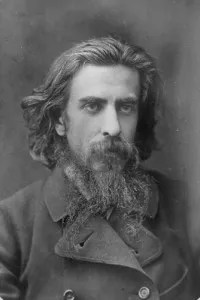
Vladimir Solovyov
Vladimir Solovyov loved Sophia, that is, Divine Wisdom. He philosophized about her throughout his life; I think this is probably a poem to that Sophia.
Solovyov was an influential person in the late 19th century and into the 20th, and is thought to be a source for some of his friend Fyodor Dostoevsky’s characters, Ivan and/or Alyosha, in The Brothers Karamozov; he gave a eulogy at Dostoevsky’s funeral. His ideas definitely were stimulating to Tolstoy, and to many other thinkers, and he continues to be controversial in the 21st century. This article: “Holy Wisdom,” explains why his ideas about Sophia have generally not been accepted by the Orthodox Church.
Wikipedia quotes David Bentley Hart, another controversial philosopher, from his forward to Solovyov’s Justification of the Good,
“In truth, the divine Sophia is first and foremost a biblical figure, and ‘Sophiology’ was born of an honest attempt to interpret intelligibly the role ascribed to her in the Wisdom literature of the Old Testament, in such a way as to complement the Logos Christology of the Fourth Gospel, while still not neglecting the ‘autonomy’ of creation within its very dependency upon the Logos.”
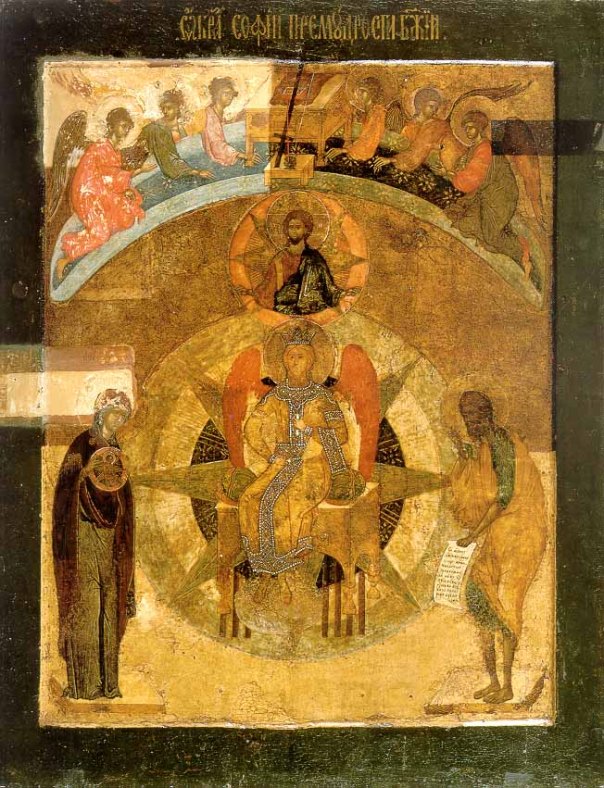
The Orthodox icon of Holy Wisdom often shows a “fiery angel” seated on a throne, with the Theotokos and St. Cosmas on either side, as in the example below. There is so much to ponder about Wisdom in the Bible. Even one of these verses I chose might provide for plenty of profitable contemplation:
Do not forsake wisdom, and she will keep you; love her, and she will guard you. Wisdom is the principal thing; therefore get wisdom: and with all thy getting get understanding. Proverbs 4:6-7
But the wisdom that is from above is first pure, then peaceable, gentle, and easy to be intreated, full of mercy and good fruits, without partiality, and without hypocrisy. James 3:17
But if any of you lacks wisdom, let him ask of God, who gives to all generously and without reproach, and it will be given to him.
“Materialism is a conviction based not upon evidence or logic but upon what Carl Sagan (speaking of another kind of faith) called a ‘deep-seated need to believe.’ Considered purely as a rational philosophy, it has little to recommend it; but as an emotional sedative, what Czeslaw Milosz liked to call the opiate of unbelief, it offers a refuge from so many elaborate perplexities, so many arduous spiritual exertions, so many trying intellectual and moral problems, so many exhausting expressions of hope or fear, charity or remorse. In this sense, it should be classified as one of those religions of consolation whose purpose is not to engage the mind or will with the mysteries of being but merely to provide a palliative for existential grievances and private disappointments. Popular atheism is not a philosophy but a therapy.”
―David Bentley Hart, The Experience of God: Being, Consciousness, Bliss
“Why do men learn through pain and suffering, and not through pleasure and happiness? Very simply, because pleasure and happiness accustom one to satisfaction with the things given in this world, whereas pain and suffering drive one to seek a more profound happiness beyond the limitations of this world. I am at this moment in some pain, and I call on the Name of Jesus — not necessarily to relieve the pain, but that Jesus, in Whom alone we may transcend this world, may be with me during it, and His will be done in me.
“But in pleasure I do not call on Him; I am content then with what I have, and I think I need no more. And why is a philosophy of pleasure untenable? — because pleasure is impermanent and unreliable, and pain is inevitable. In pain and suffering Christ speaks to us, and thus God is kind to give them to us, yes, and evil too — for in all of these we glimpse something of what must lie beyond, if there really exists what our hearts most deeply desire.”

 “Materialism is a conviction based not upon evidence or logic but upon what Carl Sagan (speaking of another kind of faith) called a ‘deep-seated need to believe.’ Considered purely as a rational philosophy, it has little to recommend it; but as an emotional sedative, what Czeslaw Milosz liked to call the opiate of unbelief, it offers a refuge from so many elaborate perplexities, so many arduous spiritual exertions, so many trying intellectual and moral problems, so many exhausting expressions of hope or fear, charity or remorse. In this sense, it should be classified as one of those religions of consolation whose purpose is not to engage the mind or will with the mysteries of being but merely to provide a palliative for existential grievances and private disappointments. Popular atheism is not a philosophy but a therapy.”
 Gladsome Lights