 “Positivist man is a curious creature who dwells in the tiny island of light composed of what he finds scientifically ‘meaningful,’ while the whole surrounding area in which ordinary men live from day to day and have their dealings with other men is consigned to the outer darkness of the ‘meaningless.’ Positivism has simply accepted the fractured being of modern man and erected a philosophy to intensify it.
“Existentialism, whether successfully or not, has attempted instead to gather all the elements of human reality into a total picture of man. Positivist man and Existentialist man are no doubt offspring of the same parent epoch, but, somewhat as Cain and Abel were, the brothers are divided unalterably by temperament and the initial choice they make of their own being.”
-William Barrett, Irrational Man
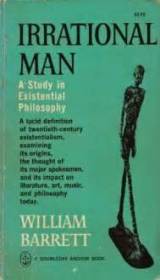
These paragraphs are from a book I’ve had on my shelf for a couple of years, since it wa s highly recommended to me by one of my most philosophical Christian friends. The subtitle is A Study in Existential Philosophy. I bought a paperback copy, but probably was unconsciously put off by the size of the print and the absence of white space on the pages.
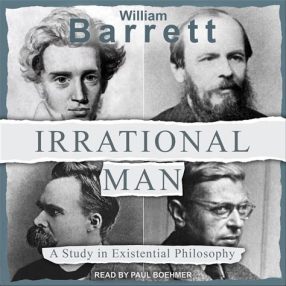
Recently I discovered that the book is on Audible, so I began yesterday on my drive to the beach to listen to it, though I wasn’t very hopeful about being able to attend to the subject matter that way, having an “ear gate” that is extra narrow or full of obstacles or something… It’s particularly hard for me to read non-fiction when I can’t underline or take notes.
It’s a testimony to the clarity and beauty of Barrett’s writing that I was swept up into the story, as he tells it so engagingly, of the context and development of Modern Existentialism. As, in his words above, the need is for true philosophy “to gather all the elements of human reality into a total picture,” so also Barrett shows us a holistic picture by describing the interplay of cultural and historical roots of existentialism and of its effects.
Since high school I’ve had an inkling, or an awareness, that I needed to understand existentialism, but I feel that I’ve made little progress toward that goal. This book and I came into the world in the same decade, but I’ve been waiting for it my whole life!
 “Before looking at the nature of good and evil, it is worth seeing the problem involved when choice is inserted into the conversation. What happens in that approach is that we are no longer speaking about the nature of good and evil, indeed, both are relativized in importance. Everything quickly revolves back to the nature of choosing, and makes the actions of our will the center of the good. Thus, there is no true good or evil, only good
 this? And how to sort out the choices that we have made? How many of our ignorant or hasty choices turned out for “evil”? Fr. Stephen recalls the example of Joseph in the Old Testament, who was the victim of his brothers’ evil choices.

 the whole of this podcast,
 Gladsome Lights