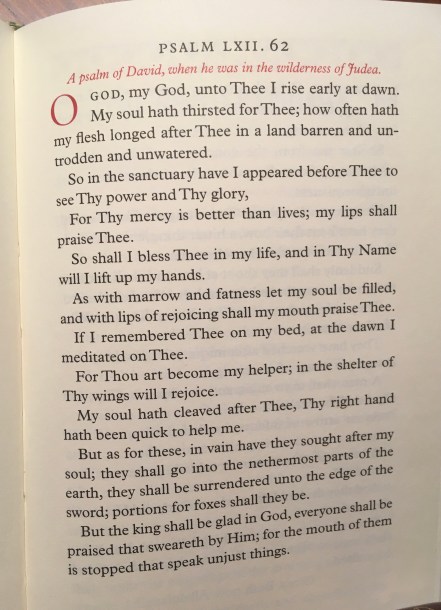
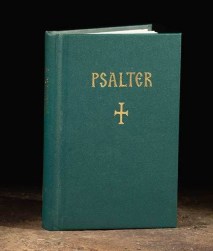
 The Psalms of the Bible are the poetry that I am focusing on this year in National Poetry Month. They are helping me to also keep a Lenten focus. I’ve had my eye on two Psalms in particular that I wanted to memorize, but deliberately working at memorizing seems to “not be happening.” Maybe if I at least read them (a little) more frequently some of the lines and verses will start to stick. I love this green pocket Psalter so much. It is from Holy Transfiguration Monastery.
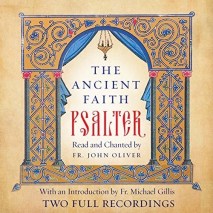
For years I’ve also made heavy use of a recording of the Ancient Faith Psalter, available from Audible. Before John Oliver begins the actual reading, there is this encouraging introduction from Fr. Michael Gillis, which I have transcribed:
Introduction to the Ancient Faith Psalter
The Psalter is a prayer book for the church. It has been so before there was a Christian church. There is an ancient saying attributed to St. Athanasius the Great that the Psalms are different from the rest of Scripture in that while the rest of Scripture speaks to us, the Psalms speak for us. When we pray the Psalms we are praying the words God has given us to pray.
It has also said that the whole story of God’s dealing with Israel is an allegory of each person’s spiritual journey, the story of God’s dealing with every human soul. Therefore, inasmuch as the Psalms sum up and interpret the story of Israel, the Psalms also sum up and interpret the spiritual journey of every human being. The Psalms touch every experience of human life in our fallen world; every joy and every terror, every fear and every hope are found expressed in the Psalms. Some Psalms are beautiful, to the point of seeming sentimental. Other Psalms are bloody and apparently vindictive.
Such a range of emotion and experience is offered to us in prayer because in some inner or outer way, at some time in our life we will all experience this full range of thoughts and feelings. In fact, because some of these thoughts and feelings are so extreme, so evidently horrible, it is only through praying the Psalms that we come to realize and then confess both to ourselves and to God in prayer that yes, even such terrible things as these at one time or another have passed through our minds and perhaps even our hands.
 This literal reading of the Psalms however is only the beginning. As one prays the Psalms one soon begins to realize that the enemy, the Amalekite or the Philistine, the nations that rage against God, are not people or situations outside myself, but are most poignantly referring to the wicked impulses and evil thoughts that I must battle within myself. The psalmist’s cry for deliverance becomes my own as I see within my own heart and mind the struggle between good and evil; the betraying thought, the accusing word, or the mocking laugh.
The Psalms give us words, images and metaphors by which we can cry out to God for help in the midst of our inner struggles. What the psalmist describes as external speaks to our internal struggles, because all outer conflict is a reflection of an inward struggle. Is this not what Jesus told us when he said it is out of the heart that murders and adultery flow?
The Psalter is a prophetic book; it is prophetic of Christ but it also speaks prophetically of all who are in Christ. Just as “strong bulls” surround Christ on the Cross, so too all who pick up their cross and follow Christ experience in one form or another this attack of the strong, and come to know their own weakness in resisting it, their own need to be delivered from the “power of the dog,” “the mouth of the lion” and “the horns of the wild bulls.” Similarly, the prophetic declaration of the Resurrection of Christ, “Let God arise, let His enemies be scattered;” this also is our declaration as we experience moments of deliverance and help over our inner enemies.
The Psalms speak of God and man, Christ and Christian, inner and outer conflict, victory and defeat, heaven and earth, wisdom and foolishness. With few words and much meaning, the Psalms provide the images and words for every prayer, every need, every celebration on our journey through this world.
-Fr. Michael Gillis