
DIVAN
I’m a slave of the moon. Speak only moon to me.
Speak of candles and of sweetness or don’t speak at all.
Speak of gains not losses, and if
you don’t know how, never mind. Say nothing.
I went crazy last night. Love saw me and said,
“I’m here. Don’t shout! Don’t tear your clothes! Be still!”
I said, “Oh, love. It’s not that I fear. It’s something more!”
“That something more is no more. Don’t say a word!
I’m going to whisper secrets in your ear.
Just nod your head and say nothing.
A moon, being made of soul, appeared on the path of love.
Ah, how delicious it is, a journey on the heart’s path! Don’t speak!”
I said, “Oh, my heart, what moon is this?” Love pointed and said,
“This one’s not right for you. Pass by in silence!”
I said, “Could this be an angel’s face? Could it be human?”
“It’s neither human nor angel. Hush!”
I said, “What is it? Tell me! You’ve turned me upside down!”
“Stay upside down, and be silent!”
You’re seated in this house filled with images and illusions.
Get up! Don’t say a word! Just pack your bags and leave!
I said, “Oh, my love. Be like a father to me.
Isn’t this the face of God?”
“It is. But by your father’s soul,
Hush! Be silent! Don’t say a word!”
-Rumi
1207-1273
translated by J.W. Clinton
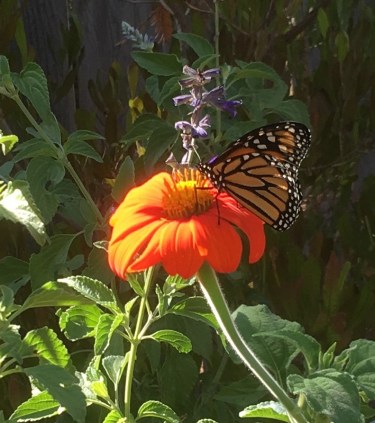
For a couple of weeks now I’ve been trying to put into words how it was for me, releasing Monarch butterflies who had emerged from their chrysalises two or three hours before. It was the most exciting thing yet to happen in my garden, that’s for sure. I had an rush of adrenaline stretching over the several days it took for all four caterpillars to finish their metamorphosis into creatures exquisite and huge. They were huge by comparison with the tiny pods from which they’d unpacked themselves, and their delicate design and bold colors were revealed in all their glory by being seen close-up and still in their mesh cage, waiting for their wings to dry.

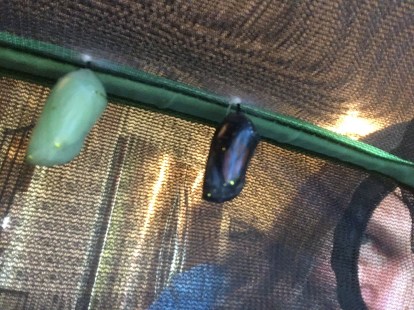

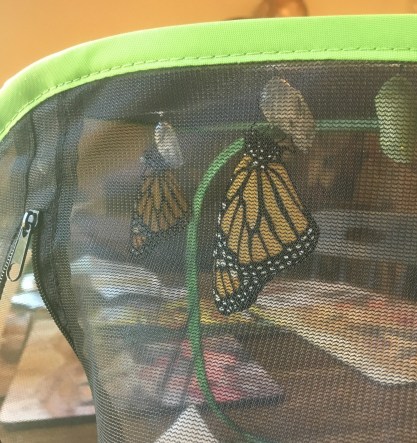
I watched them as they hung and dried. When the time was right, I followed the Monarch website instructions: Move your finger toward the head of the butterfly, and it will climb on. Lift it out… I got a phone video with one hand while carrying the first Monarch to a flower I chose because it was both a known Monarch favorite nectar source, and purple to contrast with the insect’s colors.
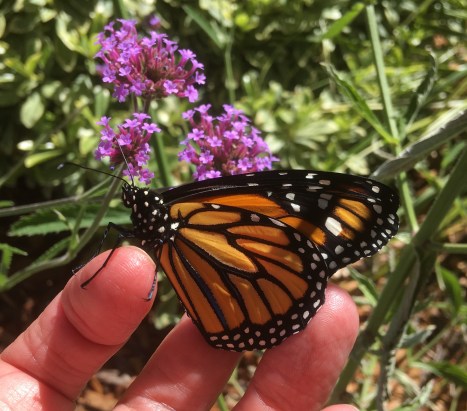
That one was fully dry and not hungry yet; it wouldn’t step off my hand onto the blossom, but as soon as a breeze came by, it flew. I looked down and the second butterfly was climbing out of the cage and fluttering away. As one friend said, “It’s like being present at a moment of creation.” Indeed. And that was a little much to take, the reason for my intense feelings, and why this Rumi poem resonates with me. An insect, a moon, a grain of sand… anything might bring you there.
 The next chrysalis wasn’t due to open until the afternoon; I deadheaded coneflowers nearby and met with this mantis, who I think was probably the same one I had encountered a few days before. I was friendly and he looked at me; I took his picture in full daylight. Then my neighbor stopped her car in the street and said out the window, “Isn’t it a little hot to be working out here?” I checked the thermometer and it was 93°; okay, I will go indoors for a while. Once in the house, I felt something on my head, and brushed it off… the mantis! Hey, fella, I know you like me, but you belong outside… So I gently carried him out, with my bare hands this time, being so comfortable/familiar with the creature. 🙂
The third butterfly’s wings were still a little damp when I released it in the afternoon; that same neighbor had come over for a cool drink in the cooler indoors, and she stayed to watch. And before the Monarch was dry enough to fly far, the little girl next door was able to come and get close to the action. I was really happy that it worked out for me to share at least a little bit of this wildlife event with other humans.
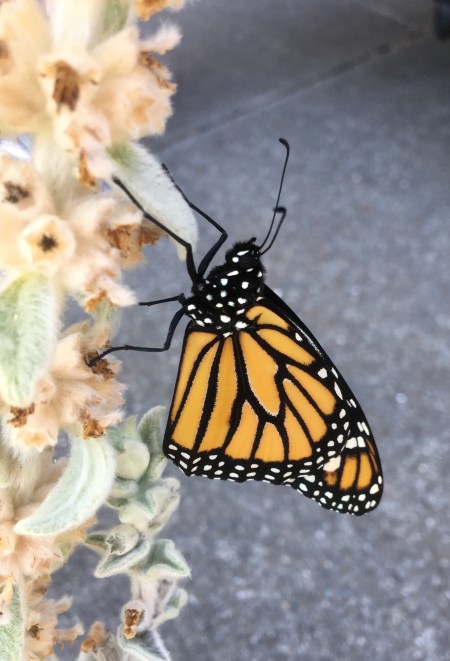
Following Rumi’s imagery, on my path in just one week’s time I have had encounters with 1) the moon and the mantis, 2) newborn butterflies walking on my hands and 3) a mantis who likes me. Somewhere inside I was going crazy and shouting, and also trying to listen to that voice saying, Hush!
This whole experience certainly jolted me out of my waiting doldrums. A word from another friend helped calm me down: She told me that mantises eat butterflies, and I laughed as I guessed the mantis “mind” as he looked so friendly-like at me: This large shape carries the scent of those juicy Monarchs I like, but I don’t see how to get my mouth around it….

At least one of the butterflies hung around the garden for a few days, giving me more opportunities for picture-taking, and to say a more leisurely good-bye. These were the babies I’d collected as eggs and raised for more than a month; I’d invested a lot of time in collecting milkweed leaves for them and cleaning their cage. It seems now a small price for the reward, though I could wish my responses were more like quiet joy and not so emotionally exhausting.
More recently, a building inspector was here and needed to write a note for the contractor, so I invited her to sit at my kitchen table, from which she immediately saw my garden and calmly gushed over it. I told her about the joy my garden gives to me, and about the Monarchs, too. She said, “It’s like the first garden….” Well, yes. Isn’t this the face of God?
 is more in the heart than the brain, this place where the Maker shares His secrets. Both of my wonderings are based on my slight understanding of philosophy and theology; what I do feel more certain of is that angels are basically very different from humans. Christ took on human nature, because it was we humans who needed His solidarity with us, and His quickening of our dead spirits. But having been created “a little lower than the angels,” we were “crowned with honor and glory.”
 Philip Larkin’s poetry is often bleak in various ways, but his uniquely beautiful voice draws me. So I borrowed a fat collection of his work from the library to peruse; it was fascinating. In a few poems, even though I don’t claim to see halfway to their depths, I catch glimmers of our common humanity and perspective, and am prompted to pray for him.

