In “The Deer’s Cry,” or “St. Patrick’s Breastplate,” it is the saint’s prayer that Christ would be in the heart of “everyone who thinks of me.” Amen! Dear Father Patrick, your prayer has been for me the height and depth of encouragement over the last years, as it leads me straight to Christ Who is the Source of all courage and hope and strength. Because of it and flowing from it, you are in my mind and my heart, and so is He.
I did write before about this prayer when I first started to memorize and to sing it in the form of a hymn composed by Charles Villiers Stanford, using two traditional Irish tunes. The poetry was written in 1899 by Cecil Frances Alexander and is based upon a translation of the ancient Irish by Whitley Stokes.
Thanks be to God, this saint and prayer belong to all Christians (although, interesting fact,  he has never been canonized by a pope). Patrick was a witness and missionary for Christ centuries before church unity was broken. You might like to read what one Orthodox site says about him: St. Patrick the Bishop of Armagh and Enlightener of Ireland.
The lyrics as I have sung them at least a thousand times are those of the hymn known as “I Bind Unto Myself Today.” One can find on YouTube many renditions of this one sung beautifully by choirs such as the Kings College Choir, and many of them are cluttered with distracting and even, to my mind, inappropriate images. This is one of the better ones. Because the choir’s sung version is abbreviated, I am posting the entire text.
Only now do I notice two verses that I’d never seen before, and which I am glad to know Alexander included in her poem, as they are definitely part of the ancient prayer as it’s come down to us, and they round out the expression of our need for God’s help in every area of life. Though we moderns might not worry about the kind of “poisoned shaft” St. Patrick knew, that phrase and other vivid images are good metaphors for realities we do face, and for attacks from without and within.
I Bind Unto Myself Today
I bind unto myself today
The strong name of the Trinity,
By invocation of the same,
The Three in One and One in Three.
I bind this day to me for ever,
By power of faith, Christ’s Incarnation;
His baptism in Jordan River;
His death on cross for my salvation;
His bursting from the spicèd tomb;
His riding up the heavenly way;
His coming at the day of doom;
I bind unto myself today.
I bind unto myself the power
Of the great love of the Cherubim;
The sweet ‘Well done’ in judgment hour;
The service of the Seraphim,
Confessors’ faith, Apostles’ word,
The Patriarchs’ prayers, the Prophets’ scrolls,
All good deeds done unto the Lord,
And purity of virgin souls.
I bind unto myself today
The virtues of the starlit heaven,
The glorious sun’s life-giving ray,
The whiteness of the moon at even,
The flashing of the lightning free,
The whirling wind’s tempestuous shocks,
The stable earth, the deep salt sea,
Among the old eternal rocks.
I bind unto myself today
The power of God to hold and lead,
His eye to watch, His might to stay,
His ear to hearken to my need.
The wisdom of my God to teach,
His hand to guide, his shield to ward,
The word of God to give me speech,
His heavenly host to be my guard.
Against the demon snares of sin,
The vice that gives temptation force,
The natural lusts that war within,
The hostile men that mar my course;
Or few or many, far or nigh,
In every place and in all hours
Against their fierce hostility,
I bind to me these holy powers.
Against all Satan’s spells and wiles,
Against false words of heresy,
Against the knowledge that defiles,
Against the heart’s idolatry,
Against the wizard’s evil craft,
Against the death-wound and the burning,
The choking wave, the poisoned shaft,
Protect me, Christ, till thy returning.
Christ be with me, Christ within me,
Christ behind me, Christ before me,
Christ beside me, Christ to win me,
Christ to comfort and restore me,
Christ beneath me, Christ above me,
Christ in quiet, Christ in danger,
Christ in hearts of all that love me,
Christ in mouth of friend and stranger.
I bind unto myself the name,
The strong name of the Trinity;
By invocation of the same.
The Three in One, and One in Three,
Of whom all nature hath creation,
Eternal Father, Spirit, Word:
Praise to the Lord of my salvation,
salvation is of Christ the Lord.
This morning I spent a little more time working on the version of this ancient and rich prayer that is my current stream of grace: Lisa Kelly singing “The Deer’s Cry”. Soon I will have learned it “by heart.” But CHRIST in ME — that is my prayer.
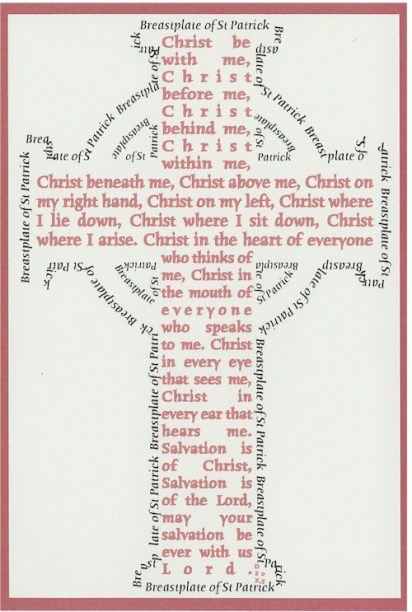
 s National Poetry Month and now that I take notice, we are nearly at the end of it. That prompts me to finally take this bit out of my files to give you in celebration.