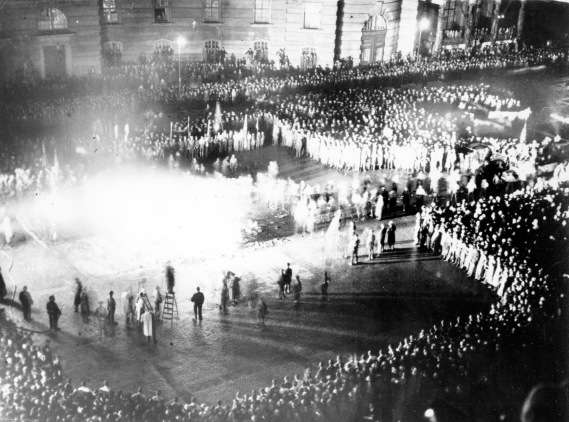
When the Regime commanded that books with harmful knowledge Should be publicly burned on all sides Oxen were forced to drag cart loads of books To the bonfires, a banished Writer, one of the best, scanning the list of the Burned, was shocked to find that his Books had been passed over. He rushed to his desk On wings of wrath, and wrote a letter to those in power. Burn me! he wrote with flying pen, burn me. Haven’t my books Always reported the truth? And here you are Treating me like a liar! I command you: Burn me!
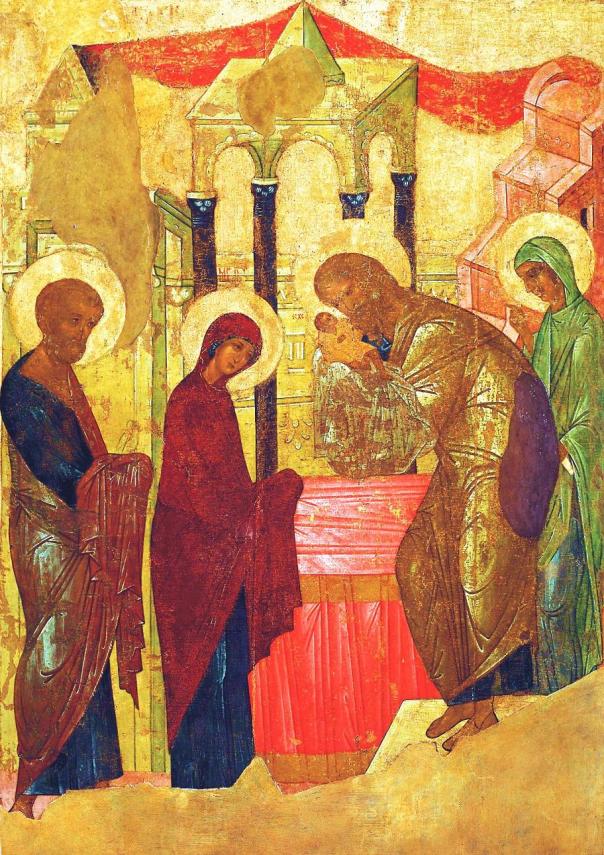
They came, as called, according to the Law. Though they were poor and had to keep things simple, They moved in grace, in quietness, in awe, For God was coming with them to His temple. Amidst the outer court’s commercial bustle They’d waited hours, enduring shouts and shoves, Buyers and sellers, sensing one more hustle, Had made a killing on the two young doves. They come at last with us to Candlemas And keep the day the prophecies came true We glimpse with them, amidst our busyness, The peace that Simeon and Anna knew. For Candlemas still keeps His kindled light, Against the dark our Saviour’s face is bright.
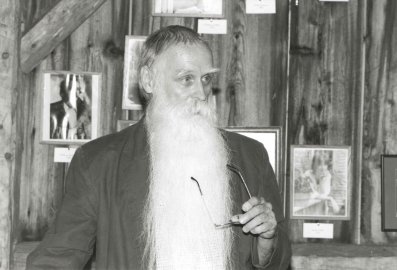
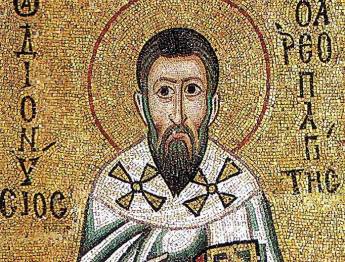
Some years ago Donald Sheehan’s widow Xenia shared on social media an excerpt from his book The Grace of Incorruption, a passage in which he links Robert Frost with St. Dionysius. She published it on the saint’s feast day in October, along with his icon below, but for re-posting Sheehan’s thoughts I have chosen today’s date, on which Robert Frost breathed his last, an appropriately wintry day in 1963. Xenia Sheehan:
This day the Orthodox Church celebrates St. Dionysius the Areopagite, 1st (or possibly 5th)-century poet of “Mystical Theology,” whom Donald Sheehan uniquely compares to American poet Robert Frost in his “deliberate turning out of all the lights of false knowing . . . in order to behold — in Dionysius’ astonishing words — ‘that darkness concealed from all the light among beings.'”
Don writes in The Grace of Incorruption that,
“…in order to know the personhood of another, we must unknow both the persona and the personality: we must let these lights go out. Again and again, in his finest poems, Robert Frost accomplishes precisely this unknowing, the deliberate extinguishing of all the false light, and a welcoming-in of the darkness in which true personhood can shine forth. And true personhood is, always, genuinely beautiful.
“I think what moves us so deeply about the poem ‘An Old Man’s Winter Night’ is Frost’s evocation of genuine personhood in the old man. The old man in Frost’s poem is not a persona nor a personality; he is, genuinely, a person. And as the lights go out in the poem, the more beautifully and movingly his personhood emerges. One vivid detail: when the log in the stove shifts with a jolt, we, too, are jolted into a deeper intimacy with the old man, an intimacy that gains in power because of the darkness.”
-Donald Sheehan
Text and icon from Donald’s widow Xenia Sheehan in 2018
AN OLD MAN’S WINTER NIGHT
All out-of-doors looked darkly in at him Through the thin frost, almost in separate stars, That gathers on the pane in empty rooms. What kept his eyes from giving back the gaze Was the lamp tilted near them in his hand. What kept him from remembering what it was That brought him to that creaking room was age. He stood with barrels round him—at a loss. And having scared the cellar under him In clomping there, he scared it once again In clomping off;—and scared the outer night, Which has its sounds, familiar, like the roar Of trees and crack of branches, common things, But nothing so like beating on a box. A light he was to no one but himself Where now he sat, concerned with he knew what, A quiet light, and then not even that. He consigned to the moon,—such as she was, So late-arising,—to the broken moon As better than the sun in any case For such a charge, his snow upon the roof, His icicles along the wall to keep; And slept. The log that shifted with a jolt Once in the stove, disturbed him and he shifted, And eased his heavy breathing, but still slept. One aged man—one man—can’t fill a house, A farm, a countryside, or if he can, It’s thus he does it of a winter night.
One of the church book clubs I currently try to keep up with met recently to discuss our current selection, Christ the Conqueror of Hell: The Descent into Hades from an Orthodox Perspective, by Metropolitan Hilarion Alfeyev. It is an impressive compendium of material on the subject from Scripture, patristic tradition, and early Christian liturgical texts and poetry. I was intrigued by the section on liturgical poetry from the 4th-6th centuries, especially the verses of St. Ephraim (or Ephrem) the Syrian.
While St. Romanos the Melodist, who lived in the 6th century, is considered by most to be the preeminent poet of the Byzantine period, he “was familiar with Ephrem’s works and drew from them. He learned from Ephrem’s poetical artistry as well as from his handling of particular literary plots and theological themes.”
The author of Conqueror explains how Ephraim and the Syrian tradition differed from that of the Greek fathers and their Ecumenical Councils. While he also formulated dogmatic teaching for his flock, he “clothed theological truths not in the armor of precise dogmatic definitions but with the bright garments of poetic symbols and metaphors …. to theologize for Ephrem meant to glorify God rather than talk about or reflect upon God. He believed the truths of Christianity should not only be comprehended, reflected upon, defined, and established but also experienced by the faithful through prayer. This same avenue was followed by most of the writers of the liturgical texts in the tradition of the Orthodox Church.”
The subject matter of Christ the Conqueror of Hell is especially appropriate for Holy Saturday and Pascha, and maybe I will post some of the liturgical poetry in that season; at this time I wanted to mention the part about Saint Ephraim because January 28th is the day we commemorate this poet and theologian. I found an enjoyable historical video about his life, using the title that has been given to him: “The Harp of the Holy Spirit.”
You may be familiar with his Lenten Prayer we use daily during the Great Fast; also, hymns and meditations of St. Ephraim were collected by St. Theophan the Recluse into A Spiritual Psalter. I have this on my shelf and could stand to spend some time perusing it, especially after reading today’s entry in The Prologue of Ohrid, where there is a hymn to Ephraim by St. Nikolai opening with the words,
Ephraim’s heart burns
With love for Christ,
And Ephraim’s tongue speaks
Of the pure wisdom of the Gospel.
Ephraim, the honey-bearing bee;
Ephraim, the fruit-bearing rain!
Just as God sends the bees and the rain to work for our joy and profit, so He sends people like this man. Let me keep that image of a buzzing and busy bee in my mind a while; let me drink holy nectar and refresh others the way God uses His creatures and creation to constantly renew my spirit.
And for today, one morsel of honey from this holy bee:
The chutzpah of our love is pleasing to you, O Lord, just as it pleased you that we should steal from your bounty.


 teaching for his flock, he “clothed theological truths not in the armor of precise dogmatic definitions but with the bright garments of poetic symbols and metaphors …. to theologize for Ephrem meant to glorify God rather than talk about or reflect upon God. He believed the truths of Christianity should not only be comprehended, reflected upon, defined, and established but also experienced by the faithful through prayer. This same avenue was followed by most of the writers of the liturgical texts in the tradition of the Orthodox Church.”
 Gladsome Lights