Not soon, as late as the approach of my ninetieth year, I felt a door opening in me and I entered the clarity of early morning.
One after another my former lives were departing, like ships, together with their sorrow.
And the countries, cities, gardens, the bays of seas assigned to my brush came closer, ready now to be described better than they were before.
I was not separated from people, grief and pity joined us. We forget—I kept saying—that we are all children of the King.
For where we come from there is no division into Yes and No, into is, was, and will be.
We were miserable, we used no more than a hundredth part of the gift we received for our long journey.
Moments from yesterday and from centuries ago— a sword blow, the painting of eyelashes before a mirror of polished metal, a lethal musket shot, a caravel staving its hull against a reef—they dwell in us, waiting for a fulfillment.
I knew, always, that I would be a worker in the vineyard, as are all men and women living at the same time, whether they are aware of it or not.
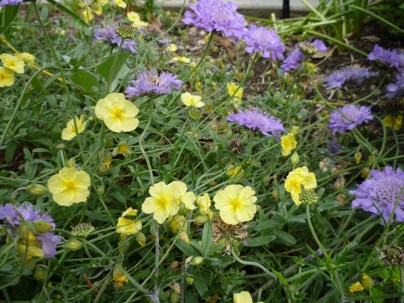
Yesterday afternoon the garden was brilliant under the sunbeams that followed rain showers. This strip of purple caught my eye, revealing itself to be violets that had quietly grown lush over the wet winter, along the edge of the patio where they also had planted themselves years ago. Sometimes they volunteer in pots and choke out whatever I had intended to nurture, but this little border didn’t encroach on anything, so I was pleased to see them suddenly dressed in their purple gowns, as one more sign announcing: SPRING!
I’m afraid my grandchildren went home before the violets bloomed, but I will invite a few young outdoorsy friends over soon, and invite them to gather happiness in their small hands.
CHILDREN, IT’S SPRING
And this is the lady Whom everyone loves, Ms. Violet in her purple gown
Or, on special occasions, A dress the color Of sunlight. She sits In the mossy weeds and waits
To be noticed. She loves dampness. She loves attention. She loves especially
To be picked by careful fingers, Young fingers, entranced By what has happened To the world.
We, the older ones, Call it Spring, And we have been through it Many times.
But there is still nothing Like the children bringing home Such happiness In their small hands.
The birds are in their trees, the toast is in the toaster, and the poets are at their windows.
They are at their windows in every section of the tangerine of earth– the Chinese poets looking up at the moon, the American poets gazing out at the pink and blue ribbons of sunrise.
The clerks are at their desks, the miners are down in their mines, and the poets are looking out their windows maybe with a cigarette, a cup of tea, and maybe a flannel shirt or bathrobe is involved.
The proofreaders are playing the ping-pong game of proofreading, glancing back and forth from page to page, the chefs are dicing celery and potatoes, and the poets are at their windows because it is their job for which they are paid nothing every Friday afternoon.
Which window it hardly seems to matter though many have a favorite, for there is always something to see– a bird grasping a thin branch, the headlight of a taxi rounding a corner, those two boys in wool caps angling across the street.
The fishermen bob in their boats, the linemen climb their round poles, the barbers wait by their mirrors and chairs, and the poets continue to stare at the cracked birdbath or a limb knocked down by the wind.
By now, it should go without saying that what the oven is to the baker and the berry-stained blouse to the dry cleaner, so the window is to the poet.
Just think– before the invention of the window, the poets would have had to put on a jacket and a winter hat to go outside or remain indoors with only a wall to stare at.
And when I say a wall, I do not mean a wall with striped wallpaper and a sketch of a cow in a frame.
I mean a cold wall of fieldstones, the wall of the medieval sonnet, the original woman’s heart of stone, the stone caught in the throat of her poet-lover.

 CHILDREN, IT’S SPRING