Category Archives: quotes

Recklessness, and words thrown away.

Everything is blooming most recklessly; if it were voices instead of colors,
there would be an unbelievable shrieking into the heart of night.

Lorrie posted that quote from Rainer Maria Rilke on her blog, and I have to agree with her that shrieking has somewhat the wrong tone as a descriptor… Even “reckless” can’t be right, because it’s all in God’s good order, even if it is more than I can fully appreciate with my puny and/or disordered soul.

She titled her post “Every Year is More Beautiful,” and I agree here, too, and that is part of the “problem.” The beauty in my world is magnified year by year, day after day, with over-the-top sweetness not to be compared with anything so flat as a slice of pie.

My garden is full of it, as is the sky above, and the birds’ songs. This week a house finch sang to me from the rooftop, and I realized I’d never heard his announcement before; it sounds like he is being quite emphatic about something. This morning I walked a little earlier than usual and saw and heard several more birds.

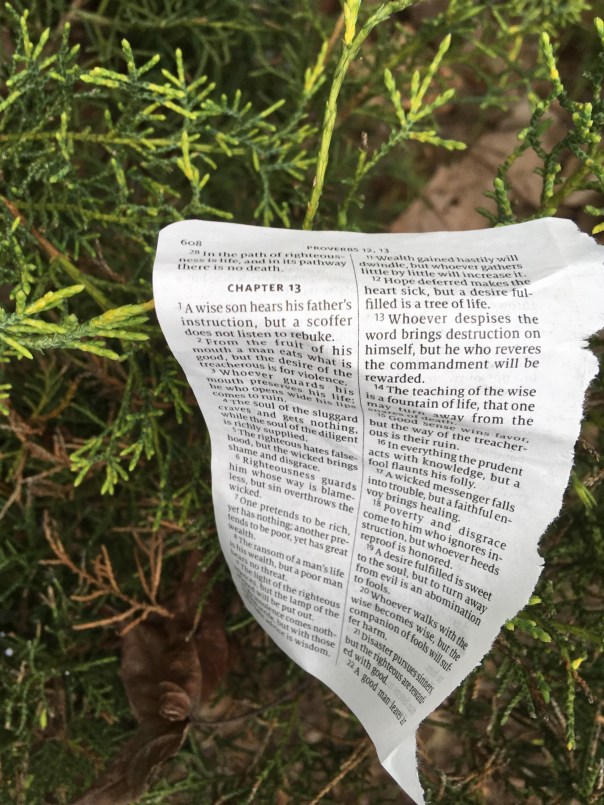
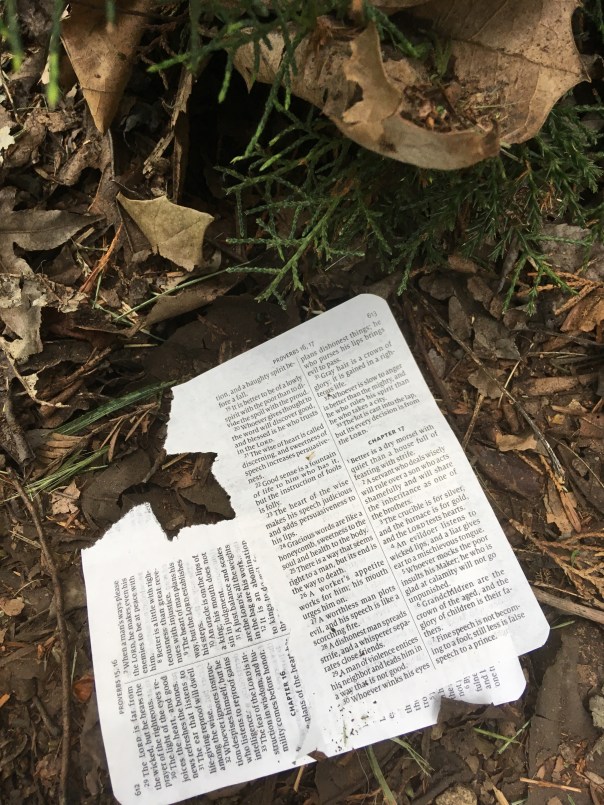
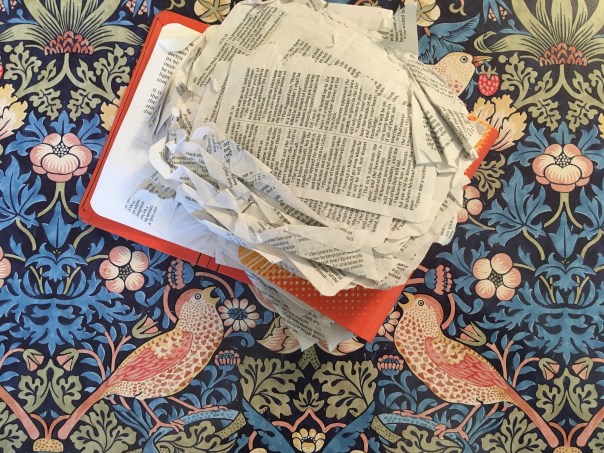
But what most occupied me on the path was hundreds of pages of Holy Scripture scattered on the pavement or in the leaves or grass at the side, and even in the creek. The first page was all alone, from the Gospel of Matthew, and as soon as I picked it up I saw another just beyond, and another… then larger parts of a little New Testament that had been ripped out of the sewn binding. I gathered each scrap or sheaf I saw, except for one of the orange covers and whatever parts might have remained inside it that I saw floating in the water below the bridge.
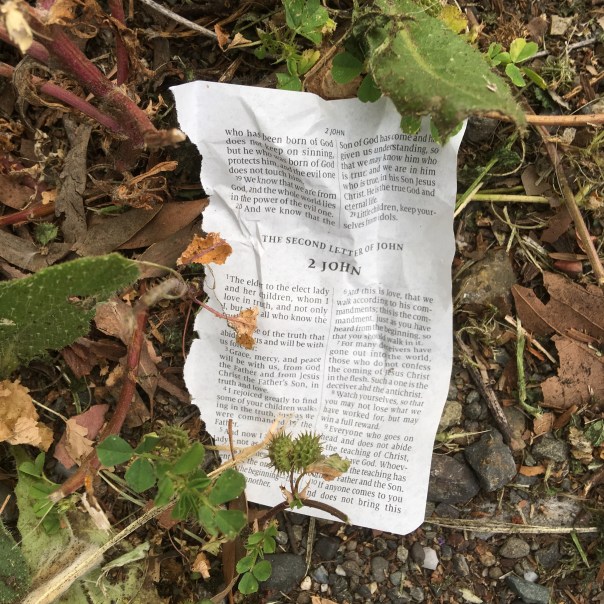
I read a line or two from a few pages, like,

Grace, mercy, and peace will be with us,
from God the Father and from Jesus Christ the Father’s Son,
in truth and love.

But mostly I tried to be efficient
in the task of recovering the pages of more words similarly poignant.
It seems impossible for me to get a good picture of the cow parsnip in the creek. The whiteness of its flowers shrieks at my phone’s camera! This is the first year I’ve noticed that plant in our stream… and say, aren’t those some healthy nettles I see next to it?

Down there flitting among the willows and the cow parsnip was an unfamiliar bird. Dark grey, the size of a crow, but not acting like a crow. He flicked his tail frequently, and he had a black head and a vague black stripe down his back. I haven’t found him in the bird guide yet. To provide (so far) two new bird encounters in one week could be thought of as recklessly generous of my Father. How can He expect me to cherish His gifts if He lavishes them continuously?

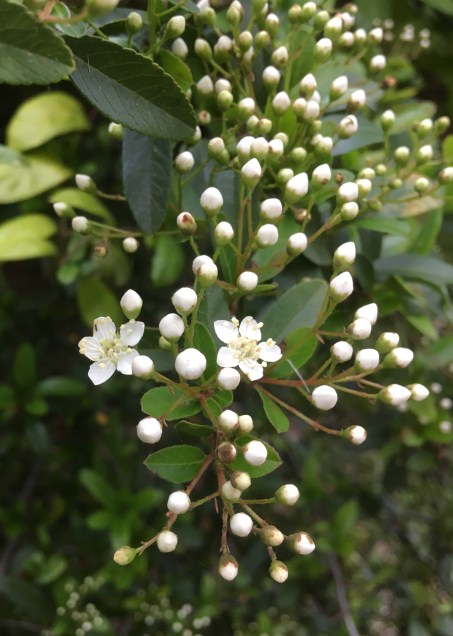
And the button buds of the pyracantha are darling, not one as large as the head of a hatpin:
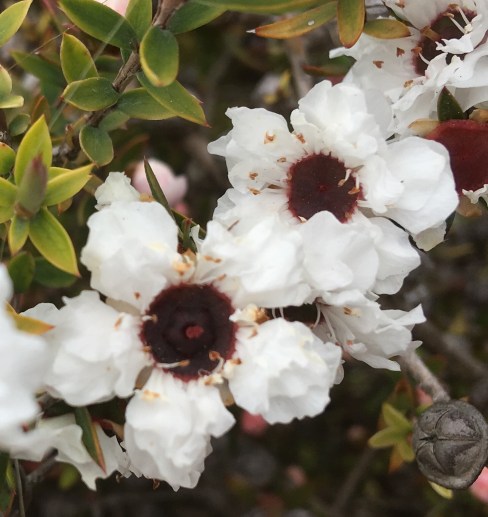
My neighbor Richard’s prickly shrubs are always half-dead, but they make white petticoated blossoms with blood-red hearts – so plucky and girly at the same time:
I wanted to read every wrinkled page of the Bible I picked up, because I was sure there were pertinent messages there… but of course I couldn’t, and I just brought them all home for a more honorable disposal. Eventually the evidence added up to three copies of the little orange Gideon New Testament with Psalms and Proverbs that had been torn and tossed.

I’ll type out just one meaningful verse from a photo above, that captures something of the excessive generosity of the Subject of these loosed leaves:

Gracious words are like a honeycomb,
Sweetness to the soul and health to the body.
But wait —
In that modern translation, I’m afraid the syntax doesn’t satisfy, as the end of my post.
So here is another excerpt from those pages, for your edification:

Whoever gives thought to the word will discover good,
And blessed is he who trusts in the LORD.

Amen.

Middlemarch in May with Arti

Arti at Ripple Effects blog is hosting a read-along for the next two or more months, and I am joining in! She invites us to the party with this inducement:
“In 2015, BBC Culture contributor Jane Ciabattari surveyed 82 book critics around the world outside UK, ‘from Australia to Zimbabwe’, and asked them to rate the greatest English novels of all time. Guess which book came up on top of the list? Guess right. Middlemarch by George Eliot.”

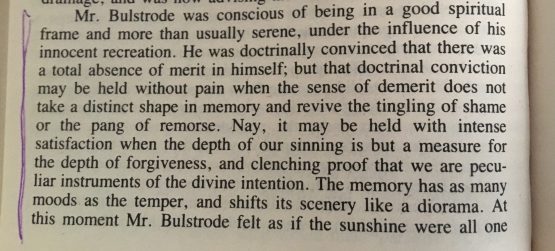
More than a dozen years ago my husband and I read this novel aloud together, and found it a rich and complex world to visit for several months, with well-drawn characters living through their thought-provoking questions and dilemmas. I knew I wanted to read it again, and here is my chance. I remember back then that occasionally when I was the one doing the reading I could not help being so rude as to stop suddenly (with apologies) because I really needed to underline a passage.

When I took my fat paperback off the shelf this week I looked inside to see just what had seemed so compelling at the time. It’s certain that of context of the whole novel I don’t recall the characters well enough at this point to fully appreciate how wise was the author’s assessment of their character and inner lives.

So I’m returning to Middlemarch, pretty confident that I will find it a rich exploration, and I’m not waiting for May, to start reading. What with all my underlining and pausing to think, I will be a slow reader as usual. So let the journey begin! Would you like to join us?

Roused out of dreams.

This morning I attended the lovely Bridegroom Matins of Holy Week, cherished because it uniquely expresses the “bright sadness” of our preparations for the joy and victory of Pascha. In my parish we are able to hold these penitential services early in the morning, at a time when people might be able to attend before going to work. Even on my drive to church I felt the grace of the clear sky, a pre-dawn blue, with a friendly gibbous moon shining down on me.


Eight years ago after attending this very service I wrote a blog post about laziness, standing up straight, and what it means to be human. Whew! I feel a bit lazier of mind these days, so that I am amazed at all I learned from Lazy Tommy Pumpkinhead and from just one chapter of Leon Kass’s book The Hungry Soul. I do often still remember the gist of the lesson, mostly when I am standing in church. If you don’t remember it well, I urge you to read it.

The article focuses on being physically upright, which helps us to be alert and attentive, ultimately to God and His will. It’s not hard to get distracted even in church, but at least we have in the Orthodox services many things to bring us back; for me it’s often necessary every minute or two, as I might simultaneously remember to put my shoulders back again and fix my gaze toward the altar. And especially during this week when we follow Christ to His voluntary sacrifice, our reverent attentiveness is facilitated by prostrating ourselves before God, which, though it is not upright posture, is the opposite of reclining in bed or watching whatever’s on TV.

When we are not in church, our Enemy probably has an easier time helping us to slouch away from Life, his methods so vividly portrayed in C.S. Lewis’s tale of correspondence between devils:

“You no longer need a good book, which he really likes, to keep [your target] from his prayers or his work or his sleep; a column of advertisements in yesterday’s paper will do…. You can keep him up late at night, not roistering, but staring at a dead fire in a cold room. All the healthy and outgoing activities which we want him to avoid can be inhibited and nothing given in return, so that at last he may say… ‘I now see that I spent most of my life in doing neither what I ought nor what I liked.’”

One theme of Holy Week comes from Christ’s cursing of the barren fig tree, in the days just preceding his crucifixion. We exhort our own souls in the hymns of Bridegroom Matins:

Why art thou idle, my wretched soul?
What useless cares cause thee to be lost in dreams?
Why busy thyself with things that pass away?
The last hour is at hand, and we shall be parted from all earthly things.
Therefore, while there is time, rouse thyself and cry:
“I have sinned before Thee, O my Savior!
Do not cut me off like the barren fig tree!”
In Thy compassion, O Christ, take pity on me who call out in fear:
Let us not remain outside the bridal chamber of Christ!”

Busying myself “with things that pass away”... yes… I mean, No! I don’t want to do that. Lord, help me to rouse myself!

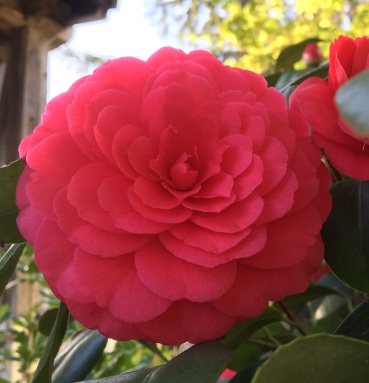
After the service — I’ve also done this before and made a blog post out of it! — I walked around the church gardens and took pictures, with which I decorated this page. Wherever you are in your liturgical cycle or in your heart’s journey, I pray that your souls may flower and bear fruit after the manner of these beautiful blooms.

The hours of the ultimate hour.

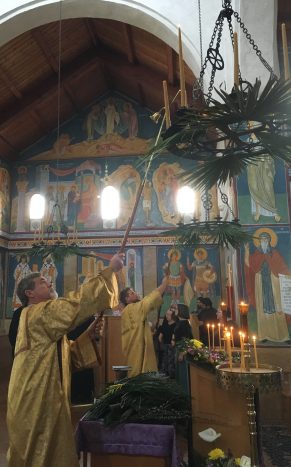
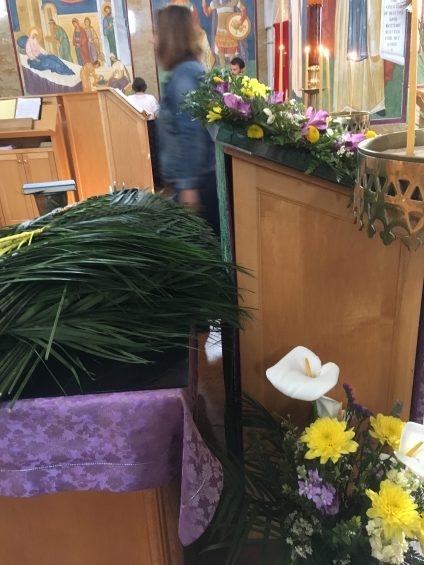
In 2018 Orthodox Easter, Pascha, falls on April 8th, a week later than Easter in the West. So today is our remembrance of Christ’s Entrance into Jerusalem, Palm Sunday. Saturday evening I am writing after attending our Vigil service for the feast, where  toward the end of the service we were given palm branches to hold, to take home and bring back tomorrow morning and hold them all through Divine Liturgy.
This morning, on the feast of Lazarus Saturday, another feast of victory, five catechumens were baptized and received into the church. The scent of holy chrism drifted over to me as they were being anointed in chrismation and I began to weep.

All week the Newly Illumined will wear their white robes to services. I caught a picture of one of them receiving a hug. What a gloriously happy day for us all!

You can see how even before palms were given into hands, the cathedral was fully decorated with them. Blooms are opening to decorate the church gardens about now as well.

I wanted to share an excerpt from a pamphlet on Holy Week by Fr. Alexander Schmemann:

But as in Lazarus we have recognized the image of each man, in this one city we acknowledge the mystical center of the world and indeed of the whole creation. For such is the biblical meaning of Jerusalem, the focal point of the whole history of salvation and redemption, the holy city of God’s advent. Therefore, the Kingdom inaugurated in Jerusalem is a universal Kingdom, embracing in its perspective all men and the totality of creation.

For a few hours – yet these were the decisive time, the ultimate hour of Jesus, the hour of fulfillment by God of all His promises, of all His decisions. It came at the end of the entire process of preparation revealed in the Bible: it was the end of all that God did for men. And thus this short hour of Christ’s earthly triumph acquires an eternal meaning. It introduces the reality of the Kingdom into our time, into all hours, makes this Kingdom the meaning of time and its ultimate goal.

The Kingdom was revealed in this world – from that hour – its presence judges and transforms human history. And at the most solemn moment of our liturgical celebration, when we receive from the priest a palm branch, we renew our oath to our King and confess His Kingdom as the ultimate meaning and content of our life. We confess that everything in our life and in the world belongs to Christ, nothing can be taken away from its sole real Owner, for there is no area of life in which He is not to rule, to save and to redeem.

– Fr. Alexander Schmemann