AT UNIVERSITY
Puritans reckoned the cadavers
in Anatomy were drunks off the street;
idealists said they were benefactors
who had willed their bodies to science,
but the averted manila-colored
people on the tables had pinned-back
graves excavated in them
around which they lay scattered in the end
as if exhumed from themselves.
-Les Murray

This month marks ten years since my husband’s departing from his earthly life, which leads me to meditate again on this topic. And today is one of the Memorial Saturdays we Orthodox have during Lent:
“Saturday is the day which the Church has set aside for the commemoration of faithful Orthodox Christians departed this life in the hope of resurrection to eternal life. Since the Divine Liturgy cannot be served on weekdays during Great Lent, the second, third, and fourth Saturdays of the Fast are appointed as Soul Saturdays when the departed are remembered at Liturgy.” (OCA)
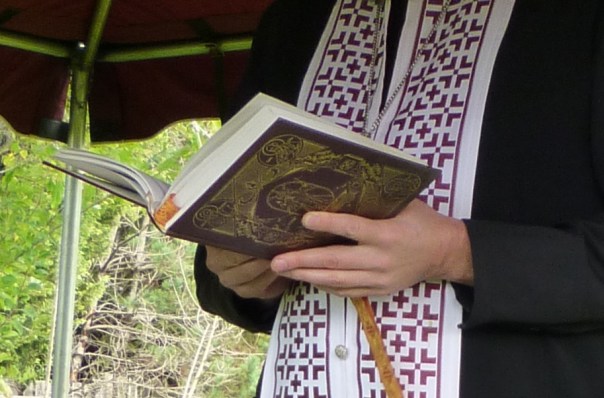 Les Murray’s poem recognizes something about human beings that our modern consciousness rarely grasps: the unity that exists between soul and body, and the brutality of violating the physical aspect of a fellow human.
Father John Whiteford writes that sometimes,
“…you will hear people say that the deceased is not in the coffin but with Christ, for example. However, if a person dies in Christ, their souls will be with Christ, but until the general resurrection, their body remains a part of them that will one day be reunited with their souls (though their body will be transformed) — and as such, the soul apart from the body is not the whole person (2 Corinthians 5:1-5).
If you are interested to know more about the Orthodox perspective on end-of-life issues, you might check out the Ancient Faith podcast “A Christian Ending” from Deacon Mark Barna, who has also co-authored a book by that title. Episodes of the podcast include: “Understanding Death,” “Cremation,” and “Preparing the Body for Burial,” and about a dozen more.

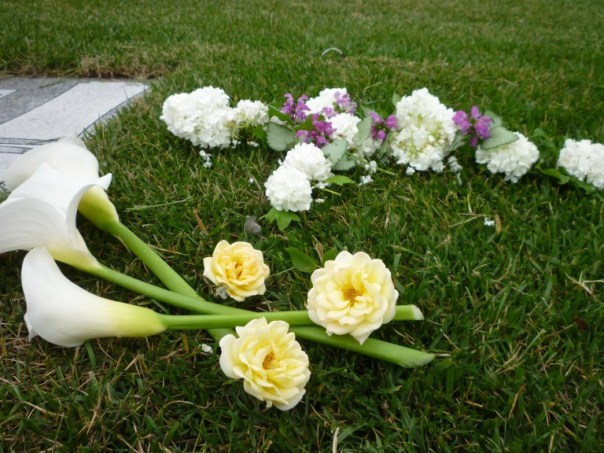
In the wholeness of Orthodox vision and practice, “…death is a change, but not an end. That which we see, the body, remains important and worthy of honor. A funeral, the service of remembrance, is a sacramental gathering in the presence of God. The body is honored, even venerated. The life of remembrance, eternal remembrance, begins.”
-Father Stephen Freeman, “A Secular Death”
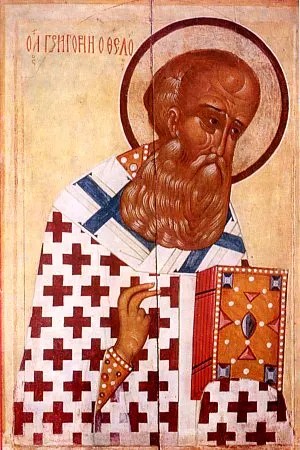 St. Gregory Nazianzus (or Nazianzen), also known as St. Gregory the Theologian, is one of the Three Holy Hierarchs of the Orthodox Church, along with St. Basil the Great and St. John Chrysostom; and one of The Cappadocian Fathers, along with St. Gregory of Nyssa and St. Basil the Great (of Caesarea). He has been called The Trinitarian Theologian, and you can read a snippet of such theology below. I was intrigued by his also being called The Minstrel of the Holy Trinity, evidently because of his poetic style, and spiritual poetry. I will be looking more into that.
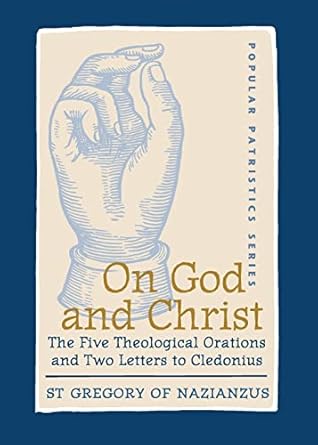 “The result is that though there is numerical distinction, there is no division, there is no division of the substance. For this reason, a one eternally changes into a two and stops at three — meaning the Father, the Son and the Holy Spirit. In a serene, non-temporal, incorporeal way the Father is parent of the ‘offspring’.”
 In the Eastern Orthodox Church, Gregory the Great (590-604) is usually called Saint Gregory Dialogus, Pope of Rome. The Liturgy of the Presanctified Gifts, which he compiled, is a service that we use on weekdays during Lent. You can read about his other writings and inspiring life, including several quotes from the saint,
  rapture. Then I too would lift my head because, for that short moment, I would know for certain that love and hope are infinitely more powerful than hate and fury, and that somewhere beyond the line of my horizon there was life indestructible, always triumphant.