Category Archives: quotes

We Need Food of All Kinds

Soldier’s wedding will take place in a few days.  Mr. Glad and I are just trying to get ourselves and the house and my father-in-law ready for the Joyous Event–and trying at the same time to get over our summer colds. I was pleased to pick the first lemon cucumber and add it with our arugula and the multi-colored cherry tomatoes to some lettuce last night, to fortify us for the work, and for the happy busyness ahead.

This morning I was well enough and eager to get back to church, where we remembered the life of St. Lawrence of Rome. God has filled my cup with delights like this–how many parishes are able to celebrate on a Tuesday morning?

St. Lawrence was a deacon serving with Pope Sixtus in the third century; his life and martyrdom are peppered with several encouraging stories. He seems to have had a good sense of humor, and among the various groups who call him patron are comedians.

G. K. Chesterton said it is the test of a good religion, whether you can joke about it. I’m sure he didn’t mean anything like mocking God or His salvation. But being able to laugh at oneself is a sign of humility, and I think it might be a collective form of this humor he is talking about. The whole subject of humor is something mysterious to me, and I would do well to study Chesterton’s other writings about it. For now I will change the subject after my favorite pertinent quote, also from him: “Angels can fly because they take themselves lightly.”

I came home from the feast and noticed the hyssop flowers having grown taller and taller. Bees were drinking nectar from the blooms, but bees are hard to photograph–one has to take time and a couple dozen pictures in hopes of getting one without a blur of bee, and I have lots of housework yet to do.

My life is like my garden. It’s full of beautiful and colorful things and events, ever changing, and I notice so few of them. Fewer still can I pick and show anyone else. My sociable or communicative side I find is always writing script in my mind, for how to tell other people about my discoveries and joys. But when the foliage and flowers grow so fast, events tumbling and intertwining with each other like a jungle, the feeling of not keeping up has been a gift in itself. From a feeling of helplessness, God has given me grace to just stop that script-writing for a few minutes at a time and direct my noticing and my thanks only to Him. Let me be like the bee, blurry if need be, but doing my job of imbibing the sweetness.

Responding to Unpleasantness

Posted on The Morning Offering, this from St. Symeon the New Theologian:

“Faith in Christ is… a good and patient disposition of the soul in enduring all temptations, whether griefs, sorrows or unpleasant happenings, until God’s favour looks down upon us; thus we would imitate David who says: ‘I waited patiently for the Lord; and He inclined to me and heard my cry’ (Ps. 40:1).”

Unpleasant happenings are my excuse for many kinds of sins, from overeating to speaking quickly and unkindly. If I would, at the first notice of unpleasantness, direct my soul to wait on God, wait to speak, wait to eat, etc., I would be enduring temptation. It appears that not all temptations are of the type from which one can flee, or that can be actively resisted. But in any circumstance we can rest in Christ. I don’t write from much experience.

On the other hand, St. Symeon did. He was abbot of a monastery when the monks attacked and nearly killed him. Don’t be confused by his title; his theology was not new, but he was younger than another man with the same name, hence the clarifier.

The Orthodox Church has given only three saints the title of Theologian. I love that the quote above hearkens back to old theology, that of a man whose tradition was of the school My Soul Follows Hard After Thee.

Architecture of War and History

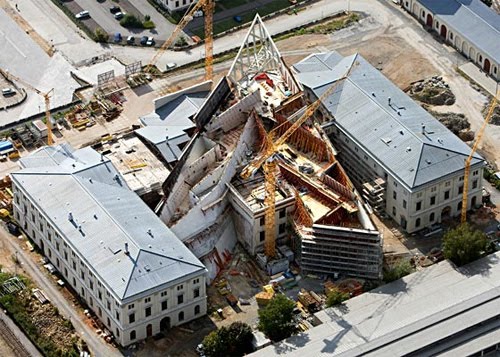
The uses and abuses of architecture, that subject that interests me but which I barely dabble in, got my attention again recently through an article by George Packer in the Feb 1, 2010 issue of The New Yorker. In his “Letter from Dresden: Embers,” Packer writes that the German city “has the unstable character of a place with a romantic self-image and a past that it would rather not discuss.” But we will discuss Dresden’s past, and ask also, if its latest building project in present time is vandalism, or an enlightening statement.

Before reading Packer’s piece I was fairly ignorant about this city, but as is often the case with New Yorker articles, this one led me on several tangents. The gist of Packer’s thesis is that Dresden is well served by having a gutsy architect like Daniel Libeskind to design its new national military museum, because the artistic violence of his plan is exactly what Dresdeners need to shake them out of their nostalgia and set their view of history straight.

Since reading that article I’ve gone on to learn a little more about the architect, the city, and what took place there toward the end of World War II. I also happened to read a novel that ties in to the reluctance of Germans to talk about the war and come to grips with that painful history. Of course, I haven’t taken my own photos. But if I do get to Germany I’ll be sure to visit these buildings and write another more personal blog post. For now, I want to set down what little I learned–I should say, the questions that have been raised–and if I put it here it’s available for anyone else who might like to know.

It was on February 13, 1945 that the Allies bombed Dresden, an event that some say resembled the horror of Hiroshima, and that the Neo-Nazis brand as equal to the Holocaust. What troubles people about the Dresden of today is the city’s selective reporting of its history, the portrayal of its wartime past as only victimization.

Matthias Neutzner is a local historian interviewed for the New Yorker article: “Neutzner said that Dresdeners remained unusually resistant to the past: ‘The city was erased in one night, and it was very easy for German propaganda to transform this city of art into a city of innocence which had nothing to do with the crimes of war.’

“In Dresden, Neutzner said, the story of the war has effectively been reduced to just one day: ‘It started and it ended on February 13, 1945.’ Neutzner’s aim is to get the city’s residents to remember ‘that this was the sixth year of a huge war, that there were twelve years of Nazi crimes, there were eight small concentration camps in Dresden with three thousand prisoners. All this is completely unknown in Dresden.'”

The diaries of Victor Klemperer are held up as an essential source text for those who want the whole story. He was one of the fewer than 200 Jews who remained in the city on that day of destruction in 1945, out of more than six thousand prewar. Published in the 1990’s, the three volumes in English are I Will Bear Witness, To the Bitter End, and The Lesser Evil. Packer writes that they tell “in mundane and relentless detail how the humanistic city of his youth turned into a place of terror that ostracized, humiliated, warehoused, tortured, and, finally, annihilated its Jews.”

Since the war the city has been busy rebuilding, trying to restore architectural Dresden as much as possible to its lovely pre-war state by recreating buildings like the Frauenkirche cathedral. This activity contrasts with the attitude of another war-torn city, Berlin, where the “new architecture often has the quality of what Bertolt Brecht called Verfremdung, or the V-effect–estrangement, distancing. Berlin makes little attempt to hide the worst decades in German history. After 1989, the city placed its vanished Jews near the center of its collective consciousness, understanding that this was part of the price of reclaiming its international status.”

It was the Jewish Museum in Berlin, shaped, as one person said, “like a deconstructed Star of David,” that in 2001 made a name for Polish-American architect Daniel Libeskind, the one chosen to design the Military History Museum in Dresden, a renovation of the former military arsenal building that has been serving as a museum since 1897.

Not everyone likes this architect’s style. Back in 2003 Deroy Murdock cautioned against Libeskind and his art in a National Review article quoting heavily from the architect’s own words, poetic and otherwise, calling his poetry grotesque and his Berlin museum ghoulish. Murdock was lobbying against Libeskind as a contestant in the running to design the new World Trade Center in New York, and in fact, he did end up designing the overall site plan.

I must admit that Libeskind’s poetry strikes me as twisted and broken, not lovely. But history shows mankind to be perverse as well, and Libeskind thinks it’s healthy to face one’s past and its ugliness, so that you can get a more balanced and true understanding of reality from which to make progress. The arrow-shaped addition to the old museum, cutting through the building just as the Holocaust made a gash through the 20th Century and human history, nonetheless rises to a higher elevation where visitors will get a broad and fresh perspective on the whole city, a view that wasn’t possible from the former museum.

Spiegel Online quotes Libeskind as saying, “…sentimentality is not a foundation on which you can build a new city.” To make a sure foundation, it would be necessary to know where the bedrock is, and where the sand. The architect has built in a degree of disorienting experience a step above the mere visual. Packer writes, “The effect of these [oddly angled] inclinations, Libeskind said, should be above all physical: ‘It’s like a collapse, isn’t it? You feel it in your knees….You can’t be neutral in these spaces.'”

He goes on to say, “The triangular structure on the front of the arsenal points to the direction from which Dresden was bombed. It also interrupts the smooth flow of that big arsenal. It creates a question mark about the continuity of history and what it means. It gives people a point of reflection.”

It’s these philosophical question marks that get my mind’s wheels turning. I can see how trying to recreate the city as it was in the 1930’s would convey that you want to go back to that better time. But was it any better, the society and people who participated in the extermination of their fellow humans? Even if it were, going back is not an option. We need to live where we are now, and go forward, trying to learn from the past, even though it speaks to us of our failings.

The new military history museum is scheduled to be completed this year and to open in 2013. Studio Daniel Libeskind’s statement about the project explains: “The central theme of the Military History Museum is the human being: those who went into the war and those who have remained at home; people of different eras and people of different generations.”

As the facade of the old building “represents the severity of the authoritarian past in which it was built, the other [new “arrow” facade] reflects the openness of a democratic society and the changed role of its military. In the new elevation of the Museum both are visible at the same time and one through the other.”

Packer concludes: “…though the museum is crude architecture, its bluntness should give it power as a civic institution: nothing more subtle than this could offer Dresden the possibility to break from its self-delusions.”

Update: Comments generated a Part II to this discussion, here: Architecture of War and History, Part II

God is constantly willing.

Weeds grew thick and tall in my recent and repeated absences, threatening to hide and destroy the beauty of the garden I’d planted. This morning I spent an hour tidying things up and giving space to the cucumbers and peppers so that they could grow unhindered. I’d hired a girl to irrigate enough to keep everything alive, but I didn’t ask her to pull weeds.

(Unripe grape tomatoes above, nasturtium in arugula below. All pictures taken just this evening.)

While hauling several baskets full to the trash I remembered my own advice to another young friend who was just falling in love with gardening. She asked me whether I thought she should do a little bit of garden work every day, or spend a couple of hours one or two days a week. I told her that the best way is to tend it a little bit every day. There is always a weed to pull, a tomato branch to be tied up, or a dead flower to be clipped off. The plants need water, and food, perhaps even a little shade from time to time.

One year our Baby was raising a pumpkin she hoped would be a huge one she could enter in the local Giant Pumpkin Contest. We were told it was advisable to put the growing pumpkin on a pallet when it was still small so that it could stay dry and be easily moved no matter how large it grew. When I got around to helping my daughter with that part of the project the fruit wasn’t very large yet, but the stem, having lain on the moist ground, had already sent out roots into the soil. This situation was hidden by a canopy of leaves, and when we hoisted the pumpkin on to the pallet, the vine stayed anchored by those roots, and the pumpkin broke off at the stem.

That was a hard lesson. I thought sadly of how a farmer, even a novice homeschooling pumpkin-grower, can’t afford to procrastinate. Any job involving a living thing has to be paced according to that creature’s rate of growth. And agriculture usually involves many living things all in relationship to one another: the plant, the soil, pests with their own life cycle, and probably others I’m not thinking of, not being a very good farmer still.

This morning’s brief mediation on how I really ought to tend more constantly to my garden continued when I later sat down at the computer to read the transcript of an interview with the Orthodox theologian and writer Vigen Guroian in which the topic of conversation turned, as is usually the case with him, to gardening, and he said “…were not God constantly willing His creation, loving His creation into existence, it would disappear.”

From my perspective as a lazy, distracted, and time-constrained gardener, I appreciate the steadfastness of our Lord in continuing His creative work moment-by-moment.  Colossians 1:17 says that he “holds all creation together.” I am one of His creatures, whom so far He has seen fit to give life and breath to every morning, making it possible for me to tend my own mini-garden, which also couldn’t live without His blessing and daily upholding.

Something G.K. Chesterton said on the subject often flits through my mind, when musing on this subject. He said, that in contrast to children, who through excess of vitality want things repeated, “…grown-up people are not strong enough to exult in monotony. But perhaps God is strong enough… It is possible that God says every morning, ‘Do it again,’ to the sun; and every evening, ‘Do it again,’ to the moon. It may not be automatic necessity that makes all daisies alike: it may be that God makes every daisy separately, but has never got tired of making them. It may be that He has the eternal appetite of infancy; for we have sinned and grown old, and our Father is younger than we.

So far, the garden hasn’t seemed monotonous to me. Every day is different there. Of course, The Creator is making the daisies, and I get to discover them, along with the roses and budding fruits and spreading spinach. I do love my garden, and will try to be more constantly willing to keep it going, imitating my Lord.