It’s the Sunday of the Prodigal Son. I’ve been reading some homilies on the subject, because I’m afraid I’ll miss my own priest’s sermon tomorrow because of illness.
One thing that impressed me about the story was the distance factor. The son was in a far country, when he realized what he needed to do. He was hungry and wasted, but he still needed to rise and go, to travel a long way, which must have been a struggle.
All of humanity is represented by the prodigal son, and most of us are still on the journey. Some of us have repented and are a bit farther on our way, but we are all clothed in our flesh, struggling with our sins, anticipating the day when we sit in the Kingdom and feast with our Father, enjoying the restoration of our full inheritance.
In the story, the son receives everything he had thrown away and lost. For now, we have the earnest of the Holy Spirit, and the grace of God to help us continue. Every day I need to decide to take the next step on the way. But I know more than the son in the parable, who hoped for a corner of the pig shed. “…for he that cometh to God must believe that he is, and that he is a rewarder of them that diligently seek him.” (Hebrews 11:6)
I’m afraid I often act a bit nonchalant, as though I am at the gate or even in my Father’s arms already. My initial coming to myself has to be followed up by a constant facing-up to the toil of the road. Maybe I have been sitting on the grassy shoulder wishing the trip weren’t so long, wondering if maybe someone will arrive and carry me the rest of the way.
St. Herman of Alaska reminds me: “The true Christian is a warrior making his way through the regiments of the invisible enemy to his heavenly homeland.”
“Bleak Midwinter” might be the title of some news articles of this day, deemed by at least one researcher as the likeliest day of the year for a peak in emotional depression. His formula takes into account failed New Year’s resolutions, the economy, the weather, and I suppose the fact that it is Monday.
Could I be counted in the numbers, because I found it harder to get myself out of bed this morning than I did last Monday? It was on the way to the gym that I heard the “news,” and it made me happy just thinking that the endorphins I was about to produce would help me through this day.
It’s another way of describing bleak midwinter, I thought as I was driving home, and wondered where that phrase came from. It didn’t take long to find out again what I had certainly known in the past, that “In the Bleak Midwinter” is the title of Christina Rossetti’s poem that ends, “What can I give Him? Give Him my heart.”
Yesterday I was told that the human soul is infinitely empty, because it is designed to hold the infinite God in Trinity. For us to become aware of our emptiness and need for God is a good thing, so some amount of what we might call depression could serve us that way. As Oswald Chambers wrote, “Sorrow burns up a great amount of shallowness.”
St. Silouan said that we ought to “keep our minds in hell and despair not.” Don’t forget all there is to grieve over, don’t pretend that the world isn’t lost in sin, but come to Christ with your grief–otherwise you can’t help but despair.
Moving on to things I know more about: the cats in my neighborhood. While we had our own cats, I mostly chased the others away from our yard, but now I have leftover food since Gus died, and it seems right to share it with them. Occasionally I set out some kibble in his old bowl, if it isn’t raining.
The markings on this black and white cat make for an optical illusion that his head is misshapen. At least, I think that’s why he looks so ugly, but I suspect he doesn’t spend much time in front of the mirror fretting about it. There are at least five cats who pass by on their daily prowl. If I hold very still I can take their pictures, but for the most part they are shy about coming so close to the house when they can see a strange human on the other side of the door. One or another will sometimes make eye contact with me, and then after a few seconds, bolt away as though he got a deadly revelation.
You might recognize the striped cat at left, because I wrote about her already, here , here and here. You’ll have to look back at one of those posts to see her amazing eyes. She doesn’t come around nearly as much as she used to, when she liked to follow Gus and pester him.
Mr. Glad was startled by a big raccoon on the other side of the glass the other night, gobbling up food I’d forgotten to bring in at dusk. The picture shows what were probably that guy’s ancestors, caught while enjoying the spoils after they tipped over a whole bucket of cat food, many years past.
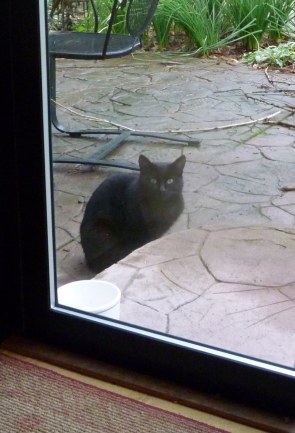
I think my favorite cat lately is the black one below, because after watching me watch him emptying the bowl, he sat down to just be near me for a spell.
When we humans notice that our cups and bowls are empty, we can simply hold them up to our Lord and He will fill them, as He told us (John 6:51): “I am the living bread which came down from heaven: if any man eat of this bread, he shall live for ever: and the bread that I will give is my flesh, which I will give for the life of the world.”
“Beauty is the promise of Happiness,” said Stendhal, quoted in The Architecture of Happiness by Alain De Botton.
Written in this 21st century, it is billed as an introduction to architecture. As for decades I have been discovering an appreciation for buildings, and at the same time have been realizing my ignorance of artistic principles generally, I was really ready for De Botton’s helpful study, which doesn’t catalog architectural styles –I seem to have a mental block against learning these—but explains why we humans might like or dislike particular buildings:
“We are drawn to call something beautiful whenever we detect that it contains in concentrated form those qualities in which we personally, or our societies more generally, are deficient.”
John Ruskin said that we want our buildings to shelter us and to speak to us, of what we find important and need reminders of. These values can change somewhat across centuries and cultures, but de Botton lists several “virtues of buildings” that are required if they are to be beautiful.
1) Order. But not over-simplified. We like to see complex elements arranged in a regular pattern.
What the author calls the “perverse dogma” from the Romantic Period, that all edifices must be of original design, led to chaos in the landscape. “Architecture should have the confidence and the kindness to be a little boring.”
2) Balance. Some concepts to be mediated are old and new, natural and man-made, luxurious and modest, masculine and feminine. This chapter gave me the most trouble. The photographs showed supposed balance that looked incongruous to me. I don’t like bare concrete, to start with. My tastes prove the point made by another quote from Stendhal: “There are as many styles of beauty as there are visions of happiness.”
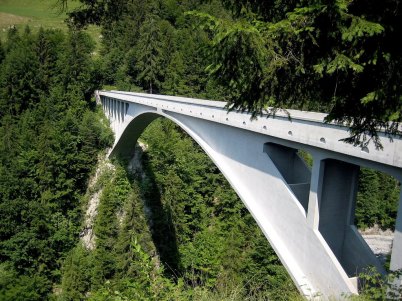
3) Elegance. When the achievement of strength or energy looks effortless and modest as in the Salginatobel Bridge in Switzerland, above.
4) Coherence. The building should not be a hodgepodge of styles. I’ll say it should be a clear declarative sentence. [I must like those a lot; I wrote this months before my last book review.] And that “sentence” should make sense in the context of its “paragraph.” As Louis Sullivan said, for example, tall buildings are all about loftiness, and that statement is made by every line of a skyscraper contributing to its being “a proud and soaring thing, rising in sheer exultation….”
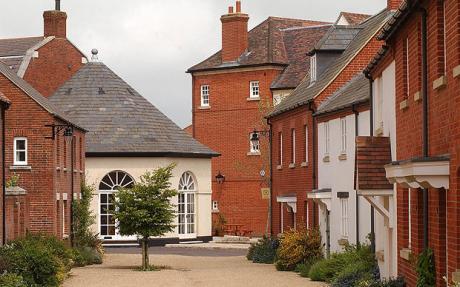
Poundbury
A building should fit into its historical and cultural place as well as its physical setting. De Botton considers one failure in this regard to be the exact replica of an 18th century village style built in the late 20th century in Poundbury, Dorchester, a psychological and practical disconnect. Others have commented on this housing development’s good and bad aspects. It was the brainchild of Prince Charles, by the way, who seems to be always pulling weight against what he considers ugly modern architecture.
The author helped me understand why a building that I have enjoyed is not appreciated in its home town. After reading Death Comes for the Archbishop by Willa Cather many years ago, I was excited to visit the 19th-century cathedral that was actually commissioned by the priest who was somewhat fictionalized in the novel, in Santa Fe, New Mexico. At that time I thought the disregard of the beautiful building was likely because of its Christian history and purpose, in a town that is now in love with its more pagan native roots.
The Cathedral Basilica of Saint Francis of Assisi
Now I understand that while Fr. Lamy conceived of a church he knew to be beautiful, that of his beloved French homeland, if he had been of the modern architect’s sensibility he would have altered the design to reflect his new home and climate. But I don’t believe he was an architect in the first place.
I appreciated the building for its Christian and literary history, even if it is in the Romanesque Revival style. It at least is built of local New Mexican stone; I know of beautiful houses in California that have design elements that required the transport of huge stones from Japan, to keep the whole piece of art Japanese–but what about the context?
The Cathedral Basilica of Saint Francis of Assisi, as it was designated in 2005, looks more odd all the time in the town of Santa Fe, which has, perhaps somewhat in the spirit of Poundsbury, tried to homogenize its architectural style:
“By an ordinance passed in 1958, new and rebuilt buildings, especially those in designated historic districts, must exhibit a Spanish Territorial or Pueblo style of architecture, with flat roofs and other features suggestive of the area’s traditional adobe construction. However, many contemporary houses in the city are built from lumber, concrete blocks, and other common building materials, but with stucco surfaces (sometimes referred to as “faux-dobe”, pronounced as one word: “foe-dough-bee”) reflecting the historic style.” [from Wikipedia]
Of course, these efforts to “pueblofy” the city have meant a loss of the eclectic elements from the past, though it was all done in the interest of promoting tourism and preventing decline of another sort.
De Botton writes of buildings having an aesthetic mission, and if one is on a mission, the last listed quality is crucial:
5) Self-knowledge. When I first saw that heading, I thought, This is carrying the anthropomorphism too far. I was relieved to find that the author was by now speaking not of buildings but of us humans, especially of the architects among us.
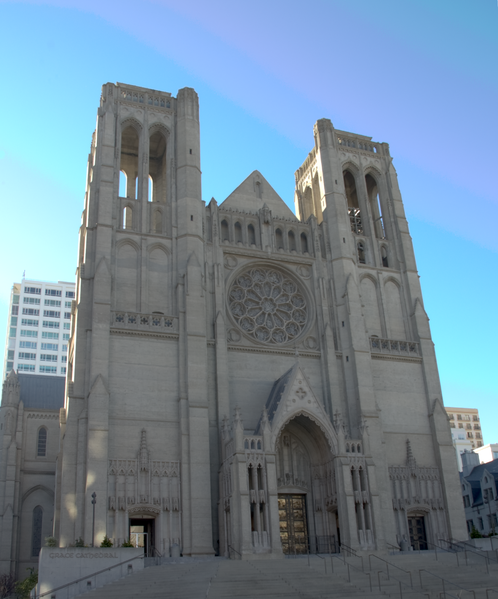
Grace Cathedral, San Francisco
We need to understand our human nature in all its complexity if we want to avoid the utopianism of the famous Swiss-French architect Le Corbusier, who seemed to have many radical plans, at least some of which we can be thankful were not accomplished, such as tearing out the heart of Paris in 1922 to replace it with 16 residential skyscrapers, some of which would house 40,000 people each. He wanted to eliminate suburbs, and abolish city streets, and glancing across the ocean, to raze Manhattan and start over. For one thing, its skyscrapers were too short.
Getting back to that quality of balance, I’m wondering if my own distaste for concrete is perhaps as closed minded as Prince Charles tends to be. My snobbishness made it hard to appreciate Grace Cathedral when I visited it last month, because though it has soaring arches and design beauty, it lacks the natural stone of the cathedrals I enjoyed in England.
I should remember that concrete is only a type of cast stone, which has a long history in antiquity, as I learned from reading The Pyramids: An Enigma Solved by Joseph Davidovits. He argues that at least the outer casing stones of the pyramids themselves were built from a masonry product poured on-site. It’s been more than ten years since I read this book when the children and I were studying ancient history, and I plan to read it again soon.
My own church is built of concrete, though one can’t see any of that base material anymore, covered as it is now in plaster and icons and marble. And on the subject of church architecture, I hope to write more, as my excitement grows into deeper understanding.
Thanks to De Botton, I have a little more foundational knowledge to aid me in my explorations. His style is slow and thoroughgoing in explanations of concepts, so much so that it took some getting used to; but I soon came to appreciate his carefulness. He includes many photographs to flesh out the architectural ideas he presents to the reader.
Alain De Botton is a philosopher as much as an artist, and helped to found a school called The School of Life. He has written several books, and my intention is that The Architecture of Happiness will be just the first of other thought-provoking works of his that I read.
My last post remembering Saint Herman prompted Pom Pom to ask me if I had read The Music of Silence, book she had just received in the mail. I haven’t read such a book, so I googled it and immediately have several tangents to run along now. I don’t know if she meant this memoir of Andrea Bocelli, or this one about singing the Hours or services of the church through the day in Gregorian Chant.
One reviewer wrote of the latter book:
“Nothing is as ordinary, or as sacred, as time. Far from being an infinitesimally small unit of measurement or a means of separating one event from another, time provides the means by which the still, small, silent voice of God may be heard.”
Silence….hmmm….I know so little of it.
When I read about music, silence, solitude, it can be an inspiration and a reminder, but my readings and thinkings are typically like so many rabbit trails, to use a term that hints at the fun of scurrying from one author or thought to another. A rabbit is doing what he was made to do, and glorifies God by it. I was made to live by the Holy Spirit in communion with my Creator.
So I need to STOP on the trail and pray–and maybe even get off the trail sometimes! It wasn’t books and ideas that made it possible for Father Herman to sing with the angels. It was prayer. The kind of prayer St Isaac of Syria is talking about when he says:
“The wisdom of the Holy Spirit is much greater than the wisdom of the entire world. Within the wisdom of the Holy Spirit, silence prevails; the wisdom of the world, however, goes astray into idle talk.”
My mind is given to talking idly with itself. So much of my remembering of my Savior is like the awareness I might have of an earthly friend when she is in the room with me, but I am not paying close attention. I might hear her talking without really listening, I might even speak with her–but not make eye contact.
Don’t we all have this weakness in our human condition, worsened by modern life, that we can’t settle our minds down firmly even when in prayer? Abba Dorotheus of Gaza says:
“Just as it is easier to sin in thought than in deed, correspondingly, it is more difficult to struggle with thoughts than with deeds.”
But C.S. Lewis encourages us:
“Virtue–even attempted virtue [I hope this includes attempted prayer]–brings light; indulgence brings fog.”
So I will keep struggling in prayer, to push past the distractions, to listen for the Silence that is God’s music.
It’s not the wonderful blog posts and the writers of them that are my problem. Nor my own writing, because just the discipline of organizing the chaos at least gets me on the road to taking every thought captive to Christ, though my readers might legitimately question how often I get to my destination. With God’s help, I know His presence and see His working in the world by the goings-on of the blogosphere and the piles of books throughout my house. Glory to God for all things! Lord, have mercy!
One more rabbit trail, leading quickly to the spot where all those paths ought eventually to end up, was brought to my attention this month, a poem by George Herbert:
Christmas
The shepherds sing; and shall I silent be? My God, no hymn for Thee? My soul’s a shepherd too; a flock it feeds Of thoughts, and words, and deeds. The pasture is Thy word: the streams, Thy grace, Enriching all the place. Shepherd and flock shall sing, and all my powers Outsing the daylight hours. Then will we chide the sun for letting night Take up his place and right: We sing one common Lord; wherefore he should Himself the candle hold.
I will go searching, till I find a sun Shall stay, till we have done; A willing shiner, that shall shine as gladly, As frost-nipped suns look sadly. Then will we sing, and shine all our own day, And one another pay: His beams shall cheer my breast, and both so twine, Till ev’n His beams sing, and my music shine.