Category Archives: quotes

Drop it gently onto the tongue.

It’s always nice to have a piece of toast, or some tasty thing to go with tea. At least, that’s how many of us think. In Kusamakura, the narrator takes tea with the host of the inn where he is staying, and there is a tea-sweets plate on the table, but it is bare. It’s there to be itself, a blue stone artifact that the owner wants to show off, and the narrator muses without speaking:

“It is nothing short of astonishing to consider the fine dexterity of the master craftsman who has carved such a large piece of stone to such thinness, and with such delicate precision! Spring sunlight shines through the translucent stone, seemingly captured and held there within its depths. It is right that such a plate remains empty.”

At a tea time earlier in the story, the guest does mention a tea-sweet, “…the firm bean jelly known as yōkan…. Yōkan happens to be my very favorite tea sweet. Not that I particularly want to eat it, but that velvety, dense texture, with its semitranslucent glow, makes it a work of art by any standards. I especially enjoy the sight of yōkan that has a slightly blue-green sheen, like a mixture of gemstones and alabaster — and this bluish yōkan piled on the plate glistens….” Sorry, I can’t go on. In a later post I hope to have more to say about this character who, while his mind overflows with voluptuous details pertaining to what he likes, dismisses more and more other things and behaviors as “vulgar.”

Because of him, I am feeling more welcoming of Lent. But before that shift toward better feasts, I want to show you my own edible works of art from blogger friend Orientikate in Japan; she wanted to contribute to my research on the land where she dwells. 🙂 In my case, I was so vulgar that I did want to eat them all! The dorayaki below is made with the same red beans that our artist praises above. Made into a sweetened paste and wrapped in a soft pancake, they make a lovely treat to eat with tea.
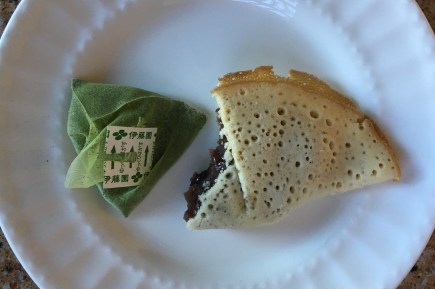
A packet of crispy snacks was in the package, and several types of green tea, and all of those gifts have been much enjoyed; sometimes I drank the tea from one of the ornate teacup twins that were given to our family more than 20 years ago, by a shy Japanese exchange student who was with us for only a week.

I try to drink tea only in the morning, because I seem to be more sensitive to caffeine the older I get. I know that green tea contains substances that have a calming effect as well, and there was a time when I could drink it all day, as I know many people do. But I laughed out loud at the end of this passage from the same book, when after admiring the plates and the kettle and the calligraphy on the wall, the guests take some nourishment:

“A connoisseur with time on his hands will elegantly taste this rich, delicately sweet liquid, ripened in the precise temperature of the hot water, by letting it run one drop at a time on to the tip of the tongue. Most people believe that tea is to be drunk, but that is a mistake. If you drop it gently onto the tongue and let the pure liquid dissipate in your mouth, almost none of it remains for you to swallow.

“Rather, the exquisite fragrance travels down to permeate the regions of the stomach. Using the teeth on solid food is vulgar, while mere water is insipid. The best green tea, on the other hand, surpasses fresh water in its delicate, rich warmth, yet lacks the firmness of more solid substances that tire the jaw. Tea is, in fact, a marvelous drink. To those who spurn it on the grounds of insomnia, I say that it’s better to be deprived of sleep than of tea.”

Glimmers and daily bread.

In regard to my reading habits of late, I am behaving much as I did during the months when my husband was sick unto death. It must be that the challenging remodeling project, combined with the physical disorder in several rooms, are taking all my resources to deal with it all, and making me hungry for literary comfort food. It’s hard to predict what I will be able to attend to, as I am impatient and flighty. The rare poem, or children’s stories of the deep and primal sort — those seem to be the best right now.

In the high school class that I help teach at church, we are are still working our way through C.S. Lewis’s The Great Divorce, in which story George MacDonald has a part, being as he was greatly responsible for Lewis coming to faith. That got us talking about MacDonald’s books, and I was reminded of The Princess and Curdie, which I hadn’t read for a long time. I brought it into my “book larder” almost as soon as I got home on Sunday, and have been taking that nourishment.

A quote from writer Mary Karr that I read today seems pertinent: “Memorize poetry & short prose hunks. This makes language eucharistic: you eat it. You take somebody else’s passion & suffering into your body, and it transforms you.” I found this to be the case a few years ago as I read MacDonald’s Phantastes at my cabin.

When I read the words that Curdie heard Princess Irene sing, before I had run across Carr’s advice, I had immediately thought that I should learn them by heart, to be part of a laid-up treasure to draw from.

They are the kind of message that must be stored in the heart if it’s to have any meaning and use at all:


The stars are spinning their threads,
And the clouds are the dust that flies,
And the suns are weaving them up
For the time when the sleepers shall rise.

The ocean in music rolls,
And gems are turning to eyes,
And the trees are gathering souls
For the day when the sleepers shall rise.

The weepers are learning to smile,
And laughter to glean the sighs;
Burn and bury the care and guile,
For the day when the sleepers shall rise.

Oh, the dews and the moths and the daisy red,
The larks and the glimmers and flows!
The lilies and sparrows and daily bread,
And the something that nobody knows!

(I wrote again briefly about The Princess and Curdie: here.)


Wooed by beauty and delight.

Just this morning I reread an old post in which I was musing on the Kasses’ research on young people who don’t fall in love the way previous generations did; I switched from there to my cup of tea and print copy of the current Touchstone Magazine, where Anthony Esolen happened to be exploring a related question in “Surprised by Delight: Divine Love and the Love of Man and Woman Surpass Mere Consent.” He skillfully brings together passages from Paradise Lost, John Donne, the Bible, and other sources to flesh out what he means by the delight of both types of love, and asks also, Why did our grandparents, in spite of hard lives full of suffering, retain a memory of delight in their relationships with the opposite sex? One excerpt, from a passage quoting Milton:

The “virgin majesty of Eve” needs no political program to protect or promote her. Virtue itself, embodied in distinctly feminine form, builds in her its lovely seat of authority, and guards her round about with awe. Eve, too, will acknowledge the superior power of Adam, when she describes her submission to his wooing, saying that from that moment on, she sees “how beauty is excelled by manly grace, / And wisdom, which alone is truly fair.”

So should we stress that each sex is for the other, raising boys and girls to be both separate from one another and destined to be united with one another; to use that separate development to endow each sex with peculiar gifts for the other, which the other will experience with surprise and gratitude. Common sense. Familiarity breeds contempt, and nobody ever said, “I love her, because I find nothing surprising in her.” We are swept away not by what we possess in ourselves, but by what we could never imagine in ourselves. If boys and girls are treated indifferently, should we expect them to treat one another as specifically members of the opposite sex with anything but indifference?

I’ve been wanting for a long time to post the poem below, trying and failing to find a painting to go with it. Maybe the descriptions from Esolen’s article (the whole article appears to be available: here) are better at placing the poem in a universal context of the delight of love and beauty and thankfulness, of which we all have our own concrete and sweet examples.

PART OF PLENTY

When she carries food to the table and stoops down
–Doing this out of love–and lays soup with its good
Tickling smell, or fry winking from the fire
And I look up, perhaps from a book I am reading
Or other work: there is an importance of beauty
Which can’t be accounted for by there and then,
And attacks me, but not separately from the welcome
Of the food, or the grace of her arms.
When she puts a sheaf of tulips in a jug
And pours in water and presses to one side
The upright stems and leaves that you hear creak,
Or loosens them, or holds them up to show me,
So that I see the tangle of their necks and cups
With the curls of her hair, and the body they are held
Against, and the stalk of the small waist rising
And flowering in the shape of breasts;
Whether in the bringing of the flowers or of the food
She offers plenty, and is part of plenty,
And whether I see her stooping, or leaning with the flowers,
What she does is ages old, and she is not simply,
No, but lovely in that way.

-Bernard Spencer

Blessed is the kingdom…

Pantocrator OW Hagia SophiaIn The Eucharist, Fr. Alexander Schmemann lays before us the glories of the faith, which “manifests and grants that to which it is directed: the presence among us of the approaching kingdom of God and its unfailing light.” The very Kingdom of God seems to shine directly from the pages of Fr. Alexander’s book into my heart; it feels that way because he brings to mind what I have experienced in our services.

Jesus himself referred to the kingdom as something present on earth when He was among his disciples; as something within us; as something for whose coming we ought to pray in The Lord’s Prayer. Truly the Divine Liturgy is where we both experience heaven and anticipate the fullness of the kingdom to come.

The Orthodox Divine Liturgy, the Eucharist, begins with the announcement, “Blessed is the kingdom of the Father, and of the Son, and of the Holy Spirit, now and ever, and unto ages of ages.”

What does it mean to bless the kingdom? It means that we acknowledge and confess it to be our highest and ultimate value, the object of our desire, our love and our hope. It means that we proclaim it to be the goal of the sacrament — of pilgrimage, ascension, entrance — that now begins. It means that we must focus our attention, our mind, heart and soul, i.e., our whole life, upon that which is the “one thing needful.” Finally, it means that now, already in “this world,” we confirm the possibility of communion with the kingdom, of entrance into its radiance, truth and joy. Each time that Christians “assemble as the Church” they witness before the whole world that Christ is King and Lord, that his kingdom has already been revealed and given to man and that a new and immortal life has begun. This is why the liturgy begins with this solemn confession and doxology of the King who comes now but abides forever and shall reign unto ages of ages.

– Father Alexander Schmemann