Over the years I’ve often written about St. Herman of Alaska and Father Alexander Schmemann, two important people in my life whom we remember on this day. This year I want to add St. Lucia of Syracuse, whose day it also is; we are blessed to have four Lucys in our parish, one of whom is my dear goddaughter.
This morning we had a glorious Divine Liturgy in honor of the saints, with our rector testifying to the power of Fr. Alexander as well, saying that if it weren’t for his influence, teaching and prayers, he would not be our priest today. We sang “Memory Eternal” for Fr. Alexander and for Leonid Ouspensky, whose legacy as an iconographer continues to enrich our parish year after year.
St. Herman and Fr. Alexander have both contributed hugely to the presence of true and living Orthodox faith in America, that Church in which I’ve found the fullness of Him Who fills all in all. Every year that we come to this date finds me more thankful.
Saint Herman of Alaska arrived in Alaska in 1794 and died there in 1837. On the occasion of his canonization in 1969 Bishop Dimitri spoke:
The Church on earth lives in a loving fellowship with the saints who have already run their race, who have fought the good fight, and have received their crowns (2 Timothy 4:7) (James 1:12). This is what the Apostle means when he says that we are compassed about or surrounded by the witness-martyrs or saints. We are assured both of their presence and their interest in us. In fact, they are concerned about the whole world and its salvation, for “there is joy in heaven over the repentance of one sinner” (Luke 15:7).
Father Schmemann was born in 1921 into a family of Russian emigres, and came to the United States in 1951 to join the faculty of St. Vladimir’s Seminary, where two of my own parish priests sat under his teaching. He reposed in the Lord in 1983. Not only has my life been enriched broadly by his contributions to the whole of Orthodoxy in America, but by my reading directly what he wrote, especially For the Life of the World, and his journals. Most recently I read his The Eucharist, which was a treasury of living truth, so vast, I haven’t known how to begin to say anything about it here.
It seems fitting that we commemorate St. Herman of Alaska on this date, when winter is making itself felt. I’ve written before (and yes, before that) about how he spurned the cold, befriended the animals, and interceded between the Aleuts and the powerful people who would exploit them. His is a good example in the Advent season, of how to keep our hearts and activities focused on the Kingdom of God in the face of distractions.
Santa Lucia buns from a previous year.
The mother of the youngest Lucia in the parish brought darling Santa Lucia buns as she always does, and a few of us stayed to drink coffee in the parish hall. But now I am home, with hospitality on my mind and heart: I have been welcomed into the household of God and fed at His table, and will go in that strength throughout the day and on to the Feast of the Nativity of Christ.
May we all prepare ourselves for the celebration by entering into the spirit of St. Herman, who advised us:
“…let us make a vow to ourselves, that from this day, from this hour, from this very moment, we shall strive above all else to love God and to fulfill His Holy Will.”
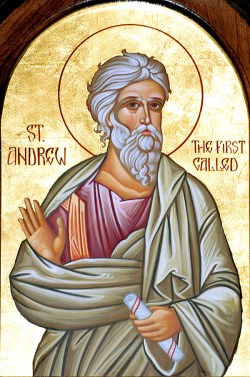
Attending Divine Liturgy on the feast of St. Andrew — what a life-giving way for me to start the day. It was a long and busy day that had me driving back and forth and all over, which is why I am only now getting to the computer to tell about it, now that we are, liturgically, in the following day.
It was a chilly morning, in the middle of the week; the little church was cold in its bones and for the first half hour I stood so close I was almost touching the wall furnace. Who would come on such a morning for a relatively unimportant commemoration? The rector came, of course, with joy. The choir director led a choir of four singers, including a nun from the monastery in the next county.
Two men named Andrew and Andrei were there, because it is their saint’s day, and who would want to miss that? One mother of an Andrew came to remember her son’s saint.
Saint Andrew, the first of the men whom Christ called to be His disciples, eventually became the patron saint of Scotland, and Mrs. Anderson came in her tartan plaid skirt to remember that aspect. She also pointed out to me that her married name means Andrew’s Son.
I myself like to participate for the sake of the Scottish ancestors that both my late husband and I have; not only that, but two of my grandsons were born on this day, and that makes it special to me. Six or eight more people were present who weren’t obviously tied to this specific feast, but I’m sure all of us were happy to receive the Eucharist and be united to Christ in that way.
Mrs. Anderson had yet another reason to be there: She was very close to a very dear parishioner named Constantine, who died on this day more than ten years ago, and every time we celebrate the feast of the Resurrection with Divine Liturgy on November 30, we also sing memorial prayers for him. She made a small portion of the memorial dish of boiled wheat, called koliva, for us to eat together in his memory at the end of the service. You can’t see the wheat in this picture because she topped it with lots of dried fruit and fresh pomegranate seeds. It did make a good breakfast.
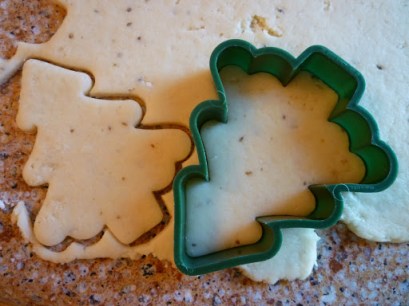
By then, the church was warmed up, but we could not linger as long as we might have liked. Out we went into the sunny day, and to all of our responsibilities. One of mine was going to the dentist, and I’m glad to get that out of the way. Afterward, I had the fun of shopping for special ingredients — and more butter– for baking Christmas cookies. The boys at the checkout stand got to talking about how they used to put out cookies for Santa. And here it isn’t even December yet! Although it likely will be before you read this.
So I wish you a December that is peaceful and bright.
(And don’t eat too many cookies before Christmas!)
“…in the early twenties—before my departure to Mt. Athos in 1925, I wept and prayed to God: ‘Find a way to save the world—to save all of us, we are all defiled and cruel.’
I would pray with particular fervor for the ‘little ones,’ the poor and oppressed. Towards morning, with my strength waning, my prayer would be disturbed by the thought that if I grieve for mankind with all my heart, how is it that God can look on indifferently at the pain and torment of millions of beings whom He Himself had created? Why does He allow the innumerable instances of brute force in the world?
And I would turn to Him with the insane challenge, ‘Where art Thou?’ And in my heart I heard: ‘Was it you who was crucified for them?’ …The gentle words uttered by the Spirit shook me to the core—He Who was crucified had answered me as God.”
—Saint Sophrony, reposed July 11th, 1993
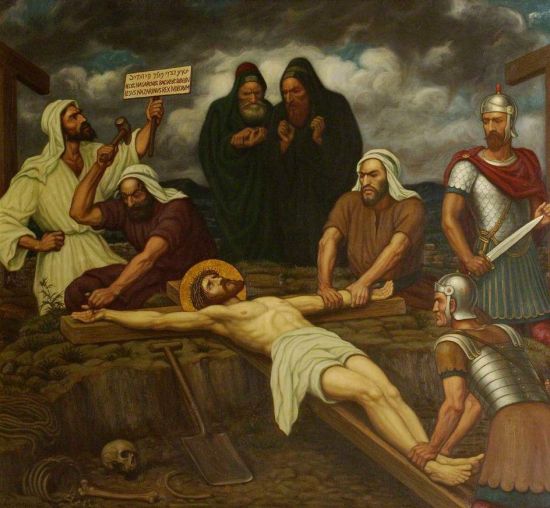
Edward Arthur Fellowes Prynne: Jesus is Nailed to the Cross
 Over the years I’ve often written about St. Herman of Alaska and Father Alexander Schmemann, two important people in my life whom we remember on this day. This year I want to add St. Lucia of Syracuse, whose day it also is; we are blessed to have four Lucys in our parish, one of whom is my dear goddaughter.
 St. Herman and Fr. Alexander have both contributed hugely to the presence of true and living Orthodox faith in America, that Church in which I’ve found the fullness of Him Who fills all in all. Every year that we come to this date finds me more thankful.

 Attending Divine Liturgy on the feast of St. Andrew — what a life-giving way for me to start the day. It was a long and busy day that had me driving back and forth and all over, which is why I am only now getting to the computer to tell about it, now that we are, liturgically, in the following day.