Category Archives: wildflowers

In the weeds and happy about it.

On my way up the mountain earlier in the week I came across several plants whose common names include the word weed: Two tarweeds and two vinegarweeds. They all got my attention by the way they added color to the drying-out landscape of late summer.

When I was still only approaching the foothills, I saw bluish plants dotting the yellow-brown expanse stretching out away from the road, and it didn’t look like anything I had ever noticed before.

It may be that in the past they were not as tall and visible from the road, and that this year’s extra rainfall helped Trichostema lanceolatum to thrive. It was hard to get a picture of it without my socks attracting various stickers waiting in ambush, but this closeup on Wikipedia shows what a graceful flower form is hidden in the overall unimpressive bush:

“The plant is an important pollen source for native bees and other insects. When a pollinating insect alights on the lower lobes of the corolla, and inserts its mouth parts into the nectar-containing lower section of the same tube, the narrow corolla portion above is straightened and snaps rapidly downward brushing pollen onto the insect’s back.

“The volatile oils make it unpalatable to grazing and foraging animals.

“The indigenous peoples of California used this as a traditional medicinal plant, as a cold and fever remedy, a pain reliever, and a flea insect repellent.”

The two species of tarweeds caught my eye a little further on. I think it was mostly Fitch’s Tarweed, Centromadia fitchii, that had turned the slopes and flatlands gold in large swaths on either side of the highway.

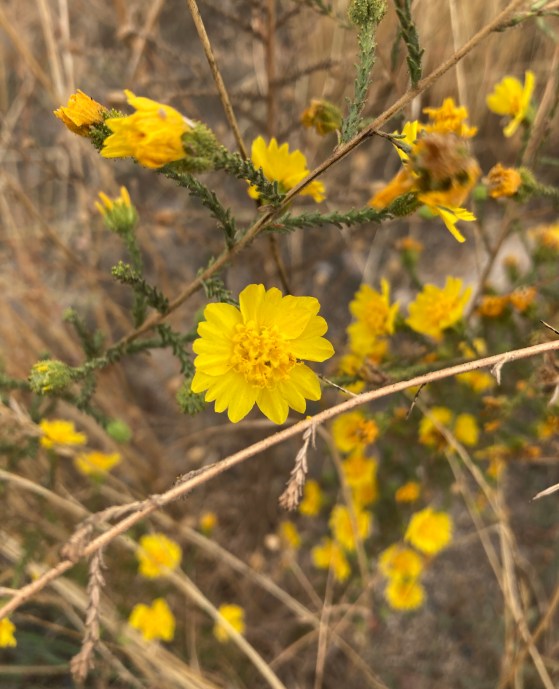
But the more photogenic plant I managed to get close to was Heermann’s Tarweed (according to my Seek app), Holocarpha heermannii. Both of these plants are in the Aster Family, but different genera. A lot of tarweeds are in the Madia Family, but it seems that Heermann’s is irregular.
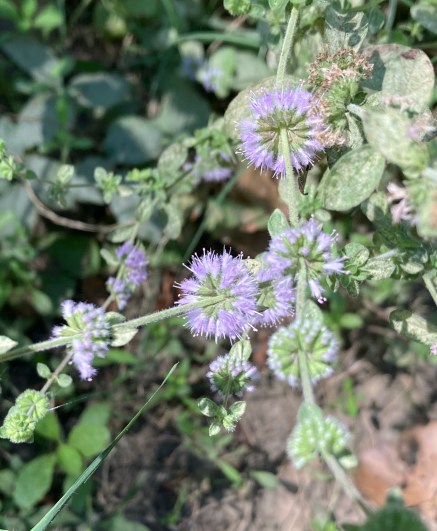
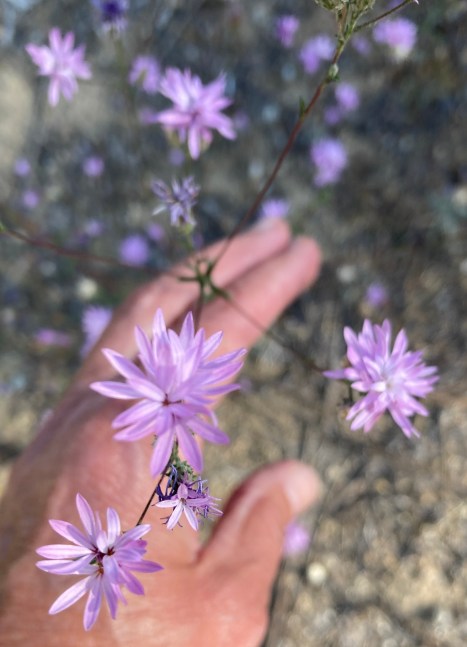
The second plant called vinegarweed grows along the roads in the High-er Sierra. When I first met it in 2009, it didn’t occur to me to taste it; maybe if I had, the idea of vinegar would have been uppermost? But my mind immediately wanted to call it Purple Haze, or Lavender Mist.
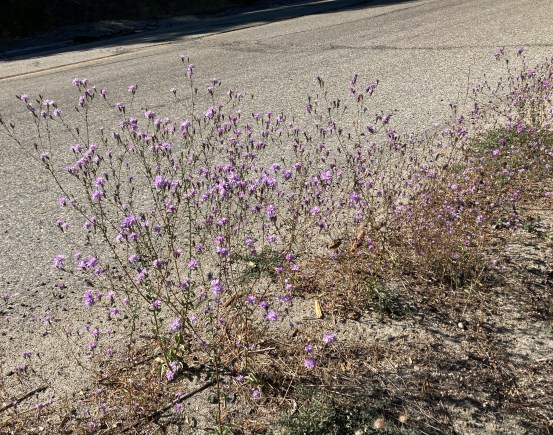
It typically gets my attention as I come  around a curve in the road, floating as a long pastel smudge on the shoulder. That first sighting was long before I had any kind of nature identification app, and when I eventually found someone who could tell me what it was (Sierra Vinegarweed or Lessingia leptoclada), that amateur botanist told me that if it had been up to her, she’d have named it Lavender Groundsmoke. The hope of encountering these flowers again would alone be enough to bring me up to the mountains every summer.
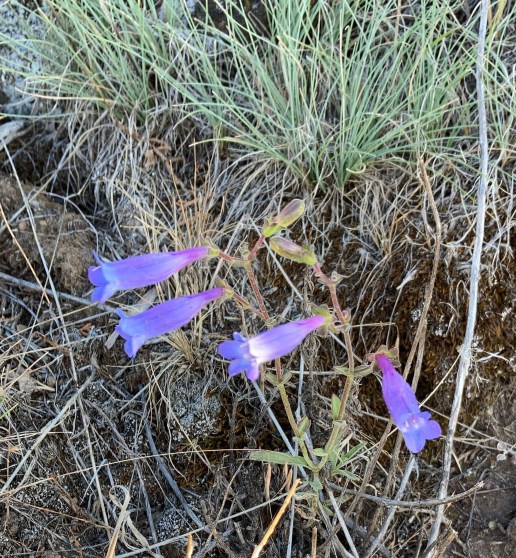
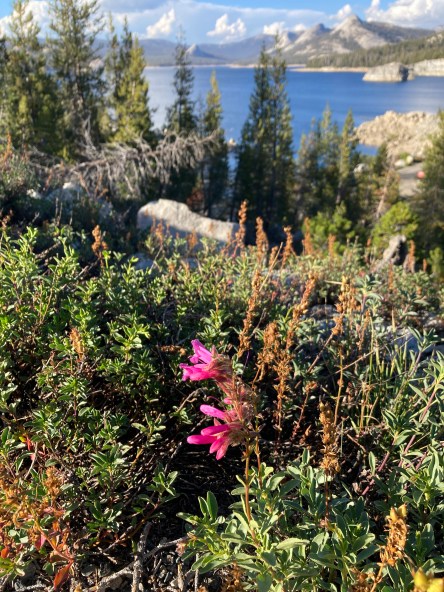
The last plant I will share has no connections to vinegar or tar; it is the favorite Mountain Pride, or Newberry’s Penstemon. In an average year, its flowers would have faded to brown by now, and in fact most of them have. But the snow hung on so late here this summer, till the end of July, that the earliest wildflowers had to wait at least a couple of weeks longer to emerge. I was happy to find one bloom of Mountain Pride still fresh and bright. These plants that sit overlooking the lake are a landmark for me, announcing at the end of my journey to the cabin, You have arrived!
Primroses were floating all around.

My friend K. and I took our first ever hike together — unless you count tromping up and down hills in San Francisco, which we used to do at Christmastime. It was a pretty easy walk, just over two miles, in a place I’d never been before. Three gravel pits near a river have been turned into small lakes, and the trail passes by two of them and loops around the third.

pennyroyal

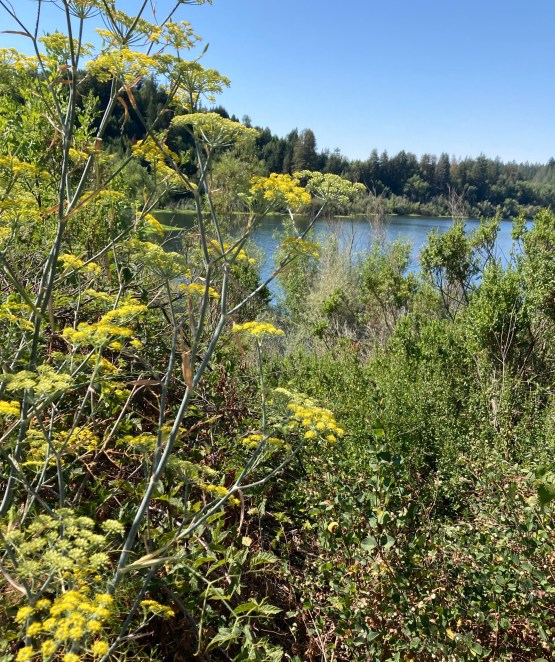
As soon as we set off from the trailhead the distinctive late summer scents of live oak and fennel and redwood filled my consciousness. It was midday, and the warmth of the air brought out their special essences and melded them into that perfume that is one of the best things about the hot season; it makes me feel at home, and quite wealthy.

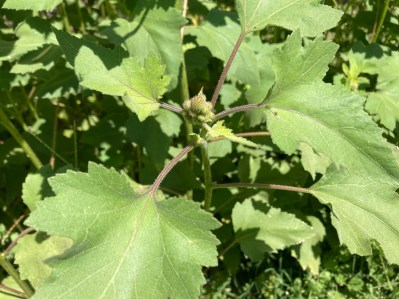
Rough Cocklebur

We saw large clumps of Rough Cocklebur, a new one to me; poison oak (of course), and — elderberries! I had just told a blogger last week that I never see elderberries unless I go to the mountains. And here were gobs of them. I wasn’t prepared to gather the berries, and it probably is forbidden anyway, as they are growing on public land. I didn’t even “gather” a photo, but you probably know what they look like.

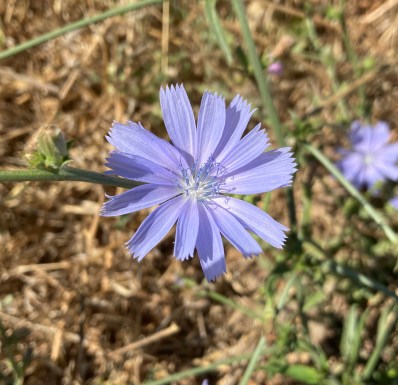
The chicory wildflowers were the most beautiful I’ve ever seen. Usually they are fading or for other reasons not very photogenic when I see them. This is the same plant from which the root is used to make a drink that people use as a coffee substitute. I have developed a love for the drink, hot or cold, that I brew from chicory that has been gathered and roasted by someone else.

chicory

My favorite discovery of the afternoon was Floating Primrose Willow, Ludwigia pepoides which was growing all around the lakes and out onto the water in broad swaths. [update: in my original title I called them “willow flowers” but Linda pointed out that in so doing I gave the impression that they are willows — they aren’t at all, are in a family of aquatic plants sometimes called water-primroses.]

K. and I hope to make a habit of our hikes together; neither of us can seem to make it happen if we are trying to go alone. We loved this outing so much. May God help us to continue!

Floating Primrose Willow

From dogwoods to biscuitroot.

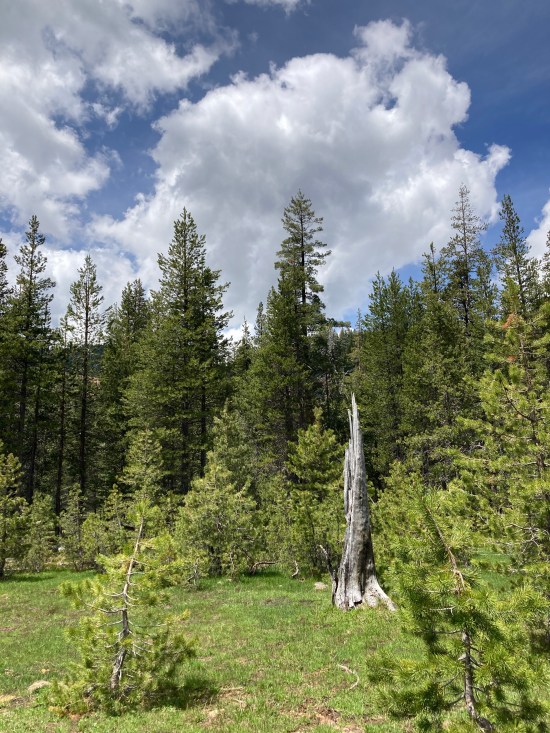
I’ve been with the family of my daughter “Pippin” for a few days, several hours farther north in California from my home; they live in the forest in the mountains, where the air right now is infused with the scent of pines and manzanitas and all the other woodland plants warming up and drying out after a wet and late winter. Every time I leave the house or get out of the car and smell it afresh, I take several breaths as deep as I can make them, trying to get the forest into my body.

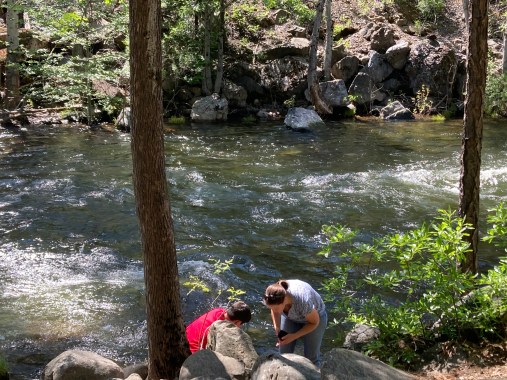
There have been many opportunities to whiff aromatics in the forest and out of it, as we’ve visited higher mountain meadows and streams (Tamarack Flat), the botanical garden in Dunsmuir, the McCloud River and waterfalls, and a hilly spot from which to watch how the setting sun colored the sky above a volcanic mountain (Mt. Shasta).

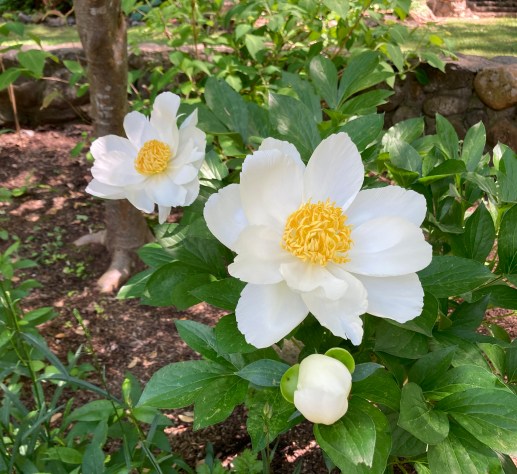
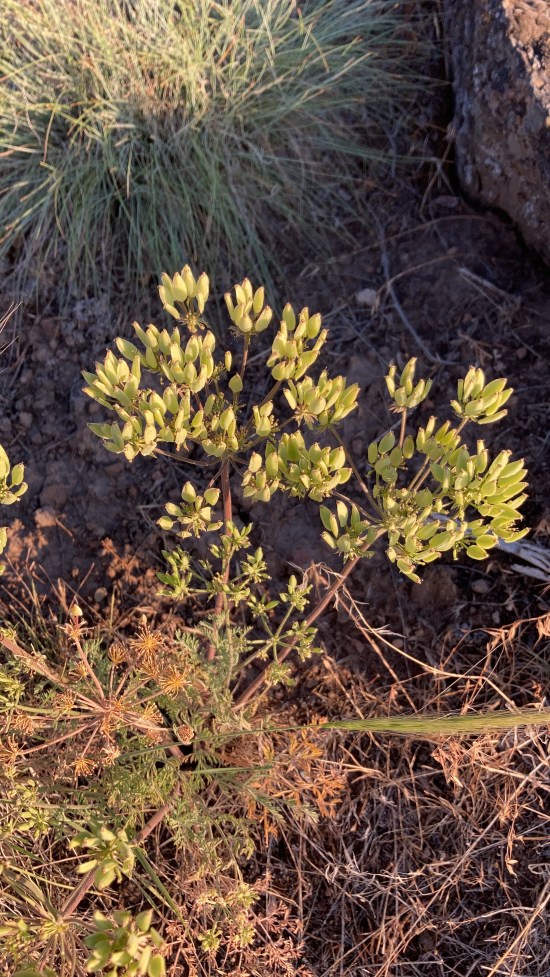
I’ve gushed over the dogwoods and peonies, and marveled at the names of plants new to me, such as scorpionweed (Phacelia) and biscuitroot. We saw swaths of the carnivorous California Pitcherplant, wild onions, and the wildflower called Pretty Face.

It’s been too much for me to process, truly! Especially when every morning brings new experiences — and I haven’t even mentioned the bird songs everywhere. Pippin introduced me to a new app called Merlin, that listens to your space and tells you what birds are talking or singing nearby. And the children are older, and staying up later now in the summer, so I am spending more time with them, and not on my computer. One book we read together was Owls in the Family by Farley Mowat.

So I won’t be identifying these photos right now, but if you have any questions about them I’ll be happy to answer in the comments or in updates once I get home again. For now, I just wanted to share a little “whiff” of my adventure with you, and I’m sorry I can’t send you the birdsong and the scents. But I hope you are discovering some of those wherever you are. Enjoy!

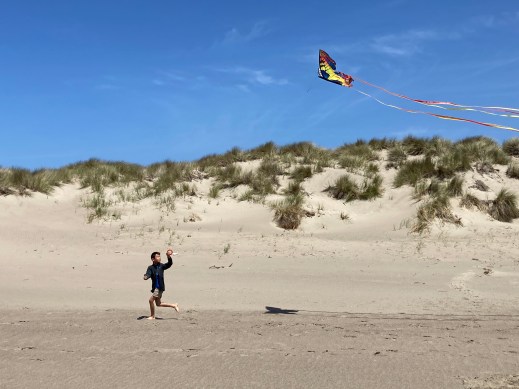
Kites fly high at Limantour.

Even though his older brother is the one I call Pathfinder, my son Soldier took the lead in planning our family outing yesterday. Both of them wanted to include not only a hike but some  beach time, coming as they did from places where one can’t make a day trip to the ocean.

All eight of us were able to go in one car, which added to the fun. The children who had recently endured 12-hour days on the road were cheerful, even though it took us a while to get to our destination, a beach farther south than we usually venture: Limantour. The main thing I always retain in my memory of this beach is that it faces south, so it is a little warmer than many North Coast beaches. It is on a long spit of land on Drakes Bay, named for Sir Francis Drake. In the article, “Drake in California”, you can read the many keys to the identification of this bay as the place where the explorer thanked God for a safe haven.

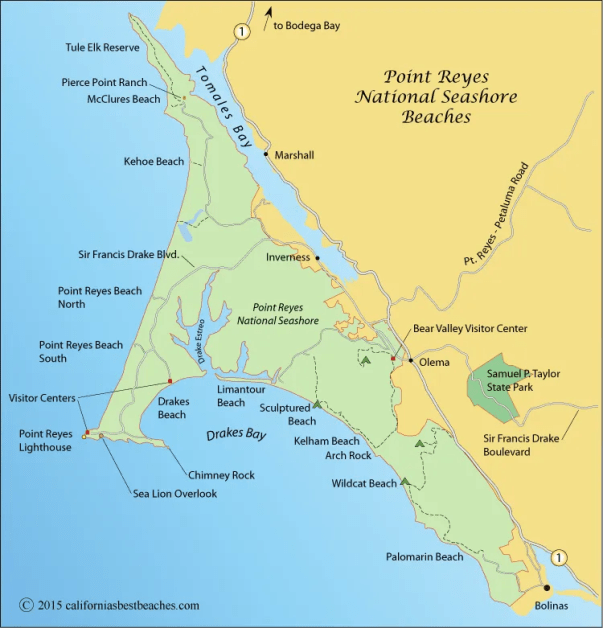
This map shows you where we were in relation to San Francisco:

And this next one reveals Limantour Beach in the Point Reyes National Seashore:

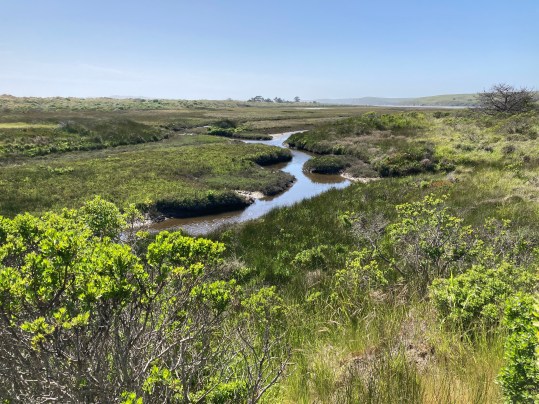
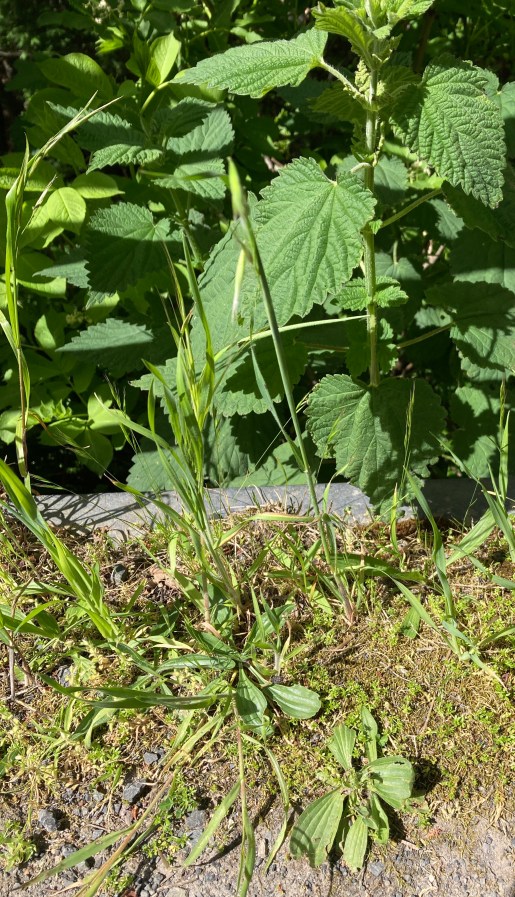
We piled out of the car at the trailhead and hiked about two miles out to the beach, through dense woods opening up from time to time to views of the estuary and wide blue skies; irises in three shades of violet and purple dotted the sunnier banks. Under the trees stands of giant nettles extended back into the dappled shade, with swaths of forget-me-nots or candy flowers at their feet by the path.

Candy Flower – Claytonia sibirica

It was the sort of hike where Grandma, with one or two companions, falls behind the main group to examine and hopefully identify wildflowers, and then eventually catches up when the group stops to wait. Liam spied the Indian Paintbrush first.

The trail was bordered by a lush jungle of trailing blackberry and manroot, strawberries, buttercups and ocean spray. I couldn’t stop for everything that was interesting, and I can only mention a few of the hundreds of plants. But at the time, I pointed out to anyone who would listen, how conveniently the plantain herb was growing near the nettles: if you were to get a nettle sting, you might chew up a few plantain leaves into a poultice to put on the burning flesh to soothe it. Or so I’ve been told many times.

In spite of my lagging, we arrived on the beach and oh, what a lovely, clean and white expanse it was to behold; we didn’t pause, but walked right on out to the shore.

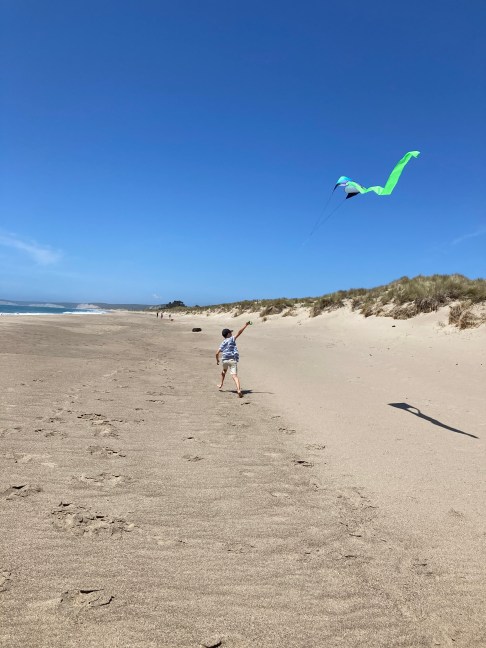
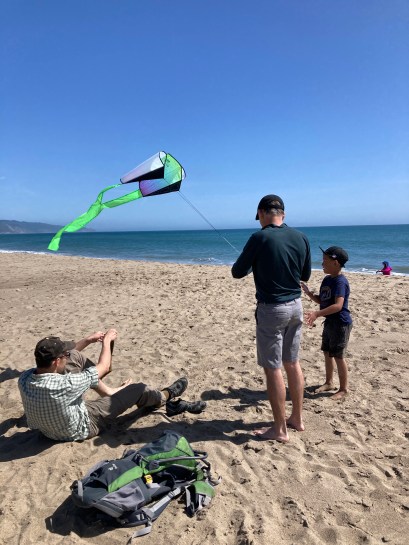
We had brought along three kites, so all the children had plenty of time
holding the fliers against the wind. It was a perfect day for that.

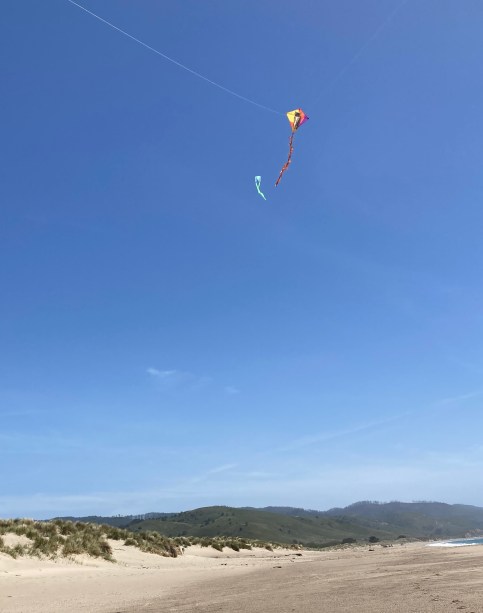
This one above, once it got up, flew by itself all afternoon at the end of its tether,
while we ate a picnic on the sand, and the men dug holes for the waves to flow into.

Then it was time to reel it in, and head back out the way we had come.


It was only on our way out that I had time to really notice these grand bushes of purple lupine, a relation no doubt of the big yellow version I’ve seen so much of farther north, and have even grown in my garden.

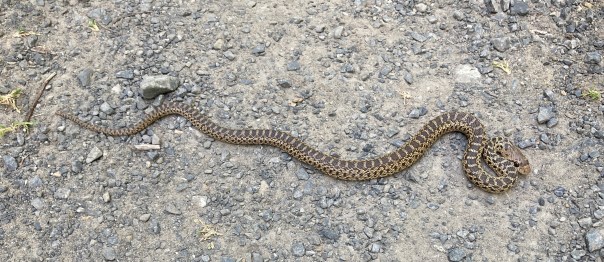
Almost the last thing I took a picture of was a baby rattlesnake lying still as could be on the path. It was too young to have rattles, but as we stood around looking at it, the other adults told us about how the shape of its head and neck helped them identify it as a rattlesnake, and how the venom of juveniles is very potent.

I couldn’t see his eye until I saw the picture I had taken enlarged; he was definitely alive and awake. We were told that rattlers aren’t able to strike effectively if they are not coiled up. But we moved on very soon, stepping around the rattleless tail.

My family all departed this morning very early, before the sun was up, and while fog was still lying low in the neighborhood. All day I’ve been reeling myself in! I had hoped to go to bed early tonight, but instead, before I move on into May — coming right up! — I wanted to finish my story of kites and wildflowers, and my dear people.