Thou tellest my wanderings: put thou my tears into thy bottle: are they not in thy book?
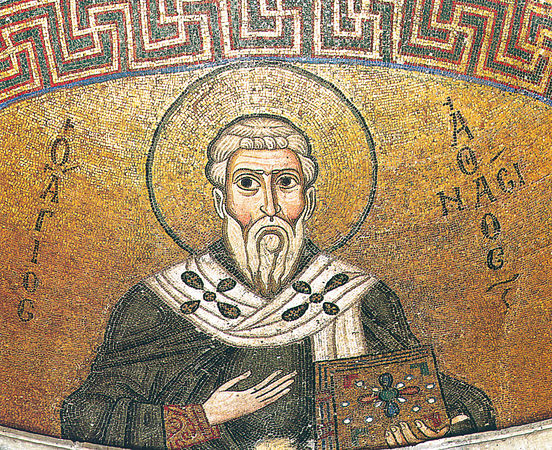
The more one researches current events, historical accounts, and the tangled web of cultures and civilizations going back to the foundation of the world, the more likely is a fall into worry and even despair. We fear especially for children who have to grow up in a violent era, as many have done. That’s why I take courage from the life of St. Athanasius, and pray that my children, grandchildren, godchildren, and all of us, might learn deep in our souls what he knew. The following is an excerpt from a post I wrote several years ago in a time of sorrow. I have shared the quote from his treatise more recently than that, but I hope you might agree with me that it’s worth rereading:
I learned in the short account of the life of Athanasius at the beginning of his On the Incarnation, that the last and worst persecution of Christians ended in Egypt in 311 A.D., when Athanasius was about fourteen. From the age of five he had lived with the constant threat of death, and with the ever-present reality of persecution of his friends and family. The behavior of the ungodly is irrational and inhuman, and tends to cause great pain and suffering, often unto death, not only of the innocent but also of the most Christ-like. As an adult the scenes and events of his childhood seem to be fresh in his mind when he writes:
“A very strong proof of this destruction of death and its conquest by the cross is supplied by the present fact, namely this. All the disciples of Christ despise death; they take the offensive against it and instead of fearing it, by the sign of the cross and by faith in Christ trample on it as on something dead. Before the divine sojourn of the Saviour, even the holiest of men were afraid of death, and mourned the dead as those who perish. But now that the Saviour has raised his body, death is no longer terrible, but all those who believe in Christ tread it underfoot as nothing, knowing full well that when they die they do not perish, but live indeed, and become incorruptible through the resurrection. But that devil who of old wickedly exulted in death, now that the pains of death are loosed, he alone it is who remains truly dead.”
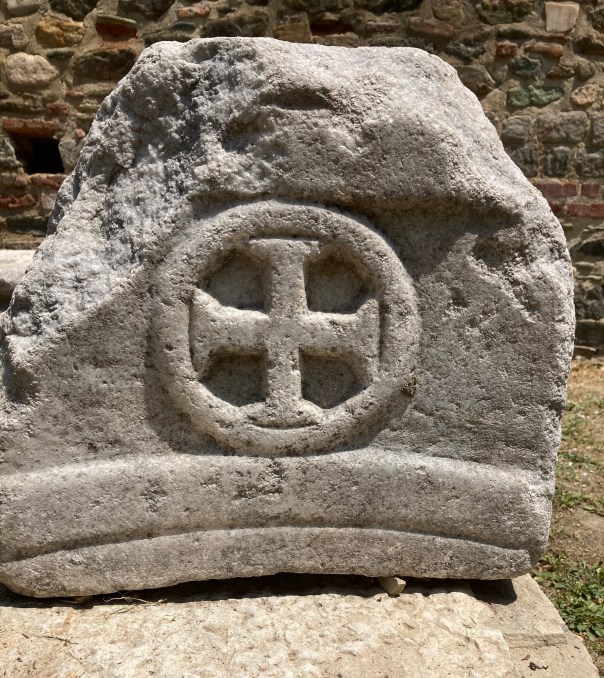
Thessaloniki – Rubble at Church of the Acheiropoietos
It’s not even midmorning as I am beginning to write this post, and already my Name Day has bestowed several particular delights. One of the first was the ability to take an early walk — it seems so easy when all the conditions are right, and somehow that rarely happens anymore. Hmmm…. Note the passive phrase that flows from my mind, referring to a thing that happens, instead of an action I take. But truly, I am always choosing a direction for my heart to follow, moment by moment, as I respond to constant promptings. This morning I felt no prompting from tired bones to stay in bed, and no prompting from the fog to mope — that tipped the balance.
St. Paisios of Mount Athos
Much as I love the church calendar, and the abundance of events and people to remember and celebrate every day, I don’t always keep in sync with it, or the civil calendar for that matter. Others have told me that they also might miss their name day if someone didn’t remember it for them and wish them a “Happy Name Day!”
I received such a prompt pretty early this morning, as it came from Greece. And the next name-day greeter shared a photo of the icon above, which is by the hand of Janet Jaime, a contemporary iconographer who is new to me. The friend who wrote me from Greece included an encouraging article about holy elders and saints whose prophecies have been much discussed of late, an example being St. Paisios.
Christ praying in Gethsemane
I do think about Current Events, of course. I wouldn’t want to close myself off from what my friends are thinking about, and right now I also have a personal reason to keep at least minimally informed, in that one of my own family members is living in the Middle East and very close to the recent action. Still, it’s important to detach from the stream of noise that is the news, for even half a day, or as long as possible. Because each of us has some work God has given us to do, whether washing the morning dishes or praying on your sick bed, managing a busy restaurant or walking across the street to check on a neighbor. We should be present wherever we physically are.
Today another thing “happened” that became a celebration of my name day, which was the long-awaited lunch together that my goddaughter and I have been trying to accomplish for two years. Naturally we had set the time and place, but without either of us realizing that it was the feast day of St. Joanna, until the day arrived. We spent half the afternoon catching up, and didn’t have a spare moment to talk about events outside of our realm of influence.
Father Stephen Freeman’s blog post for today just happened to be perfect for my name day and my mood: “Everything is in Motion”:
“God’s creation (as we should well know) is everywhere in motion. Every object in the universe is moving (further apart we are told). Even the particles of matter that compose so-called stationary objects (such as rocks) are in motion. Nothing is completely at rest.”
“Everything is in motion, and everything has its direction. That direction is its purpose – its reason for existence and reason for continuing in existence. This reason is its logos. The Logos of all logoi (plural), is Christ Himself.
In the beginning was the Logos, and the Logos was with God and the Logos was God. All things were made through Him… (John 1:1)
“Each of us has a purpose and reason for existence. For human beings (and all creation), that purpose is union with God…. We move rightly towards the end for which we were created. Salvation, like all things in God’s creation, is dynamic and not static.”
Fr. Stephen goes on to mention how “dizzying” it can be, to live in the midst of this constant swirl that is our world, and our life. He relates how monasteries on Mount Athos will at times set chandeliers swinging during services, which has been described as “representing the dancing of the angels before God.” We often do this in my parish, with four of the six chandeliers that hold real candles turning and twirling while the flames dance.
When I first experienced this I had no idea I would one day enter the Orthodox Church at that parish. I was sitting on the floor during a Vespers service, having come primarily for a weekend food fair. So much was going on in that space, people coming out and going into the altar, other people bowing before the icons or lighting candles, the choir singing beautifully, and no pause in the hymns of praises going up — that is, a lot of movement! — when my gaze was lifted up to the huge chandelier above me — at that time there being just one — which was being pushed by an altar server in such a way that it began to swing into a wide and majestic arc. I thought at the time, These are serious Christians, to worship so extravagantly.
Over the many years since then, I should have known this tradition was symbolic of something, and not just a random act of jubilation. I found a short video that shows one such otherworldly occasion, where multiple chandeliers are in motion, on the Holy Mountain: The Dance of the Cherubim.
You may find it a little jarring, as I did, when phones and cameras other than the one making that video come into view. But I comforted myself knowing that since the angels are immaterial, they are not able to be seen in person or caught in a video unless they choose to take on a material form. But they are probably too busy doing their work of crying “Holy!”, carrying messages, and dancing, to bother about our devices — at least the material kind.
My day is now coming to an end, and it’s time to bring this post to a full stop. The universe is still in motion, I know, but my rational mind and my fingers will cease moving for a few hours. Thank you, St. Joanna, whose name I bear, for your example in actively following Christ in His earthly life, and for your prayers. Thanks be to God for the many ways I have felt His movement, pulling me in, and giving me the strength and will to respond. It feels very much as though I am in The Dance.
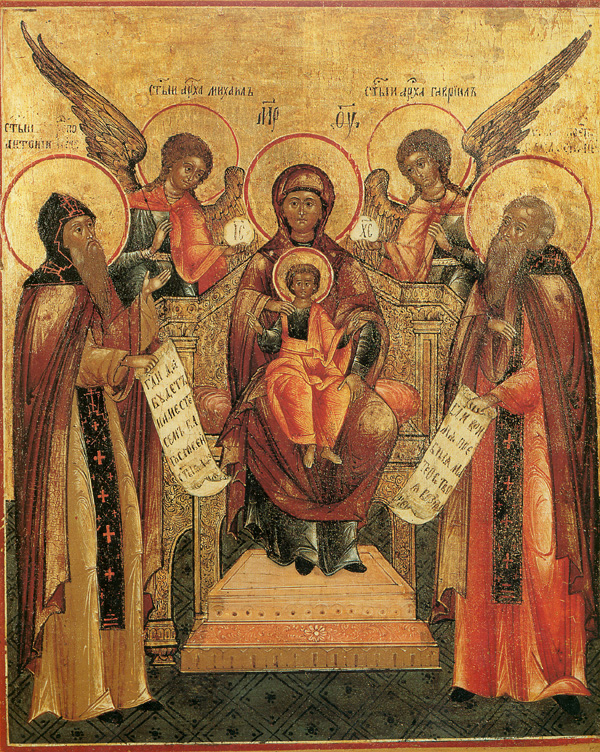
Sometimes good things can be found on Facebook, like the quote below. (I added the icons and Psalm.) We are at the Sunday of the Last Judgment in the Orthodox calendar, and also in the midst of painful current events. We might acknowledge that the traumas and crises and pain are always with us, and being experienced by countless souls. So the exhortation applies at all times:
“It is often thought: what can we do? When the heart is torn with love for some and sympathy for others, what can we do if we are powerless, hopeless, and suppressed?
“We can stand before the Lord in prayer, in the prayer that Elder Silouan spoke about, that praying for the world is shedding blood.
“Not in that easy prayer that we offer out of our comfort, but in a prayer that rushes to heaven from sleepless nights; in a prayer that does not give rest; in a prayer that is born from the horror of compassion; in a prayer that no longer allows us to continue living our insignificant and empty life. That prayer requires us to finally understand that life is deep and that we are spending it racing about something unworthy and also unworthy of ourselves, unworthy of God, unworthy of sorrow and joy, the torment on the Cross and the Glory of Resurrection, which constantly alternate and intertwine on our earth.
“It is not enough to sympathize a little, and it is not enough to say that ‘we cannot do anything.’ If only we would stand in such a prayer, if only such compassion would exclude from our life everything insignificant in the face of the horror of our existence, then we would become people worthy of Christ. And then, perhaps, our prayer would also ascend like a burning and shining flame. Then, maybe, there would be no more inertia, indifference, or hatred that prospers around us because we do not become an obstacle to every evil in our own life.
“In the face of what is going on in front of the Cross, death, and spiritual agony of people, let us renounce the pettiness and insignificance of our life—and then we will be able to do something: by our prayer, by way of our life, and perhaps even by something braver and more creative.
“But let us remember that Christ did not differentiate between people; Christ died for all—because righteous are persecuted and because sinners perish. In His unity with all the people around us, in this dual unity with a righteous and a sinner, let us pray for the salvation of both. For the mercy of God, that the blind may see, and that truth may be established—not judgment, but the truth. This truth will lead us to love, to the triumph of unity, and the victory of God. Amen.”
-Metropolitan Anthony of Sourozh, excerpt from a 1968 sermon
P.S. 1968 Events:
-Soviet armed forces invaded and occupied Czechoslovakia, reinstituting hardline Communist rule.
-The U.S. State Department announced the highest U.S. casualty toll of the Vietnam War, with 543 Americans killed in action and 2,547 wounded. U.S. ground troops killed more than 500 Vietnamese civilians in the My Lai massacre in South Vietnam.
-Martin Luther King, Jr. was assassinated.
-Students protest all over the world.
-Robert F. Kennedy was assassinated.
-Olympic protests.
Our soul shall wait for the Lord, for He is our helper and our defender. For our heart shall be glad in Him, and in His holy Name have we hoped. Let thy mercy, O Lord, be upon us, according as we have hoped in Thee.
“In all nations, storms are gathering; minds are confused. May God save this poor world of ours that is blowing steam like a pressure cooker! Look at those in power! The schemes they come up with! They throw it all into a pressure cooker and leave it, boiling and boiling; the cooker is whistling now! The steam valve is ready to explode!”
“We have not yet realised that the devil has set out to destroy God’s creation and all His creatures. He has put together an alliance to destroy the world… He has become even more vicious now because he knows that he has but a short time. (cf. Revelation 12:12.) He resembles a criminal, who, when surrounded, thinks to himself, ‘There is no way out; they will get me,’ and he starts destroying everything around him. Or, he is like soldiers at war who, having run out of ammunition, draw their bayonets or swords and start slashing away at everything because they have nothing to lose. They say, ‘We are going to die anyway; let’s get as many of the enemy as we can.'”
“Wherever one turns, one thing is clear: things are falling apart! It’s not, for example, that we have a house, and we need to fix a window or something else. No, here it is an entire house that is in shambles — worse yet, the entire village. Things are spinning out of control. Only God can step in and stop it…. The world has an inflamed wound, full of pus, that needs to be opened and treated. But it’s too soon to open it now; evil must first run its course as it did back in Jericho (cf. Joshua 6.), a long time ago.”
-St. Paisios of Mt. Athos, 1924-1994 From With Pain and love for Contemporary Man
 and civilizations going back to the foundation of the world, the more likely is a fall into worry and even despair. We fear especially for children who have to grow up in a violent era, as many have done. That’s why I take courage from the life of St. Athanasius, and pray that my children, grandchildren, godchildren, and all of us, might learn deep in our souls what he knew. The following is an excerpt from a post I wrote several years ago in a time of sorrow. I have shared the quote from his treatise more recently than that, but I hope you might agree with me that it’s worth rereading:


 the universe is moving (further apart we are told). Even the particles of matter that compose so-called stationary objects (such as rocks) are in motion. Nothing is completely at rest.”




 Gladsome Lights