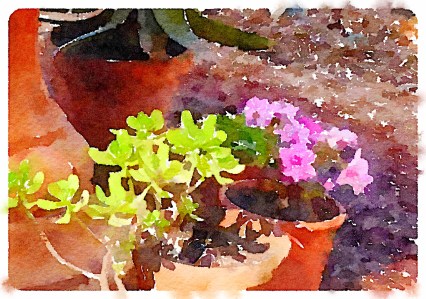
I watch the birds, bees and weeds.

gl P1030454

In the back yard I heard the jay before I saw him, as he remarked in short screeches about the breakfast I’d laid out. In the last couple of weeks I’ve taken pictures of doves, chickadees and juncos at the feeders, but the jay was the first to come since I moved this one closer to the window, and he is a larger target to focus on, so his picture came out best.

As soon as he flew off I went out front to tackle the perennial bed that was a mess, but before ten minutes of weeding had passed, I had a burning need to go back indoors and fetch my Weeds of the West.  I returned to sit on the bench swing and leaf through the whole book, trying to find the names of two or three weeds that had challenged me that morning. It’s good to know your enemy.

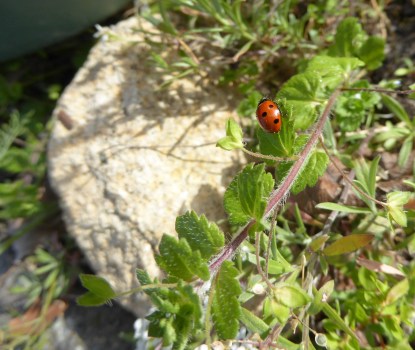
Though it’s hard to think of Persian Speedwell as an enemy. It is pretty, and the book says “It was probably introduced as a border or rock garden ornamental.” See, the ladybug likes it.

I spent a lot of time on the beds where chard, collards and kale grow, and I picked a big bowl of greens which I washed later in the day. In the picture below you can see Swiss chard behind the speedwell and also the feather-like arrangement of “scattery weed” seed pods that exploded a few minutes later at the touch of my hand.

I still have not found out the real name of that scattery weed, whose picture I re-post below. In the past I asked if any of my readers knows its name, but they did not; maybe one of my newer readers does? I couldn’t find it in Weeds of the West. It arrived in our garden in the last ten years. UPDATE: It’s Hairy Bittercress or cardamine hirsuta.

cardamine hirsuta

Just a few feet away from the Persian Speedwell — a weed to me — is another cultivated type that I planted because I wanted it, Creeping Speedwell (below). So far the Persian has not even tried to invade the Creeping, though if the Creeping can be said to creep, the Persian gallops.

Before Fall I plan to revamp this whole area, but in the meantime, I must try to keep a little order. Today I put in several hours of work and got plumb tuckered out! I’m glad tomorrow is a day of rest.

They rise against their rootedness.

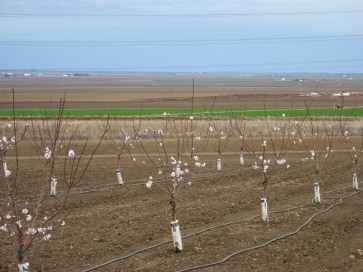
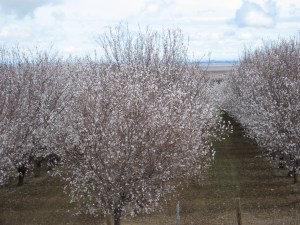
February is one of my favorite months for driving up and down the center of our very agricultural state. I won’t have that pleasure this year, but a few Februarys when I managed to visit family and the land where I grew up, the expanses of almond orchards were to be seen out my window for at least as many miles as it took me to drive one of the hours through what is called the West Side of the Central Valley. They are especially pretty on stormy days when the clouds are also playing their melodrama in the skies above.

The landscape along Highway 5 is never static, and not just because the seasons change. Our drought, and the loss of aquifer, mean that some farms will have to change what they grow, or downsize, or go out of business. One grower recently announced that they will be taking 10,000 acres of almonds out of production this year.

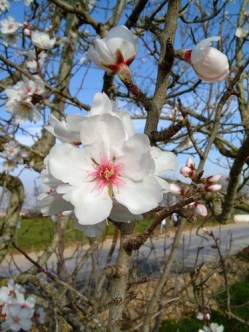
So I will enjoy the orchards I see, and not presume on their future. Richard Wilbur in this poem helps me to see aspects of fruit trees that I might not consider on my own, such as lifespans. Is it old orchards that are being “taken out,” or young trees that will never have the chance to be fully grown? What are the West Side bees meditating about this year?

gl w-side alm nurs closer

YOUNG ORCHARD

These trees came to stay. w-side alm med close
Planted at intervals of
Thirty feet each way,

Each one stands alone
Where it is to live and die.
Still, when they are grown

To full size, these trees
Will blend their crowns, and hum with
Meditating bees.almond-tree-flower

Meanwhile, see how they
Rise against their rootedness
On a gusty day,

Nodding one and all
To one another, as they
Rise again and fall,

Swept by flutterings
So that they appear a great
Consort of sweet strings.

~ Richard Wilbur

gl w-side alm orch clouds

Elizabeth

gl P1030373 manzanita
Manzanita

My friend Elizabeth sat with me today on the patio and we had lunch together at 4:00. Yes, lunch. That is what time she normally eats what she calls lunch, and it worked for me. I tried to have her for her 100th birthday earlier this month but illness prevented us. The Comfort Soup I had put away into the freezer came out again and we ate it along with some sourdough bread, and Sumo mandarins that came in the mail this week. Yes, in the mail! Magical, that was.

As soon as she walked into the family room Elizabeth saw a photo of some of my grandchildren, and recalled events at church involving two of them, when they were 15 years younger. She told stories to Susan and me of the last severe drought that was also about 15 years ago, and kept me entranced as she always does with tales from throughout her life, from Hawaii, Saudi Arabia, South America and many other places she has lived or spent a lot of time.

Today I learned about how her mother detested the cold, but gave birth to my friend in high elevations of the Rocky Mountains, in icy February. When she was near to full-term the doctor said she must not ride the horse to town any longer, but rather should walk, because she was less likely to slip on the ice than the horse was.

It was balmy in my neighborhood this afternoon, especially for February! First we sat in the corner of the garden next to the manzanita bush, where eventually I want to have a bench, but where today we sat in black iron chairs. (You can see them in the upper left corner of this photo.) gl fountain w plants crp

Elizabeth played with her cane by dangling it around by its strap loop on the top. The neighbors on one side were playing drummy rock music in the garage. Over the fence near us children were squealing and running around. I shared stories of my Chinese neighbors in the next house from that, who have loud-laughing parties outdoors in any month of the year, and of the grandma who sings Chinese karaoke into her microphone for the pleasure of the whole neighborhood.

The fountain was gurgling, and I assured Elizabeth that yes, it is recirculating its water. (You can see how it splashes some on the ground, too.) She lamented about how the southern California swimming pools “are taking our water!” and about how all of the neighbors on her block are gone to work every  weekday, not one is around. While her son is at work in the afternoons she is busy making her lunch, watching animal programs on TV, reading the Bible or doing crossword puzzles. She feeds the local animals, that is, their several cats.

Elizabeth lost her husband after they had been married 43 years, the same as me. She says that probably the Lord wanted her to know Him better on her own, and while her husband lived she didn’t put much effort into that “vertical” relationship. She is very thankful for her good life, and she reminds me of the blessings of my own. She is nice to have around.gl fountain group Waterlogue-2016-02-24

A feast of a book.

From a certain angle, the spring seems so calm: warm, tender, each night redolent and composed. And yet everything radiates tension, as if the city has been built upon the skin of a balloon and someone is inflating it toward the breaking point.

This paragraph from All the Light We Cannot See by Anthony Doerr conveys the tone of the whole book, which I am only halfway through. Too soon, certainly, to be writing a review, but I can’t help myself, I have to share the joy. My copy was a Christmas gift from Kate and Tom; Kate said it was the best book she’d read all year.

I got into it right away, but it isn’t the kind of book you want to rush through. In that way it reminds me of The Red Horse by Eugenio Corti. They are both set during World War II with all its horrors, but even they can’t blot out the love that glows in these novels. Reading them is like being in the company of the best sort of humans, illuminated by a wise and able storyteller, someone who seemingly effortlessly paints lush pictures in your mind of the landscape of humanity and even of the dark places in individual souls, but who somehow leaves you with hope. You don’t want to leave, and while you are at this feast you want to linger over every bite, every description and metaphor that wants to pull you into another aspect of life and reality.

One of the protagonists is a young blind girl, Marie-Laure. Doerr’s descriptions of  her imagination make me wonder if he spent a lot of time under a blindfold, learning what sensory riches are available to those who can’t depend on their eyesight. Telling the story from her point of view enlarges the world that we get to live in as we read. One such moment is when she is accompanying the housekeeper on errands, often to give food to the needy:

…[Madame] burgeons, shoots off stalks, wakes early, works late, concocts  bisques without a drop of cream, loaves with less than a cup of flour. They clomp together through narrow streets, Marie-Laure’s hand on the back of Madame’s apron, following the odors of her stews and cakes; in such moments Madame seems like a great moving wall of rosebushes, thorny and fragrant and crackling with bees.

The other protagonist is an orphan boy, to whose orphanage a Nazi officer pays a visit, in a moment that hints at the impending gloom:

The lance corporal looks around the room — the coal stove, the hanging laundry, the undersize children — with equal measures of condescension and hostility. His handgun is black; it seems to draw all the light in the room toward it.

I have read very little 20th, and less 21st-century fiction,  but I can identify two elements of this novel’s style as those that I am more likely to encounter in newer books: Present-tense narration, and alternating chapters set in different time periods and about different characters whose lives, we predict, will merge in the end.

More than once in the past I’ve laid aside a book because one or more of these devices was annoying or contrived, but in this case the suspense is only heightened by getting glimpses of what the future will hold for for these young people. The plot was already deliciously thickened by the second chapter, because of these tiny bits of foreknowledge.

So many books I have gobbled up too fast, trying to get to the main point, to find out What Happened, promising myself that I will go back and read the story again so I can pay closer attention and do justice to the other facets of the creation the author has made. Doerr makes it so that I have no compulsion to rush. Everyone is in a process, we all have time. Take time to notice the feel of the air and the way the seasons are changing, the story progressing. Though the war is hanging over them (and the reader) and using them and hurting them, it is not everything. There is a bigger world, a whole universe, of which this one crazy man and his evil system is but a very small room.

Marie-Laure has felt trapped in her house near the sea for months — her father doesn’t think it safe for her to go out exploring the way they used to do back in Paris, now that they are occupied by the Germans. But Madame takes matters into her own hands and walks the girl down to the beach for the first time in her life. As they get close to the shore, Briny, weedy, pewter-colored air slips down her collar.

And then her feet touch the sand:

...wet, unwrinkled sand. She bends and spreads her fingers. It’s like cold silk. Cold, sumptuous silk onto which the sea has laid offerings: pebbles, shells, barnacles. Tiny slips of wrack.

Her world that was dreamily expansive when she was younger and raised by her doting father, and then became overshadowed and dirtied by the privations and separations of wartime, begins to open up again.

The German orphan boy Werner also has a rich childhood, because of kind people and in his exploration of the abundance of wonders in the physical world. He holds within himself a knowledge of the good even through years when he is victimized into participating in the wickedness.

The depictions of the heroes of this book, children growing up, ring true to me. I don’t think it is easy to get that right, and it’s not surprising. No accomplished author is that close to the experience of being a child, and no one can have had the experience of every child. It seems to me a very great gift to be able to “create” young people especially, and to reveal them so deeply and keep them real.

Maybe this will only be Part One of my review, but just in case, I will end with my own reflection of one theme that emanates from this novel: You are never ultimately trapped in a dark place. Light fills this universe of which the darkest moments are only specks, and light is in you.