Mountain Air – smoke and writing


I returned this week from a solitary trip to the mountains, where I stayed in a cabin off the grid for four nights. I could easily write a book about my five days of journeying and lodging, probably a philosophical novel. Or would it be a how-to treatise with packing lists and suggested activities and prayers?

I’m always saying, “I could write a book about ____.” And it just occurred to me that I am always writing, as I endlessly analyze events as to their significance, and organize my thoughts, composing and reworking the lines in my mind. If I have a pencil or keyboard handy and hands free I might scribble down some of it, often in a notebook or in the margin of the book I’m reading. But the process has begun long before that.

It wouldn’t be a lie exactly, when people ask me what I do, to say, “I write.” Because I’m a process-oriented type, I can’t see a book ever resulting from my work, but no pressure — no one is clamoring for a discussion of the things in my pocket or the interrelatedness of the last ten books I read.

I thought I might do some sort of scribbling during my getaway, but I didn’t make much visible progress on my “books.” Many things that are fascinating to my self-centered self consumed my hours and my thoughts, and I do want to reflect on some of that here, hopefully without rambling on and on.


Today I just want to mention one sad thing about my experience: Smoke. The brown cinders from that horrid Rim Fire, the largest wildfire on record in the Sierra Nevada, had drifted south and made the air murky around Our Lake. One day was so bad that my eyes and throat and head hurt from the pollution. But I didn’t have to come home early, because it cleared up a little by the next morning.


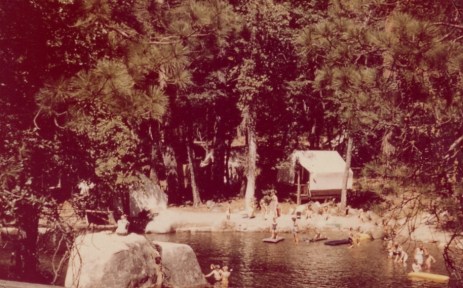
I can’t imagine what the landscape will look like, the next time we visit our beloved Yosemite and drive through the scorched forests. One thing I know: On August 25th the fire destroyed the Berkeley City Camp Tuolumne where my sisters and I as children vacationed with our grandparents.

It has been many decades since I did water ballet in that swimming hole in the Tuolumne River, or even visited the camp, and it won’t change my life that it is wiped out. But what a heartache for the people who spent dozens of formative summers in the context of that special place, and those for whom the rustic cabin life in an idyllic setting was a very recent tradition and expectation. I’m very thankful it was only smoke that invaded our family’s lake and village.
Know this and let your heart dance for joy.

September 1st marks the beginning of the church calendar, and St. Nikolai in his Prologue of Ohrid explains:

The First Ecumenical Council [Nicaea, 325] decreed that the Church year should begin on September 1. The month of September was, for the Hebrews, the beginning of the civil year (Exodus 23:16), the month of gathering the harvest and of the offering of thanks to God. It was on this feast that the Lord Jesus entered the synagogue in Nazareth (Luke 4:16-21), opened the book of the Prophet Isaiah and read the words:

The Spirit of the Lord God is upon Me; because the Lord hath anointed Me to preach good tidings unto the meek; He hath sent Me to bind up the brokenhearted, to proclaim liberty to the captives, and the opening of the prison to them that are bound; to proclaim the acceptable year of the Lord, and the day of vengeance of our God; to comfort all that mourn (Isaiah 61:1-2).

In the Prologue the first entries for September contain themes of beginnings, including this homily that I find very heartening as I myself start over, as we are exhorted to do, as many million times as necessary. I want to put behind me my past failures, even those of the last few minutes, as distracting weights, and enjoy the liberty our Lord proclaims. It is just one of the rich gifts that Christ brought with his visiting of the earth.

HOMILY
on the Word of God
revealed in the flesh
And the Word was made flesh
(John 1:14).

Here, brethren, is a new, blessed and salvific beginning for us — the beginning of our salvation. Adam was in the flesh when he fell under the authority of sin and death. Now the Creator of Adam has appeared in the flesh, to deliver Adam and Adam’s posterity from the power of sin and death.

The Son of God — the Word, Wisdom, Light and Life — descended among men in human flesh and with a human soul. He was incarnate but not divided from His Divinity. He descended without being separated from His Father. He retained all that He had been and would be for all eternity, and yet He received something new: human nature.

His eternal attributes were not diminished by the Incarnation, neither was His relationship to the Father and the Spirit changed. Lo, the Father testified to this, both on the Jordan and on Mount Tabor: This is my beloved Son! He did not say: “This was my Son,” but “This is my Son.” The Holy Spirit was with Him at His bodily conception and throughout His mission on earth. The divine and human nature were united in Him, but not intermingled.

How? Do not ask, you who do not even know how to explain yourself to yourself, and cannot say how your soul and body are united in you. Only know this: God came to visit the earth, bringing unspeakably rich treasures for mankind — royal gifts, incorruptible, eternal, priceless and irreplaceable gifts.

Know this and let your heart dance for joy. Strive to cleanse your hands, purify your senses, wash your soul, whiten your heart, and set your mind straight, that you may receive the royal gifts. For they are not given to the unclean.

O Lord Jesus Christ, help us to cleanse and wash ourselves by Thy blood and Thy Spirit, that we may be made worthy of Thy royal gifts.

To Thee be glory and praise forever. Amen.

You will find an odd and small collection….

…of recipes, if you visit my Recipes Page on this blog, by clicking the link in this post or the one on the sidebar. I just updated it for the first time in many months, adding links to all the recipes (and vague instructions) that I’ve posted since last October. For an example of what you will find there, here is one section:

SOUPS and STEWS
Creamy Green Soup
Egg Lemon Soup
Indian Chickpea and Spinach Stew
Moroccan Lamb and Sweet Potato Pie
Curried Orange Squash Bisque
Roasted Fennel Soup

What’d life be without ’em?

My title is a line from Guy Clark’s “Homegrown Tomatoes,” a song that’s running through my mind these days when our tomato harvest is nearing its peak. I’ve never weighed one day’s pickings before yesterday’s harvest, pictured below, which came it at about 13 pounds. I’m sure everyone has had quite enough of my tomato reports, so I’m including a little music to reward your patience.