Tag Archives: beauty

Recklessness, and words thrown away.

Everything is blooming most recklessly; if it were voices instead of colors,
there would be an unbelievable shrieking into the heart of night.

Lorrie posted that quote from Rainer Maria Rilke on her blog, and I have to agree with her that shrieking has somewhat the wrong tone as a descriptor… Even “reckless” can’t be right, because it’s all in God’s good order, even if it is more than I can fully appreciate with my puny and/or disordered soul.

She titled her post “Every Year is More Beautiful,” and I agree here, too, and that is part of the “problem.” The beauty in my world is magnified year by year, day after day, with over-the-top sweetness not to be compared with anything so flat as a slice of pie.

My garden is full of it, as is the sky above, and the birds’ songs. This week a house finch sang to me from the rooftop, and I realized I’d never heard his announcement before; it sounds like he is being quite emphatic about something. This morning I walked a little earlier than usual and saw and heard several more birds.

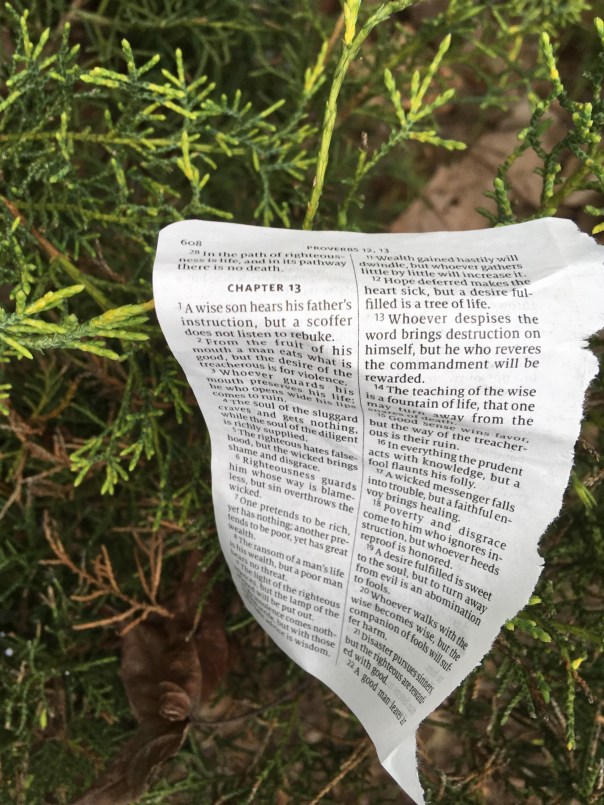
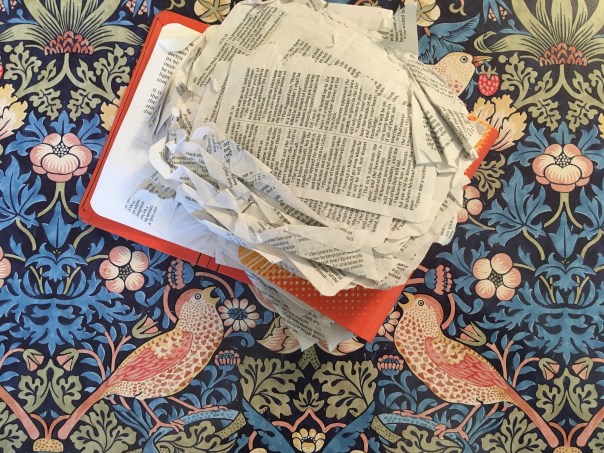
But what most occupied me on the path was hundreds of pages of Holy Scripture scattered on the pavement or in the leaves or grass at the side, and even in the creek. The first page was all alone, from the Gospel of Matthew, and as soon as I picked it up I saw another just beyond, and another… then larger parts of a little New Testament that had been ripped out of the sewn binding. I gathered each scrap or sheaf I saw, except for one of the orange covers and whatever parts might have remained inside it that I saw floating in the water below the bridge.
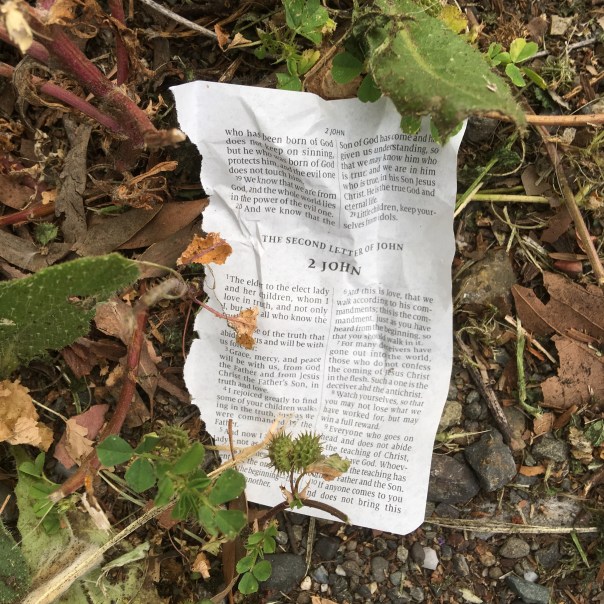
I read a line or two from a few pages, like,

Grace, mercy, and peace will be with us,
from God the Father and from Jesus Christ the Father’s Son,
in truth and love.

But mostly I tried to be efficient
in the task of recovering the pages of more words similarly poignant.
It seems impossible for me to get a good picture of the cow parsnip in the creek. The whiteness of its flowers shrieks at my phone’s camera! This is the first year I’ve noticed that plant in our stream… and say, aren’t those some healthy nettles I see next to it?

Down there flitting among the willows and the cow parsnip was an unfamiliar bird. Dark grey, the size of a crow, but not acting like a crow. He flicked his tail frequently, and he had a black head and a vague black stripe down his back. I haven’t found him in the bird guide yet. To provide (so far) two new bird encounters in one week could be thought of as recklessly generous of my Father. How can He expect me to cherish His gifts if He lavishes them continuously?

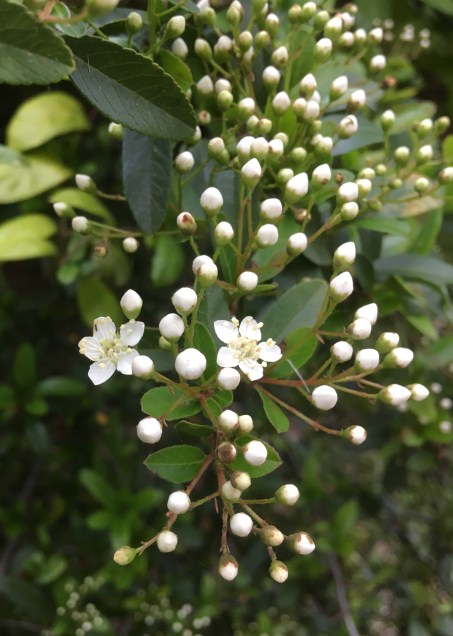
And the button buds of the pyracantha are darling, not one as large as the head of a hatpin:
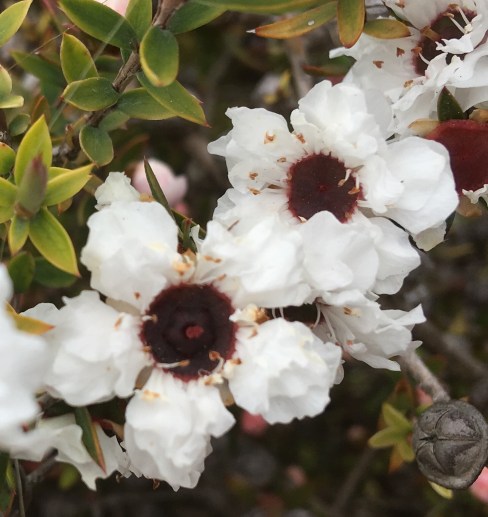
My neighbor Richard’s prickly shrubs are always half-dead, but they make white petticoated blossoms with blood-red hearts – so plucky and girly at the same time:
I wanted to read every wrinkled page of the Bible I picked up, because I was sure there were pertinent messages there… but of course I couldn’t, and I just brought them all home for a more honorable disposal. Eventually the evidence added up to three copies of the little orange Gideon New Testament with Psalms and Proverbs that had been torn and tossed.

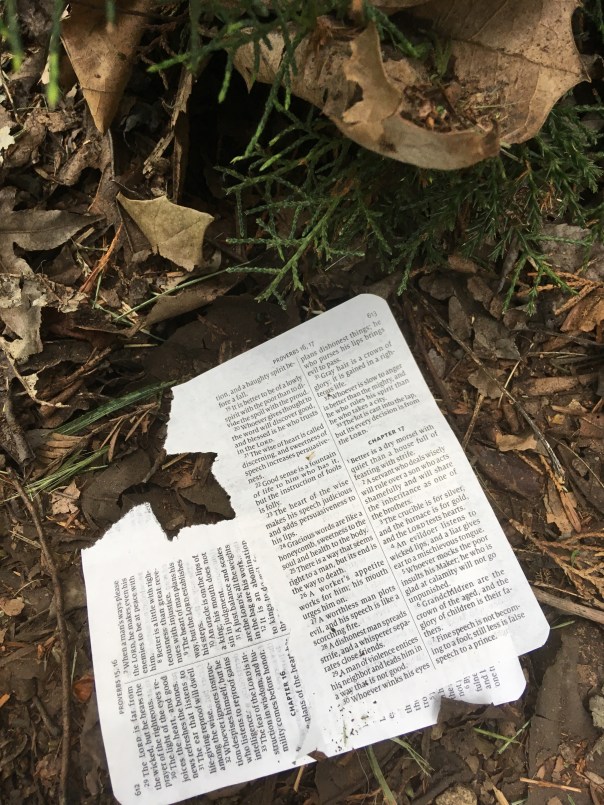
I’ll type out just one meaningful verse from a photo above, that captures something of the excessive generosity of the Subject of these loosed leaves:

Gracious words are like a honeycomb,
Sweetness to the soul and health to the body.
But wait —
In that modern translation, I’m afraid the syntax doesn’t satisfy, as the end of my post.
So here is another excerpt from those pages, for your edification:

Whoever gives thought to the word will discover good,
And blessed is he who trusts in the LORD.

Amen.
Isak Dinesen amongst graves.

p1060599

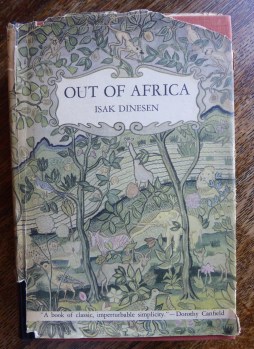
One of the books that I took off the shelf this month was Out of Africa by Isak Dinesen, what looks to be a first edition that my grandfather received through the Book-of-the-Month club soon after it was published in 1938. I have read parts of this book many times over the years, but never the whole thing. It is one of those works that is compelling in many ways, though it “lacks narrative interest,” i.e., it is not a page-turner.

It was sitting on my desk and one day I opened it in the middle and enjoyed, as always, the voice of the writer through her vivid stories. I transcribed one for my edification, and I trust yours.

THE IGUANA

In the Reserve I have sometimes come upon the Iguana, the big lizards, as they were sunning themselves upon a flat stone in a river-bed. They are not pretty in shape, but nothing can be imagined more beautiful than their colouring. They shine like a heap of precious stones or like a pane cut out of an old church window. When, as you approach, they swish away, there is a flash of azure, green and purple over the stones, the colour seems to be standing behind them in the air, like a comet’s luminous tail.

Once I shot an Iguana. I thought that I should be able to make some pretty things from his skin. A strange thing happened then, that I have never afterwards forgotten. As I went up to him, where he was lying dead upon his stone, and actually while I was walking the few steps, he faded and grew pale, all the colour died out of him as in one long sigh, and by the time that I touched him he was grey and dull like a lump of concrete. It was the live impetuous blood pulsating within the animal, which had radiated out all that glow and splendour. Now that the flame was put out, and the soul had flown, the Iguana was as dead as a sandbag.

Often since I have, in some sort, shot an Iguana, and I have remembered the one of the Reserve. Up at Meru I saw a young Native girl with a bracelet on, a leather strap two inches wide, and embroidered all over with very small turquoise-coloured beads which varied a little in colour and played in green, light blue, and ultramarine. It was an extraordinarily live thing; it seemed to draw breath on her arm, so that I wanted it for myself, and made Farah buy it from her. No sooner had it come upon my own arm than it gave up the ghost. It was nothing now, a small, cheap, purchased article of finery. It had been the play of colours, the duet between the turquoise and the “nègre”, — that quick, sweet, brownish black, like peat and black pottery, of the Native’s skin, — that had created the life of the bracelet.

In the Zoological Museum of Pietermaritzburg, I have seen, in a stuffed deep-water fish in a showcase, the same combination of colouring, which there had survived death; it made me wonder what life can well be like, on the bottom of the sea, to send up something so live and airy. I stood in Meru and looked at my pale hand and the dead bracelet, it was as if an injustice had been done to a noble thing, as if truth had been suppressed. So sad did it seem that I remembered the saying of the hero in a book that I had read as a child: “I have conquered them all, but I am standing amongst graves.”

— Isak Dinesen in Out of Africa

The Beautiful Changes

The Beautiful Changes

One wading a Fall meadow finds on all sides
The Queen Anne’s Lace lying like lilies
On water; it glides
So from the walker, it turns
Dry grass to a lake, as the slightest shade of you
Valleys my mind in fabulous blue Lucernes.

The beautiful changes as a forest is changed
By a chameleon’s tuning his skin to it;
As a mantis, arranged
On a green leaf, grows
Into it, makes the leaf leafier, and proves
Any greenness is deeper than anyone knows.

Your hands hold roses always in a way that says
They are not only yours; the beautiful changes
In such kind ways,
Wishing ever to sunder
Things and things’ selves for a second finding, to lose
For a moment all that it touches back to wonder.

-Richard Wilbur, from Collected Poems 1943-2004