Tag Archives: bees

October on Central Valley farms.

glt-p1050721-bee-fairy-duster
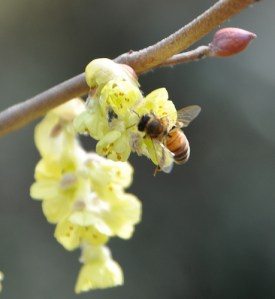
bees on fairy duster – calliandra


For a long weekend I returned to the Central Valley (California) territory of my childhood as I had done in May. Both times were for nephews’ weddings, so I was there primarily to be with my family, but I also managed to visit with three dear friends before and after the festivities.


glt-sumo-ripening-10-16

Back in May, I didn’t get to see much of my childhood friend Dick’s garden or groves, but this time I asked for and was given a thorough tour, and I took so many pictures of his vast collection of plants, I will have to scatter them at random around this post and the next. I hung around with my farmer sister Nancy long enough to ask more questions, and hear stories about the trials and adventures of being a farmer in these times. Heat, drought, frost, and the hot pursuit of thieves are a few of them.

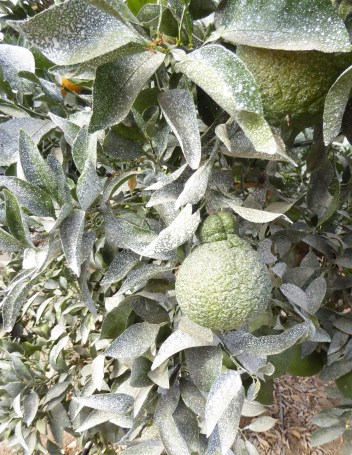
As I pulled into Nancy’s driveway I noticed that the Sumo mandarins were whiter than I remembered from May. Have you ever wondered why Sumos are so expensive? It might have something to do with the extra care they need to make it to harvest and on to market. Whitewash is used for several reasons, not least of which is as a sunscreen for the fruit. Whether it helps the leaves to withstand the withering rays, I don’t know. Citrus does like a warm summer, but the one that just ended featured 44 days over 100°, while the average would be 32 days. Some trees baked to death.glt-grove-dtRain was hoped for last week, even though an outdoor wedding was on the schedule. You can see how the sky was grey with clouds — but storms often come as far south as Fresno, and no further, which was the case again. A few sprinkles did fall as a happy gift at the wedding reception, just enough to feel like a blessing, and to create a rainbow!
glt-dog-beds
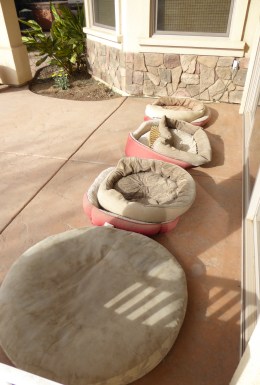
Beds for the essential watchdogs.


One topic of conversation as we sat around in various assortments of kinfolk over the days was the problem of thievery and vandalism in the citrus groves and around the farmers’ houses. People will steal copper irrigation valve fittings worth $2, and the damage requires the farmer to spend $200 in repairs. Next to one of Dick’s groves live some teenagers with nothing better to do than drive their cars into orange trees and stuff rags into pipes. This kind of thing adds up to a cost of $100-200 every month for just that few acres.

glt-grove-in-fall-prp
young grove against the Sierra foothills

Sometimes thieves will spread tarps on the ground under trees in the middle of a large orchard and pick fruit into them; then after dark they come back and haul it off. A woman rides her bicycle down a driveway to see if there might be something to pilfer, and when challenged by the dogs and/or the homeowner she makes up a story about being lost and needing directions. My sister is becoming famous for the many times she has jumped in her car to chase down such interlopers (some in cars) and take their pictures, or tell them to leave the neighborhood, because they aren’t fooling her.

October is the month when the citrus growers can breathe a sigh of relief that the hottest season of the year is past, and they begin to watch the sky for signs of rain. The oranges really need some rain in October if they are going to “size up” — no amount of irrigating will accomplish what atmospheric moisture does.

And in the coldest months the lemons and oranges have to be protected from hard frosts, nowadays usually by wind machines that make a breeze to keep the frigid air from settling on the trees and their ripening fruit. If you are growing one of the ultra-early varieties that now exist, which can be picked as early as October, you might have less to worry about come December and January.glt-grafting-lemons-on-to-oranges-10-16
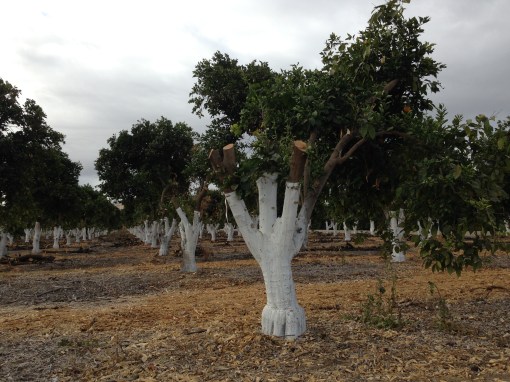
Just down the road from Nancy’s I saw this grafting project the likes of which I don’t remember seeing in all my years living in the citrus orchards and coming back to visit. I wondered what was going on that required such brutal cuts. It’s this: these are mature orange trees that are being changed into lemon trees.  All but one of the major branches have been cut off, and lemon wood was grafted in under the bark. (I wish I had been able to get over the ditch to get a closeup photo.) The one branch carries on photosynthesis while the lemon parts are growing, and eventually that remaining upper part of the orange tree will be pruned off, leaving a lemon tree with an orange rootstock.
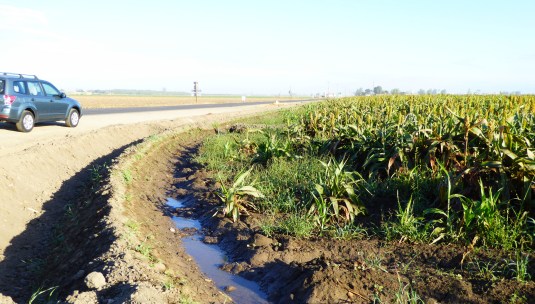
glt-sorghum-silage-10-16-central-valley

I drove past fields of something I didn’t recognize, so I took a picture and texted it to my sister, who told me it is silage for dairy cattle. When I researched it I found out that it is sorghum silage, and uses less water than corn silage. That feature is always a good thing in this thirsty land we live in.

Nearby, alfalfa covered fields with its sweet green blanket; cotton was drying and popping out of its bolls. Cotton is also a plant that can be grown in arid regions such as the Central Valley’s West Side. When I was a child my father grew cotton for a few years.

To complete the report of my fun trip, next time I’ll focus on the specific microclimate of my friend Dick’s place, and the lush gardens three generations have created on a hunk of granite. A lot is still blooming in October, but some of the harvest is just now coming in.

How gardens are made – or not.

In a way, my gardens have been too successful. I planted tomatoes where they didn’t have gl berries P1040889room to grow, and have had to drastically prune them back so that I could get in there to pick them as they ripen. No pretty picture to show you there.
The fennel grew so lovely – now I realize it was overgrown and woody before I picked it. I’m eating it anyway, and the edible parts are yummy. Next year will be my third growing fennel and it should be the charm.

Rudyard Kipling said,

“Gardens are not made by singing ‘Oh how beautiful,’ and sitting in the shade.”

That goes for harvesting, too! But the making I need to do today and next week concerns seeds…. Before my next trip to see grandchildren, I have a few weeks to get seeds planted in flats in the greenhouse, and to water them once or more daily until they are big enough to set out in the garden where they will get automatic watering from then on.P1050162

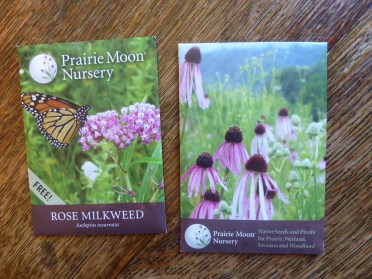
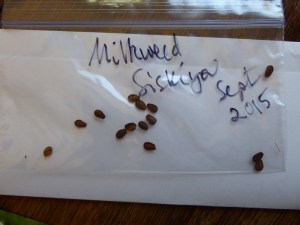
What seeds? I don’t even know yet. But perhaps these that I received from Prairie Moon. I saw a picture on a blog post, of unidentified coneflowers growing wild on the prairie, and researched to find out what variety it might be, and where to buy seeds. It turns out they are Echinacea pallida. The company sent me milkweed seeds also, as a gift, and I dug out my own milkweed I had collected a couple of years ago.P1050165 I’m not even sure that I can successfully plant them now to have plants to set out in the spring. Probably I should be reading up on that instead of writing and speculating!
My front yard is taking a lot of attention. In July we laid cardboard and mulch thickly all over the lawn (this is called “sheet mulching”) to kill it, and now that that has been done stonemasons are beginning work on a walkway and a wall. gl P1050150

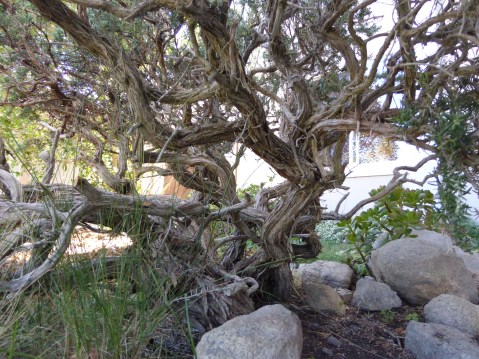
Later we’ll landscape with some plants about which I am still deciding. I had two rosemary bushes in the front, one of which was about 25 years old. Landscape Lady said it looked like a Bristlecone Pine, and at first we were going to keep it around for its venerableness. But it wasn’t that worthy, and would scratch and poke me twice a year when I took the pruners to it, over the years shaping it into its crotchety self. I didn’t want to go through that one more time….so I took parting pictures.

gl P1040918

Now that I have great soil and many options for growing various things, I don’t know if I will ever have a chance of “keeping up” with my garden. But I plan to go on enjoying it, and reporting about it here. Perhaps even while sitting in the shade.

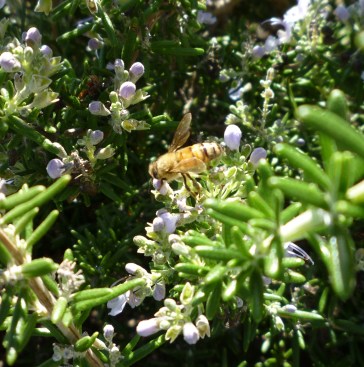
gl bee on rosemary
bee on rosemary in its younger years

Girl on Bachelors Button

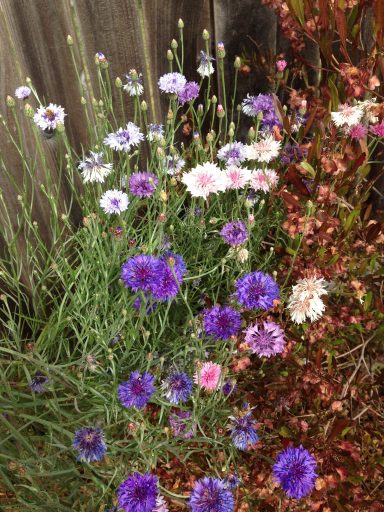
IMG_2706I knew that Bachelors Buttons get straggly, and that there was no obvious place that they would fit in my new garden, but I was drawn in by these phrases in the nursery description:
…well loved …. quite edible and delightful to sprinkle on cakes, in salads, and in herb infused waters …. range from deep clear blue to violet, deep burgundy, pale pink, fuchsia, and white…. grow to 3½ feet tall and flower continuously throughout the summer.

…so I bought a six-pack. I stuck them behind the playhouse where they grew leggily much higher that expected and are leaning on the hopbush. They are pretty if you focus on the colors of the flowers.

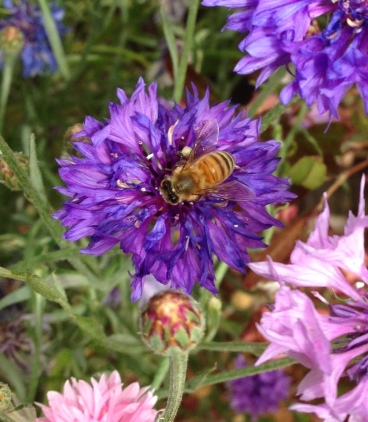
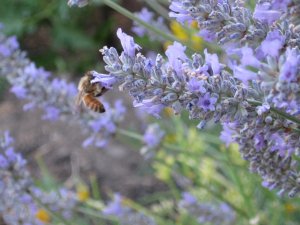
I went out this morning to take a picture before the sun broke all the way through the fog, and soon realized that a bee was enjoying them at the same time, surely even more than I. She is on a pale pink bloom in the upper left of this top photo. I began to focus on the fauna on my flora.

Now I can add her to my collection of bees on flowers. She was the easiest one I’ve ever tried to catch in the middle of her work, and she makes me glad I planted these buttons.

gl IMG_2716 bee on bachelor's button blue

Suddenly it occurs to me to post Naomi Shihab Nye’s poem “Girls, Girls” in its entirety. It is about these insects, and is what made me realize that I want to use the female pronoun when talking about them.

GIRLS, GIRLS

When the boys are alone,
they wash the dishes with facecloths.

When a honeybee is alone — rare, very rare —
it tastes the sweetness
it lives inside all the time.

What pollen are we gathering, anyway?
Bees take naps, too.
Maybe honeybees taste pollen side by side
pretending they’re alone.
Maybe the concept of “alone” means nothing
in a hive.

A bumblebee is not a honeybee.
It only pretends to be.

The cell phone in your pocket
buzzes against your leg.
It’s not a honeybee, though. It’s just a
mining bee, or leaf-cutter, or
carpenter.

You’re stung by messages from people far away.
You can’t make anyone well.
You can’t stop a war.
What good are you?

Bees drink from thousands of flowers,
spitting up nectar
so you may have honey
in your tea.

Maybe you don’t want to think about it
so much.
Pass the honey please.

During winter, bees lock legs
and beat wings fast to stay warm.
Fifty thousand bees can live in
a single hive.
Clover honey is most popular
and clover is a weed.
All the worker bees are female.
Why is that no surprise?

-Naomi Shihab Nye, from Honeybee

gl IMG_2728 irish bee from scotland 05


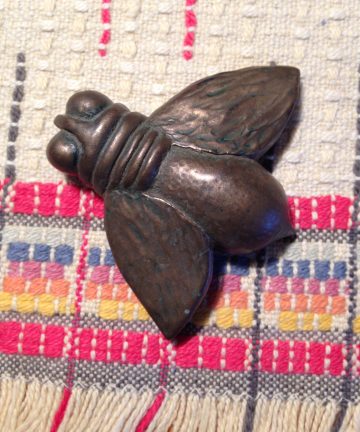
Above, a bee decoration made in Ireland,
which I bought when Pippin and I were in Scotland.

What summer is for.

Do you know how hard it is to pick up just one book at the library? I managed to do it twice this week and I felt my self-control as a great freedom; I didn’t even go into the used bookstore that is off the lobby. But since then everything has changed.d76bf-beefromside

“People can lose their lives in libraries. They ought to be warned.” –Saul Bellow

When I was a child we lived ten miles from the nearest public library, and I never visited it until high school. I had lovely hours in the library in Berkeley when in the summers I visited my grandmother, and she would leave my sisters and me there for a while, and come back later when we had picked out a stack to take home. I remember checking out Anna Pavlova and Little Men when I was ten, and lying outdoors on a cot in the afternoons, in the mountains with Grandma at the Berkeley City Camp. When not at Grandma’s, our summers were too hot to manage much activity, so I sat indoors in an easy chair and read a book every day in those carefree days of youth, supplied by the bookmobile.

I think one of the books I read then was Seventeen by Booth Tarkington. When Bellezza wrote recently about Seventeenth Summer by Maureen Daly, I thought that was it, and I bought a used paperback and have been reading it, but it’s not what I remember. So I hopefully borrowed Booth Tarkington’s Seventeen from the library (closed stacks), and it’s waiting for me now. In no time at all I should be getting to it, because the Daly book is hard to put down. How can that be?

The backdrop of the story is the most luscious and lazy summer imaginable, evoked very effectively by the author’s prose. But when I’m reading it at night I don’t fall asleep, and one morning when I was still in recovery mode (She says, wondering if she will ever again not be in recovery mode…) I picked it up from my nightstand and read for an hour before getting out of bed. It is a book that makes me feel something of the leisure of my youth, when there was no need to hurry. Absolutely no need.14110-beeonflowerfrted

The worst way to read, he said, is with the thought that you do not have enough time. The only way to read is in the knowledge that there is an infinite amount of time stretching ahead, and that if one wishes to taste only a few sentences per day one is free to do so. –Gabriel Josipovici, Moo Pak

Last week on my way home from visiting my children I listened to Mary Norris reading her own Between You and Me, a book that has made me laugh out loud countless times, all by myself in the car. I’m so glad she narrated her own book, and I love her voice and her humor. She reminds me of the women in my father’s family. I could not be content, though, to only listen to it — I must have my own print copy. So I ordered one online. But I could not be content to wait for that to be shipped, and I discovered that the local library had a copy, so that was the first book I picked up.

Two days later Seventeen became available, so I went back for it. Today a dear person sent me a link to a Naomi Shihab Nye poem, “Different Ways to Pray,” and reading it confirmed in me the feeling I’ve had that I need to calm myself and sink into some poetry. I began to read more about Nye and her books. I saw that my local library had a couple of collections by her, and I also ran across this that she said:

There is a Thai saying: ‘Life is so short, we must move very slowly,’ ….Being busy has become our calling card, our sign of success, our obsession—but poetry doesn’t want us to be busy. When you live in a rapidly moving swirl, you can only view your surroundings with a glance. Poetry requires us to slow down, to take time to pause.

So I hurried over to the library and found 4c80e-gjreadhobbitwo27dellcrpthe one children’s book by Nye that I wanted…. and then I found a few more children’s poetry books to take with me; that’s probably the level that I am most likely to access currently.
Then on to the adult non-fiction and another book by Nye… but I could not make myself leave as quickly as I’d come. There I was with shelves of poetry and literature towering on either side of me, and I had to scan some titles, and take a few books down, and notice that a couple of my favorite poets were not even there! The armload I carried to my car included Robert Bly and W.S. Merwin.

Now, will I manage to sink in and let the poetry teach me to move. very. slowly…? I am finding it difficult to quiet down today; it seems that the effort to truly rest is wearing me out. Maybe that’s because I was awake past midnight reading about Angie, whose life before cordless phones and TV served up a flavor of time that we can hardly remember the taste of. Angie speaks of doing “leisurely things like ironing or peeling potatoes for dinner.” (Hinting at an attitude among teens that also may have become extinct soon after this book was written.) If she hadn’t recently fallen in love she’d probably be reading on the porch swing in the warm afternoons, too.

After all this rambling around the subject, I feel I must leave you with at least a little piece of a poem. So here are some lines from Nye’s children’s poetry collection titled Honeybee. They are from the poem “Girls, Girls”:8ec4e-beeinshadowlambsears

When a honeybee is alone–rare, very rare–
It tastes the sweetness
It lives inside all the time.

What pollen are we gathering, anyway?
Bees take naps, too….