Tag Archives: California

Anthropology of water and radio.

One Friday I set off for the mountains to our family’s cabin in the southern Sierra Nevada. P1000688 sf close w roadThe homesickness that always comes on in advance seems to be even worse these days. I did not want to leave what feels like my soul’s safe place,  and it took me all the next morning to drag myself away. The sun was high in the sky before I got on the road, but from then on I was the Happy Wanderer. And I didn’t get lost, at least not very soon.
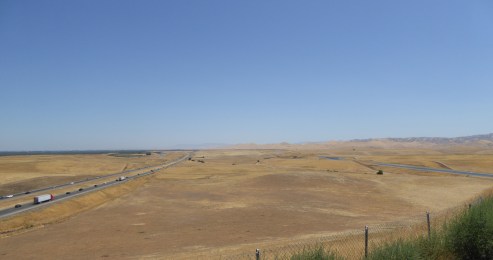
It’s dry out there, folks! Even so, crops are growing, and canals are full of water. This view of Highway 5, the interstate that runs right down the middle of the state, shows the most barren looking stretch. I took the picture looking south, and you can see the California Aqueduct running along in the same general direction and to the west of the highway here.
P1000662 5 & aqueduct

I was listening to the radio and thinking about the anthropology of radio stations. Close to home I had tuned into my favorite jazz or classical stations, but after a while there were more Christian, Spanish, and talk radio options. I landed on a gospel station as a rich woman’s voice began to sing meaningfully, “Bless the Lord, O my soul, oh-oh-oh my soul….” and I wept with joy. I think it was joy. I weep so much lately, I probably don’t know all the reasons.

Soon I turned east toward the mountains and drove through miles and miles of farmland as I crossed the Central Valley. Huge plantings of tomatoes and cotton and alfalfa, and what I think were safflower plants maturing all coppery gold. Around here farmers are rightly worried about the future, and they put up billboards asking, “IS GROWING FOOD A WASTE OF WATER?” and “DAMS or TRAINS – BUILD WATER STORAGE NOW.” Over a farm machinery dealership yard, surrounded by fields of corn, the largest American flag I’ve ever seen billowed in the wind.

I kept stopping to take pictures, assuring myself that I had time, because the summer sun wouldn’t set too early. I didn’t really want to arrive by myself in the dark at the cabin. My sister would not join me until the next day.P1000703
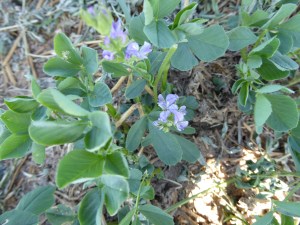
After years of knowing alfalfa only by its summery sweetness in the air, I parked near a freshly mown field and bent down to see its lavender flowers and clovery leaves.

The temperature outside had reached 102° by this time, so when I stopped for gas it seemed the right thing to do, to buy myself a Snapple Kiwi Strawberry drink, hearkening a long ways back to a time when that was the “special” drink that many in our family favored. That disappeared fast.

P1000709

P1000712

And then I came upon the pistachio trees, which I didn’t recognize until I walked through the pale plowed dirt and got close to them, too. I noticed that the orchards were not flooded as nut trees sometimes are, but were irrigated by means of very localized misters.

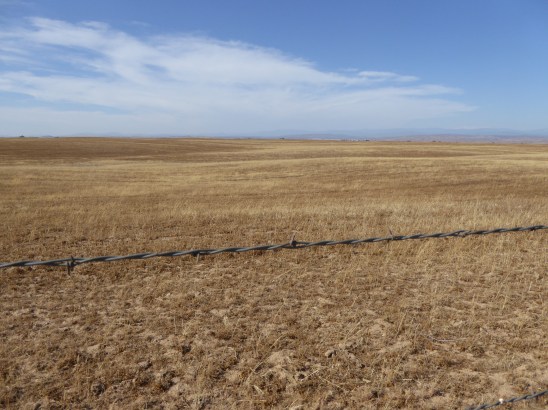
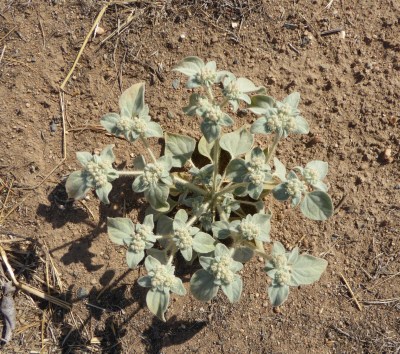
A sign read: “50% of THE FRUITS, VEGETABLES and NUTS of THE NATION ARE GROWN in CALIFORNIA.” But often, directly across the highway from the orchards, would be land like this:
P1000713

P1000720

…..and these gray-green weeds and tumbleweeds were common wild plants, showing what the natural state of affairs is in these parts.
P1000687


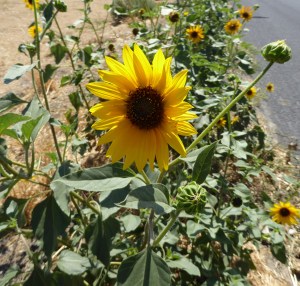
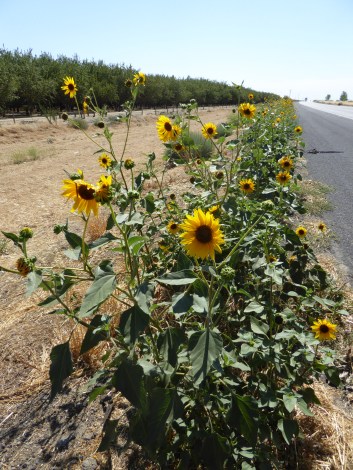
But I think the most common roadside plants are probably not considered weeds at all, because they are wild sunflowers that brighten up long stretches of highway and wave at the traffic whizzing past.

The singer on the country station was asking, “Mama, should I run for President? Mama, should I trust the government?”

When I lost that station I came upon more Christian radio with the blessing, “God be with you till we meet again….,” and you can imagine who was on my mind right then.

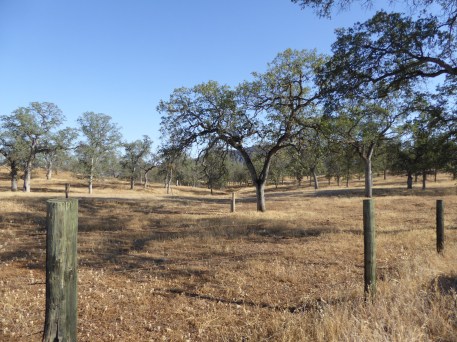
I was just starting to climb into the foothills, where there were oak trees, but no crops. The temperature had dropped to 99°, and I kept the AC on. This area slightly above the hottest parts of the valley like Fresno or Bakersfield is where a lot of people have liked to retreat at 2,000 feet or so above the valley floor. Over the years I many times heard my father wonder at the foolishness (and he used stronger descriptors) of building houses where there is no groundwater in all but the wettest years. I saw houses on hilltops and wondered myself if the occupants were still living there, or if they have to bring all their water in by truck nowadays.

Maybe cattle are grazed here in greener seasons, but all I saw were a few beehives. As the road climbed up toward my destination, pines began to appear. And in this transition zone of the foothills I will break my story in two. The next installment will be: Mountains!P1000739
Roots and Rest

Pinecrest lk & sun
Pinecrest Lake

Sunday morning instead of driving to church I packed my car and drove up into the Sierras, not to one of the familiar destinations but to a lake on the Sonora Pass where I’d only been once before. I was meeting my three cousins for a very brief reunion. It was only two years ago that I’d met them as though for the first time, for their mother’s memorial.

Maybe because it was Sunday morning, as I headed out along the most familiar roads I tried to listen to a sort of sermon in the form of Richard Rohr’s Falling Upward, in which he speaks (and reads his own book in a very pleasant voice) as a would-be life coach to those anticipating or making big transitions in life. I liked one line I heard in the introduction: “We are the clumsy caretakers of our own souls.” But the paradigm he presented, of a life span in two halves, The First Half of life and The Second Half, was not at all useful to me. In other ways as well I didn’t feel like a member of his intended audience, so I wasn’t sorry when I realized my listening set-up was not giving me enough volume and I had to give up on books for this trip.

I had been looking forward to crossing the valley, this farmland that feeds the whole nation its fruits and vegetables, and where alfalfa and sunflowers and more also grow in plots of hundreds of acres. Even though I’ve written about this aspect of the California landscape before, I was as excited to make this drive as I was to see my relatives at the end of it. It’s because I love California, I realized with joy, and not just the agricultural parts. Thanks to my late husband, I was introduced to pretty much every region of our vast state, and it’s Home. I’m so glad I can keep on living here, where My People have lived for six generations now.

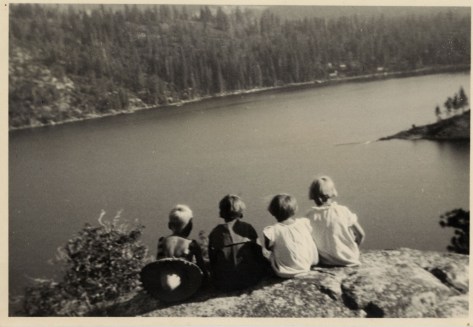
Pinecrest kids RHBJ 1927 ed
the previous generation in the 1920’s

My destination was Pinecrest Lake, where my father and his family, including my cousins’ mother, had often camped as children with their parents. They lived in Berkeley, and from there it was not too daunting an effort to get a carful of family up into the aromatic pines and cedars where the women and children might stay for the whole summer, while the menfolk would keep working down below and drive up most weekends. Eighty or a hundred years ago it probably took twice as long as my journey did, but it would have been easy to leave the city and cook dinner in camp on the same day.

I was only able to stay with my cousins one night and half a day, but during that time we took a boat out on the lake. I had a bum foot so it was just as well that they had hiked earlier while I was on the road. While we were on the water a bald eagle flew back and forth above us against the blue sky, which we took as friendly interest on his part, but he is just a speck on a cloud in the only photo I got of that encounter.

Pinecrest Mr G 07 crp
Mr. Glad at Pinecrest in 2007

We went out to dinner and told stories about our ancestors, and kept straying from that obvious subject to many others. Maybe it was being in the outdoors that led our conversation to the topic of rats and mice, and to comparing tales of house or tent visits, or downright infestations, of undesirable critters. When cockroach stories entered the stream, we tried harder to talk instead about something more appealing before the food arrived. And then we went on laughing and being happy together until a late bedtime.

After my father died several years ago, I made a point of visiting his youngest sister, my aunt Bettie, trying to hold on to whatever thin conduit might remain in the world, that might still connect me to him and that part of my history. Her family had always lived so far away that we rarely saw them and I didn’t know my cousins growing up.

I found her to be much more than a fulfillment of my familial longings; she was a warm and gracious and funny person who was quite admirable in herself, and I soaked up as much love and kindred feeling as I could in a too-brief visit. I planned to come back soon and spend more time, but those many miles prevented me, and then she died too. I was so thankful that I was then able to connect with her daughters, and now we will be catching up until we die.

Of course I cherish my brother and sisters as a link to my father, and for themselves even more, but it helps me to have cousins in my life now, too. My father didn’t pass on family history to me until it was too late to imbibe very much, but my aunt was telling her daughters stories their whole life long, and from a woman’s perspective. They can help me to know my father and even my mother better, as she and my aunt were close friends when they were young, before ripples of effects of war and family changes put such a geographical distance between them.

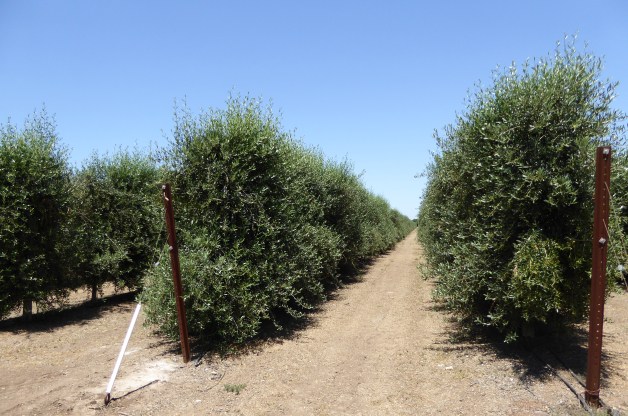
On Monday the oldest of these cousins, Renée, came home with me for a couple of nights. We didn’t stop often on the way down, and the sun was too bright for taking pictures, but even so I had to note these trellised olive trees that intrigued us as we drove across the Central Valley.

P1000347

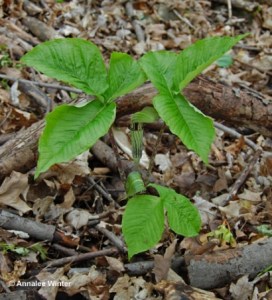
Renée wanted to help me weed my garden or whatever else would ease my grief and weariness. So we spent the next morning on the front yard, and the afternoon on the back yard. She was amazed at the difficulty of digging the taproot of a weed out of our clay soil, and amazed too that anything grows in this kind of dirt. We filled up the yard waste with pine needles, rockrose trimmings, wisteria vines and spent calla lilies. And she told me that one of my most hated weeds is Jack-in-the-Pulpit — but I don’t think so. Compare these pictures:

P1120869 weed 4-15

My weed is on the jackinthepulpit2c_thumb_410right, and Jack on the left.


Does anyone know what “mine” is? It looks like a lily of some sort… [Update: see in comments below for the full answer to my question. It’s an Italian Arum Lily.]

My last several days have been incredibly full and rich. In the wee hours of yesterday I woke to hear rain falling — in June in California! A special gift. It continued all morning and maybe contributed to the horrible traffic on the way to the airport, which made Renée almost miss her plane. When I came home and was eating my lunch I was surprised to nearly fall asleep in my tea; until then I hadn’t realized that so much talking instead of sleeping had taken such a toll that I could actually — and must — take a nap.

So I slept for most of the afternoon, and got up late today, and I think I could nap again! When I’m this tired I’m very susceptible to the floods of emotion that show me I am always on the verge of being a bit depressed. The liberty I have to pace myself is a great blessing.

Before my nap yesterday I’d read Albert’s blog post where he shared a “bit” from another blog, and even though the rain we had just experienced on our way to the airport was not cold and hard, the basic idea seems to fit how I quoted from this blog post:

Do what you can – because sometimes it is going to rain on your life and then you can only do what you can. And sometimes it is Cold hard rain. And sometimes it is on the day you had pegged to cut hay. And that is what we had yesterday. Wet, cold, hard rain.  But the work went on – just in a different direction.  We don’t need to save the world every day. Some days we just do what we can then take to the swing chairs when enough is done.

I do have a bench swing on the patio and I may use that this afternoon, after my nap. See ya later!

dry but so alive

Annadel park 5-22-15

Thanks to the encouragement of my friend Eleanor, I went outside my usual walking realm this morning on a trail she suggested, and with her along to make sure I didn’t get lost.

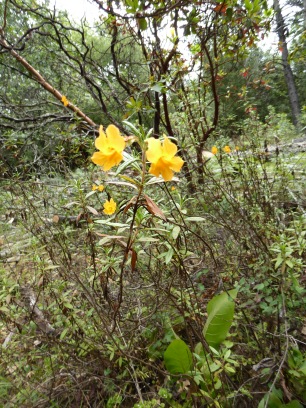
fb sticky monkey flwr
sticky monkey flower


She and I had enjoyed walking together a couple of times, say, ten years ago? but then our lives got busy with expanding family. Now that I don’t have Mr. Glad for a walking companion, various friends with whom I’ve had ongoing and indefinite plans to walk or hike will find me easier to pin down to a date.

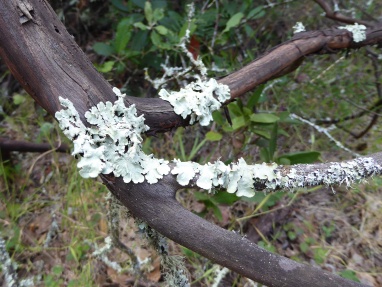
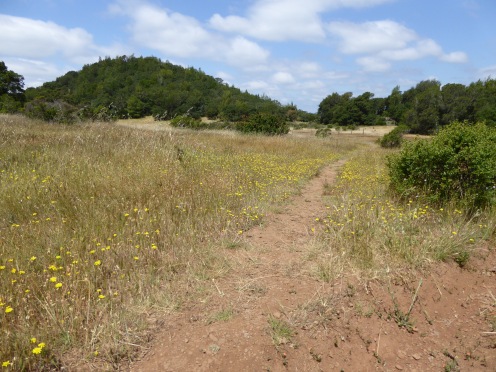
We went up into those hills from which streams run down – but we didn’t get near any wet areas this time. The hills had their typical summer parched look, but lots of wildflowers were scattered over the landscape, and the oaks and bay trees had green leaves.   gl annadel lichen on branch 5-15

fb poison oak
oaks safe and dangerous

The poison oak was profuse. This picture shows the leaves with three leaflets of the toxic plant Toxicodendron diversilobum alongside some other oak sprout in the foreground, the “regular” oak having four leaves and a coarser form.

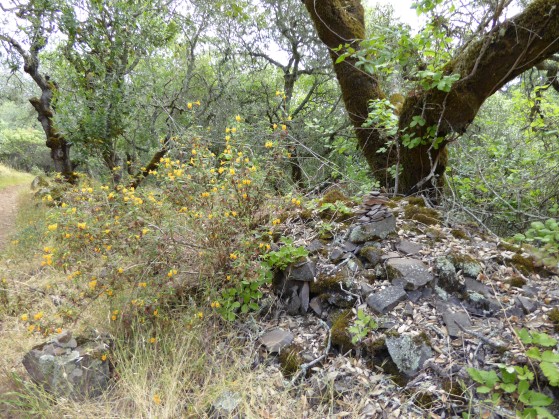
Poison oak is often, but not always, glossy, and it sometimes has these pretty colors, but the easiest way to identify it — except when is leafless in winter — is by the clusters of three oak leaves.   gl sticky monkey rocks tree Annadel

brodiaea elegans


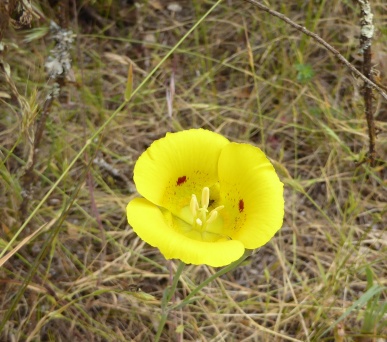
So strange and dramatic to see a densely bright, perfect bloom rising above the pale and crispy grass. Even its name is a contrast to the setting.     fb P1000179 I was shocked when the names of three flowers came to my mind right while I was looking at them! I guess after dozens of instances of entering the same data into my brain, a synapse is finally ignited? I only had to think for half a minute to remember Mariposa Lily and Elegant Brodiaea when we came upon them.
manzanita
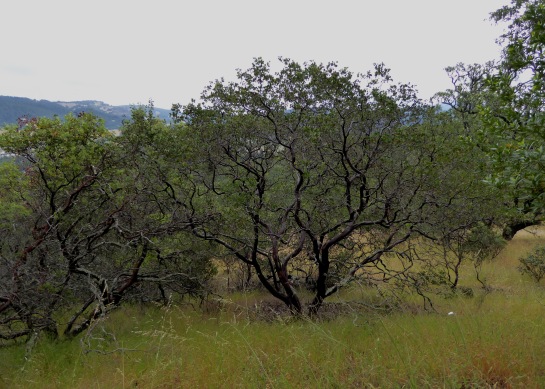
manzanita

This is a park where I’ve hiked many times, but not much lately. Maybe now that I’ve been reintroduced to its system of trails I might return on my own.

fb mariposa lily
Mariposa Lily


But I’m afraid this may be the last I’ll see of the spring wildflowers.

Flying high.

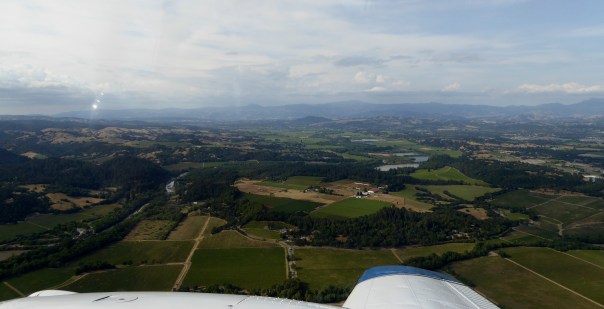
30 vineyards and trees About twenty years ago my son and son-in-law were both learning to fly airplanes, and after they were qualified they offered at different times to take me up flying with them. I declined, I think because there was usually someone else more eager on whatever day they asked, when I didn’t feel relaxed enough to appreciate the experience.P1000035 Russian R
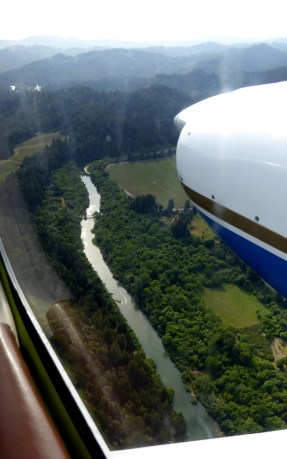
 

Yesterday when that same son-in-law Nate was here helping me with electronics stuff, he offered to fly me over to the coast, and I didn’t hesitate to say yes. I have all kinds of disposable time these days and in this case the time was available on a day when I was also in a happy and calm mood.

We flew over vineyards and trees, and along the Russian River as it flows to the ocean.


At the mouth of the river is Jenner-by-the-Sea.

48 at Jenner

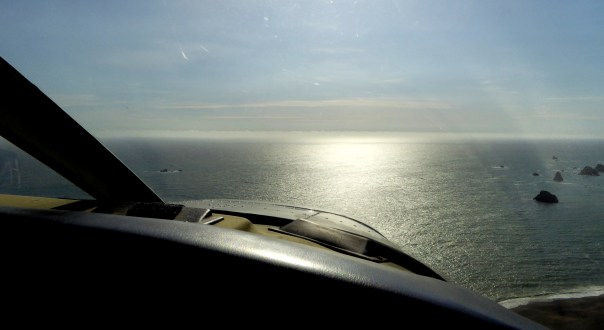
flying ocean Jenner 5-15

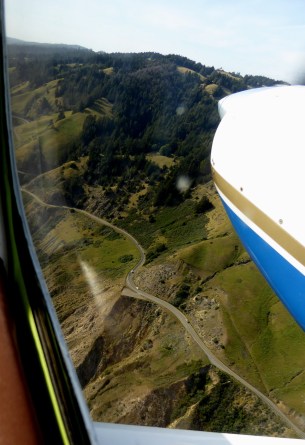
P1000056 Hwy 1


It was a mild and lovely day, with some clouds. At times we bumped over crests of waves, waves of air that followed the contours of the hills.

And we flew along Highway 1 for a few miles, as it twists back and forth above the cliffs. In a plane, switchbacks were not necessary.

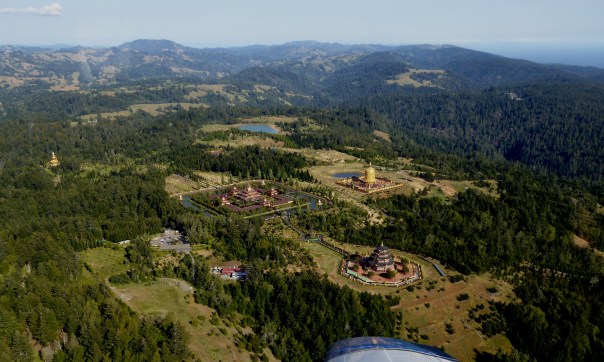
Just inland the Copper Mountain Mandala Buddhist retreat center was spread out over the hills in all its glittering and elaborate glory.


66 retreat center 7 w ocean

Nate didn’t have an extra headset so that we could talk to each other; I wore some hearing protectors I used to put on in the days when Mr. Glad’s drum practice was going on downstairs. So my pilot and I mostly rode along in a comfortable silence, unless I wanted to lift one side of my headgear and lean close to him to try to communicate above the loud hum of the propellers.

Nate said he was flying at about 150 miles per hour on his way over to my house earlier in the day; I don’t know how fast we were moving on this tour. I had no sense of time up there — every moment did seem precious, as the scenes passed behind us so quickly, and it was only a half hour, so I’m told, before we were floating down over the runway again and had landed with a soft bump.

Knowing that we are suffering drought, you might wonder at all the green in my pictures. We have been blessed by some late rains, as recently as three days ago. In another month or two, there will be more brown and gold tones mixed in.

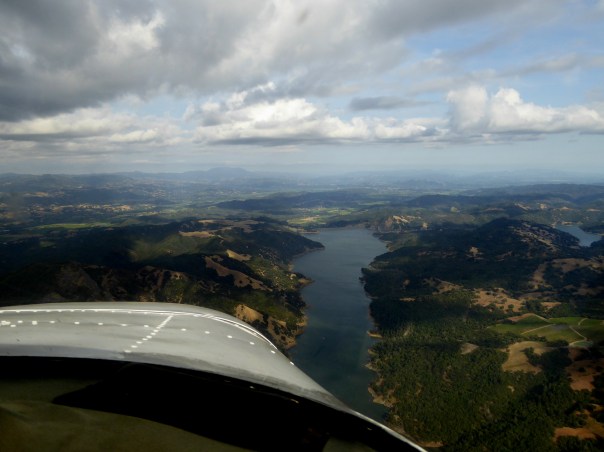
On the theme of water I will leave you with a last picture, of Lake Sonoma, a source of water for cities and agriculture, created in the 80’s from the building of Warm Springs Dam on Dry Creek. Obviously the creek is not always Dry. Our North Bay counties are beautiful even in drought, but I’m happy as can be that I was given an aerial view just at this season, in a moist springtime.

76 Lk Sonoma