Tag Archives: Central Valley

Anthropology of water and radio.

One Friday I set off for the mountains to our family’s cabin in the southern Sierra Nevada. P1000688 sf close w roadThe homesickness that always comes on in advance seems to be even worse these days. I did not want to leave what feels like my soul’s safe place,  and it took me all the next morning to drag myself away. The sun was high in the sky before I got on the road, but from then on I was the Happy Wanderer. And I didn’t get lost, at least not very soon.
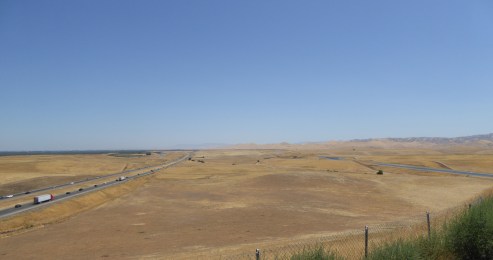
It’s dry out there, folks! Even so, crops are growing, and canals are full of water. This view of Highway 5, the interstate that runs right down the middle of the state, shows the most barren looking stretch. I took the picture looking south, and you can see the California Aqueduct running along in the same general direction and to the west of the highway here.
P1000662 5 & aqueduct

I was listening to the radio and thinking about the anthropology of radio stations. Close to home I had tuned into my favorite jazz or classical stations, but after a while there were more Christian, Spanish, and talk radio options. I landed on a gospel station as a rich woman’s voice began to sing meaningfully, “Bless the Lord, O my soul, oh-oh-oh my soul….” and I wept with joy. I think it was joy. I weep so much lately, I probably don’t know all the reasons.

Soon I turned east toward the mountains and drove through miles and miles of farmland as I crossed the Central Valley. Huge plantings of tomatoes and cotton and alfalfa, and what I think were safflower plants maturing all coppery gold. Around here farmers are rightly worried about the future, and they put up billboards asking, “IS GROWING FOOD A WASTE OF WATER?” and “DAMS or TRAINS – BUILD WATER STORAGE NOW.” Over a farm machinery dealership yard, surrounded by fields of corn, the largest American flag I’ve ever seen billowed in the wind.

I kept stopping to take pictures, assuring myself that I had time, because the summer sun wouldn’t set too early. I didn’t really want to arrive by myself in the dark at the cabin. My sister would not join me until the next day.P1000703
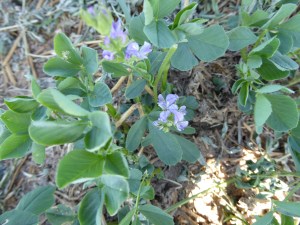
After years of knowing alfalfa only by its summery sweetness in the air, I parked near a freshly mown field and bent down to see its lavender flowers and clovery leaves.

The temperature outside had reached 102° by this time, so when I stopped for gas it seemed the right thing to do, to buy myself a Snapple Kiwi Strawberry drink, hearkening a long ways back to a time when that was the “special” drink that many in our family favored. That disappeared fast.

P1000709

P1000712

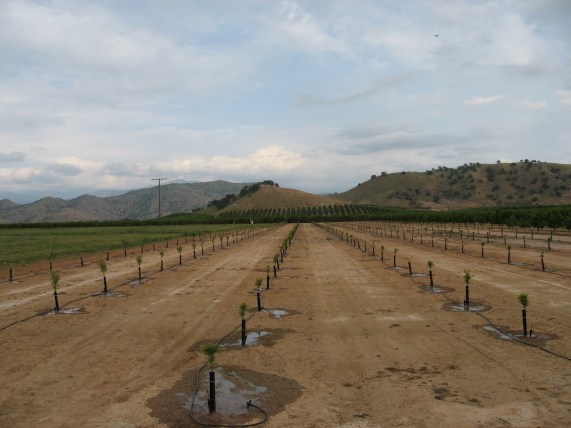
And then I came upon the pistachio trees, which I didn’t recognize until I walked through the pale plowed dirt and got close to them, too. I noticed that the orchards were not flooded as nut trees sometimes are, but were irrigated by means of very localized misters.

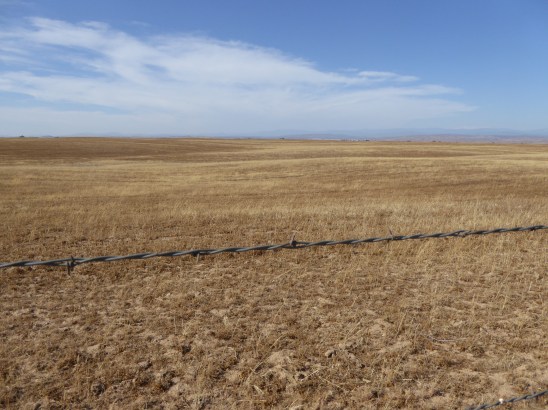
A sign read: “50% of THE FRUITS, VEGETABLES and NUTS of THE NATION ARE GROWN in CALIFORNIA.” But often, directly across the highway from the orchards, would be land like this:
P1000713

P1000720

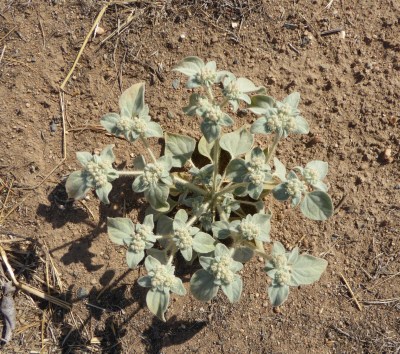
…..and these gray-green weeds and tumbleweeds were common wild plants, showing what the natural state of affairs is in these parts.
P1000687


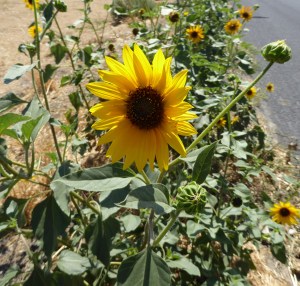
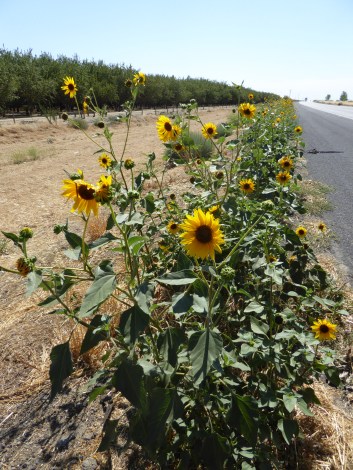
But I think the most common roadside plants are probably not considered weeds at all, because they are wild sunflowers that brighten up long stretches of highway and wave at the traffic whizzing past.

The singer on the country station was asking, “Mama, should I run for President? Mama, should I trust the government?”

When I lost that station I came upon more Christian radio with the blessing, “God be with you till we meet again….,” and you can imagine who was on my mind right then.

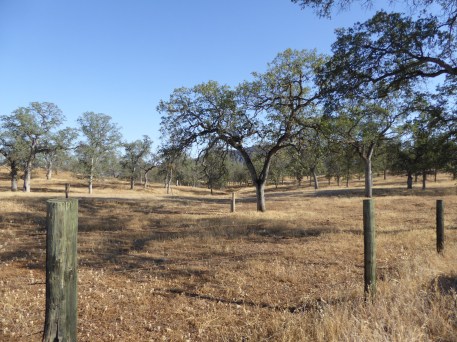
I was just starting to climb into the foothills, where there were oak trees, but no crops. The temperature had dropped to 99°, and I kept the AC on. This area slightly above the hottest parts of the valley like Fresno or Bakersfield is where a lot of people have liked to retreat at 2,000 feet or so above the valley floor. Over the years I many times heard my father wonder at the foolishness (and he used stronger descriptors) of building houses where there is no groundwater in all but the wettest years. I saw houses on hilltops and wondered myself if the occupants were still living there, or if they have to bring all their water in by truck nowadays.

Maybe cattle are grazed here in greener seasons, but all I saw were a few beehives. As the road climbed up toward my destination, pines began to appear. And in this transition zone of the foothills I will break my story in two. The next installment will be: Mountains!P1000739
Davis

After World War II my father took a two-year agricultural course at the Northern Branch of the College of Agriculture, later to become the University of California at Davis. My sister-in-law was a UC Davis professor for a long time and still lives in the town, and our daughter lived there for six years while getting an advanced degree from the school. So it’s a place with which our family has a long history.P1000561 sunflowers crp 2

Now my son-in-law Nate is employed by the university and that branch of the family is the latest to settle in. After living in Maryland for eleven years, just last week Pearl and the children completed their cross-country camping trip along with dog Jack, and returned to California where they had all been born (the humans, that is).

P1000539

We’ve been anticipating this event for most of a year, and when school was out and they had set out on their journey, I followed their progress on paper maps with occasional text-message updates from the travelers. As soon as I got the message, “We’re here!” I began to calculate how soon I might make the drive over; I hadn’t seen most of the children for almost a year, since Kate’s wedding.

They arrived Thursday afternoon, and everyone seemed to be welcoming me to come, so two days later I pulled up in front of the house that previously I’d seen only in pictures, and as I got out of the car I caught the smells familiar to my childhood, which are always so comforting to me. Davis is in the Central Valley, where I also grew up, albeit 200+ miles to the south, and the warm air and the earth and fields of fast-growing corn or alfalfa or tomatoes all combine to make for a distinctive environment. P1000533crp

Even though I am back home now where we have that marine influence that makes for a very different climate, it seems I can almost get a whiff of the Valley air by seeing this picture taken from the balcony, looking east toward Sacramento over a plantation of sunflowers. A loaded lemon tree on the right and wisteria encroaching give a hint of how eager the plant life is.

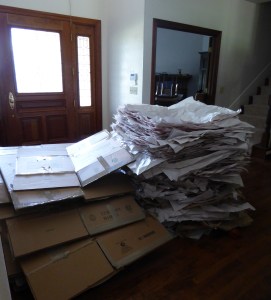
I think I started on that first evening, to help Pearl unpack boxes that the movers had stacked all over the house. In any case, we spent hours on that task during my stay, and certainly didn’t finish it. Often I would unroll a sheaf of large papers that had encased some item, and I’d set the bowl or whatever on the kitchen counter for her to put away; then I would smooth out the paper and eventually add it to the growing stack in the entry. I brought home some of these papers, hoping to reuse them myself for starting fires or to place inDavis June IMG_0078 Maggie front of young children with crayons.

It was amusing to see what was in some of the packages. We took to guessing what was inside, by the shape and the weight. Often the contents of one bundle were more haphazard than could be accounted for, as with a barbeque fork packed with two pencils and a pen; some unbreakables were heavily protected with multiple layers. The most surprising find for me was wrapped up all by itself; a cereal bowl containing two dry Weetabix, covered in plastic wrap.

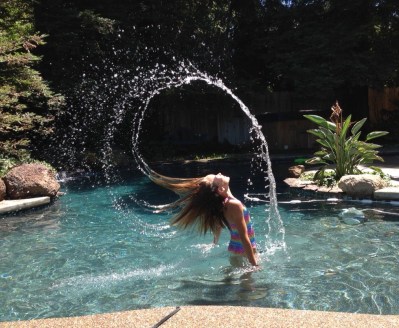
Their new house has a swimming pool, and the children were swimming every day. A screened patio is right off the pool, where we ate some meals in the style of Sunset Magazine. Monday afternoon I took pictures of Maggie doing water stunts for a while, and was pleased when I got warm enough that my desire to cool off overcame my usual inertia in regard to swimming. I was glad I’d brought my suit.

The pool is kept clean by a saltwater system, so there is not the destructive chlorine to rot one’s swimsuit or destroy hair. Several redwood trees shade one end of the pool and so far this keeps the water cool enough to be refreshing even on 100+° days such as occurred while I was there.

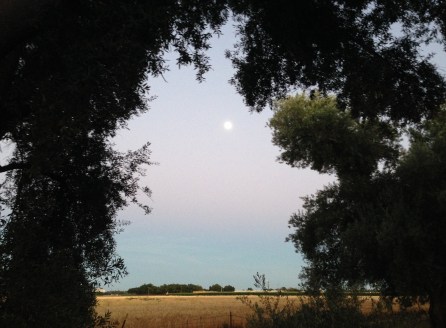
The last evening oIMG_0115moon lg dusk Davisf my stay, Pearl and I took a walk with a longtime friend and former roommate of Pippin, who still lives in the area. She introduced us to one of her favorite routes on the west side of town and we walked and talked for an hour. The light wasn’t good enough for most of my pictures to turn out well; on my next visit I’d like to do that walk in the morning. As it’s less than two hours away, I should be able to accomplish a visit another time or two while it’s still summer.
Esthetics and Agriculture


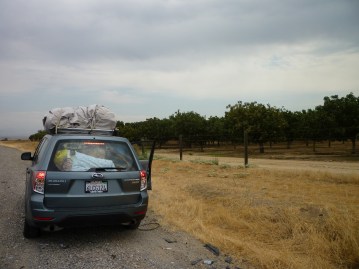
We made at least two wrong turns getting to the mountains last month, and they helped put me in touch with my farming roots. In the middle of August the fields are lush with the bounty that gives California’s Central Valley the name of The Greatest Garden in the World. Tomatoes, corn, cotton, walnuts, tree fruits, grapes… Wikipedia says that every non-tropical crop is grown here.

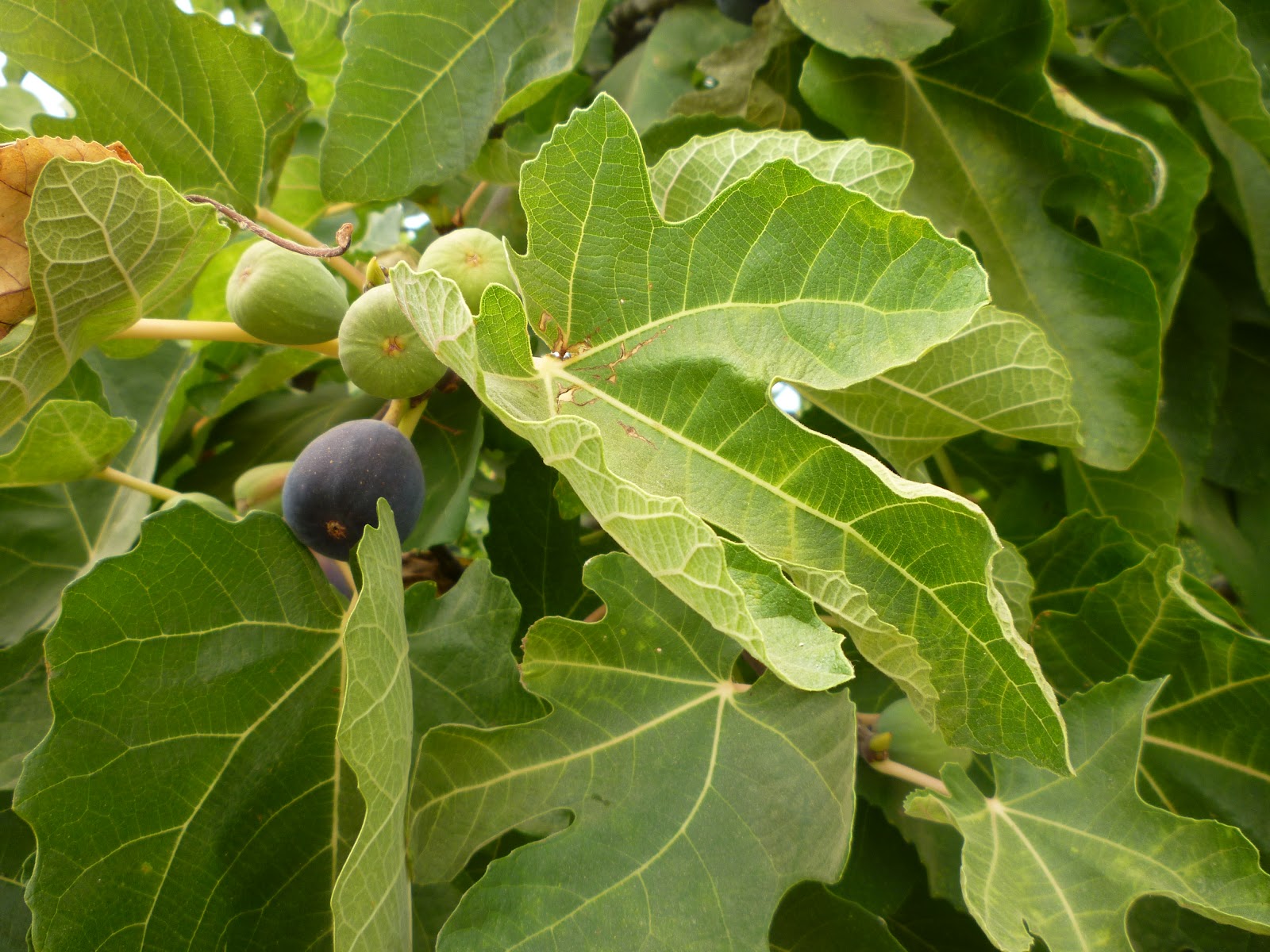
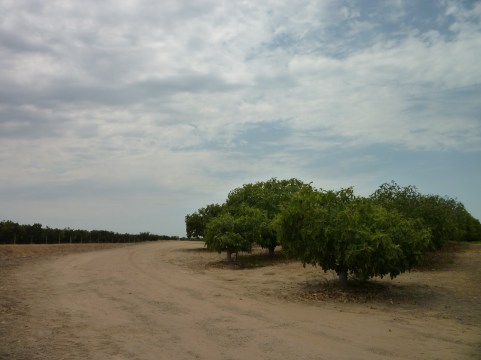
On our second meander, in the northeasterly instead of southeasterly direction, we were surprised to see fig orchards on one side and pomegranates on the other. What could be more exotic or impossible? William Saroyan describes the impossibility in his 1930’s story “The Pomegranate Trees” that Mr. Glad and I have laughed over a few times:
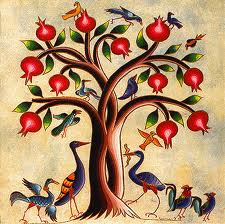
 

“My uncle Melik was just the worst farmer that ever lived. He was too imaginative and poetic for his own good. What he wanted was beauty. He wanted to plant it and see it grow. I myself planted over one hundred pomegranate trees for my uncle one year back there in the good old days of poetry and youth in the world. I drove a John Deere tractor too, and so did my uncle. It was all pure esthetics, not agriculture. My uncle just liked the idea of planting trees and watching them grow.

“Only they wouldn’t grow. It was on account of the soil. The soil was desert soil. It was dry. My uncle waved at the six hundred and eighty acres of desert he had bought and he said in the most poetic Armenian anybody ever heard, Here in this awful desolation a garden shall flower, fountains of cold water shall bubble out of the earth, and all things of beauty shall come into being.”

Melik plans to have apricots, peaches, figs and olives too, but he never gets beyond planting the pomegranates, which eventually fail, because instead of a fountain there is only a trickle of water flowing from the many wells he digs.

Fig orchard in Madera Co.

But since the 1930’s, state-funded irrigation projects have increased the available farmland to such a degree that in the present day about one-sixth of the irrigated land in the nation is in our Central Valley. The pomegranate trees we saw with their ripening red fruits were not far from where the fictional Uncle Melik farmed.

I do think there is nothing more lovely than a fig tree with its extravagant leaves on curvy branches, and fruits more refreshing than a cup of cold water. Though I grew up in the Valley this was my first sighting of a groveful. I didn’t notice what kind of irrigation system is used in the orchard, but no doubt there was one.

View of Sierras from Tulare County (Pippin pic)

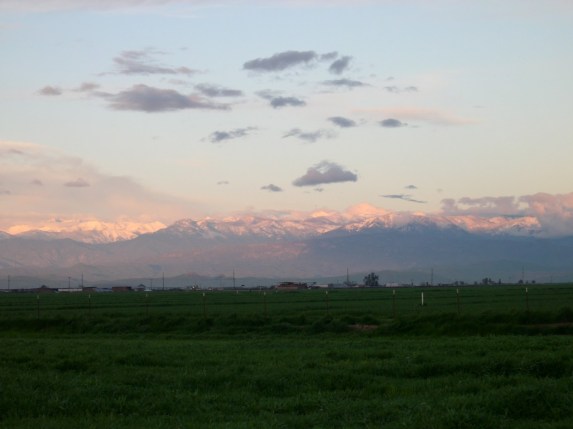
By means of our state water projects we take all that melted mountain snow pack and hold it behind dams so that we can let it out bit-by-bit all through the summer. In this long agricultural center of the state, on less than one percent of the total farmland in the United States, we produce 8% of the nation’s agricultural output by value. (Wikipedia)

Tulare Co. in Spring – still green in places

I’ve been googling to find out how many dams are in California, but that list is too long for me to take the time to count. Maybe I’ll just stick to the ones in the Sierra Nevadas that end up feeding canals and rivers that water orange groves and almond orchards and alfalfa fields. It turns out that list above is sortable, and I can see that in Fresno County alone there are eleven dammed lakes.

When you drive across the state, from a dammed mountain lake to San Francisco Bay Area in one day, the repetition of scenes along the highway impresses on you the importance of water. There are dead almond orchards on Highway 5, on the “West Side” of the Valley, that testify to water wars still going on, and to our inability to grow very much without irrigation.

Westside tomato field in April

It was 101° as we headed home through that fertile swath. All the crops whose irrigation was current were happy. The corn was probably growing inches every day, and the almonds swelling in their shells. We were happy to look out from our car through the windows that were closed to keep in the cooled air.

A little north of the dead trees, on a slope above the freeway, a Hispanic family were systematically planting new almond trees. It dawned on me that Why, yes, it is a week day, a work day, isn’t it? Not all the farm work can be done in the cooler mornings or evenings.

I recalled my sweaty and tanned father getting off his tractor, coming into the house mid-afternoon with a watermelon and slicing it into rounds at the kitchen counter. He’d put one big slice on a plate and eat it with a fork before going back out to take care of his orange trees.

Water melon. Melons are some of those things of beauty that Uncle Melik likely envisioned as he was trying to find their necessary water. And the people who tend the earth’s gardens, who are willing to build the dams and plant the trees and irrigate them all summer long are beautiful to me, too.

The house where my father ate watermelon.
Gardening requires lots of water – 
most of it in the form of perspiration. 

~Lou Erickson

Journal of October Trip South

As we were getting ready to go on a weekend trip, I was more calm than usual, because we’d only be gone one night, then home again. And it appeared to be the last trip I would make for months to come. The occasion was a gathering with my sisters and brother, in a countryside place spread with orange groves. One brother and sister live within a couple of miles of each other, but with mailing addresses in different towns, and neither of them close to even a village. We drove south, instead of my more frequent northward to Pippin’s, but about the same distance, 5+ hours.

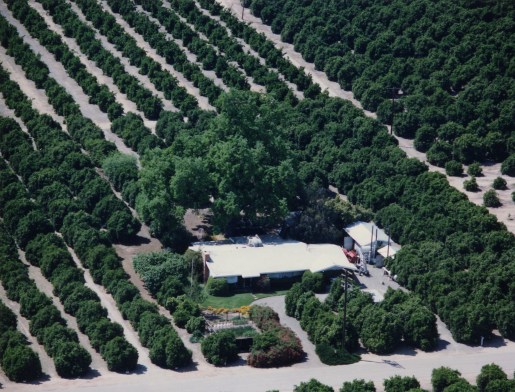
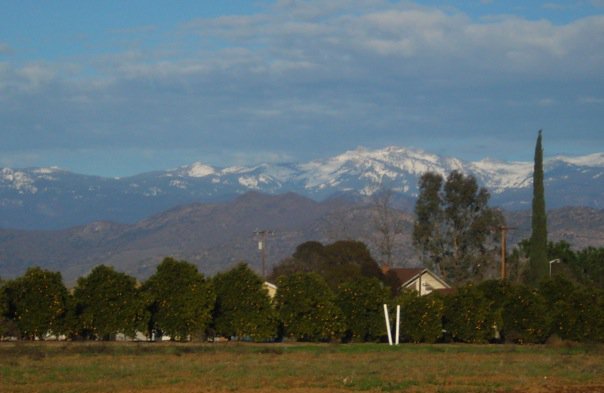
Mr. Glad and I stayed overnight with my brother, who lives in the house my dad built over 50 years ago, where I mostly grew up. This morning I got up early and sat in a big stuffed chair in the living room, tucking my feet under me the way I used to as a girl. The house feels so quietly solid. It’s a wood-frame stucco house on a concrete slab, and you never hear any creaks walking around the ranch-style layout. A big picture window looks out on the foothills that are dotted with oaks, and behind them shady layers of taller and taller mountains forming the Sierra Nevada. Curving grids of trees like dark green pom poms hug the lower slopes nearby. The first time I went home after living in Northern California for a while, I was struck with how short all the orange trees were, not even as tall as nut trees or peach trees, but certainly dwarfed by the Coast Redwoods and other tall trees we have up here where the rainfall is doubled.

The net effect is of a lush but flattish scene, house and orchards keeping close to the earth. The sky is bigger therefore. This October we got quite a bit of rain; all the autumn landscapes were more beautiful having been washed by the rains, making every tree and bush stand out brightly against the background of greening fields. I had my usual thrill of watching the cloud performances all the way down and up the center of the state. We saw black cattle grazing in a pasture, and in the middle of the herd, a white egret standing at attention.

Over a big dinner, we siblings talked about our mountain cabin and how to manage things as the new owners since our father passed it to us just over a year ago. We hadn’t all been together for more than a year, and we aren’t big phone or e-mail users, so we had a good time catching up. We always have to hear as well the news of our mutual old school and neighborhood friends, and the goings-on of the farming community there.

Some citrus crops are being picked already, by crews of Mexican farm workers. And olives are at the peak of harvest in the same general area. Cell phones have created changes in the way the picking crews operate. You might say they have created some degree of anarchy, or at least free-lance options that didn’t exist before. My sister Farmer Woman told us about how some growers were having difficulties getting enough pickers for the oranges, because they could make more money in olive-picking, at least until the frost cuts off that opportunity.

Because of the shortage, a crew was enlisted one day to drive down from the county to the north, in several cars. At least one car-full never arrived, because on the way someone got a call on his cell phone with a tip from a friend, that a different grower was paying $1 more per box, so they detoured that way. This sort of thing happens all the time now.

Dinner was over, and we were sitting lazily around a big table when Farmer Woman’s cell phone rang. The screen said it was her nephew, our Soldier, who was calling. As she talked to him it became apparent that he and Joy were in the area, too, having been to a wedding nearby. Neither of us had told the other that we were making a trip down there this weekend, so it was a pleasant surprise for everyone when they were able to join us for breakfast this morning, and a bigger family get-together than they had hoped for.

After that, they took off northwesterly, and we more to the north, but evidently we both wandered around the next city of over 100,000 population for a while, getting fueled up or something, because when we were leaving town, there we were driving alongside one another. Twenty minutes later, merging on to the interstate, we were right behind them. It was the kind of happenstance that would make a child happy, and it did me, too.

On the way home I read the Forward, the Introduction, and the Preface to a book by Leon Kass that I plan to write about at length later on. It’s philosophy, and as I had nothing much else to do, I could put the book down every few minutes and chew on the ideas. I read it two years ago and might need to read the whole thing again before I’ll be able to know and express why I love it so much.

Then I dozed for a while, and when I woke up my husband was playing parts of his iPod collection. I asked again, for the fortieth time, “Who is singing that song?” It was Police. So I worked on a mnemonic that would make me learn this fact for once and forever. They were singing, “There’s a little black spot on the sun today,” so I imagined that the black spot was a black Police car driving around. I watched them in my mind for a few minutes, and then on the iPod they were singing a different song, “Every little thing she does is magic,” very ardently, so I amplified my image so that the Police car driving over the sun’s surface was full of Policemen who were loudly singing these very words about a magical woman. I can’t lose it now.

Getting closer to home, I was more and more excited about the beauty of the world. Rows of eucalyptus trees form windbreaks here and there, and beneath them the colors of a dahlia farm don’t seem to have faded in the rains.  On the slopes in our county it’s the vineyards that catch your eye, and they are starting to turn gold and orange. Flocks of starlings were swooping like fluttered polka dots. I understand that they are eating insects as they do their dances. That reminded me of my book, which is about eating, nature, our souls, the unity of reality. There is a wholeness to life, because God in His Holy Spirit fills all things.

I guess that’s the reason I’m content to write about our trip without trying to find a theme for it. The entire weekend seems of a piece, a large piece of joy.