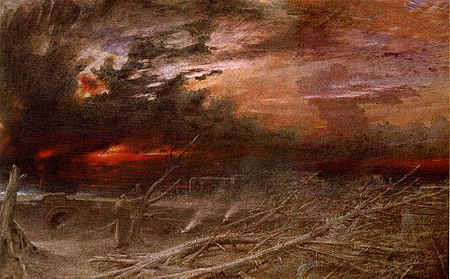
The trees and bushes in my garden get bigger year by year, requiring more attention from me; and several other aspects of my present life prevent me from having the leisure I once had, to write reviews of the books I read. For example, A Canticle for Leibowitz, which I only finished this month. It is the first post-apocalyptic novel I’ve ever read, published in 1959.
 It made a big impression on me, which I probably wouldn’t be able to analyze or articulate to my satisfaction, so I didn’t even begin to try, but immediately moved on to a different book. (It’s my experience that reading books doesn’t require the same quality of leisure as writing reviews.) But O happy day! Jeff Bilbro mentioned the book, with a quote, in the newsletter of The Front Porch Republic, so I will just pass that on, with thanks to him. I also commend the other articles on that site, or their print journal, as worthy of your consideration. Here’s Jeff:
“I recently read Canticle for Leibowitz by Walter M. Miller Jr., and I found it a moving narrative exploring the proper cultural and religious conditions for rightly valuing knowledge. The novel follows a monastic order that forms in the wake of a nuclear holocaust, and they carefully preserve remnants of the former industrial civilization through generations of warfare until human civilization is ready to rediscover natural science and its applications. Can such knowledge ever be used wisely, or does increased technical know-how inevitably lead cultures to abandon religious and moral wisdom? Miller offers no easy answers. In this passage, an abbot of this monastic order reflects on the significance of the rising interest in their archives:
‘Now a Dark Age seemed to be passing. For twelve centuries, a small flame of knowledge had been kept smoldering in the monasteries; only now were their minds ready to be kindled. Long ago, during the last age of reason, certain proud thinkers had claimed that valid knowledge was indestructible—that ideas were deathless and truth immortal. But that was true only in the subtlest sense, the abbot thought, and not superficially true at all. There was objective meaning in the world, to be sure: the nonmoral logos or design of the Creator; but such meanings were God’s and not Man’s, until they found an imperfect incarnation, a dark reflection, within the mind and speech and culture of a given human society, which might ascribe values to the meanings so that they become valid in a human sense within the culture. For Man was a culture-bearer as well as a soul-bearer, but his cultures were not immortal and they could die with a race or an age, and then human reflections of meaning and human portrayals of truth receded, and truth and meaning resided, unseen, only in the objective logos of Nature and the ineffable Logos of God. Truth could be crucified; but soon, perhaps, a resurrection.’
“Thanks for spending some time with us on the Porch,
Jeff Bilbro”

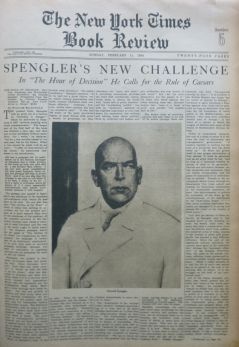 column in 2017. Of course, it being the birthday of G.K. Chesterton, I wanted to read what Keillor might say about that favorite writer of mine. But Bob Hope and Oswald Spengler were also born on the 29th of May. Spengler studied the history of civilizations, and published the book The Decline of the West in 1918.
 “The death of the spirit is the price of progress. Nietzsche revealed this mystery of the Western apocalypse when he announced that God was dead and that He had been murdered. This Gnostic murder is constantly committed by the men who sacrificed God to civilization. The more fervently all human energies are thrown into the great enterprise of salvation through world–immanent action, the farther the human beings who engage in this enterprise move away from the life of the spirit. And since the life the spirit is the source of order in man and society, the very success of a Gnostic civilization is the cause of its decline.
 Gladsome Lights